Q15070
Gene name |
OXA1L |
Protein name |
Mitochondrial inner membrane protein OXA1L |
Names |
Hsa, OXA1Hs, Oxidase assembly 1-like protein, OXA1-like protein |
Species |
Homo sapiens (Human) |
KEGG Pathway |
hsa:5018 |
EC number |
|
Protein Class |
|
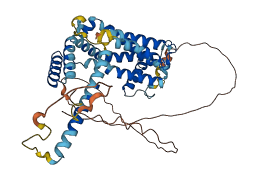
Descriptions
The autoinhibited protein was predicted that may have potential autoinhibitory elements via cis-regPred.
Autoinhibitory domains (AIDs)
Target domain |
|
Relief mechanism |
|
Assay |
cis-regPred |
Accessory elements
No accessory elements
Autoinhibited structure

Activated structure
3 structures for Q15070
| Entry ID | Method | Resolution | Chain | Position | Source |
|---|---|---|---|---|---|
| 6ZM5 | EM | 289 A | u | 1-435 | PDB |
| 7A5K | EM | 370 A | A5 | 1-435 | PDB |
| AF-Q15070-F1 | Predicted | AlphaFoldDB |
2 variants for Q15070
| Variant ID(s) | Position | Change | Description | Diseaes Association | Provenance |
|---|---|---|---|---|---|
|
rs8572 VAR_014932 CA7103885 |
44 | V>A | No |
ClinGen UniProt 1000Genomes ESP ExAC TOPMed dbSNP gnomAD |
|
|
VAR_014933 CA7103948 rs17619 |
91 | V>I | No |
ClinGen UniProt 1000Genomes ESP ExAC TOPMed dbSNP gnomAD |
No associated diseases with Q15070
1 regional properties for Q15070
| Type | Name | Position | InterPro Accession |
|---|---|---|---|
| domain | Membrane insertase YidC/Oxa/ALB, C-terminal | 140 - 331 | IPR028055 |
6 GO annotations of cellular component
| Name | Definition |
|---|---|
| integral component of mitochondrial inner membrane | The component of the mitochondrial inner membrane consisting of the gene products having at least some part of their peptide sequence embedded in the hydrophobic region of the membrane. |
| integral component of mitochondrial membrane | The component of the mitochondrial membrane consisting of the gene products having at least some part of their peptide sequence embedded in the hydrophobic region of the membrane. |
| mitochondrial matrix | The gel-like material, with considerable fine structure, that lies in the matrix space, or lumen, of a mitochondrion. It contains the enzymes of the tricarboxylic acid cycle and, in some organisms, the enzymes concerned with fatty acid oxidation. |
| mitochondrial membrane | Either of the lipid bilayers that surround the mitochondrion and form the mitochondrial envelope. |
| mitochondrion | A semiautonomous, self replicating organelle that occurs in varying numbers, shapes, and sizes in the cytoplasm of virtually all eukaryotic cells. It is notably the site of tissue respiration. |
| protein-containing complex | A stable assembly of two or more macromolecules, i.e. proteins, nucleic acids, carbohydrates or lipids, in which at least one component is a protein and the constituent parts function together. |
3 GO annotations of molecular function
| Name | Definition |
|---|---|
| membrane insertase activity | Binds transmembrane domain-containing proteins and mediates their integration into a membrane. |
| mitochondrial ribosome binding | Binding to a mitochondrial ribosome. |
| protein homodimerization activity | Binding to an identical protein to form a homodimer. |
8 GO annotations of biological process
| Name | Definition |
|---|---|
| aerobic respiration | The enzymatic release of energy from inorganic and organic compounds (especially carbohydrates and fats) which requires oxygen as the terminal electron acceptor. |
| mitochondrial proton-transporting ATP synthase complex assembly | The aggregation, arrangement and bonding together of a proton-transporting ATP synthase in the mitochondrial inner membrane. |
| mitochondrial respiratory chain complex I assembly | The aggregation, arrangement and bonding together of a set of components to form mitochondrial respiratory chain complex I. |
| negative regulation of ATP-dependent activity | Any process that stops or reduces the rate of an ATP-dependent activity. |
| negative regulation of oxidoreductase activity | Any process that stops or reduces the rate of oxidoreductase activity, the catalysis of an oxidation-reduction (redox) reaction, a reversible chemical reaction in which the oxidation state of an atom or atoms within a molecule is altered. |
| protein insertion into membrane | The process that results in the incorporation of a protein into a biological membrane. Incorporation in this context means having some part or covalently attached group that is inserted into the the hydrophobic region of one or both bilayers. |
| protein insertion into mitochondrial inner membrane from matrix | The process in which a protein is incorporated into the mitochondrial inner membrane from the matrix side. This includes membrane insertion of newly synthesized mitochondrially-encoded proteins, and insertion of nuclear-encoded proteins after their import into the mitochondrial matrix. |
| protein tetramerization | The formation of a protein tetramer, a macromolecular structure consisting of four noncovalently associated identical or nonidentical subunits. |
| 10 | 20 | 30 | 40 | 50 | 60 |
| MAMGLMCGRR | ELLRLLQSGR | RVHSVAGPSQ | WLGKPLTTRL | LFPVAPCCCR | PHYLFLAASG |
| 70 | 80 | 90 | 100 | 110 | 120 |
| PRSLSTSAIS | FAEVQVQAPP | VVAATPSPTA | VPEVASGETA | DVVQTAAEQS | FAELGLGSYT |
| 130 | 140 | 150 | 160 | 170 | 180 |
| PVGLIQNLLE | FMHVDLGLPW | WGAIAACTVF | ARCLIFPLIV | TGQREAARIH | NHLPEIQKFS |
| 190 | 200 | 210 | 220 | 230 | 240 |
| SRIREAKLAG | DHIEYYKASS | EMALYQKKHG | IKLYKPLILP | VTQAPIFISF | FIALREMANL |
| 250 | 260 | 270 | 280 | 290 | 300 |
| PVPSLQTGGL | WWFQDLTVSD | PIYILPLAVT | ATMWAVLELG | AETGVQSSDL | QWMRNVIRMM |
| 310 | 320 | 330 | 340 | 350 | 360 |
| PLITLPITMH | FPTAVFMYWL | SSNLFSLVQV | SCLRIPAVRT | VLKIPQRVVH | DLDKLPPREG |
| 370 | 380 | 390 | 400 | 410 | 420 |
| FLESFKKGWK | NAEMTRQLRE | REQRMRNQLE | LAARGPLRQT | FTHNPLLQPG | KDNPPNIPSS |
| 430 | |||||
| SSKPKSKYPW | HDTLG |