Q10042
Gene name |
K01A12.3 |
Protein name |
Probable G-protein coupled receptor K01A12.3 |
Names |
|
Species |
Caenorhabditis elegans |
KEGG Pathway |
cel:CELE_K01A12.3 |
EC number |
|
Protein Class |
|
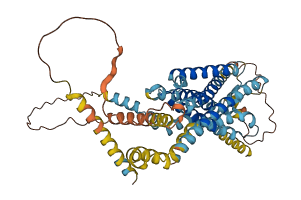
Descriptions
The autoinhibited protein was predicted that may have potential autoinhibitory elements via cis-regPred.
Autoinhibitory domains (AIDs)
Target domain |
|
Relief mechanism |
|
Assay |
cis-regPred |
Accessory elements
No accessory elements
Autoinhibited structure

Activated structure
1 structures for Q10042
| Entry ID | Method | Resolution | Chain | Position | Source |
|---|---|---|---|---|---|
| AF-Q10042-F1 | Predicted | AlphaFoldDB |
No variants for Q10042
| Variant ID(s) | Position | Change | Description | Diseaes Association | Provenance |
|---|---|---|---|---|---|
| No variants for Q10042 | |||||
No associated diseases with Q10042
1 GO annotations of cellular component
| Name | Definition |
|---|---|
| integral component of plasma membrane | The component of the plasma membrane consisting of the gene products and protein complexes having at least some part of their peptide sequence embedded in the hydrophobic region of the membrane. |
1 GO annotations of molecular function
| Name | Definition |
|---|---|
| G protein-coupled receptor activity | Combining with an extracellular signal and transmitting the signal across the membrane by activating an associated G-protein; promotes the exchange of GDP for GTP on the alpha subunit of a heterotrimeric G-protein complex. |
1 GO annotations of biological process
| Name | Definition |
|---|---|
| G protein-coupled receptor signaling pathway | The series of molecular signals initiated by a ligand binding to its receptor, in which the activated receptor promotes the exchange of GDP for GTP on the alpha-subunit of an associated heterotrimeric G-protein complex. The GTP-bound activated alpha-G-protein then dissociates from the beta- and gamma-subunits to further transmit the signal within the cell. The pathway begins with receptor-ligand interaction, and ends with regulation of a downstream cellular process. The pathway can start from the plasma membrane, Golgi or nuclear membrane. |
| 10 | 20 | 30 | 40 | 50 | 60 |
| MESVTRHRAD | MISFFTFDSY | ISIVGVAYTA | VGLLGVFCNV | TTVIMILTNR | VFRLSAYTIM |
| 70 | 80 | 90 | 100 | 110 | 120 |
| ANVALADSIV | MLIAGVACGM | DVMWPNPNDL | TSFIPSLEEP | YQKIAPVSLR | NDSKTDSSAA |
| 130 | 140 | 150 | 160 | 170 | 180 |
| GFETGNIHAV | LSFSFVAAWT | AGVISYAMLG | TNRCIAICYY | GTKARALNQV | SVAVACSAST |
| 190 | 200 | 210 | 220 | 230 | 240 |
| WIVGIAAALV | GTLSQPMIGI | QRTMWSISFL | EPRPHTTLFF | TLLCAANLLG | LGAQWVCSTL |
| 250 | 260 | 270 | 280 | 290 | 300 |
| VLLKIRQVKK | KISKNKLNQN | SANRFRKQVI | LALNEIIVTG | NFKARLTFQF | FYPSILCTIS |
| 310 | 320 | 330 | 340 | 350 | 360 |
| TFLFFIKPYA | FEYLSGWQLV | ILHLLWLCNH | TCNPFIYAYF | NDRMRLTYKE | ILTCAAIRYQ |
| 370 | 380 | 390 | 400 | 410 | 420 |
| IRKRRSSHPF | RMHGRHNVSK | RSNAAGMKST | RISARSGRTN | RDGNFVRNSL | QMQSRDFEQL |
| 430 | 440 | 450 | 460 | 470 | 480 |
| CEFIMRVNPL | YDSSEGWRES | SDDEPFQPEF | TKELESAHNQ | GGSSRFDSER | EAKSIVLDLG |
| 490 | |||||
| RQTVEHWVKF | AKKASI |