Q08156
Gene name |
KIT |
Protein name |
Mast/stem cell growth factor receptor Kit |
Names |
SCFR , EC 2.7.10.1 , Proto-oncogene c-Kit , Tyrosine-protein kinase Kit |
Species |
Homo sapiens (Human) |
KEGG Pathway |
gga:378783 |
EC number |
2.7.11.1: Protein-serine/threonine kinases |
Protein Class |
SERINE/THREONINE-PROTEIN KINASE (PTHR24356) |
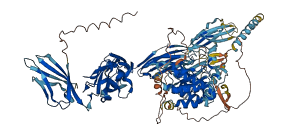
Descriptions
3-Phosphoinositide-dependent protein kinase-1 (PDPK1) plays a central role in activating the protein kinase A, G, and C subfamily. In particular, PDPK1 plays an important role in regulating the Akt survival pathway. PDPK1 forms a homodimer via its PH domain, which is an autoinhibited conformation. The ATP-binding site is buried in the structure and the PIF pocket in the kinase domain of one monomer is not accessible because of its occupancy by the αG helix of the other monomer. Thus, though the PH domain in PDPK1 does not mediate intramolecular interactions, it mediates the homodimerization by PH-PH interaction and results in autoinhibition. Deletion of the PH domain increases the interaction between PDPK1 and PKB.
Autoinhibitory domains (AIDs)
Target domain |
575-909 (Protein kinase domain) |
Relief mechanism |
PTM, Ligand binding |
Assay |
|
Accessory elements
794-819 (Activation loop from InterPro)
Target domain |
575-913 (Protein kinase domain) |
Relief mechanism |
|
Assay |
|
794-819 (Activation loop from InterPro)
Target domain |
575-908 (Serine-threonine/tyrosine-protein kinase, catalytic domain) |
Relief mechanism |
|
Assay |
|
References
- Yeon JH et al. (2016) "Systems-wide Identification of cis-Regulatory Elements in Proteins", Cell systems, 2, 89-100
- Griffith J et al. (2004) "The structural basis for autoinhibition of FLT3 by the juxtamembrane domain", Molecular cell, 13, 169-78
- Reindl C et al. (2006) "From kinases to cancer: leakiness, loss of autoinhibition and leukemia", Cell cycle (Georgetown, Tex.), 5, 599-602
- Jiang J et al. (2004) "Identifying and characterizing a novel activating mutation of the FLT3 tyrosine kinase in AML", Blood, 104, 1855-8
- Hubbard SR (2004) "Juxtamembrane autoinhibition in receptor tyrosine kinases", Nature reviews. Molecular cell biology, 5, 464-71
- Mol CD et al. (2004) "Structural basis for the autoinhibition and STI-571 inhibition of c-Kit tyrosine kinase", The Journal of biological chemistry, 279, 31655-63
- Liang L et al. (2016) "Structural and biochemical studies of the PDGFRA kinase domain", Biochemical and biophysical research communications, 477, 667-672
Autoinhibited structure

Activated structure
1 structures for Q08156
| Entry ID | Method | Resolution | Chain | Position | Source |
|---|---|---|---|---|---|
| AF-Q08156-F1 | Predicted | AlphaFoldDB |
5 variants for Q08156
| Variant ID(s) | Position | Change | Description | Diseaes Association | Provenance |
|---|---|---|---|---|---|
| rs738432562 | 237 | S>F | No | Ensembl | |
| rs732433745 | 414 | C>G | No | Ensembl | |
| rs740698566 | 738 | T>P | No | Ensembl | |
| rs734835226 | 836 | D>G | No | Ensembl | |
| rs731035659 | 947 | S>T | No | Ensembl |
1 associated diseases with Q08156
[MIM: 610475]: Primary pigmented nodular adrenocortical disease 2 (PPNAD2)
A rare bilateral adrenal defect causing ACTH-independent Cushing syndrome. Macroscopic appearance of the adrenals is characteristic with small pigmented micronodules observed in the cortex. Adrenal glands show overall normal size and weight, and multiple small yellow-to-dark brown nodules surrounded by a cortex with a uniform appearance. Microscopically, there are moderate diffuse cortical hyperplasia with mostly nonpigmented nodules, multiple capsular deficits and massive circumscribed and infiltrating extra-adrenal cortical excrescences with micronodules. Clinical manifestations of Cushing syndrome include facial and truncal obesity, abdominal striae, muscular weakness, osteoporosis, arterial hypertension, diabetes. . Note=The disease is caused by variants affecting the gene represented in this entry.
Without disease ID
- A rare bilateral adrenal defect causing ACTH-independent Cushing syndrome. Macroscopic appearance of the adrenals is characteristic with small pigmented micronodules observed in the cortex. Adrenal glands show overall normal size and weight, and multiple small yellow-to-dark brown nodules surrounded by a cortex with a uniform appearance. Microscopically, there are moderate diffuse cortical hyperplasia with mostly nonpigmented nodules, multiple capsular deficits and massive circumscribed and infiltrating extra-adrenal cortical excrescences with micronodules. Clinical manifestations of Cushing syndrome include facial and truncal obesity, abdominal striae, muscular weakness, osteoporosis, arterial hypertension, diabetes. . Note=The disease is caused by variants affecting the gene represented in this entry.
10 regional properties for Q08156
| Type | Name | Position | InterPro Accession |
|---|---|---|---|
| domain | FERM domain | 35 - 355 | IPR000299 |
| domain | Protein kinase domain | 422 - 680 | IPR000719 |
| domain | Serine-threonine/tyrosine-protein kinase, catalytic domain | 422 - 676 | IPR001245 |
| domain | Focal adhesion kinase, targeting (FAT) domain | 917 - 1048 | IPR005189 |
| active_site | Tyrosine-protein kinase, active site | 542 - 554 | IPR008266 |
| binding_site | Protein kinase, ATP binding site | 428 - 454 | IPR017441 |
| domain | FERM central domain | 135 - 250 | IPR019748 |
| domain | Band 4.1 domain | 31 - 258 | IPR019749 |
| domain | Tyrosine-protein kinase, catalytic domain | 422 - 676 | IPR020635 |
| domain | FAK1/PYK2, FERM domain C-lobe | 254 - 364 | IPR041784 |
Functions
| Description | ||
|---|---|---|
| EC Number | 2.7.11.1 | Protein-serine/threonine kinases |
| Subcellular Localization |
|
|
| PANTHER Family | PTHR24356 | SERINE/THREONINE-PROTEIN KINASE |
| PANTHER Subfamily | PTHR24356:SF163 | 3-PHOSPHOINOSITIDE-DEPENDENT PROTEIN KINASE 1-RELATED |
| PANTHER Protein Class |
non-receptor serine/threonine protein kinase
protein modifying enzyme |
|
| PANTHER Pathway Category |
Inflammation mediated by chemokine and cytokine signaling pathway PDK1 Ras Pathway PDK CCKR signaling map PDPK1 PI3 kinase pathway PDK1 ACT PI3 kinase pathway PDK1 p53 pathway feedback loops 2 PDK1/2 p53 pathway PDK1/2 Interleukin signaling pathway PDK1/2 Insulin/IGF pathway-protein kinase B signaling cascade PDK1/2 PDGF signaling pathway PDK1/2 PI3 kinase pathway P110ACT |
|
5 GO annotations of cellular component
| Name | Definition |
|---|---|
| cell-cell junction | A cell junction that forms a connection between two or more cells of an organism; excludes direct cytoplasmic intercellular bridges, such as ring canals in insects. |
| external side of plasma membrane | The leaflet of the plasma membrane that faces away from the cytoplasm and any proteins embedded or anchored in it or attached to its surface. |
| extracellular space | That part of a multicellular organism outside the cells proper, usually taken to be outside the plasma membranes, and occupied by fluid. |
| fibrillar center | A structure found most metazoan nucleoli, but not usually found in lower eukaryotes; surrounded by the dense fibrillar component; the zone of transcription from multiple copies of the pre-rRNA genes is in the border region between these two structures. |
| receptor complex | Any protein complex that undergoes combination with a hormone, neurotransmitter, drug or intracellular messenger to initiate a change in cell function. |
9 GO annotations of molecular function
| Name | Definition |
|---|---|
| ATP binding | Binding to ATP, adenosine 5'-triphosphate, a universally important coenzyme and enzyme regulator. |
| cytokine binding | Binding to a cytokine, any of a group of proteins that function to control the survival, growth and differentiation of tissues and cells, and which have autocrine and paracrine activity. |
| growth factor binding | Binding to a growth factor, proteins or polypeptides that stimulate a cell or organism to grow or proliferate. |
| metal ion binding | Binding to a metal ion. |
| protease binding | Binding to a protease or a peptidase. |
| protein homodimerization activity | Binding to an identical protein to form a homodimer. |
| SH2 domain binding | Binding to a SH2 domain (Src homology 2) of a protein, a protein domain of about 100 amino-acid residues and belonging to the alpha + beta domain class. |
| stem cell factor receptor activity | Combining with stem cell factor (SCF) receptor ligand and transmitting the signal from one side of the membrane to the other to initiate a change in cell activity by catalysis of the reaction |
| transmembrane receptor protein tyrosine kinase activity | Combining with a signal and transmitting the signal from one side of the membrane to the other to initiate a change in cell activity by catalysis of the reaction |
46 GO annotations of biological process
| Name | Definition |
|---|---|
| actin cytoskeleton organization | A process that is carried out at the cellular level which results in the assembly, arrangement of constituent parts, or disassembly of cytoskeletal structures comprising actin filaments and their associated proteins. |
| B cell differentiation | The process in which a precursor cell type acquires the specialized features of a B cell. A B cell is a lymphocyte of B lineage with the phenotype CD19-positive and capable of B cell mediated immunity. |
| detection of mechanical stimulus involved in sensory perception of sound | The series of events involved in the perception of sound vibration in which the vibration is received and converted into a molecular signal. |
| digestive tract development | The process whose specific outcome is the progression of the digestive tract over time, from its formation to the mature structure. The digestive tract is the anatomical structure through which food passes and is processed. |
| ectopic germ cell programmed cell death | Programmed cell death of an errant germ line cell that is outside the normal migratory path or ectopic to the gonad. This is an important mechanism of regulating germ cell survival within the embryo. |
| embryonic hemopoiesis | The stages of blood cell formation that take place within the embryo. |
| erythrocyte differentiation | The process in which a myeloid precursor cell acquires specializes features of an erythrocyte. |
| erythropoietin-mediated signaling pathway | The series of molecular signals initiated by erythropoietin (EPO) binding to the erythropoietin receptor (EPO-R) on the surface of a target cell, and ending with the regulation of a downstream cellular process, e.g. transcription. |
| Fc receptor signaling pathway | The series of molecular signals initiated by the binding of the Fc portion of an immunoglobulin to an Fc receptor on the surface of a target cell, and ending with the regulation of a downstream cellular process, e.g. transcription. The Fc portion of an immunoglobulin is its C-terminal constant region. |
| glycosphingolipid metabolic process | The chemical reactions and pathways involving glycosphingolipids, any compound with residues of sphingoid and at least one monosaccharide. |
| hematopoietic progenitor cell differentiation | The process in which precursor cell type acquires the specialized features of a hematopoietic progenitor cell, a class of cell types including myeloid progenitor cells and lymphoid progenitor cells. |
| hematopoietic stem cell migration | The orderly movement of a hematopoietic stem cell from one site to another. A hematopoietic stem cell is a cell from which all cells of the lymphoid and myeloid lineages develop, including blood cells and cells of the immune system. |
| immature B cell differentiation | The process in which a precursor cell type acquires the specialized features of an immature B cell. |
| inflammatory response | The immediate defensive reaction (by vertebrate tissue) to infection or injury caused by chemical or physical agents. The process is characterized by local vasodilation, extravasation of plasma into intercellular spaces and accumulation of white blood cells and macrophages. |
| intracellular signal transduction | The process in which a signal is passed on to downstream components within the cell, which become activated themselves to further propagate the signal and finally trigger a change in the function or state of the cell. |
| Kit signaling pathway | The series of molecular signals initiated by the binding of stem cell factor to the tyrosine kinase receptor KIT on the surface of a target cell, and ending with regulation of a downstream cellular process, e.g. transcription. Stem cell factor (KIT ligand) binding to the receptor Kit mediates receptor dimerization, activation of its intrinsic tyrosine kinase activity and autophosphorylation. The activated receptor then phosphorylates various substrates, thereby activating distinct signaling cascades within the cell that trigger a change in state or activity of the cell. |
| lamellipodium assembly | Formation of a lamellipodium, a thin sheetlike extension of the surface of a migrating cell. |
| lymphoid progenitor cell differentiation | The process in which a precursor cell type acquires the specialized features of a lymphoid progenitor cell. Lymphoid progenitor cells include progenitor cells for any of the lymphoid lineages. |
| male gonad development | The process whose specific outcome is the progression of the male gonad over time, from its formation to the mature structure. |
| mast cell chemotaxis | The movement of a mast cell in response to an external stimulus. |
| mast cell degranulation | The regulated exocytosis of secretory granules containing preformed mediators such as histamine, serotonin, and neutral proteases by a mast cell. |
| mast cell differentiation | The process in which a relatively unspecialized myeloid precursor cell acquires the specialized features of a mast cell. A mast cell is a cell that is found in almost all tissues containing numerous basophilic granules and capable of releasing large amounts of histamine and heparin upon activation. |
| mast cell proliferation | The expansion of a mast cell population by cell division. |
| megakaryocyte development | The process whose specific outcome is the progression of a megakaryocyte cell over time, from its formation to the mature structure. Megakaryocyte development does not include the steps involved in committing a cell to a megakaryocyte fate. A megakaryocyte is a giant cell 50 to 100 micron in diameter, with a greatly lobulated nucleus, found in the bone marrow. |
| melanocyte adhesion | The attachment of a melanocyte to another cell via adhesion molecules. |
| melanocyte differentiation | The process in which a relatively unspecialized cell acquires specialized features of a melanocyte. |
| melanocyte migration | The orderly movement of melanocytes from one site to another, often during the development of a multicellular organism. A melanocyte is a pigment cell derived from the neural crest. It contains melanin-filled pigment granules, which give a brown to black appearance. |
| myeloid progenitor cell differentiation | The process in which a precursor cell type acquires the specialized features of a myeloid progenitor cell. Myeloid progenitor cells include progenitor cells for any of the myeloid lineages. |
| negative regulation of developmental process | Any process that stops, prevents or reduces the rate or extent of development, the biological process whose specific outcome is the progression of an organism over time from an initial condition (e.g. a zygote, or a young adult) to a later condition (e.g. a multicellular animal or an aged adult). |
| negative regulation of programmed cell death | Any process that stops, prevents, or reduces the frequency, rate or extent of programmed cell death, cell death resulting from activation of endogenous cellular processes. |
| negative regulation of reproductive process | Any process that stops, prevents, or reduces the frequency, rate or extent of reproductive process. |
| ovarian follicle development | The process whose specific outcome is the progression of the ovarian follicle over time, from its formation to the mature structure. |
| phosphorylation | The process of introducing a phosphate group into a molecule, usually with the formation of a phosphoric ester, a phosphoric anhydride or a phosphoric amide. |
| positive regulation of cell migration | Any process that activates or increases the frequency, rate or extent of cell migration. |
| positive regulation of dendritic cell cytokine production | Any process that activates or increases the frequency, rate, or extent of dendritic cell cytokine production. |
| positive regulation of MAPK cascade | Any process that activates or increases the frequency, rate or extent of signal transduction mediated by the MAPK cascade. |
| positive regulation of mast cell cytokine production | Any process that activates or increases the frequency, rate, or extent of mast cell cytokine production. |
| positive regulation of mast cell proliferation | Any process that activates or increases the rate or extent of mast cell proliferation. |
| positive regulation of receptor signaling pathway via JAK-STAT | Any process that activates or increases the frequency, rate or extent of the JAK-STAT signaling pathway activity. |
| positive regulation of tyrosine phosphorylation of STAT protein | Any process that activates or increases the frequency, rate or extent of the introduction of a phosphate group to a tyrosine residue of a STAT (Signal Transducer and Activator of Transcription) protein. |
| positive regulation of vascular associated smooth muscle cell differentiation | Any process that activates or increases the frequency, rate or extent of vascular smooth muscle cell differentiation. |
| regulation of cell shape | Any process that modulates the surface configuration of a cell. |
| response to radiation | Any process that results in a change in state or activity of a cell or an organism (in terms of movement, secretion, enzyme production, gene expression, etc.) as a result of an electromagnetic radiation stimulus. Electromagnetic radiation is a propagating wave in space with electric and magnetic components. These components oscillate at right angles to each other and to the direction of propagation. |
| spermatid development | The process whose specific outcome is the progression of a spermatid over time, from its formation to the mature structure. |
| stem cell differentiation | The process in which a relatively unspecialized cell acquires specialized features of a stem cell. A stem cell is a cell that retains the ability to divide and proliferate throughout life to provide progenitor cells that can differentiate into specialized cells. |
| T cell differentiation | The process in which a precursor cell type acquires characteristics of a more mature T-cell. A T cell is a type of lymphocyte whose definin characteristic is the expression of a T cell receptor complex. |
77 homologous proteins in AiPD
| UniProt AC | Gene Name | Protein Name | Species | Evidence Code |
|---|---|---|---|---|
| Q06805 | TIE1 | Tyrosine-protein kinase receptor Tie-1 | Bos taurus (Bovine) | PR |
| Q06807 | TEK | Angiopoietin-1 receptor | Bos taurus (Bovine) | SS |
| P43481 | KIT | Mast/stem cell growth factor receptor Kit | Bos taurus (Bovine) | SS |
| P13369 | CSF1R | Macrophage colony-stimulating factor 1 receptor | Felis catus (Cat) (Felis silvestris catus) | SS |
| Q28889 | KIT | Mast/stem cell growth factor receptor Kit | Felis catus (Cat) (Felis silvestris catus) | SS |
| P18460 | FGFR3 | Fibroblast growth factor receptor 3 | Gallus gallus (Chicken) | SS |
| P18461 | FGFR2 | Fibroblast growth factor receptor 2 | Gallus gallus (Chicken) | SS |
| P21804 | FGFR1 | Fibroblast growth factor receptor 1 | Gallus gallus (Chicken) | SS |
| Q8AXY6 | MUSK | Muscle, skeletal receptor tyrosine protein kinase | Gallus gallus (Chicken) | SS |
| Q5F3X2 | DDR1 | receptor protein-tyrosine kinase | Gallus gallus (Chicken) | SS |
| Q91987 | NTRK2 | BDNF/NT-3 growth factors receptor | Gallus gallus (Chicken) | SS |
| Q91044 | NTRK3 | NT-3 growth factor receptor | Gallus gallus (Chicken) | SS |
| Q8QHL3 | FLT1 | Vascular endothelial growth factor receptor 1 | Gallus gallus (Chicken) | SS |
| Q98949 | TYRO3 | Tyrosine-protein kinase receptor TYRO3 | Gallus gallus (Chicken) | PR |
| Q9PUF6 | PDGFRA | Platelet-derived growth factor receptor alpha | Gallus gallus (Chicken) | SS |
| Q91009 | NTRK1 | High affinity nerve growth factor receptor | Gallus gallus (Chicken) | SS |
| Q07494 | EPHB1 | Ephrin type-B receptor 1 | Gallus gallus (Chicken) | SS |
| O97799 | KIT | Mast/stem cell growth factor receptor Kit | Canis lupus familiaris (Dog) (Canis familiaris) | PR |
| Q07407 | htl | Fibroblast growth factor receptor homolog 1 | Drosophila melanogaster (Fruit fly) | PR |
| Q6J9G0 | STYK1 | Tyrosine-protein kinase STYK1 | Homo sapiens (Human) | PR |
| P36888 | FLT3 | Receptor-type tyrosine-protein kinase FLT3 | Homo sapiens (Human) | EV |
| P16234 | PDGFRA | Platelet-derived growth factor receptor alpha | Homo sapiens (Human) | EV |
| P09619 | PDGFRB | Platelet-derived growth factor receptor beta | Homo sapiens (Human) | EV |
| P35916 | FLT4 | Vascular endothelial growth factor receptor 3 | Homo sapiens (Human) | SS |
| P35968 | KDR | Vascular endothelial growth factor receptor 2 | Homo sapiens (Human) | EV |
| P17948 | FLT1 | Vascular endothelial growth factor receptor 1 | Homo sapiens (Human) | SS |
| P07333 | CSF1R | Macrophage colony-stimulating factor 1 receptor | Homo sapiens (Human) | SS |
| P22455 | FGFR4 | Fibroblast growth factor receptor 4 | Homo sapiens (Human) | SS |
| P22607 | FGFR3 | Fibroblast growth factor receptor 3 | Homo sapiens (Human) | EV |
| P07949 | RET | Proto-oncogene tyrosine-protein kinase receptor Ret | Homo sapiens (Human) | EV |
| P35590 | TIE1 | Tyrosine-protein kinase receptor Tie-1 | Homo sapiens (Human) | PR |
| Q02763 | TEK | Angiopoietin-1 receptor | Homo sapiens (Human) | SS |
| P11362 | FGFR1 | Fibroblast growth factor receptor 1 | Homo sapiens (Human) | EV |
| P21802 | FGFR2 | Fibroblast growth factor receptor 2 | Homo sapiens (Human) | EV |
| P10721 | KIT | Mast/stem cell growth factor receptor Kit | Homo sapiens (Human) | EV |
| Q03142 | Fgfr4 | Fibroblast growth factor receptor 4 | Mus musculus (Mouse) | PR |
| Q91V87 | Fgfrl1 | Fibroblast growth factor receptor-like 1 | Mus musculus (Mouse) | PR |
| P35917 | Flt4 | Vascular endothelial growth factor receptor 3 | Mus musculus (Mouse) | SS |
| P05622 | Pdgfrb | Platelet-derived growth factor receptor beta | Mus musculus (Mouse) | SS |
| P09581 | Csf1r | Macrophage colony-stimulating factor 1 receptor | Mus musculus (Mouse) | SS |
| P35969 | Flt1 | Vascular endothelial growth factor receptor 1 | Mus musculus (Mouse) | SS |
| P35546 | Ret | Proto-oncogene tyrosine-protein kinase receptor Ret | Mus musculus (Mouse) | SS |
| Q06806 | Tie1 | Tyrosine-protein kinase receptor Tie-1 | Mus musculus (Mouse) | SS |
| Q00342 | Flt3 | Receptor-type tyrosine-protein kinase FLT3 | Mus musculus (Mouse) | SS |
| Q6J9G1 | Styk1 | Tyrosine-protein kinase STYK1 | Mus musculus (Mouse) | PR |
| P16092 | Fgfr1 | Fibroblast growth factor receptor 1 | Mus musculus (Mouse) | SS |
| Q61851 | Fgfr3 | Fibroblast growth factor receptor 3 | Mus musculus (Mouse) | PR |
| Q02858 | Tek | Angiopoietin-1 receptor | Mus musculus (Mouse) | SS |
| P35918 | Kdr | Vascular endothelial growth factor receptor 2 | Mus musculus (Mouse) | PR |
| P21803 | Fgfr2 | Fibroblast growth factor receptor 2 | Mus musculus (Mouse) | SS |
| P26618 | Pdgfra | Platelet-derived growth factor receptor alpha | Mus musculus (Mouse) | SS |
| P05532 | Kit | Mast/stem cell growth factor receptor Kit | Mus musculus (Mouse) | PR |
| Q2HWD6 | KIT | Mast/stem cell growth factor receptor Kit | Sus scrofa (Pig) | SS |
| Q7TQM3 | Fgfrl1 | Fibroblast growth factor receptor-like 1 | Rattus norvegicus (Rat) | PR |
| P53767 | Flt1 | Vascular endothelial growth factor receptor 1 | Rattus norvegicus (Rat) | PR |
| P20786 | Pdgfra | Platelet-derived growth factor receptor alpha | Rattus norvegicus (Rat) | SS |
| Q91ZT1 | Flt4 | Vascular endothelial growth factor receptor 3 | Rattus norvegicus (Rat) | SS |
| Q04589 | Fgfr1 | Fibroblast growth factor receptor 1 | Rattus norvegicus (Rat) | SS |
| G3V9H8 | Ret | Proto-oncogene tyrosine-protein kinase receptor Ret | Rattus norvegicus (Rat) | SS |
| Q498D6 | Fgfr4 | Fibroblast growth factor receptor 4 | Rattus norvegicus (Rat) | PR |
| Q05030 | Pdgfrb | Platelet-derived growth factor receptor beta | Rattus norvegicus (Rat) | SS |
| O08775 | Kdr | Vascular endothelial growth factor receptor 2 | Rattus norvegicus (Rat) | SS |
| Q17833 | old-1 | Tyrosine-protein kinase receptor old-1 | Caenorhabditis elegans | PR |
| Q19238 | F09A5.2 | Putative tyrosine-protein kinase F09A5.2 | Caenorhabditis elegans | SS |
| Q10656 | egl-15 | Myoblast growth factor receptor egl-15 | Caenorhabditis elegans | PR |
| P34892 | kin-16 | Receptor-like tyrosine-protein kinase kin-16 | Caenorhabditis elegans | PR |
| G5ED65 | ver-1 | Protein ver-1 | Caenorhabditis elegans | PR |
| Q8AXB3 | kdrl | Vascular endothelial growth factor receptor kdr-like | Danio rerio (Zebrafish) (Brachydanio rerio) | SS |
| Q5GIT4 | kdr | Vascular endothelial growth factor receptor 2 | Danio rerio (Zebrafish) (Brachydanio rerio) | SS |
| O73791 | tek | Angiopoietin-1 receptor | Danio rerio (Zebrafish) (Brachydanio rerio) | SS |
| Q90Z00 | fgfr1a | Fibroblast growth factor receptor 1-A | Danio rerio (Zebrafish) (Brachydanio rerio) | SS |
| Q8JG38 | fgfr2 | Fibroblast growth factor receptor 2 | Danio rerio (Zebrafish) (Brachydanio rerio) | SS |
| Q9I8N6 | csf1r | Macrophage colony-stimulating factor 1 receptor | Danio rerio (Zebrafish) (Brachydanio rerio) | SS |
| Q90413 | fgfr4 | Fibroblast growth factor receptor 4 | Danio rerio (Zebrafish) (Brachydanio rerio) | SS |
| Q9DE49 | pdgfra | Platelet-derived growth factor receptor alpha | Danio rerio (Zebrafish) (Brachydanio rerio) | SS |
| Q5MD89 | flt4 | Vascular endothelial growth factor receptor 3 | Danio rerio (Zebrafish) (Brachydanio rerio) | SS |
| Q8JFR5 | kita | Mast/stem cell growth factor receptor kita | Danio rerio (Zebrafish) (Brachydanio rerio) | SS |
| 10 | 20 | 30 | 40 | 50 | 60 |
| MARTTSQLYD | AVPIQSSVVL | CSCPSPSMVR | TQTESSTPPG | IPGGSRQGPA | MDGTAAEPRP |
| 70 | 80 | 90 | 100 | 110 | 120 |
| GAGSLQHAQP | PPQPRKKRPE | DFKFGKILGE | GSFSTVVLAR | ELATSREYAI | KILEKRHIIK |
| 130 | 140 | 150 | 160 | 170 | 180 |
| ENKVPYVTRE | RDVMSRLDHP | FFVKLYFTFQ | DDEKLYFGLS | YAKNGELLKY | IRKIGSFDET |
| 190 | 200 | 210 | 220 | 230 | 240 |
| CTRFYTAEIV | SALEYLHGKG | IIHRDLKPEN | ILLNEDMHIQ | ITDFGTAKVL | SPESKQARAN |
| 250 | 260 | 270 | 280 | 290 | 300 |
| SFVGTAQYVS | PELLTEKSAC | KSSDLWALGC | IIYQLVAGLP | PFRAGNEYLI | FQKIIKLEYD |
| 310 | 320 | 330 | 340 | 350 | 360 |
| FPEKFFPKAR | DLVEKLLVLD | ATKRLGCEEM | EGYGPLKAHP | FFESVTWENL | HQQTPPKLTA |
| 370 | 380 | 390 | 400 | 410 | 420 |
| YLPAMSEDDE | DCYGNYDNLL | SQFGCMQVSS | SSSSHSLSAS | DTGLPQRSGS | NIEQYIHDLD |
| 430 | 440 | 450 | 460 | 470 | 480 |
| SNSFELDLQF | SEDEKRLLLE | KQAGGNPWHQ | FVENNLILKM | GPVDKRKGLF | ARRRQLLLTE |
| 490 | 500 | 510 | 520 | 530 | 540 |
| GPHLYYVDPV | NKVLKGEIPW | SQELRPEAKN | FKTFFVHTPN | RTYYLMDPSG | NAHKWCRKIQ |
| 550 | |||||
| EVWRQRYQSH | PDAAVQ |