Q07883
Gene name |
GRB2 |
Protein name |
Growth factor receptor-bound protein 2 |
Names |
Adapter protein GRB2, SH2/SH3 adapter GRB2 |
Species |
Gallus gallus (Chicken) |
KEGG Pathway |
gga:386572 |
EC number |
|
Protein Class |
|
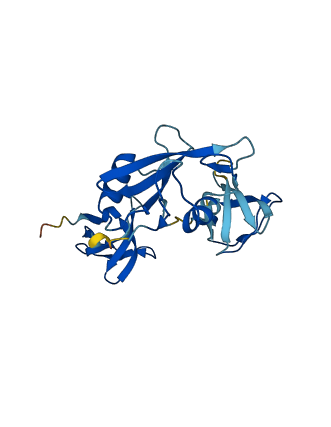
Descriptions
The autoinhibited protein was predicted that may have potential autoinhibitory elements via cis-regPred.
Autoinhibitory domains (AIDs)
Target domain |
|
Relief mechanism |
|
Assay |
cis-regPred |
Accessory elements
No accessory elements
Autoinhibited structure

Activated structure
1 structures for Q07883
| Entry ID | Method | Resolution | Chain | Position | Source |
|---|---|---|---|---|---|
| AF-Q07883-F1 | Predicted | AlphaFoldDB |
No variants for Q07883
| Variant ID(s) | Position | Change | Description | Diseaes Association | Provenance |
|---|---|---|---|---|---|
| No variants for Q07883 | |||||
No associated diseases with Q07883
5 regional properties for Q07883
| Type | Name | Position | InterPro Accession |
|---|---|---|---|
| domain | SH2 domain | 58 - 152 | IPR000980 |
| domain | SH3 domain | 1 - 58 | IPR001452-1 |
| domain | SH3 domain | 156 - 215 | IPR001452-2 |
| domain | GRB2, N-terminal SH3 domain | 1 - 56 | IPR035641 |
| domain | GRB2, C-terminal SH3 domain | 160 - 212 | IPR035643 |
7 GO annotations of cellular component
| Name | Definition |
|---|---|
| COP9 signalosome | A protein complex that catalyzes the deneddylation of proteins, including the cullin component of SCF ubiquitin E3 ligase; deneddylation increases the activity of cullin family ubiquitin ligases. The signalosome is involved in many regulatory process, including some which control development, in many species; also regulates photomorphogenesis in plants; in many species its subunits are highly similar to those of the proteasome. |
| cytoplasm | The contents of a cell excluding the plasma membrane and nucleus, but including other subcellular structures. |
| endosome | A vacuole to which materials ingested by endocytosis are delivered. |
| Golgi apparatus | A membrane-bound cytoplasmic organelle of the endomembrane system that further processes the core oligosaccharides (e.g. N-glycans) added to proteins in the endoplasmic reticulum and packages them into membrane-bound vesicles. The Golgi apparatus operates at the intersection of the secretory, lysosomal, and endocytic pathways. |
| nucleoplasm | That part of the nuclear content other than the chromosomes or the nucleolus. |
| nucleus | A membrane-bounded organelle of eukaryotic cells in which chromosomes are housed and replicated. In most cells, the nucleus contains all of the cell's chromosomes except the organellar chromosomes, and is the site of RNA synthesis and processing. In some species, or in specialized cell types, RNA metabolism or DNA replication may be absent. |
| plasma membrane | The membrane surrounding a cell that separates the cell from its external environment. It consists of a phospholipid bilayer and associated proteins. |
2 GO annotations of molecular function
| Name | Definition |
|---|---|
| epidermal growth factor receptor binding | Binding to an epidermal growth factor receptor. |
| phosphotyrosine residue binding | Binding to a phosphorylated tyrosine residue within a protein. |
2 GO annotations of biological process
| Name | Definition |
|---|---|
| regulation of MAPK cascade | Any process that modulates the frequency, rate or extent of signal transduction mediated by the MAP kinase (MAPK) cascade. |
| signal transduction | The cellular process in which a signal is conveyed to trigger a change in the activity or state of a cell. Signal transduction begins with reception of a signal (e.g. a ligand binding to a receptor or receptor activation by a stimulus such as light), or for signal transduction in the absence of ligand, signal-withdrawal or the activity of a constitutively active receptor. Signal transduction ends with regulation of a downstream cellular process, e.g. regulation of transcription or regulation of a metabolic process. Signal transduction covers signaling from receptors located on the surface of the cell and signaling via molecules located within the cell. For signaling between cells, signal transduction is restricted to events at and within the receiving cell. |
| 10 | 20 | 30 | 40 | 50 | 60 |
| MEAIAKYDFK | ATADDELSFK | RGDILKVLNE | ECDQNWYKAE | LNGKGGFIPK | NYIEMKPHPW |
| 70 | 80 | 90 | 100 | 110 | 120 |
| FFGKIPRAKA | EEMLGKQRHD | GAFLIRESES | APGDFSLSVK | FGNDVQQFKV | LRDGAGKYLL |
| 130 | 140 | 150 | 160 | 170 | 180 |
| WVVKFNSLNE | LVDYHRSTSV | SRNQQIFLRD | IEQVPQQPTY | VQALFDFDPQ | EEGELGFRRG |
| 190 | 200 | 210 | |||
| DFIQVLDNSD | PNWWKGACHG | QTGMFPRNYV | TPVNRNI |