Q06AS9
Gene name |
EFNA1 |
Protein name |
Ephrin-A1 |
Names |
|
Species |
Sus scrofa (Pig) |
KEGG Pathway |
ssc:100144501 |
EC number |
|
Protein Class |
|
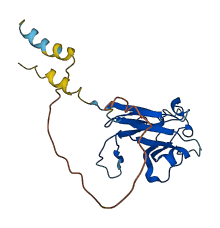
Descriptions
The autoinhibited protein was predicted that may have potential autoinhibitory elements via cis-regPred.
Autoinhibitory domains (AIDs)
Target domain |
|
Relief mechanism |
|
Assay |
cis-regPred |
Accessory elements
No accessory elements
Autoinhibited structure

Activated structure
1 structures for Q06AS9
| Entry ID | Method | Resolution | Chain | Position | Source |
|---|---|---|---|---|---|
| AF-Q06AS9-F1 | Predicted | AlphaFoldDB |
No variants for Q06AS9
| Variant ID(s) | Position | Change | Description | Diseaes Association | Provenance |
|---|---|---|---|---|---|
| No variants for Q06AS9 | |||||
No associated diseases with Q06AS9
5 regional properties for Q06AS9
| Type | Name | Position | InterPro Accession |
|---|---|---|---|
| domain | Tyrosine-specific protein phosphatases domain | 343 - 390 | IPR000387 |
| domain | Protein-tyrosine phosphatase, catalytic | 319 - 470 | IPR003595 |
| domain | GRAM domain | 29 - 142 | IPR004182 |
| domain | Myotubularin-like, phosphatase domain | 150 - 537 | IPR010569 |
| active_site | Protein-tyrosine phosphatase, active site | 372 - 382 | IPR016130 |
3 GO annotations of cellular component
| Name | Definition |
|---|---|
| anchored component of plasma membrane | The component of the plasma membrane consisting of the gene products that are tethered to the membrane only by a covalently attached anchor, such as a lipid group, that is embedded in the membrane. Gene products with peptide sequences that are embedded in the membrane are excluded from this grouping. |
| extracellular region | The space external to the outermost structure of a cell. For cells without external protective or external encapsulating structures this refers to space outside of the plasma membrane. This term covers the host cell environment outside an intracellular parasite. |
| plasma membrane | The membrane surrounding a cell that separates the cell from its external environment. It consists of a phospholipid bilayer and associated proteins. |
1 GO annotations of molecular function
| Name | Definition |
|---|---|
| ephrin receptor binding | Binding to an ephrin receptor. |
5 GO annotations of biological process
| Name | Definition |
|---|---|
| angiogenesis | Blood vessel formation when new vessels emerge from the proliferation of pre-existing blood vessels. |
| axon guidance | The chemotaxis process that directs the migration of an axon growth cone to a specific target site in response to a combination of attractive and repulsive cues. |
| ephrin receptor signaling pathway | The series of molecular signals initiated by ephrin binding to its receptor, and ending with the regulation of a downstream cellular process, e.g. transcription. |
| negative regulation of dendritic spine morphogenesis | Any process that decreases the rate, frequency, or extent of dendritic spine morphogenesis, the process in which the anatomical structures of a dendritic spine are generated and organized. A dendritic spine is a protrusion from a dendrite and a specialized subcellular compartment involved in synaptic transmission. |
| regulation of peptidyl-tyrosine phosphorylation | Any process that modulates the frequency, rate or extent of the phosphorylation of peptidyl-tyrosine. |
| 10 | 20 | 30 | 40 | 50 | 60 |
| MEFLWAPLLG | LCCSLAAADR | HTVFWNSSEP | KFWNEDYTVH | VRLNDYLDII | CPHYEDDSVA |
| 70 | 80 | 90 | 100 | 110 | 120 |
| EAAMERYTLY | LVEREQYQLC | QPQSKDQVRW | QCNQPNARHG | PEKLSEKFQR | FTPFTLGKEF |
| 130 | 140 | 150 | 160 | 170 | 180 |
| KEGHSYYYIS | KPIHHQEDQC | LKLKVTVSGK | ITHSPQAHAN | PQEKRLPADD | PEVQVLHSIG |
| 190 | 200 | ||||
| HSAAPRLSPL | AWAVLLLPFL | LLQTS |