Q06890
Gene name |
Clu |
Protein name |
Clusterin |
Names |
Apolipoprotein J, Apo-J, Clustrin, Sulfated glycoprotein 2, SGP-2 |
Species |
Mus musculus (Mouse) |
KEGG Pathway |
mmu:12759 |
EC number |
|
Protein Class |
|
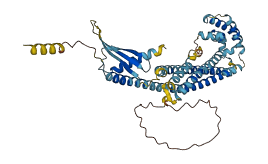
Descriptions
The autoinhibited protein was predicted that may have potential autoinhibitory elements via cis-regPred.
Autoinhibitory domains (AIDs)
Target domain |
|
Relief mechanism |
|
Assay |
cis-regPred |
Accessory elements
No accessory elements
Autoinhibited structure

Activated structure
1 structures for Q06890
| Entry ID | Method | Resolution | Chain | Position | Source |
|---|---|---|---|---|---|
| AF-Q06890-F1 | Predicted | AlphaFoldDB |
18 variants for Q06890
| Variant ID(s) | Position | Change | Description | Diseaes Association | Provenance |
|---|---|---|---|---|---|
| rs3410930439 | 13 | I>F | No | EVA | |
| rs260141444 | 13 | I>T | No | EVA | |
| rs3389262096 | 17 | G>S | No | EVA | |
| rs3389338023 | 113 | K>N | No | EVA | |
| rs3389353447 | 210 | F>Y | No | EVA | |
| rs223199300 | 230 | S>P | No | EVA | |
| rs3389292148 | 259 | V>A | No | EVA | |
| rs3389301533 | 266 | F>L | No | EVA | |
| rs3389353428 | 276 | E>D | No | EVA | |
| rs3389338009 | 292 | T>K | No | EVA | |
| rs3389320185 | 312 | C>Y | No | EVA | |
| rs233720588 | 314 | T>A | No | EVA | |
| rs3389337013 | 336 | L>Q | No | EVA | |
| rs3389339173 | 380 | K>* | No | EVA | |
| rs3389348880 | 387 | T>S | No | EVA | |
| rs3389301473 | 423 | S>F | No | EVA | |
| rs3389340632 | 424 | K>M | No | EVA | |
| rs3389328701 | 424 | K>Q | No | EVA |
No associated diseases with Q06890
4 regional properties for Q06890
| Type | Name | Position | InterPro Accession |
|---|---|---|---|
| domain | Clusterin, N-terminal | 22 - 226 | IPR016014 |
| domain | Clusterin, C-terminal | 227 - 442 | IPR016015 |
| conserved_site | Clusterin, conserved site | 112 - 120 | IPR033986-1 |
| conserved_site | Clusterin, conserved site | 294 - 304 | IPR033986-2 |
Functions
22 GO annotations of cellular component
| Name | Definition |
|---|---|
| aggresome | An inclusion body formed by dynein-dependent retrograde transport of an aggregated protein on microtubules. |
| apical dendrite | A dendrite that emerges near the apical pole of a neuron. In bipolar neurons, apical dendrites are located on the opposite side of the soma from the axon. |
| cell periphery | The part of a cell encompassing the cell cortex, the plasma membrane, and any external encapsulating structures. |
| cell surface | The external part of the cell wall and/or plasma membrane. |
| chromaffin granule | Specialized secretory vesicle found in the cells of adrenal glands and various other organs, which is concerned with the synthesis, storage, metabolism, and secretion of epinephrine and norepinephrine. |
| cytoplasm | The contents of a cell excluding the plasma membrane and nucleus, but including other subcellular structures. |
| cytoskeleton | A cellular structure that forms the internal framework of eukaryotic and prokaryotic cells. The cytoskeleton includes intermediate filaments, microfilaments, microtubules, the microtrabecular lattice, and other structures characterized by a polymeric filamentous nature and long-range order within the cell. The various elements of the cytoskeleton not only serve in the maintenance of cellular shape but also have roles in other cellular functions, including cellular movement, cell division, endocytosis, and movement of organelles. |
| cytosol | The part of the cytoplasm that does not contain organelles but which does contain other particulate matter, such as protein complexes. |
| extracellular space | That part of a multicellular organism outside the cells proper, usually taken to be outside the plasma membranes, and occupied by fluid. |
| growth cone | The migrating motile tip of a growing neuron projection, where actin accumulates, and the actin cytoskeleton is the most dynamic. |
| intracellular membrane-bounded organelle | Organized structure of distinctive morphology and function, bounded by a single or double lipid bilayer membrane and occurring within the cell. Includes the nucleus, mitochondria, plastids, vacuoles, and vesicles. Excludes the plasma membrane. |
| membrane | A lipid bilayer along with all the proteins and protein complexes embedded in it an attached to it. |
| mitochondrial inner membrane | The inner, i.e. lumen-facing, lipid bilayer of the mitochondrial envelope. It is highly folded to form cristae. |
| mitochondrion | A semiautonomous, self replicating organelle that occurs in varying numbers, shapes, and sizes in the cytoplasm of virtually all eukaryotic cells. It is notably the site of tissue respiration. |
| neurofibrillary tangle | Intracellular mass of paired, helically wound protein filaments (also called PHF) lying in the cytoplasm of neuronal cell bodies and neuritic cell processes. Neurofibrillary tangles contain an abnormally phosphorylated form of a microtubule-associated protein, tau. The shape of these inclusions may resemble a flame or a star. |
| neuron projection | A prolongation or process extending from a nerve cell, e.g. an axon or dendrite. |
| nucleus | A membrane-bounded organelle of eukaryotic cells in which chromosomes are housed and replicated. In most cells, the nucleus contains all of the cell's chromosomes except the organellar chromosomes, and is the site of RNA synthesis and processing. In some species, or in specialized cell types, RNA metabolism or DNA replication may be absent. |
| perinuclear endoplasmic reticulum lumen | The volume enclosed by the membranes of the perinuclear endoplasmic reticulum. |
| perinuclear region of cytoplasm | Cytoplasm situated near, or occurring around, the nucleus. |
| protein-containing complex | A stable assembly of two or more macromolecules, i.e. proteins, nucleic acids, carbohydrates or lipids, in which at least one component is a protein and the constituent parts function together. |
| spherical high-density lipoprotein particle | A mature high-density lipoprotein (HDL) particle, converted from discoidal HDL particles following the esterification of cholesterol in the particle by phosphatidylcholine-sterol O-acyltransferase (lecithin cholesterol acyltransferase; LCAT). |
| synapse | The junction between an axon of one neuron and a dendrite of another neuron, a muscle fiber or a glial cell. As the axon approaches the synapse it enlarges into a specialized structure, the presynaptic terminal bouton, which contains mitochondria and synaptic vesicles. At the tip of the terminal bouton is the presynaptic membrane; facing it, and separated from it by a minute cleft (the synaptic cleft) is a specialized area of membrane on the receiving cell, known as the postsynaptic membrane. In response to the arrival of nerve impulses, the presynaptic terminal bouton secretes molecules of neurotransmitters into the synaptic cleft. These diffuse across the cleft and transmit the signal to the postsynaptic membrane. |
10 GO annotations of molecular function
| Name | Definition |
|---|---|
| amyloid-beta binding | Binding to an amyloid-beta peptide/protein. |
| low-density lipoprotein particle receptor binding | Binding to a low-density lipoprotein receptor. |
| misfolded protein binding | Binding to a misfolded protein. |
| protein carrier chaperone | Binding to and carrying a protein between two different cellular components by moving along with the target protein. |
| protein N-terminus binding | Binding to a protein N-terminus, the end of any peptide chain at which the 2-amino (or 2-imino) function of a constituent amino acid is not attached in peptide linkage to another amino-acid residue. |
| protein-containing complex binding | Binding to a macromolecular complex. |
| signaling receptor binding | Binding to one or more specific sites on a receptor molecule, a macromolecule that undergoes combination with a hormone, neurotransmitter, drug or intracellular messenger to initiate a change in cell function. |
| tau protein binding | Binding to tau protein. tau is a microtubule-associated protein, implicated in Alzheimer's disease, Down Syndrome and ALS. |
| ubiquitin protein ligase binding | Binding to a ubiquitin protein ligase enzyme, any of the E3 proteins. |
| unfolded protein binding | Binding to an unfolded protein. |
45 GO annotations of biological process
| Name | Definition |
|---|---|
| cell morphogenesis | The developmental process in which the size or shape of a cell is generated and organized. |
| central nervous system myelin maintenance | The process in which the structure and material content of mature central nervous system myelin is kept in a functional state. |
| chaperone-mediated protein complex assembly | The aggregation, arrangement and bonding together of a set of components to form a protein complex, mediated by chaperone molecules that do not form part of the finished complex. |
| chaperone-mediated protein folding | The process of inhibiting aggregation and assisting in the covalent and noncovalent assembly of single chain polypeptides or multisubunit complexes into the correct tertiary structure that is dependent on interaction with a chaperone. |
| endocrine pancreas development | The process whose specific outcome is the progression of the endocrine pancreas over time, from its formation to the mature structure. The endocrine pancreas is made up of islet cells that produce insulin, glucagon and somatostatin. |
| immune complex clearance | A process directed at removing immune complexes from the body. Immune complexes are clusters of antibodies bound to antigen, to which complement may also be fixed, and which may precipitate or remain in solution. |
| intrinsic apoptotic signaling pathway | The series of molecular signals in which an intracellular signal is conveyed to trigger the apoptotic death of a cell. The pathway starts with reception of an intracellular signal (e.g. DNA damage, endoplasmic reticulum stress, oxidative stress etc.), and ends when the execution phase of apoptosis is triggered. The intrinsic apoptotic signaling pathway is crucially regulated by permeabilization of the mitochondrial outer membrane (MOMP). |
| microglial cell activation | The change in morphology and behavior of a microglial cell resulting from exposure to a cytokine, chemokine, cellular ligand, or soluble factor. |
| microglial cell proliferation | The expansion of a microglial cell population by cell division. |
| negative regulation of amyloid fibril formation | Any process that stops, prevents or reduces the frequency, rate or extent of amyloid fibril formation. |
| negative regulation of amyloid-beta formation | Any process that stops, prevents or reduces the frequency, rate or extent of amyloid-beta formation. |
| negative regulation of apoptotic process | Any process that stops, prevents, or reduces the frequency, rate or extent of cell death by apoptotic process. |
| negative regulation of cell death | Any process that decreases the rate or frequency of cell death. Cell death is the specific activation or halting of processes within a cell so that its vital functions markedly cease, rather than simply deteriorating gradually over time, which culminates in cell death. |
| negative regulation of cellular response to thapsigargin | OBSOLETE. Any process that stops, prevents or reduces the frequency, rate or extent of cellular response to thapsigargin. |
| negative regulation of cellular response to tunicamycin | OBSOLETE. Any process that stops, prevents or reduces the frequency, rate or extent of cellular response to tunicamycin. |
| negative regulation of intrinsic apoptotic signaling pathway in response to DNA damage | Any process that stops, prevents or reduces the frequency, rate or extent of intrinsic apoptotic signaling pathway in response to DNA damage. |
| negative regulation of protein-containing complex assembly | Any process that stops, prevents, or reduces the frequency, rate or extent of protein complex assembly. |
| negative regulation of response to endoplasmic reticulum stress | Any process that stops, prevents or reduces the frequency, rate or extent of a response to endoplasmic reticulum stress. |
| neuron projection morphogenesis | The process in which the anatomical structures of a neuron projection are generated and organized. A neuron projection is any process extending from a neural cell, such as axons or dendrites. |
| positive regulation of amyloid-beta formation | Any process that activates or increases the frequency, rate or extent of amyloid-beta formation. |
| positive regulation of apoptotic process | Any process that activates or increases the frequency, rate or extent of cell death by apoptotic process. |
| positive regulation of cell differentiation | Any process that activates or increases the frequency, rate or extent of cell differentiation. |
| positive regulation of cell population proliferation | Any process that activates or increases the rate or extent of cell proliferation. |
| positive regulation of gene expression | Any process that increases the frequency, rate or extent of gene expression. Gene expression is the process in which a gene's coding sequence is converted into a mature gene product (protein or RNA). |
| positive regulation of intrinsic apoptotic signaling pathway | Any process that activates or increases the frequency, rate or extent of intrinsic apoptotic signaling pathway. |
| positive regulation of neurofibrillary tangle assembly | Any process that activates or increases the frequency, rate or extent of neurofibrillary tangle assembly. |
| positive regulation of neuron death | Any process that activates or increases the frequency, rate or extent of neuron death. |
| positive regulation of NF-kappaB transcription factor activity | Any process that activates or increases the frequency, rate or extent of activity of the transcription factor NF-kappaB. |
| positive regulation of nitric oxide biosynthetic process | Any process that activates or increases the frequency, rate or extent of the chemical reactions and pathways resulting in the formation of nitric oxide. |
| positive regulation of proteasomal ubiquitin-dependent protein catabolic process | Any process that activates or increases the frequency, rate or extent of the breakdown of a protein or peptide by hydrolysis of its peptide bonds, initiated by the covalent attachment of ubiquitin, and mediated by the proteasome. |
| positive regulation of protein-containing complex assembly | Any process that activates or increases the frequency, rate or extent of protein complex assembly. |
| positive regulation of receptor-mediated endocytosis | Any process that activates or increases the frequency, rate or extent of receptor mediated endocytosis, the uptake of external materials by cells, utilizing receptors to ensure specificity of transport. |
| positive regulation of tau-protein kinase activity | Any process that activates or increases the frequency, rate or extent of tau-protein kinase activity. |
| positive regulation of tumor necrosis factor production | Any process that activates or increases the frequency, rate or extent of tumor necrosis factor production. |
| positive regulation of ubiquitin-dependent protein catabolic process | Any process that activates or increases the frequency, rate or extent of ubiquitin-dependent protein catabolic process. |
| protein import | The targeting and directed movement of proteins into a cell or organelle. Not all import involves an initial targeting event. |
| protein stabilization | Any process involved in maintaining the structure and integrity of a protein and preventing it from degradation or aggregation. |
| protein targeting to lysosome involved in chaperone-mediated autophagy | The targeting of a protein to the lysosome process in which an input protein binds to a chaperone and subsequently to a lysosomal receptor. |
| regulation of amyloid-beta clearance | Any process that modulates the frequency, rate or extent of amyloid-beta clearance. |
| regulation of apoptotic process | Any process that modulates the occurrence or rate of cell death by apoptotic process. |
| regulation of cell population proliferation | Any process that modulates the frequency, rate or extent of cell proliferation. |
| regulation of neuron death | Any process that modulates the frequency, rate or extent of neuron death. |
| regulation of neuronal signal transduction | Any process that modulates the frequency, rate or extent of neuronal signal transduction. |
| response to misfolded protein | Any process that results in a change in state or activity of a cell or an organism (in terms of movement, secretion, enzyme production, gene expression, etc.) as a result of a misfolded protein stimulus. |
| response to virus | Any process that results in a change in state or activity of a cell or an organism (in terms of movement, secretion, enzyme production, gene expression, etc.) as a result of a stimulus from a virus. |
5 homologous proteins in AiPD
| UniProt AC | Gene Name | Protein Name | Species | Evidence Code |
|---|---|---|---|---|
| P25473 | CLU | Clusterin | Canis lupus familiaris (Dog) (Canis familiaris) | PR |
| Q29482 | CLU | Clusterin | Equus caballus (Horse) | PR |
| P10909 | CLU | Clusterin | Homo sapiens (Human) | PR |
| Q3ZRW6 | Clul1 | Clusterin-like protein 1 | Mus musculus (Mouse) | PR |
| Q29549 | CLU | Clusterin | Sus scrofa (Pig) | PR |
| 10 | 20 | 30 | 40 | 50 | 60 |
| MKILLLCVAL | LLIWDNGMVL | GEQEVSDNEL | QELSTQGSRY | INKEIQNAVQ | GVKHIKTLIE |
| 70 | 80 | 90 | 100 | 110 | 120 |
| KTNAERKSLL | NSLEEAKKKK | EDALEDTRDS | EMKLKAFPEV | CNETMMALWE | ECKPCLKHTC |
| 130 | 140 | 150 | 160 | 170 | 180 |
| MKFYARVCRS | GSGLVGQQLE | EFLNQSSPFY | FWMNGDRIDS | LLESDRQQSQ | VLDAMQDSFA |
| 190 | 200 | 210 | 220 | 230 | 240 |
| RASGIIDTLF | QDRFFARELH | DPHYFSPIGF | PHKRPHFLYP | KSRLVRSLMS | PSHYGPPSFH |
| 250 | 260 | 270 | 280 | 290 | 300 |
| NMFQPFFEMI | HQAQQAMDVQ | LHSPAFQFPD | VDFLREGEDD | RTVCKEIRRN | STGCLKMKGQ |
| 310 | 320 | 330 | 340 | 350 | 360 |
| CEKCQEILSV | DCSTNNPAQA | NLRQELNDSL | QVAERLTEQY | KELLQSFQSK | MLNTSSLLEQ |
| 370 | 380 | 390 | 400 | 410 | 420 |
| LNDQFNWVSQ | LANLTQGEDK | YYLRVSTVTT | HSSDSEVPSR | VTEVVVKLFD | SDPITVVLPE |
| 430 | 440 | ||||
| EVSKDNPKFM | DTVAEKALQE | YRRKSRAE |