Q29549
Gene name |
CLU |
Protein name |
Clusterin |
Names |
CP40, Complement cytolysis inhibitor, CLI |
Species |
Sus scrofa (Pig) |
KEGG Pathway |
ssc:397025 |
EC number |
|
Protein Class |
|
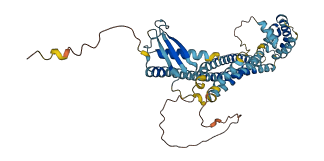
Descriptions
The autoinhibited protein was predicted that may have potential autoinhibitory elements via cis-regPred.
Autoinhibitory domains (AIDs)
Target domain |
|
Relief mechanism |
|
Assay |
cis-regPred |
Accessory elements
No accessory elements
Autoinhibited structure

Activated structure
1 structures for Q29549
| Entry ID | Method | Resolution | Chain | Position | Source |
|---|---|---|---|---|---|
| AF-Q29549-F1 | Predicted | AlphaFoldDB |
No variants for Q29549
| Variant ID(s) | Position | Change | Description | Diseaes Association | Provenance |
|---|---|---|---|---|---|
| No variants for Q29549 | |||||
No associated diseases with Q29549
4 regional properties for Q29549
| Type | Name | Position | InterPro Accession |
|---|---|---|---|
| domain | Clusterin, N-terminal | 23 - 227 | IPR016014 |
| domain | Clusterin, C-terminal | 228 - 440 | IPR016015 |
| conserved_site | Clusterin, conserved site | 113 - 121 | IPR033986-1 |
| conserved_site | Clusterin, conserved site | 294 - 304 | IPR033986-2 |
Functions
11 GO annotations of cellular component
| Name | Definition |
|---|---|
| chromaffin granule | Specialized secretory vesicle found in the cells of adrenal glands and various other organs, which is concerned with the synthesis, storage, metabolism, and secretion of epinephrine and norepinephrine. |
| cytoplasm | The contents of a cell excluding the plasma membrane and nucleus, but including other subcellular structures. |
| cytosol | The part of the cytoplasm that does not contain organelles but which does contain other particulate matter, such as protein complexes. |
| extracellular space | That part of a multicellular organism outside the cells proper, usually taken to be outside the plasma membranes, and occupied by fluid. |
| intracellular membrane-bounded organelle | Organized structure of distinctive morphology and function, bounded by a single or double lipid bilayer membrane and occurring within the cell. Includes the nucleus, mitochondria, plastids, vacuoles, and vesicles. Excludes the plasma membrane. |
| mitochondrial inner membrane | The inner, i.e. lumen-facing, lipid bilayer of the mitochondrial envelope. It is highly folded to form cristae. |
| mitochondrion | A semiautonomous, self replicating organelle that occurs in varying numbers, shapes, and sizes in the cytoplasm of virtually all eukaryotic cells. It is notably the site of tissue respiration. |
| nucleus | A membrane-bounded organelle of eukaryotic cells in which chromosomes are housed and replicated. In most cells, the nucleus contains all of the cell's chromosomes except the organellar chromosomes, and is the site of RNA synthesis and processing. In some species, or in specialized cell types, RNA metabolism or DNA replication may be absent. |
| perinuclear endoplasmic reticulum lumen | The volume enclosed by the membranes of the perinuclear endoplasmic reticulum. |
| perinuclear region of cytoplasm | Cytoplasm situated near, or occurring around, the nucleus. |
| spherical high-density lipoprotein particle | A mature high-density lipoprotein (HDL) particle, converted from discoidal HDL particles following the esterification of cholesterol in the particle by phosphatidylcholine-sterol O-acyltransferase (lecithin cholesterol acyltransferase; LCAT). |
3 GO annotations of molecular function
| Name | Definition |
|---|---|
| misfolded protein binding | Binding to a misfolded protein. |
| ubiquitin protein ligase binding | Binding to a ubiquitin protein ligase enzyme, any of the E3 proteins. |
| unfolded protein binding | Binding to an unfolded protein. |
16 GO annotations of biological process
| Name | Definition |
|---|---|
| chaperone-mediated protein folding | The process of inhibiting aggregation and assisting in the covalent and noncovalent assembly of single chain polypeptides or multisubunit complexes into the correct tertiary structure that is dependent on interaction with a chaperone. |
| immune complex clearance | A process directed at removing immune complexes from the body. Immune complexes are clusters of antibodies bound to antigen, to which complement may also be fixed, and which may precipitate or remain in solution. |
| intrinsic apoptotic signaling pathway | The series of molecular signals in which an intracellular signal is conveyed to trigger the apoptotic death of a cell. The pathway starts with reception of an intracellular signal (e.g. DNA damage, endoplasmic reticulum stress, oxidative stress etc.), and ends when the execution phase of apoptosis is triggered. The intrinsic apoptotic signaling pathway is crucially regulated by permeabilization of the mitochondrial outer membrane (MOMP). |
| negative regulation of amyloid fibril formation | Any process that stops, prevents or reduces the frequency, rate or extent of amyloid fibril formation. |
| negative regulation of intrinsic apoptotic signaling pathway in response to DNA damage | Any process that stops, prevents or reduces the frequency, rate or extent of intrinsic apoptotic signaling pathway in response to DNA damage. |
| negative regulation of protein-containing complex assembly | Any process that stops, prevents, or reduces the frequency, rate or extent of protein complex assembly. |
| positive regulation of apoptotic process | Any process that activates or increases the frequency, rate or extent of cell death by apoptotic process. |
| positive regulation of intrinsic apoptotic signaling pathway | Any process that activates or increases the frequency, rate or extent of intrinsic apoptotic signaling pathway. |
| positive regulation of NF-kappaB transcription factor activity | Any process that activates or increases the frequency, rate or extent of activity of the transcription factor NF-kappaB. |
| positive regulation of proteasomal ubiquitin-dependent protein catabolic process | Any process that activates or increases the frequency, rate or extent of the breakdown of a protein or peptide by hydrolysis of its peptide bonds, initiated by the covalent attachment of ubiquitin, and mediated by the proteasome. |
| positive regulation of receptor-mediated endocytosis | Any process that activates or increases the frequency, rate or extent of receptor mediated endocytosis, the uptake of external materials by cells, utilizing receptors to ensure specificity of transport. |
| positive regulation of ubiquitin-dependent protein catabolic process | Any process that activates or increases the frequency, rate or extent of ubiquitin-dependent protein catabolic process. |
| protein stabilization | Any process involved in maintaining the structure and integrity of a protein and preventing it from degradation or aggregation. |
| regulation of apoptotic process | Any process that modulates the occurrence or rate of cell death by apoptotic process. |
| regulation of cell population proliferation | Any process that modulates the frequency, rate or extent of cell proliferation. |
| response to misfolded protein | Any process that results in a change in state or activity of a cell or an organism (in terms of movement, secretion, enzyme production, gene expression, etc.) as a result of a misfolded protein stimulus. |
| 10 | 20 | 30 | 40 | 50 | 60 |
| MKTLLLLVGL | LLTWENGPWV | LGDKAISDKE | LQEMSTEGSK | YVNKEIKNAL | KEVKQIKTLI |
| 70 | 80 | 90 | 100 | 110 | 120 |
| EQSNEERKSL | LSSLEEAKKK | KEDALNDTRD | TETKLKGSQG | LCNETMMALW | EECKPCLKQT |
| 130 | 140 | 150 | 160 | 170 | 180 |
| CMKFYARVCR | SGSGLVGHQL | EEFLNQSSPF | YFWINGDRID | SLMENDRQQS | HVMDIMEDSF |
| 190 | 200 | 210 | 220 | 230 | 240 |
| NRASNIMDEL | FQDRFFNREP | FDTQFFSPFG | SSHRGSLFFN | PKSRFARNIM | PFPLFTDLNY |
| 250 | 260 | 270 | 280 | 290 | 300 |
| HDMFQPFFDM | IHQAQQAMDA | HLHRIPYHFP | EAGVPENSND | RAVCKEIRHN | STGCLRMKDQ |
| 310 | 320 | 330 | 340 | 350 | 360 |
| CEKCREILSV | DCSASNSSQM | QLRQELYTSL | QMAEKFSKLY | DQLLQSYQQK | MLNTSSLLKQ |
| 370 | 380 | 390 | 400 | 410 | 420 |
| LNEQFSWVSQ | LANLTQNDDR | YYLQVTTVNS | HGSDPSVPSG | LTKVVVKLFD | SYPITLIIPQ |
| 430 | 440 | ||||
| EVSDPKFMET | VAEEALQQYR | QRSREE |