Q04264
Gene name |
PDS5 (YMR076C, YM9582.01C, YM9916.15C) |
Protein name |
Sister chromatid cohesion protein PDS5 |
Names |
Precocious dissociation of sisters protein 5 |
Species |
Saccharomyces cerevisiae (strain ATCC 204508 / S288c) (Baker's yeast) |
KEGG Pathway |
sce:YMR076C |
EC number |
|
Protein Class |
|
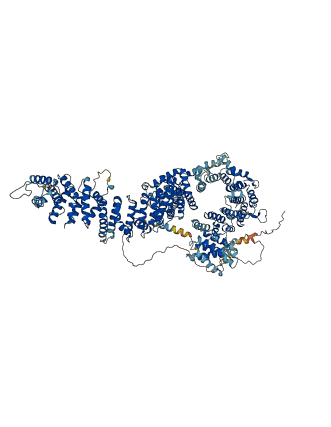
Descriptions
The autoinhibited protein was predicted that may have potential autoinhibitory elements via cis-regPred.
Autoinhibitory domains (AIDs)
Target domain |
|
Relief mechanism |
|
Assay |
cis-regPred |
Accessory elements
No accessory elements
Autoinhibited structure

Activated structure
4 structures for Q04264
| Entry ID | Method | Resolution | Chain | Position | Source |
|---|---|---|---|---|---|
| 5FRP | X-ray | 290 A | A/B | 1-701 | PDB |
| 5FRR | X-ray | 580 A | A/B | 1-701 | PDB |
| 5FRS | X-ray | 407 A | A | 1-701 | PDB |
| AF-Q04264-F1 | Predicted | AlphaFoldDB |
18 variants for Q04264
| Variant ID(s) | Position | Change | Description | Diseaes Association | Provenance |
|---|---|---|---|---|---|
| s13-419812 | 73 | R>C | No | SGRP | |
| s13-419557 | 158 | D>N | No | SGRP | |
| s13-419274 | 252 | N>S | No | SGRP | |
| s13-418981 | 350 | A>T | No | SGRP | |
| s13-418962 | 356 | S>F | No | SGRP | |
| s13-418870 | 387 | V>I | No | SGRP | |
| s13-418423 | 536 | S>C | No | SGRP | |
| s13-418354 | 559 | S>P | No | SGRP | |
| s13-418336 | 565 | I>V | No | SGRP | |
| s13-417999 | 677 | K>R | No | SGRP | |
| s13-417795 | 745 | E>A | No | SGRP | |
| s13-417534 | 832 | E>G | No | SGRP | |
| s13-417523 | 836 | V>I | No | SGRP | |
| s13-417061 | 990 | V>I | No | SGRP | |
| s13-416928 | 1034 | G>E | No | SGRP | |
| s13-416745 | 1095 | P>L | No | SGRP | |
| s13-416371 | 1220 | A>P | No | SGRP | |
| s13-416347 | 1228 | D>N | No | SGRP |
No associated diseases with Q04264
No regional properties for Q04264
| Type | Name | Position | InterPro Accession |
|---|---|---|---|
| No domain, repeats, and functional sites for Q04264 | |||
5 GO annotations of cellular component
| Name | Definition |
|---|---|
| chromatin | The ordered and organized complex of DNA, protein, and sometimes RNA, that forms the chromosome. |
| condensed nuclear chromosome | A highly compacted molecule of DNA and associated proteins resulting in a cytologically distinct nuclear chromosome. |
| cytosol | The part of the cytoplasm that does not contain organelles but which does contain other particulate matter, such as protein complexes. |
| meiotic recombination initiation complex | A protein complex that initiates the formation of double-strand breaks (DSBs) required for meiotic recombination. Consists of a protein that catalyses formation of the double-strand breaks (Spo11 in S. cerevisiae and Rec12 in S. pombe), and a number of accessory proteins. |
| nucleus | A membrane-bounded organelle of eukaryotic cells in which chromosomes are housed and replicated. In most cells, the nucleus contains all of the cell's chromosomes except the organellar chromosomes, and is the site of RNA synthesis and processing. In some species, or in specialized cell types, RNA metabolism or DNA replication may be absent. |
1 GO annotations of molecular function
| Name | Definition |
|---|---|
| structural molecule activity | The action of a molecule that contributes to the structural integrity of a complex or its assembly within or outside a cell. |
9 GO annotations of biological process
| Name | Definition |
|---|---|
| cell division | The process resulting in division and partitioning of components of a cell to form more cells; may or may not be accompanied by the physical separation of a cell into distinct, individually membrane-bounded daughter cells. |
| chromatin looping | A chromatin organization process that starts with the loading of an extrusion motor (by an SMC family complex) onto the chromatin, followed by chromatin extrusion that stops at loop anchoring sites on the chromosome. |
| DNA repair | The process of restoring DNA after damage. Genomes are subject to damage by chemical and physical agents in the environment (e.g. UV and ionizing radiations, chemical mutagens, fungal and bacterial toxins, etc.) and by free radicals or alkylating agents endogenously generated in metabolism. DNA is also damaged because of errors during its replication. A variety of different DNA repair pathways have been reported that include direct reversal, base excision repair, nucleotide excision repair, photoreactivation, bypass, double-strand break repair pathway, and mismatch repair pathway. |
| double-strand break repair | The repair of double-strand breaks in DNA via homologous and nonhomologous mechanisms to reform a continuous DNA helix. |
| homologous chromosome pairing at meiosis | The meiotic cell cycle process where side by side pairing and physical juxtaposition of homologous chromosomes is created during meiotic prophase. Homologous chromosome pairing begins when the chromosome arms begin to pair from the clustered telomeres and ends when synaptonemal complex or linear element assembly is complete. |
| meiotic cell cycle | Progression through the phases of the meiotic cell cycle, in which canonically a cell replicates to produce four offspring with half the chromosomal content of the progenitor cell via two nuclear divisions. |
| meiotic DNA double-strand break formation | The cell cycle process in which double-strand breaks are generated at defined hotspots throughout the genome during meiosis I. This results in the initiation of meiotic recombination. |
| mitotic chromosome condensation | The cell cycle process in which chromatin structure is compacted prior to and during mitosis in eukaryotic cells. |
| mitotic sister chromatid cohesion | The cell cycle process in which the sister chromatids of a replicated chromosome are joined along the entire length of the chromosome, from their formation in S phase through metaphase during a mitotic cell cycle. This cohesion cycle is critical for high fidelity chromosome transmission. |
3 homologous proteins in AiPD
| UniProt AC | Gene Name | Protein Name | Species | Evidence Code |
|---|---|---|---|---|
| Q29RF7 | PDS5A | Sister chromatid cohesion protein PDS5 homolog A | Homo sapiens (Human) | PR |
| Q4VA53 | Pds5b | Sister chromatid cohesion protein PDS5 homolog B | Mus musculus (Mouse) | PR |
| Q6A026 | Pds5a | Sister chromatid cohesion protein PDS5 homolog A | Mus musculus (Mouse) | PR |
| 10 | 20 | 30 | 40 | 50 | 60 |
| MAKGAVTKLK | FNSPIISTSD | QLISTNELLD | RLKALHEELA | SLDQDNTDLT | GLDKYRDALV |
| 70 | 80 | 90 | 100 | 110 | 120 |
| SRKLLKHKDV | GIRAFTACCL | SDILRLYAPD | APYTDAQLTD | IFKLVLSQFE | QLGDQENGYH |
| 130 | 140 | 150 | 160 | 170 | 180 |
| IQQTYLITKL | LEYRSIVLLA | DLPSSNNLLI | ELFHIFYDPN | KSFPARLFNV | IGGILGEVIS |
| 190 | 200 | 210 | 220 | 230 | 240 |
| EFDSVPLEVL | RLIFNKFLTY | NPNEIPEGLN | VTSDCGYEVS | LILCDTYSNR | MSRHLTKYYS |
| 250 | 260 | 270 | 280 | 290 | 300 |
| EIIHEATNDD | NNSRLLTVVV | KLHKLVLRLW | ETVPELINAV | IGFIYHELSS | ENELFRKEAT |
| 310 | 320 | 330 | 340 | 350 | 360 |
| KLIGQILTSY | SDLNFVSTHS | DTFKAWISKI | ADISPDVRVE | WTESIPQIIA | TREDISKELN |
| 370 | 380 | 390 | 400 | 410 | 420 |
| QALAKTFIDS | DPRVRRTSVM | IFNKVPVTEI | WKNITNKAIY | TSLLHLAREK | HKEVRELCIN |
| 430 | 440 | 450 | 460 | 470 | 480 |
| TMAKFYSNSL | NEIERTYQNK | EIWEIIDTIP | STLYNLYYIN | DLNINEQVDS | VIFEYLLPFE |
| 490 | 500 | 510 | 520 | 530 | 540 |
| PDNDKRVHRL | LTVLSHFDKK | AFTSFFAFNA | RQIKISFAIS | KYIDFSKFLN | NQESMSSSQG |
| 550 | 560 | 570 | 580 | 590 | 600 |
| PIVMNKYNQT | LQWLASGLSD | STKAIDALET | IKQFNDERIF | YLLNACVTND | IPFLTFKNCY |
| 610 | 620 | 630 | 640 | 650 | 660 |
| NELVSKLQTP | GLFKKYNIST | GASIMPRDIA | KVIQILLFRA | SPIIYNVSNI | SVLLNLSNNS |
| 670 | 680 | 690 | 700 | 710 | 720 |
| DAKQLDLKRR | ILDDISKVNP | TLFKDQIRTL | KTIIKDLDDP | DAEKNDNLSL | EEALKTLYKA |
| 730 | 740 | 750 | 760 | 770 | 780 |
| SKTLKDQVDF | DDTFFFTKLY | DFAVESKPEI | TKYATKLIAL | SPKAEETLKK | IKIRILPLDL |
| 790 | 800 | 810 | 820 | 830 | 840 |
| QKDKYFTSHI | IVLMEIFKKF | PHVLNDDSTD | IISYLIKEVL | LSNQVVGDSK | KEIDWVEDSL |
| 850 | 860 | 870 | 880 | 890 | 900 |
| LSDTKYSAIG | NKVFTLKLFT | NKLRSIAPDV | PRDELAESFT | EKTMKLFFYL | IASGGELISE |
| 910 | 920 | 930 | 940 | 950 | 960 |
| FNKEFYPTPS | NYQTKLRCVA | GIQVLKLARI | SNLNNFIKPS | DIIKLINLVE | DESLPVRKTF |
| 970 | 980 | 990 | 1000 | 1010 | 1020 |
| LEQLKDYVAN | ELISIKFLPL | VFFTAYEPDV | ELKTTTKIWI | NFTFGLKSFK | KGTIFERALP |
| 1030 | 1040 | 1050 | 1060 | 1070 | 1080 |
| RLIHAIAHHP | DIVGGLDSEG | DAYLNALTTA | IDYLLFYFDS | IAAQENFSLL | YYLSERVKNY |
| 1090 | 1100 | 1110 | 1120 | 1130 | 1140 |
| QDKLVEDEID | EEEGPQKEEA | PKKHRPYGQK | MYIIGELSQM | ILLNLKEKKN | WQHSAYPGKL |
| 1150 | 1160 | 1170 | 1180 | 1190 | 1200 |
| NLPSDLFKPF | ATVQEAQLSF | KTYIPESLTE | KIQNNIKAKI | GRILHTSQTQ | RQRLQKRLLA |
| 1210 | 1220 | 1230 | 1240 | 1250 | 1260 |
| HENNESQKKK | KKVHHARSQA | DDEEGDGDRE | SDSDDDSYSP | SNKNETKKGH | ENIVMKKLRV |
| 1270 | |||||
| RKEVDYKDDE | DDDIEMT |