P97544
Gene name |
Plpp3 |
Protein name |
Phospholipid phosphatase 3 |
Names |
Differentially expressed in rat intestine 42, Dri42, Lipid phosphate phosphohydrolase 3, PAP2-beta, Phosphatidate phosphohydrolase type 2b, Phosphatidic acid phosphatase 2b, PAP-2b, PAP2b |
Species |
Rattus norvegicus (Rat) |
KEGG Pathway |
|
EC number |
3.1.3.4: Phosphoric monoester hydrolases |
Protein Class |
|
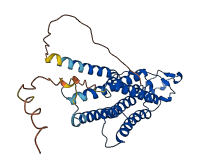
Descriptions
The autoinhibited protein was predicted that may have potential autoinhibitory elements via cis-regPred.
Autoinhibitory domains (AIDs)
Target domain |
|
Relief mechanism |
|
Assay |
cis-regPred |
Accessory elements
No accessory elements
Autoinhibited structure

Activated structure
1 structures for P97544
| Entry ID | Method | Resolution | Chain | Position | Source |
|---|---|---|---|---|---|
| AF-P97544-F1 | Predicted | AlphaFoldDB |
No variants for P97544
| Variant ID(s) | Position | Change | Description | Diseaes Association | Provenance |
|---|---|---|---|---|---|
| No variants for P97544 | |||||
No associated diseases with P97544
1 regional properties for P97544
| Type | Name | Position | InterPro Accession |
|---|---|---|---|
| domain | Phosphatidic acid phosphatase type 2/haloperoxidase | 131 - 277 | IPR000326 |
Functions
| Description | ||
|---|---|---|
| EC Number | 3.1.3.4 | Phosphoric monoester hydrolases |
| Subcellular Localization |
|
|
| PANTHER Family | ||
| PANTHER Subfamily | ||
| PANTHER Protein Class | ||
| PANTHER Pathway Category | No pathway information available | |
12 GO annotations of cellular component
| Name | Definition |
|---|---|
| basolateral plasma membrane | The region of the plasma membrane that includes the basal end and sides of the cell. Often used in reference to animal polarized epithelial membranes, where the basal membrane is the part attached to the extracellular matrix, or in plant cells, where the basal membrane is defined with respect to the zygotic axis. |
| endoplasmic reticulum exit site | An endoplasmic reticulum part at which COPII-coated vesicles are produced. |
| endoplasmic reticulum membrane | The lipid bilayer surrounding the endoplasmic reticulum. |
| endoplasmic reticulum-Golgi intermediate compartment membrane | The lipid bilayer surrounding any of the compartments of the endoplasmic reticulum (ER)-Golgi intermediate compartment system. |
| Golgi apparatus | A membrane-bound cytoplasmic organelle of the endomembrane system that further processes the core oligosaccharides (e.g. N-glycans) added to proteins in the endoplasmic reticulum and packages them into membrane-bound vesicles. The Golgi apparatus operates at the intersection of the secretory, lysosomal, and endocytic pathways. |
| Golgi membrane | The lipid bilayer surrounding any of the compartments of the Golgi apparatus. |
| integral component of membrane | The component of a membrane consisting of the gene products and protein complexes having at least some part of their peptide sequence embedded in the hydrophobic region of the membrane. |
| integral component of plasma membrane | The component of the plasma membrane consisting of the gene products and protein complexes having at least some part of their peptide sequence embedded in the hydrophobic region of the membrane. |
| membrane | A lipid bilayer along with all the proteins and protein complexes embedded in it an attached to it. |
| membrane raft | Any of the small (10-200 nm), heterogeneous, highly dynamic, sterol- and sphingolipid-enriched membrane domains that compartmentalize cellular processes. Small rafts can sometimes be stabilized to form larger platforms through protein-protein and protein-lipid interactions. |
| plasma membrane | The membrane surrounding a cell that separates the cell from its external environment. It consists of a phospholipid bilayer and associated proteins. |
| trans-Golgi network | The network of interconnected tubular and cisternal structures located within the Golgi apparatus on the side distal to the endoplasmic reticulum, from which secretory vesicles emerge. The trans-Golgi network is important in the later stages of protein secretion where it is thought to play a key role in the sorting and targeting of secreted proteins to the correct destination. |
5 GO annotations of molecular function
| Name | Definition |
|---|---|
| ceramide-1-phosphate phosphatase activity | Catalysis of the reaction: ceramide-1-phosphate + H2O = ceramide+ phosphate. |
| integrin binding | Binding to an integrin. |
| lipid phosphatase activity | Catalysis of the reaction: a phospholipid + H2O = a lipid + phosphate. |
| phosphatidate phosphatase activity | Catalysis of the reaction: a 1,2-diacylglycerol 3-phosphate + H2O = a 1,2-diacyl-sn-glycerol + phosphate. |
| sphingosine-1-phosphate phosphatase activity | Catalysis of the reaction: sphingosine 1-phosphate + H2O = sphingosine + phosphate. |
27 GO annotations of biological process
| Name | Definition |
|---|---|
| Bergmann glial cell differentiation | The process in which neuroepithelial cells of the neural tube give rise to Brgmann glial cells, specialized bipotential progenitors cells of the cerebellum. Differentiation includes the processes involved in commitment of a cell to a specific fate. |
| blood vessel development | The process whose specific outcome is the progression of a blood vessel over time, from its formation to the mature structure. The blood vessel is the vasculature carrying blood. |
| canonical Wnt signaling pathway | The series of molecular signals initiated by binding of a Wnt protein to a frizzled family receptor on the surface of the target cell, followed by propagation of the signal via beta-catenin, and ending with a change in transcription of target genes. In this pathway, the activated receptor signals via downstream effectors that result in the inhibition of beta-catenin phosphorylation, thereby preventing degradation of beta-catenin. Stabilized beta-catenin can then accumulate and travel to the nucleus to trigger changes in transcription of target genes. |
| canonical Wnt signaling pathway involved in positive regulation of cell-cell adhesion | The series of molecular signals initiated by binding of a Wnt protein to a frizzled family receptor on the surface of the target cell, followed by propagation of the signal via beta-catenin, and ending with a change in transcription of target genes involved in the positive regulation of cell to cell adhesion. |
| canonical Wnt signaling pathway involved in positive regulation of endothelial cell migration | The series of molecular signals initiated by binding of a Wnt protein to a frizzled family receptor on the surface of the target cell, followed by propagation of the signal via beta-catenin, and ending with a change in transcription of target genes involved in the positive regulation of endothelial cell migration. |
| canonical Wnt signaling pathway involved in positive regulation of wound healing | The series of molecular signals initiated by binding of a Wnt protein to a frizzled family receptor on the surface of the target cell, followed by propagation of the signal via beta-catenin, and ending with a change in transcription of target genes involved in positive regulation of wound healing. |
| cell adhesion | The attachment of a cell, either to another cell or to an underlying substrate such as the extracellular matrix, via cell adhesion molecules. |
| cell-cell adhesion | The attachment of one cell to another cell via adhesion molecules. |
| cell-cell adhesion mediated by integrin | The attachment of one cell to another cell via an integrin, a heterodimeric adhesion receptor formed by the non-covalent association of particular alpha and beta subunits. |
| ceramide metabolic process | The chemical reactions and pathways involving ceramides, any N-acylated sphingoid. |
| gastrulation with mouth forming second | A gastrulation process in which the initial invagination becomes the anus and the mouth forms second. |
| homotypic cell-cell adhesion | The attachment of a cell to a second cell of the identical type via adhesion molecules. |
| integrin-mediated signaling pathway | The series of molecular signals initiated by an extracellular ligand binding to an integrin on the surface of a target cell, and ending with the regulation of a downstream cellular process, e.g. transcription. |
| negative regulation of protein phosphorylation | Any process that stops, prevents or reduces the rate of addition of phosphate groups to amino acids within a protein. |
| phospholipid dephosphorylation | The process of removing one or more phosphate groups from a phosphorylated lipid, any member of a group of substances soluble in lipid solvents but only sparingly soluble in aqueous solvents. |
| phospholipid metabolic process | The chemical reactions and pathways involving phospholipids, any lipid containing phosphoric acid as a mono- or diester. |
| positive regulation of cell-cell adhesion | Any process that activates or increases the rate or extent of cell adhesion to another cell. |
| positive regulation of DNA-binding transcription factor activity | Any process that activates or increases the frequency, rate or extent of activity of a transcription factor, any factor involved in the initiation or regulation of transcription. |
| positive regulation of endothelial cell migration | Any process that increases the rate, frequency, or extent of the orderly movement of an endothelial cell into the extracellular matrix to form an endothelium. |
| positive regulation of peptidyl-tyrosine phosphorylation | Any process that activates or increases the frequency, rate or extent of the phosphorylation of peptidyl-tyrosine. |
| protein stabilization | Any process involved in maintaining the structure and integrity of a protein and preventing it from degradation or aggregation. |
| regulation of sphingolipid mediated signaling pathway | Any process that modulates the frequency, rate or extent of sphingolipid signaling. |
| regulation of Wnt signaling pathway | Any process that modulates the frequency, rate or extent of the activity of the Wnt signal transduction pathway. |
| retrograde vesicle-mediated transport, Golgi to endoplasmic reticulum | The directed movement of substances from the Golgi back to the endoplasmic reticulum, mediated by vesicles bearing specific protein coats such as COPI or COG. |
| signal transduction | The cellular process in which a signal is conveyed to trigger a change in the activity or state of a cell. Signal transduction begins with reception of a signal (e.g. a ligand binding to a receptor or receptor activation by a stimulus such as light), or for signal transduction in the absence of ligand, signal-withdrawal or the activity of a constitutively active receptor. Signal transduction ends with regulation of a downstream cellular process, e.g. regulation of transcription or regulation of a metabolic process. Signal transduction covers signaling from receptors located on the surface of the cell and signaling via molecules located within the cell. For signaling between cells, signal transduction is restricted to events at and within the receiving cell. |
| sphingosine metabolic process | The chemical reactions and pathways involving sphingosine (sphing-4-enine), trans-D-erytho-2-amino-octadec-4-ene-1,3-diol, a long chain amino diol sphingoid base that occurs in most sphingolipids in animal tissues. |
| wound healing | The series of events that restore integrity to a damaged tissue, following an injury. |
6 homologous proteins in AiPD
| UniProt AC | Gene Name | Protein Name | Species | Evidence Code |
|---|---|---|---|---|
| Q8TBJ4 | PLPPR1 | Phospholipid phosphatase-related protein type 1 | Homo sapiens (Human) | PR |
| O14495 | PLPP3 | Phospholipid phosphatase 3 | Homo sapiens (Human) | PR |
| Q8BFZ2 | Plppr1 | Phospholipid phosphatase-related protein type 1 | Mus musculus (Mouse) | PR |
| Q99JY8 | Plpp3 | Phospholipid phosphatase 3 | Mus musculus (Mouse) | PR |
| Q6WAY2 | Plppr1 | Phospholipid phosphatase-related protein type 1 | Rattus norvegicus (Rat) | PR |
| A4II83 | plppr1 | Phospholipid phosphatase-related protein type 1 | Xenopus tropicalis (Western clawed frog) (Silurana tropicalis) | PR |
| 10 | 20 | 30 | 40 | 50 | 60 |
| MQSYKYDKAI | VPESKNGGSP | ALNNNPRKGG | SKRVLLICLD | LFCLFMAALP | FLIIETSTIK |
| 70 | 80 | 90 | 100 | 110 | 120 |
| PYRRGFYCND | ESIKYPLKVS | ETINDAVLCA | VGIVIAILRI | ITGEFYRIYY | LKEKSRSTIQ |
| 130 | 140 | 150 | 160 | 170 | 180 |
| NPYVAALYKQ | VGCFLFGCAI | SQSFTDIAKV | SIGRLRPHFL | SVCDPDFSQI | NCSEGYIQNY |
| 190 | 200 | 210 | 220 | 230 | 240 |
| RCRGEDSKVQ | EARKSFFSGH | ASFSMFTMLY | LVLYLQARFT | WRGARLLRPL | LQFTLLMMAF |
| 250 | 260 | 270 | 280 | 290 | 300 |
| YTGLSRVSDY | KHHPSDVLAG | FAQGALVACC | IVFFVSDLFK | TKTTLSLPAP | AIRREILSPV |
| 310 | |||||
| DIMDRSNHHN | MV |