P97478
Gene name |
Coq7 |
Protein name |
5-demethoxyubiquinone hydroxylase, mitochondrial |
Names |
DMQ hydroxylase, Timing protein clk-1 homolog, Ubiquinone biosynthesis monooxygenase COQ7 |
Species |
Mus musculus (Mouse) |
KEGG Pathway |
mmu:12850 |
EC number |
1.14.99.60: Miscellaneous |
Protein Class |
|
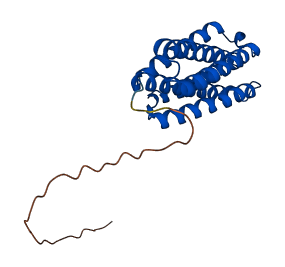
Descriptions
The autoinhibited protein was predicted that may have potential autoinhibitory elements via cis-regPred.
Autoinhibitory domains (AIDs)
Target domain |
|
Relief mechanism |
|
Assay |
cis-regPred |
Accessory elements
No accessory elements
Autoinhibited structure

Activated structure
1 structures for P97478
| Entry ID | Method | Resolution | Chain | Position | Source |
|---|---|---|---|---|---|
| AF-P97478-F1 | Predicted | AlphaFoldDB |
15 variants for P97478
| Variant ID(s) | Position | Change | Description | Diseaes Association | Provenance |
|---|---|---|---|---|---|
| rs259750667 | 14 | R>C | No | EVA | |
| rs3388945815 | 68 | A>V | No | EVA | |
| rs3388944632 | 75 | G>D | No | EVA | |
| rs3388946673 | 95 | K>N | No | EVA | |
| rs3388939693 | 96 | K>R | No | EVA | |
| rs3388946694 | 121 | A>V | No | EVA | |
| rs3388913632 | 136 | A>G | No | EVA | |
| rs3388929854 | 157 | M>T | No | EVA | |
| rs3388899069 | 158 | E>K | No | EVA | |
| rs3388934912 | 161 | P>T | No | EVA | |
| rs3388939864 | 165 | E>K | No | EVA | |
| rs3388920144 | 174 | F>S | No | EVA | |
| rs3388934916 | 182 | H>L | No | EVA | |
| rs3388939821 | 186 | L>M | No | EVA | |
| rs222667909 | 189 | D>G | No | EVA |
No associated diseases with P97478
No regional properties for P97478
| Type | Name | Position | InterPro Accession |
|---|---|---|---|
| No domain, repeats, and functional sites for P97478 | |||
Functions
| Description | ||
|---|---|---|
| EC Number | 1.14.99.60 | Miscellaneous |
| Subcellular Localization |
|
|
| PANTHER Family | ||
| PANTHER Subfamily | ||
| PANTHER Protein Class | ||
| PANTHER Pathway Category | No pathway information available | |
5 GO annotations of cellular component
| Name | Definition |
|---|---|
| extrinsic component of mitochondrial inner membrane | The component of mitochondrial inner membrane consisting of gene products and protein complexes that are loosely bound to one of its surfaces, but not integrated into the hydrophobic region. |
| mitochondrial inner membrane | The inner, i.e. lumen-facing, lipid bilayer of the mitochondrial envelope. It is highly folded to form cristae. |
| mitochondrion | A semiautonomous, self replicating organelle that occurs in varying numbers, shapes, and sizes in the cytoplasm of virtually all eukaryotic cells. It is notably the site of tissue respiration. |
| nucleus | A membrane-bounded organelle of eukaryotic cells in which chromosomes are housed and replicated. In most cells, the nucleus contains all of the cell's chromosomes except the organellar chromosomes, and is the site of RNA synthesis and processing. In some species, or in specialized cell types, RNA metabolism or DNA replication may be absent. |
| ubiquinone biosynthesis complex | The cytosolic ubiquinone biosynthesis complex is composed of enzymes and accessory factors of the ubiquinone biosynthesis pathway and enables synthesis of the extremely hydrophobic molecule ubiquinone. In E. coli, the complex is composed of seven proteins: UbiE, F, G, H, I, J and K. |
4 GO annotations of molecular function
| Name | Definition |
|---|---|
| 3-demethoxyubiquinol 3-hydroxylase activity | Catalysis of the reaction: a 6-methoxy-3-methyl-2-all-trans-polyprenyl-1,4-benzoquinol + AH2 + O2 = A + a 3-demethylubiquinol + H2O. |
| chromatin binding | Binding to chromatin, the network of fibers of DNA, protein, and sometimes RNA, that make up the chromosomes of the eukaryotic nucleus during interphase. |
| metal ion binding | Binding to a metal ion. |
| oxidoreductase activity, acting on paired donors, with incorporation or reduction of molecular oxygen, NAD(P)H as one donor, and incorporation of one atom of oxygen | Catalysis of an oxidation-reduction (redox) reaction in which hydrogen or electrons are transferred from NADH or NADPH and one other donor, and one atom of oxygen is incorporated into one donor. |
14 GO annotations of biological process
| Name | Definition |
|---|---|
| cellular response to oxidative stress | Any process that results in a change in state or activity of a cell (in terms of movement, secretion, enzyme production, gene expression, etc.) as a result of oxidative stress, a state often resulting from exposure to high levels of reactive oxygen species, e.g. superoxide anions, hydrogen peroxide (H2O2), and hydroxyl radicals. |
| determination of adult lifespan | The pathways that regulate the duration of the adult phase of the life-cycle of an animal. |
| in utero embryonic development | The process whose specific outcome is the progression of the embryo in the uterus over time, from formation of the zygote in the oviduct, to birth. An example of this process is found in Mus musculus. |
| mitochondrial ATP synthesis coupled electron transport | The transfer of electrons through a series of electron donors and acceptors, generating energy that is ultimately used for synthesis of ATP, as it occurs in the mitochondrial inner membrane or chloroplast thylakoid membrane. |
| mitochondrion morphogenesis | The process in which the anatomical structures of a mitochondrion are generated and organized. |
| negative regulation of transcription by RNA polymerase II | Any process that stops, prevents, or reduces the frequency, rate or extent of transcription mediated by RNA polymerase II. |
| neural tube formation | The formation of a tube from the flat layer of ectodermal cells known as the neural plate. This will give rise to the central nervous system. |
| neurogenesis | Generation of cells within the nervous system. |
| positive regulation of transcription by RNA polymerase II | Any process that activates or increases the frequency, rate or extent of transcription from an RNA polymerase II promoter. |
| regulation of gene expression | Any process that modulates the frequency, rate or extent of gene expression. Gene expression is the process in which a gene's coding sequence is converted into a mature gene product (protein or RNA). |
| regulation of reactive oxygen species metabolic process | Any process that modulates the frequency, rate or extent of reactive oxygen species metabolic process. |
| respiratory electron transport chain | A process in which a series of electron carriers operate together to transfer electrons from donors such as NADH and FADH2 to any of several different terminal electron acceptors to generate a transmembrane electrochemical gradient. |
| response to oxidative stress | Any process that results in a change in state or activity of a cell or an organism (in terms of movement, secretion, enzyme production, gene expression, etc.) as a result of oxidative stress, a state often resulting from exposure to high levels of reactive oxygen species, e.g. superoxide anions, hydrogen peroxide (H2O2), and hydroxyl radicals. |
| ubiquinone biosynthetic process | The chemical reactions and pathways resulting in the formation of ubiquinone, a lipid-soluble electron-transporting coenzyme. |
2 homologous proteins in AiPD
| 10 | 20 | 30 | 40 | 50 | 60 |
| MSAAGAIAAA | SVGRLRTGVR | RPFSEYGRGL | IIRCHSSGMT | LDNINRAAVD | RIIRVDHAGE |
| 70 | 80 | 90 | 100 | 110 | 120 |
| YGANRIYAGQ | MAVLGRTSVG | PVIQKMWDQE | KNHLKKFNEL | MIAFRVRPTV | LMPLWNVAGF |
| 130 | 140 | 150 | 160 | 170 | 180 |
| ALGAGTALLG | KEGAMACTVA | VEESIANHYN | NQIRMLMEED | PEKYEELLQV | IKQFRDEELE |
| 190 | 200 | 210 | |||
| HHDTGLDHDA | ELAPAYALLK | RIIQAGCSAA | IYLSERF |