P94102
Gene name |
RAD51 |
Protein name |
DNA repair protein RAD51 homolog 1 |
Names |
Rad51-like protein 1, AtRAD51 |
Species |
Arabidopsis thaliana (Mouse-ear cress) |
KEGG Pathway |
ath:AT5G20850 |
EC number |
|
Protein Class |
|
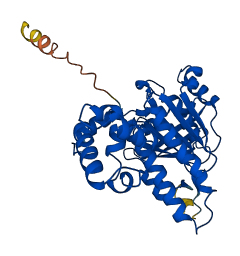
Descriptions
The autoinhibited protein was predicted that may have potential autoinhibitory elements via cis-regPred.
Autoinhibitory domains (AIDs)
Target domain |
|
Relief mechanism |
|
Assay |
cis-regPred |
Accessory elements
No accessory elements
Autoinhibited structure

Activated structure
1 structures for P94102
| Entry ID | Method | Resolution | Chain | Position | Source |
|---|---|---|---|---|---|
| AF-P94102-F1 | Predicted | AlphaFoldDB |
6 variants for P94102
| Variant ID(s) | Position | Change | Description | Diseaes Association | Provenance |
|---|---|---|---|---|---|
| ENSVATH07004659 | 5 | E>D | No | 1000Genomes | |
| tmp_5_7072823_A_G | 13 | V>A | No | 1000Genomes | |
| tmp_5_7072078_G_C | 90 | T>S | No | 1000Genomes | |
| tmp_5_7071080_T_C,A | 268 | I>L | No | 1000Genomes | |
| tmp_5_7071080_T_C,A | 268 | I>V | No | 1000Genomes | |
| tmp_5_7071019_T_C | 288 | K>R | No | 1000Genomes |
No associated diseases with P94102
4 regional properties for P94102
| Type | Name | Position | InterPro Accession |
|---|---|---|---|
| domain | AAA+ ATPase domain | 122 - 309 | IPR003593 |
| domain | DNA recombination and repair protein Rad51-like, C-terminal | 87 - 340 | IPR013632 |
| domain | DNA recombination and repair protein RecA, monomer-monomer interface | 279 - 342 | IPR020587 |
| domain | DNA recombination and repair protein RecA-like, ATP-binding domain | 101 - 272 | IPR020588 |
3 GO annotations of cellular component
| Name | Definition |
|---|---|
| chromosome | A structure composed of a very long molecule of DNA and associated proteins (e.g. histones) that carries hereditary information. |
| condensed nuclear chromosome | A highly compacted molecule of DNA and associated proteins resulting in a cytologically distinct nuclear chromosome. |
| nucleus | A membrane-bounded organelle of eukaryotic cells in which chromosomes are housed and replicated. In most cells, the nucleus contains all of the cell's chromosomes except the organellar chromosomes, and is the site of RNA synthesis and processing. In some species, or in specialized cell types, RNA metabolism or DNA replication may be absent. |
6 GO annotations of molecular function
| Name | Definition |
|---|---|
| ATP binding | Binding to ATP, adenosine 5'-triphosphate, a universally important coenzyme and enzyme regulator. |
| ATP-dependent activity, acting on DNA | Catalytic activity that acts to modify DNA, driven by ATP hydrolysis. |
| ATP-dependent DNA damage sensor activity | A molecule that recognises toxic DNA structures, and initiates a signalling response, driven by ATP hydrolysis. |
| DNA strand exchange activity | Catalysis of the identification and base-pairing of homologous sequences between single-stranded DNA and double-stranded DNA. |
| double-stranded DNA binding | Binding to double-stranded DNA. |
| single-stranded DNA binding | Binding to single-stranded DNA. |
12 GO annotations of biological process
| Name | Definition |
|---|---|
| chromosome organization involved in meiotic cell cycle | A process of chromosome organization that is involved in a meiotic cell cycle. |
| DNA metabolic process | Any cellular metabolic process involving deoxyribonucleic acid. This is one of the two main types of nucleic acid, consisting of a long, unbranched macromolecule formed from one, or more commonly, two, strands of linked deoxyribonucleotides. |
| DNA recombinase assembly | The aggregation, arrangement and bonding together of strand exchange proteins (recombinases) into higher order oligomers on single-stranded DNA. |
| double-strand break repair | The repair of double-strand breaks in DNA via homologous and nonhomologous mechanisms to reform a continuous DNA helix. |
| double-strand break repair via synthesis-dependent strand annealing | SDSA is a major mechanism of double-strand break repair in mitosis which allows for the error-free repair of a double-strand break without the exchange of adjacent sequences. The broken DNA searches for and base pairs with a homologous region in an intact chromosome. DNA synthesis initiates from the 3' end of the invading DNA strand, using the intact chromosome as the template. Newly synthesized DNA is then displaced from the template and anneal with its complement on the other side of the double-strand break. |
| mitotic recombination | The exchange, reciprocal or nonreciprocal, of genetic material between one DNA molecule and a homologous DNA region that occurs during mitotic cell cycles. |
| mitotic recombination-dependent replication fork processing | Replication fork processing that includes recombination between DNA near the arrested fork and homologous sequences. Proteins involved in homologous recombination are required for replication restart. |
| reciprocal meiotic recombination | The cell cycle process in which double strand breaks are formed and repaired through a single or double Holliday junction intermediate. This results in the equal exchange of genetic material between non-sister chromatids in a pair of homologous chromosomes. These reciprocal recombinant products ensure the proper segregation of homologous chromosomes during meiosis I and create genetic diversity. |
| regulation of DNA-templated transcription | Any process that modulates the frequency, rate or extent of cellular DNA-templated transcription. |
| response to gamma radiation | Any process that results in a change in state or activity of a cell or an organism (in terms of movement, secretion, enzyme production, gene expression, etc.) as a result of a gamma radiation stimulus. Gamma radiation is a form of electromagnetic radiation (EMR) or light emission of a specific frequency produced from sub-atomic particle interaction, such as electron-positron annihilation and radioactive decay. Gamma rays are generally characterized as EMR having the highest frequency and energy, and also the shortest wavelength, within the electromagnetic radiation spectrum. |
| response to radiation | Any process that results in a change in state or activity of a cell or an organism (in terms of movement, secretion, enzyme production, gene expression, etc.) as a result of an electromagnetic radiation stimulus. Electromagnetic radiation is a propagating wave in space with electric and magnetic components. These components oscillate at right angles to each other and to the direction of propagation. |
| strand invasion | The process in which the nucleoprotein complex (composed of the broken single-strand DNA and the recombinase) searches and identifies a region of homology in intact duplex DNA. The broken single-strand DNA displaces the like strand and forms Watson-Crick base pairs with its complement, forming a duplex in which each strand is from one of the two recombining DNA molecules. |
| 10 | 20 | 30 | 40 | 50 | 60 |
| MTTMEQRRNQ | NAVQQQDDEE | TQHGPFPVEQ | LQAAGIASVD | VKKLRDAGLC | TVEGVAYTPR |
| 70 | 80 | 90 | 100 | 110 | 120 |
| KDLLQIKGIS | DAKVDKIVEA | ASKLVPLGFT | SASQLHAQRQ | EIIQITSGSR | ELDKVLEGGI |
| 130 | 140 | 150 | 160 | 170 | 180 |
| ETGSITELYG | EFRSGKTQLC | HTLCVTCQLP | MDQGGGEGKA | MYIDAEGTFR | PQRLLQIADR |
| 190 | 200 | 210 | 220 | 230 | 240 |
| FGLNGADVLE | NVAYARAYNT | DHQSRLLLEA | ASMMIETRFA | LLIVDSATAL | YRTDFSGRGE |
| 250 | 260 | 270 | 280 | 290 | 300 |
| LSARQMHLAK | FLRSLQKLAD | EFGVAVVITN | QVVAQVDGSA | LFAGPQFKPI | GGNIMAHATT |
| 310 | 320 | 330 | 340 | ||
| TRLALRKGRA | EERICKVISS | PCLPEAEARF | QISTEGVTDC | KD |