O55230
Gene name |
Rad51d (R51h3, Rad51l3) |
Protein name |
DNA repair protein RAD51 homolog 4 |
Names |
R51H3, RAD51 homolog D, RAD51-like protein 3 |
Species |
Mus musculus (Mouse) |
KEGG Pathway |
mmu:19364 |
EC number |
|
Protein Class |
|
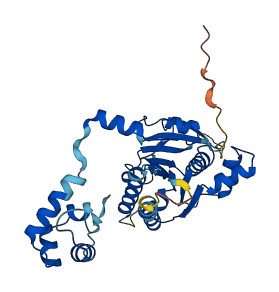
Descriptions
The autoinhibited protein was predicted that may have potential autoinhibitory elements via cis-regPred.
Autoinhibitory domains (AIDs)
Target domain |
|
Relief mechanism |
|
Assay |
cis-regPred |
Accessory elements
No accessory elements
Autoinhibited structure

Activated structure
1 structures for O55230
| Entry ID | Method | Resolution | Chain | Position | Source |
|---|---|---|---|---|---|
| AF-O55230-F1 | Predicted | AlphaFoldDB |
17 variants for O55230
| Variant ID(s) | Position | Change | Description | Diseaes Association | Provenance |
|---|---|---|---|---|---|
| rs225055891 | 44 | G>V | No | EVA | |
| rs3402512536 | 54 | R>* | No | EVA | |
| rs3389181417 | 112 | G>A | No | EVA | |
| rs260003585 | 127 | S>T | No | EVA | |
| rs3389181397 | 139 | G>R | No | EVA | |
| rs3389196383 | 144 | S>F | No | EVA | |
| rs3389187383 | 152 | A>T | No | EVA | |
| rs3389186999 | 165 | Q>* | No | EVA | |
| rs3389160272 | 165 | Q>R | No | EVA | |
| rs3389156365 | 168 | Q>R | No | EVA | |
| rs219351297 | 177 | R>Q | No | EVA | |
| rs3389187342 | 178 | M>I | No | EVA | |
| rs3389150729 | 181 | M>I | No | EVA | |
| rs3413145586 | 201 | K>M | No | EVA | |
| rs28209138 | 212 | V>A | No | EVA | |
| rs3389156416 | 294 | V>I | No | EVA | |
| rs248393189 | 297 | T>I | No | EVA |
No associated diseases with O55230
4 regional properties for O55230
| Type | Name | Position | InterPro Accession |
|---|---|---|---|
| domain | AAA+ ATPase domain | 99 - 274 | IPR003593 |
| domain | DNA recombination and repair protein Rad51-like, C-terminal | 76 - 315 | IPR013632 |
| domain | DNA recombination and repair protein RecA-like, ATP-binding domain | 78 - 251 | IPR020588 |
| domain | DNA repair protein RAD51 homolog 4, C-terminal | 94 - 299 | IPR047323 |
4 GO annotations of cellular component
| Name | Definition |
|---|---|
| centrosome | A structure comprised of a core structure (in most organisms, a pair of centrioles) and peripheral material from which a microtubule-based structure, such as a spindle apparatus, is organized. Centrosomes occur close to the nucleus during interphase in many eukaryotic cells, though in animal cells it changes continually during the cell-division cycle. |
| chromosome, telomeric region | The end of a linear chromosome, required for the integrity and maintenance of the end. A chromosome telomere usually includes a region of telomerase-encoded repeats the length of which rarely exceeds 20 bp each and that permits the formation of a telomeric loop (T-loop). The telomeric repeat region is usually preceded by a sub-telomeric region that is gene-poor but rich in repetitive elements. Some telomeres only consist of the latter part (for eg. D. melanogaster telomeres). |
| Rad51B-Rad51C-Rad51D-XRCC2 complex | A DNA recombinase mediator complex that contains the Rad51 paralogs RAD51B, RAD51C, RAD51D, and XRCC2, or orthologs thereof. |
| replication fork | The Y-shaped region of a replicating DNA molecule, resulting from the separation of the DNA strands and in which the synthesis of new strands takes place. Also includes associated protein complexes. |
6 GO annotations of molecular function
| Name | Definition |
|---|---|
| ATP binding | Binding to ATP, adenosine 5'-triphosphate, a universally important coenzyme and enzyme regulator. |
| ATP-dependent activity, acting on DNA | Catalytic activity that acts to modify DNA, driven by ATP hydrolysis. |
| ATP-dependent DNA damage sensor activity | A molecule that recognises toxic DNA structures, and initiates a signalling response, driven by ATP hydrolysis. |
| four-way junction DNA binding | Binding to a DNA segment containing four-way junctions, also known as Holliday junctions, a structure where two DNA double strands are held together by reciprocal exchange of two of the four strands, one strand each from the two original helices. |
| gamma-tubulin binding | Binding to the microtubule constituent protein gamma-tubulin. |
| single-stranded DNA binding | Binding to single-stranded DNA. |
9 GO annotations of biological process
| Name | Definition |
|---|---|
| cellular response to DNA damage stimulus | Any process that results in a change in state or activity of a cell (in terms of movement, secretion, enzyme production, gene expression, etc.) as a result of a stimulus indicating damage to its DNA from environmental insults or errors during metabolism. |
| chromosome organization | A process that is carried out at the cellular level that results in the assembly, arrangement of constituent parts, or disassembly of chromosomes, structures composed of a very long molecule of DNA and associated proteins that carries hereditary information. This term covers covalent modifications at the molecular level as well as spatial relationships among the major components of a chromosome. |
| double-strand break repair via homologous recombination | The error-free repair of a double-strand break in DNA in which the broken DNA molecule is repaired using homologous sequences. A strand in the broken DNA searches for a homologous region in an intact chromosome to serve as the template for DNA synthesis. The restoration of two intact DNA molecules results in the exchange, reciprocal or nonreciprocal, of genetic material between the intact DNA molecule and the broken DNA molecule. |
| interstrand cross-link repair | Removal of a DNA interstrand crosslink (a covalent attachment of DNA bases on opposite strands of the DNA) and restoration of the DNA. DNA interstrand crosslinks occur when both strands of duplex DNA are covalently tethered together (e.g. by an exogenous or endogenous agent), thus preventing the strand unwinding necessary for essential DNA functions such as transcription and replication. |
| reciprocal meiotic recombination | The cell cycle process in which double strand breaks are formed and repaired through a single or double Holliday junction intermediate. This results in the equal exchange of genetic material between non-sister chromatids in a pair of homologous chromosomes. These reciprocal recombinant products ensure the proper segregation of homologous chromosomes during meiosis I and create genetic diversity. |
| regulation of cell cycle | Any process that modulates the rate or extent of progression through the cell cycle. |
| strand invasion | The process in which the nucleoprotein complex (composed of the broken single-strand DNA and the recombinase) searches and identifies a region of homology in intact duplex DNA. The broken single-strand DNA displaces the like strand and forms Watson-Crick base pairs with its complement, forming a duplex in which each strand is from one of the two recombining DNA molecules. |
| telomere maintenance | Any process that contributes to the maintenance of proper telomeric length and structure by affecting and monitoring the activity of telomeric proteins, the length of telomeric DNA and the replication and repair of the DNA. These processes includes those that shorten, lengthen, replicate and repair the telomeric DNA sequences. |
| telomere maintenance via recombination | Any recombinational process that contributes to the maintenance of proper telomeric length. |
| 10 | 20 | 30 | 40 | 50 | 60 |
| MGMLRAGLCP | GLTEETVQLL | RGRKIKTVAD | LAAADLEEVA | QKCGLSYKAL | VALRRVLLAQ |
| 70 | 80 | 90 | 100 | 110 | 120 |
| FSAFPLNGAD | LYEELKTSTA | ILSTGIGSLD | KLLDAGLYTG | EVTEIVGGPG | SGKTQVCLCV |
| 130 | 140 | 150 | 160 | 170 | 180 |
| AANVAHSLQQ | NVLYVDSNGG | MTASRLLQLL | QARTQDEEKQ | ASALQRIQVV | RSFDIFRMLD |
| 190 | 200 | 210 | 220 | 230 | 240 |
| MLQDLRGTIA | QQEATSSGAV | KVVIVDSVTA | VVAPLLGGQQ | REGLALMMQL | ARELKILARD |
| 250 | 260 | 270 | 280 | 290 | 300 |
| LGVAVVVTNH | LTRDWDGRRF | KPALGRSWSF | VPSTRILLDV | TEGAGTLGSS | QRTVCLTKSP |
| 310 | 320 | ||||
| RQPTGLQEMI | DIGTLGTEEQ | SPELPGKQT |