Descriptions
The autoinhibited protein was predicted that may have potential autoinhibitory elements via cis-regPred.
Autoinhibitory domains (AIDs)
Target domain |
|
Relief mechanism |
|
Assay |
cis-regPred |
Accessory elements
No accessory elements
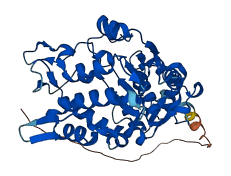
Autoinhibited structure

Activated structure
2 structures for P82922
| Entry ID | Method | Resolution | Chain | Position | Source |
|---|---|---|---|---|---|
| 3JD5 | EM | 700 A | g | 1-397 | PDB |
| AF-P82922-F1 | Predicted | AlphaFoldDB |
No variants for P82922
| Variant ID(s) | Position | Change | Description | Diseaes Association | Provenance |
|---|---|---|---|---|---|
| No variants for P82922 | |||||
No associated diseases with P82922
No regional properties for P82922
| Type | Name | Position | InterPro Accession |
|---|---|---|---|
| No domain, repeats, and functional sites for P82922 | |||
3 GO annotations of cellular component
| Name | Definition |
|---|---|
| mitochondrial inner membrane | The inner, i.e. lumen-facing, lipid bilayer of the mitochondrial envelope. It is highly folded to form cristae. |
| mitochondrial small ribosomal subunit | The smaller of the two subunits of a mitochondrial ribosome. |
| mitochondrion | A semiautonomous, self replicating organelle that occurs in varying numbers, shapes, and sizes in the cytoplasm of virtually all eukaryotic cells. It is notably the site of tissue respiration. |
1 GO annotations of molecular function
| Name | Definition |
|---|---|
| structural constituent of ribosome | The action of a molecule that contributes to the structural integrity of the ribosome. |
2 GO annotations of biological process
| Name | Definition |
|---|---|
| apoptotic process | A programmed cell death process which begins when a cell receives an internal (e.g. DNA damage) or external signal (e.g. an extracellular death ligand), and proceeds through a series of biochemical events (signaling pathway phase) which trigger an execution phase. The execution phase is the last step of an apoptotic process, and is typically characterized by rounding-up of the cell, retraction of pseudopodes, reduction of cellular volume (pyknosis), chromatin condensation, nuclear fragmentation (karyorrhexis), plasma membrane blebbing and fragmentation of the cell into apoptotic bodies. When the execution phase is completed, the cell has died. |
| mitochondrial translation | The chemical reactions and pathways resulting in the formation of a protein in a mitochondrion. This is a ribosome-mediated process in which the information in messenger RNA (mRNA) is used to specify the sequence of amino acids in the protein; the mitochondrion has its own ribosomes and transfer RNAs, and uses a genetic code that differs from the nuclear code. |
| 10 | 20 | 30 | 40 | 50 | 60 |
| MLKGMTRLVS | RVHKLDPGRF | SHLGTQAPQC | PVAHLDNQVP | TERTRAISRT | LENDPAKHGE |
| 70 | 80 | 90 | 100 | 110 | 120 |
| QHVGQHYNIS | IQELKTVFPH | GLPPRFVMQV | KTFNEACLMV | RKPALELLHY | LKNTNFAHPA |
| 130 | 140 | 150 | 160 | 170 | 180 |
| VRYVLYGEKG | TGKTLSLCHI | IHFCAKQDWL | ILHIPDAHLW | VKNCRDLLQS | TYNKQRFDQP |
| 190 | 200 | 210 | 220 | 230 | 240 |
| LEASIWLKNF | KTANERFLSQ | IKVQDKYVWN | KRESTEKGSP | LAEVVEQGIM | RVRNATDAVG |
| 250 | 260 | 270 | 280 | 290 | 300 |
| IVLKELKRQS | SLGVFRLLVA | VDGVNALWGR | TTLKREDKSP | ITPEELALIY | NLRKMVKNDW |
| 310 | 320 | 330 | 340 | 350 | 360 |
| QGGAIVLTVS | QTGSLFKPRK | AYLPQELLGK | EGFDTLDPFI | PILVSNYNPK | EFEGCIQYYL |
| 370 | 380 | 390 | |||
| ENNWLQHEKA | HTEEGKKELL | FLSNRNPGLL | ERLCAYL |