P79795
Gene name |
NRP1 (NRP) |
Protein name |
Neuropilin-1 |
Names |
A5 protein |
Species |
Gallus gallus (Chicken) |
KEGG Pathway |
gga:395560 |
EC number |
|
Protein Class |
|
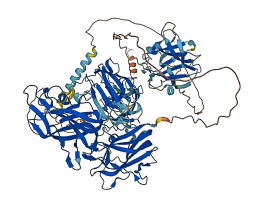
Descriptions
The autoinhibited protein was predicted that may have potential autoinhibitory elements via cis-regPred.
Autoinhibitory domains (AIDs)
Target domain |
|
Relief mechanism |
|
Assay |
cis-regPred |
Accessory elements
No accessory elements
Autoinhibited structure

Activated structure
1 structures for P79795
| Entry ID | Method | Resolution | Chain | Position | Source |
|---|---|---|---|---|---|
| AF-P79795-F1 | Predicted | AlphaFoldDB |
No variants for P79795
| Variant ID(s) | Position | Change | Description | Diseaes Association | Provenance |
|---|---|---|---|---|---|
| No variants for P79795 | |||||
No associated diseases with P79795
4 regional properties for P79795
| Type | Name | Position | InterPro Accession |
|---|---|---|---|
| domain | Tudor domain | 4 - 62 | IPR002999 |
| conserved_site | Sterol reductase, conserved site | 355 - 370 | IPR018083-1 |
| conserved_site | Sterol reductase, conserved site | 572 - 595 | IPR018083-2 |
| domain | Lamin-B receptor of TUDOR domain | 1 - 55 | IPR019023 |
8 GO annotations of cellular component
| Name | Definition |
|---|---|
| axon | The long process of a neuron that conducts nerve impulses, usually away from the cell body to the terminals and varicosities, which are sites of storage and release of neurotransmitter. |
| axon terminus | Terminal inflated portion of the axon, containing the specialized apparatus necessary to release neurotransmitters. The axon terminus is considered to be the whole region of thickening and the terminal button is a specialized region of it. |
| axonal growth cone | The migrating motile tip of a growing nerve cell axon. |
| cell body fiber | A neuron projection that is found in unipolar neurons and corresponds to the region between the cell body and the point at which the single projection branches. |
| growth cone membrane | The portion of the plasma membrane surrounding a growth cone. |
| integral component of membrane | The component of a membrane consisting of the gene products and protein complexes having at least some part of their peptide sequence embedded in the hydrophobic region of the membrane. |
| mitochondrial membrane | Either of the lipid bilayers that surround the mitochondrion and form the mitochondrial envelope. |
| plasma membrane | The membrane surrounding a cell that separates the cell from its external environment. It consists of a phospholipid bilayer and associated proteins. |
5 GO annotations of molecular function
| Name | Definition |
|---|---|
| growth factor binding | Binding to a growth factor, proteins or polypeptides that stimulate a cell or organism to grow or proliferate. |
| heparin binding | Binding to heparin, a member of a group of glycosaminoglycans found mainly as an intracellular component of mast cells and which consist predominantly of alternating alpha-(1->4)-linked D-galactose and N-acetyl-D-glucosamine-6-sulfate residues. |
| metal ion binding | Binding to a metal ion. |
| semaphorin receptor activity | Combining with a semaphorin, and transmitting the signal from one side of the membrane to the other to initiate a change in cell activity. |
| vascular endothelial growth factor receptor activity | Combining with a vascular endothelial growth factor (VEGF) receptor ligand and transmitting the signal across the plasma membrane to initiate a change in cell activity. |
10 GO annotations of biological process
| Name | Definition |
|---|---|
| angiogenesis | Blood vessel formation when new vessels emerge from the proliferation of pre-existing blood vessels. |
| animal organ morphogenesis | Morphogenesis of an animal organ. An organ is defined as a tissue or set of tissues that work together to perform a specific function or functions. Morphogenesis is the process in which anatomical structures are generated and organized. Organs are commonly observed as visibly distinct structures, but may also exist as loosely associated clusters of cells that work together to perform a specific function or functions. |
| axon guidance | The chemotaxis process that directs the migration of an axon growth cone to a specific target site in response to a combination of attractive and repulsive cues. |
| cell adhesion | The attachment of a cell, either to another cell or to an underlying substrate such as the extracellular matrix, via cell adhesion molecules. |
| cell aggregation | The clustering together and adhesion of initially separate cells to form an aggregate. Examples include the clustering of unicellular organisms or blood cells in suspension and the condensation of mesenchymal cells during cartilage formation. |
| endothelial cell chemotaxis | The directed movement of an endothelial cell guided by a specific chemical concentration gradient. Movement may be towards a higher concentration (positive chemotaxis) or towards a lower concentration (negative chemotaxis). |
| positive regulation of filopodium assembly | Any process that activates or increases the frequency, rate or extent of the assembly of a filopodium, a thin, stiff protrusion extended by the leading edge of a motile cell such as a crawling fibroblast or amoeba, or an axonal growth cone. |
| rhombomere cell migration | The movement of a cell within a rhombomere. This process is known to occur as an early step in the generation of anatomical structure from a rhombomere. |
| tissue morphogenesis | The process in which the anatomical structures of a tissue are generated and organized. |
| vascular endothelial growth factor receptor signaling pathway | The series of molecular signals initiated by a ligand binding to a vascular endothelial growth factor receptor (VEGFR) on the surface of the target cell, and ending with the regulation of a downstream cellular process, e.g. transcription. |
4 homologous proteins in AiPD
| 10 | 20 | 30 | 40 | 50 | 60 |
| MDWGLFLHCA | ALTFTLSRAL | RSDKCGDTIK | ILSPGYLTSP | GYPQSYHPSQ | KCEWLIQAPE |
| 70 | 80 | 90 | 100 | 110 | 120 |
| PYQRIMINFN | PHFDLEDRDC | KYDYVEVIDG | DNAEGRLWGK | YCGKIAPPPL | VSSGPYLFIK |
| 130 | 140 | 150 | 160 | 170 | 180 |
| FVSDYETHGA | GFSIRYEVFK | RGPECSRNFT | SSSGMIKSPG | FPEKYPNSLE | CTYIIFAPKM |
| 190 | 200 | 210 | 220 | 230 | 240 |
| SEIILEFESF | ELEPDSNTPG | GAFCRYDRLE | IWDGFPDVGP | HIGRYCGQNN | PGRVRSSTGI |
| 250 | 260 | 270 | 280 | 290 | 300 |
| LSMVFYTDSA | IAKEGFSANY | SVSQSSVSED | FQCMEPLGME | SGEIHSDQIT | VSSQYSAIWS |
| 310 | 320 | 330 | 340 | 350 | 360 |
| SERSRLNYPE | NGWTPGEDSV | REWIQVDLGL | LRFVSGIGTQ | GAISKETKKE | YYLKTYRVDV |
| 370 | 380 | 390 | 400 | 410 | 420 |
| SSNGEDWITL | KEGNKPVVFQ | GNSNPTDVVY | RPFPKPVLTR | FVRIKPVSWE | NGVSLRFEVY |
| 430 | 440 | 450 | 460 | 470 | 480 |
| GCKITDYPCS | GMLGMVSGLI | PDSQITASTQ | VDRNWIPENA | RLITSRSGWA | LPPTTHPYTN |
| 490 | 500 | 510 | 520 | 530 | 540 |
| EWLQIDLGEE | KIVRGIIVQG | GKHRENKVFM | KKFKIGYSNN | GSDWKMIMDS | SKKKIKTFEG |
| 550 | 560 | 570 | 580 | 590 | 600 |
| NTNYDTPELR | TFEPVSTRII | RVYPERATHA | GLGLRMELLG | CELEAPTAVP | TVSEGKPVDE |
| 610 | 620 | 630 | 640 | 650 | 660 |
| CDDDQANCHS | GTGGTTVLNT | EKPTVIDNTV | QPELPPYNLN | CGFGWGSHKT | LCQWEHDNQV |
| 670 | 680 | 690 | 700 | 710 | 720 |
| DLKWAILTSK | TGPIQDHTGD | GNFIYSQADE | SQKGKVARLL | SPIIYSQNSA | HCMTFWYHMS |
| 730 | 740 | 750 | 760 | 770 | 780 |
| GPHVGTLKIK | LRYQKPDEYD | QVLLSLNGHQ | ANCWQEGRVL | LHKSVKLYQV | VIEGEIGKGN |
| 790 | 800 | 810 | 820 | 830 | 840 |
| GGIAVDDINI | DNHISQEDCQ | KSTDVESEIV | EEDPESNQTG | FTPSYRTDED | YDDISRKPGN |
| 850 | 860 | 870 | 880 | 890 | 900 |
| VLKTLDPILI | TIIAMSALGV | LLGAICGVVL | YCACWHNGMS | ERNLSALENY | NFELVDGVKL |
| 910 | |||||
| KKDKLNTQNS | YSEA |