P70662
Gene name |
Ldb1 (Nli) |
Protein name |
LIM domain-binding protein 1 |
Names |
LDB-1, Carboxyl-terminal LIM domain-binding protein 2, CLIM-2, LIM domain-binding factor CLIM2, mLdb1, Nuclear LIM interactor |
Species |
Mus musculus (Mouse) |
KEGG Pathway |
mmu:16825 |
EC number |
|
Protein Class |
|
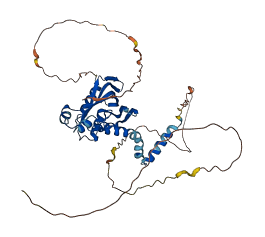
Descriptions
The autoinhibited protein was predicted that may have potential autoinhibitory elements via cis-regPred.
Autoinhibitory domains (AIDs)
Target domain |
|
Relief mechanism |
|
Assay |
cis-regPred |
Accessory elements
No accessory elements
Autoinhibited structure

Activated structure
10 structures for P70662
| Entry ID | Method | Resolution | Chain | Position | Source |
|---|---|---|---|---|---|
| 1J2O | NMR | - | A | 336-375 | PDB |
| 1M3V | NMR | - | A | 336-375 | PDB |
| 1RUT | X-ray | 130 A | X | 336-375 | PDB |
| 2JTN | NMR | - | A | 331-375 | PDB |
| 2L6Y | NMR | - | B | 336-348 | PDB |
| 2L6Z | NMR | - | C | 336-348 | PDB |
| 2LXD | NMR | - | A | 336-375 | PDB |
| 4JCJ | X-ray | 300 A | A/B/C | 336-366 | PDB |
| 6PTL | X-ray | 250 A | A | 50-236 | PDB |
| AF-P70662-F1 | Predicted | AlphaFoldDB |
15 variants for P70662
| Variant ID(s) | Position | Change | Description | Diseaes Association | Provenance |
|---|---|---|---|---|---|
| rs3389535739 | 52 | Y>C | No | EVA | |
| rs3409403328 | 137 | T>* | No | EVA | |
| rs3389558893 | 175 | Q>* | No | EVA | |
| rs3389536514 | 253 | Q>E | No | EVA | |
| rs3389544664 | 273 | C>Y | No | EVA | |
| rs1133708177 | 274 | L>H | No | EVA | |
| rs1132646018 | 276 | Q>* | No | EVA | |
| rs1132530541 | 276 | Q>R | No | EVA | |
| rs1133793164 | 278 | W>R | No | EVA | |
| rs3389491595 | 292 | Q>E | No | EVA | |
| rs3389535719 | 294 | S>N | No | EVA | |
| rs3389450644 | 370 | N>K | No | EVA | |
| rs215367180 | 371 | G>C | No | EVA | |
| rs3389543708 | 376 | D>V | No | EVA | |
| rs3389521676 | 396 | S>T | No | EVA |
No associated diseases with P70662
1 regional properties for P70662
| Type | Name | Position | InterPro Accession |
|---|---|---|---|
| domain | LIM interaction domain | 336 - 375 | IPR041363 |
8 GO annotations of cellular component
| Name | Definition |
|---|---|
| beta-catenin-TCF complex | A protein complex that contains beta-catenin and a member of the T-cell factor (TCF)/lymphoid enhancer binding factor (LEF) family of transcription factors. |
| cell leading edge | The area of a motile cell closest to the direction of movement. |
| chromatin | The ordered and organized complex of DNA, protein, and sometimes RNA, that forms the chromosome. |
| nucleoplasm | That part of the nuclear content other than the chromosomes or the nucleolus. |
| nucleus | A membrane-bounded organelle of eukaryotic cells in which chromosomes are housed and replicated. In most cells, the nucleus contains all of the cell's chromosomes except the organellar chromosomes, and is the site of RNA synthesis and processing. In some species, or in specialized cell types, RNA metabolism or DNA replication may be absent. |
| protein-containing complex | A stable assembly of two or more macromolecules, i.e. proteins, nucleic acids, carbohydrates or lipids, in which at least one component is a protein and the constituent parts function together. |
| RNA polymerase II transcription regulator complex | A transcription factor complex that acts at a regulatory region of a gene transcribed by RNA polymerase II. |
| transcription regulator complex | A protein complex that is capable of associating with DNA by direct binding, or via other DNA-binding proteins or complexes, and regulating transcription. |
9 GO annotations of molecular function
| Name | Definition |
|---|---|
| chromatin binding | Binding to chromatin, the network of fibers of DNA, protein, and sometimes RNA, that make up the chromosomes of the eukaryotic nucleus during interphase. |
| DNA-binding transcription factor binding | Binding to a DNA-binding transcription factor, a protein that interacts with a specific DNA sequence (sometimes referred to as a motif) within the regulatory region of a gene to modulate transcription. |
| enzyme binding | Binding to an enzyme, a protein with catalytic activity. |
| identical protein binding | Binding to an identical protein or proteins. |
| LIM domain binding | Binding to a LIM domain (for Lin-11 Isl-1 Mec-3) of a protein, a domain with seven conserved cysteine residues and a histidine, that binds two zinc ions and acts as an interface for protein-protein interactions. |
| protein homodimerization activity | Binding to an identical protein to form a homodimer. |
| protein self-association | Binding to a domain within the same polypeptide. |
| RNA polymerase II-specific DNA-binding transcription factor binding | Binding to a sequence-specific DNA binding RNA polymerase II transcription factor, any of the factors that interact selectively and non-covalently with a specific DNA sequence in order to modulate transcription. |
| transcription coregulator activity | A transcription regulator activity that modulates the transcription of specific gene sets via binding to a DNA-bound DNA-binding transcription factor, either on its own or as part of a complex. Coregulators often act by altering chromatin structure and modifications. For example, one class of transcription coregulators modifies chromatin structure through covalent modification of histones. A second class remodels the conformation of chromatin in an ATP-dependent fashion. A third class modulates interactions of DNA-bound DNA-binding transcription factors with other transcription coregulators. |
29 GO annotations of biological process
| Name | Definition |
|---|---|
| anterior/posterior axis specification | The establishment, maintenance and elaboration of the anterior/posterior axis. The anterior-posterior axis is defined by a line that runs from the head or mouth of an organism to the tail or opposite end of the organism. |
| cell adhesion | The attachment of a cell, either to another cell or to an underlying substrate such as the extracellular matrix, via cell adhesion molecules. |
| cell differentiation | The process in which relatively unspecialized cells, e.g. embryonic or regenerative cells, acquire specialized structural and/or functional features that characterize the cells, tissues, or organs of the mature organism or some other relatively stable phase of the organism's life history. Differentiation includes the processes involved in commitment of a cell to a specific fate and its subsequent development to the mature state. |
| cellular component assembly | The aggregation, arrangement and bonding together of a cellular component. |
| cerebellar Purkinje cell differentiation | The process in which neuroblasts acquire specialized structural and/or functional features that characterize the mature cerebellar Purkinje cell. Differentiation includes the processes involved in commitment of a neuroblast to a Purkinje cell fate. A Purkinje cell is an inhibitory GABAergic neuron found in the cerebellar cortex that projects to the deep cerebellar nuclei and brain stem. |
| cerebellum development | The process whose specific outcome is the progression of the cerebellum over time, from its formation to the mature structure. The cerebellum is the portion of the brain in the back of the head between the cerebrum and the pons. In mice, the cerebellum controls balance for walking and standing, modulates the force and range of movement and is involved in the learning of motor skills. |
| epithelial structure maintenance | A tissue homeostatic process required for the maintenance of epithelial structure. |
| gastrulation with mouth forming second | A gastrulation process in which the initial invagination becomes the anus and the mouth forms second. |
| hair follicle development | The process whose specific outcome is the progression of the hair follicle over time, from its formation to the mature structure. A hair follicle is a tube-like opening in the epidermis where the hair shaft develops and into which the sebaceous glands open. |
| head development | The biological process whose specific outcome is the progression of a head from an initial condition to its mature state. The head is the anterior-most division of the body. |
| histone H3-K4 acetylation | The modification of histone H3 by the addition of an acetyl group to a lysine residue at position 4 of the histone. |
| mesendoderm development | The process whose specific outcome is the progression of the mesendoderm over time, from its formation to the mature structure. In animal embryos, mesendoderm development gives rise to both mesoderm and endoderm tissues. |
| negative regulation of DNA-templated transcription | Any process that stops, prevents, or reduces the frequency, rate or extent of cellular DNA-templated transcription. |
| negative regulation of erythrocyte differentiation | Any process that stops, prevents, or reduces the frequency, rate or extent of erythrocyte differentiation. |
| negative regulation of transcription by RNA polymerase II | Any process that stops, prevents, or reduces the frequency, rate or extent of transcription mediated by RNA polymerase II. |
| nervous system development | The process whose specific outcome is the progression of nervous tissue over time, from its formation to its mature state. |
| neuron differentiation | The process in which a relatively unspecialized cell acquires specialized features of a neuron. |
| positive regulation of cell adhesion | Any process that activates or increases the frequency, rate or extent of cell adhesion. |
| positive regulation of hemoglobin biosynthetic process | Any process that activates or increases the frequency, rate or extent of the chemical reactions and pathways resulting in the formation of hemoglobin, an oxygen carrying, conjugated protein containing four heme groups and globin. |
| positive regulation of transcription by RNA polymerase II | Any process that activates or increases the frequency, rate or extent of transcription from an RNA polymerase II promoter. |
| primitive erythrocyte differentiation | Erythrocyte differentiation which occurs as part of the process of primitive hemopoiesis. |
| regulation of cell migration | Any process that modulates the frequency, rate or extent of cell migration. |
| regulation of focal adhesion assembly | Any process that modulates the frequency, rate or extent of focal adhesion formation, the establishment and maturation of focal adhesions. |
| regulation of kinase activity | Any process that modulates the frequency, rate or extent of kinase activity, the catalysis of the transfer of a phosphate group, usually from ATP, to a substrate molecule. |
| regulation of transcription elongation by RNA polymerase II | Any process that modulates the frequency, rate or extent of transcription elongation, the extension of an RNA molecule after transcription initiation and promoter clearance by the addition of ribonucleotides, catalyzed by RNA polymerase II. |
| somatic stem cell population maintenance | Any process by which an organism retains a population of somatic stem cells, undifferentiated cells in the embryo or adult which can undergo unlimited division and give rise to cell types of the body other than those of the germ-line. |
| transcription by RNA polymerase II | The synthesis of RNA from a DNA template by RNA polymerase II (RNAP II), originating at an RNA polymerase II promoter. Includes transcription of messenger RNA (mRNA) and certain small nuclear RNAs (snRNAs). |
| transcription-dependent tethering of RNA polymerase II gene DNA at nuclear periphery | The chromosome organization process in which the DNA sequence containing a gene transcribed by RNA polymerase II is maintained in a specific location at the nuclear periphery. In S. cerevisiae, this process involves cis-acting DNA sequences such as the TATA box and upstream activating sequence (UAS) elements, trans-acting transcriptional activators, and also the 3'-UTR of the transcript. |
| Wnt signaling pathway | The series of molecular signals initiated by binding of a Wnt protein to a frizzled family receptor on the surface of the target cell and ending with a change in cell state. |
| 10 | 20 | 30 | 40 | 50 | 60 |
| MSVGCACPGC | SSKSFKLYSP | KEPPNGNAFP | PFHPGTMLDR | DVGPTPMYPP | TYLEPGIGRH |
| 70 | 80 | 90 | 100 | 110 | 120 |
| TPYGNQTDYR | IFELNKRLQN | WTEECDNLWW | DAFTTEFFED | DAMLTITFCL | EDGPKRYTIG |
| 130 | 140 | 150 | 160 | 170 | 180 |
| RTLIPRYFRS | IFEGGATELY | YVLKHPKEAF | HSNFVSLDCD | QGSMVTQHGK | PMFTQVCVEG |
| 190 | 200 | 210 | 220 | 230 | 240 |
| RLYLEFMFDD | MMRIKTWHFS | IRQHRELIPR | SILAMHAQDP | QMLDQLSKNI | TRCGLSNSTL |
| 250 | 260 | 270 | 280 | 290 | 300 |
| NYLRLCVILE | PMQELMSRHK | TYSLSPRDCL | KTCLFQKWQR | MVAPPAEPAR | QQPSKRRKRK |
| 310 | 320 | 330 | 340 | 350 | 360 |
| MSGGSTMSSG | GGNTNNSNSK | KKSPASTFAL | SSQVPDVMVV | GEPTLMGGEF | GDEDERLITR |
| 370 | 380 | 390 | 400 | 410 | |
| LENTQFDAAN | GIDDEDSFNN | SPALGANSPW | NSKPPSSQES | KSENPTSQAS | Q |