O42252
Gene name |
LDB1 |
Protein name |
LIM domain-binding protein 1 |
Names |
LDB-1, Carboxyl-terminal LIM domain-binding protein 2, CLIM-2, LIM domain-binding factor CLIM2, cLdb1, Neural Src-interacting protein, Nuclear LIM interactor |
Species |
Gallus gallus (Chicken) |
KEGG Pathway |
gga:395952 |
EC number |
|
Protein Class |
|
Descriptions
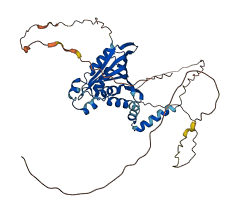
The autoinhibited protein was predicted that may have potential autoinhibitory elements via cis-regPred.
Autoinhibitory domains (AIDs)
Target domain |
|
Relief mechanism |
|
Assay |
cis-regPred |
Accessory elements
No accessory elements
Autoinhibited structure

Activated structure
1 structures for O42252
| Entry ID | Method | Resolution | Chain | Position | Source |
|---|---|---|---|---|---|
| AF-O42252-F1 | Predicted | AlphaFoldDB |
15 variants for O42252
| Variant ID(s) | Position | Change | Description | Diseaes Association | Provenance |
|---|---|---|---|---|---|
| rs732846400 | 52 | Y>H | No | Ensembl | |
| rs734743421 | 52 | Y>S | No | Ensembl | |
| rs737757509 | 82 | T>A | No | Ensembl | |
| rs737507126 | 142 | V>G | No | Ensembl | |
| rs732588468 | 149 | S>P | No | Ensembl | |
| rs738342049 | 177 | C>W | No | Ensembl | |
| rs740255322 | 178 | V>G | No | Ensembl | |
| rs735533354 | 179 | E>G | No | Ensembl | |
| rs737497207 | 183 | Y>F | No | Ensembl | |
| rs740427247 | 261 | T>P | No | Ensembl | |
| rs1060467180 | 368 | A>T | No | Ensembl | |
| rs315445036 | 380 | N>T | No | Ensembl | |
| rs1057979215 | 382 | P>S | No | Ensembl | |
| rs317242903 | 387 | N>T | No | Ensembl | |
| rs1059972275 | 396 | S>A | No | Ensembl |
No associated diseases with O42252
1 regional properties for O42252
| Type | Name | Position | InterPro Accession |
|---|---|---|---|
| domain | Lateral organ boundaries, LOB | 7 - 108 | IPR004883 |
3 GO annotations of cellular component
| Name | Definition |
|---|---|
| nucleus | A membrane-bounded organelle of eukaryotic cells in which chromosomes are housed and replicated. In most cells, the nucleus contains all of the cell's chromosomes except the organellar chromosomes, and is the site of RNA synthesis and processing. In some species, or in specialized cell types, RNA metabolism or DNA replication may be absent. |
| protein-containing complex | A stable assembly of two or more macromolecules, i.e. proteins, nucleic acids, carbohydrates or lipids, in which at least one component is a protein and the constituent parts function together. |
| transcription regulator complex | A protein complex that is capable of associating with DNA by direct binding, or via other DNA-binding proteins or complexes, and regulating transcription. |
3 GO annotations of molecular function
| Name | Definition |
|---|---|
| LIM domain binding | Binding to a LIM domain (for Lin-11 Isl-1 Mec-3) of a protein, a domain with seven conserved cysteine residues and a histidine, that binds two zinc ions and acts as an interface for protein-protein interactions. |
| protein homodimerization activity | Binding to an identical protein to form a homodimer. |
| transcription coregulator activity | A transcription regulator activity that modulates the transcription of specific gene sets via binding to a DNA-bound DNA-binding transcription factor, either on its own or as part of a complex. Coregulators often act by altering chromatin structure and modifications. For example, one class of transcription coregulators modifies chromatin structure through covalent modification of histones. A second class remodels the conformation of chromatin in an ATP-dependent fashion. A third class modulates interactions of DNA-bound DNA-binding transcription factors with other transcription coregulators. |
7 GO annotations of biological process
| Name | Definition |
|---|---|
| anterior/posterior axis specification | The establishment, maintenance and elaboration of the anterior/posterior axis. The anterior-posterior axis is defined by a line that runs from the head or mouth of an organism to the tail or opposite end of the organism. |
| negative regulation of erythrocyte differentiation | Any process that stops, prevents, or reduces the frequency, rate or extent of erythrocyte differentiation. |
| negative regulation of transcription by RNA polymerase II | Any process that stops, prevents, or reduces the frequency, rate or extent of transcription mediated by RNA polymerase II. |
| nervous system development | The process whose specific outcome is the progression of nervous tissue over time, from its formation to its mature state. |
| neuron differentiation | The process in which a relatively unspecialized cell acquires specialized features of a neuron. |
| positive regulation of transcription by RNA polymerase II | Any process that activates or increases the frequency, rate or extent of transcription from an RNA polymerase II promoter. |
| Wnt signaling pathway | The series of molecular signals initiated by binding of a Wnt protein to a frizzled family receptor on the surface of the target cell and ending with a change in cell state. |
| 10 | 20 | 30 | 40 | 50 | 60 |
| MSVGCACPGC | SSKSFKLYSP | KEPPNGNAFP | PFHPGTMLDR | DVGPTPMYPP | TYLEPGIGRH |
| 70 | 80 | 90 | 100 | 110 | 120 |
| TPYGNQTDYR | IFELNKRLQN | WTEECDNLWW | DAFTTEFFED | DAMLTITFCL | EDGPKRYTIG |
| 130 | 140 | 150 | 160 | 170 | 180 |
| RTLIPRYFRS | IFEGGATELY | YVLKHPKESF | HNNFVSLDCD | QCTMVTQHGK | PMFTQVCVEG |
| 190 | 200 | 210 | 220 | 230 | 240 |
| RLYLEFMFDD | MMRIKTWHFS | IRQHRELIPR | SILAMHAQDP | QMLDQLSKNI | TRCGLSNSTL |
| 250 | 260 | 270 | 280 | 290 | 300 |
| NYLRLCVILE | PMQELMSRHK | TYSLSPRDCL | KTCLFQKWQR | MVAPPAEPAR | QQPSKRRKRK |
| 310 | 320 | 330 | 340 | 350 | 360 |
| MSGGSTMSSG | GGNTNNSNSK | KKSPASTFAL | SSQVPDVMVV | GEPTLMGGEF | GDEDERLITR |
| 370 | 380 | 390 | 400 | 410 | |
| LENTQFDAAN | GIDDEDSFNN | SPALGANSPW | NSKPPSSQES | KSENPTSQAS | Q |