P70447
Gene name |
Neurog2 (Ath4a, Atoh4, Ngn2) |
Protein name |
Neurogenin-2 |
Names |
NGN-2, Helix-loop-helix protein mATH-4A, mATH4A, Protein atonal homolog 4 |
Species |
Mus musculus (Mouse) |
KEGG Pathway |
mmu:11924 |
EC number |
|
Protein Class |
|
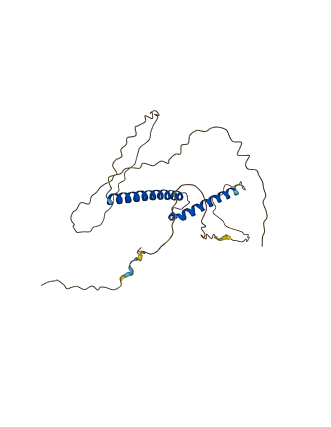
Descriptions
The autoinhibited protein was predicted that may have potential autoinhibitory elements via cis-regPred.
Autoinhibitory domains (AIDs)
Target domain |
|
Relief mechanism |
|
Assay |
cis-regPred |
Accessory elements
No accessory elements
Autoinhibited structure

Activated structure
1 structures for P70447
| Entry ID | Method | Resolution | Chain | Position | Source |
|---|---|---|---|---|---|
| AF-P70447-F1 | Predicted | AlphaFoldDB |
No variants for P70447
| Variant ID(s) | Position | Change | Description | Diseaes Association | Provenance |
|---|---|---|---|---|---|
| No variants for P70447 | |||||
No associated diseases with P70447
1 GO annotations of cellular component
| Name | Definition |
|---|---|
| nucleus | A membrane-bounded organelle of eukaryotic cells in which chromosomes are housed and replicated. In most cells, the nucleus contains all of the cell's chromosomes except the organellar chromosomes, and is the site of RNA synthesis and processing. In some species, or in specialized cell types, RNA metabolism or DNA replication may be absent. |
6 GO annotations of molecular function
| Name | Definition |
|---|---|
| DNA-binding transcription factor activity, RNA polymerase II-specific | A DNA-binding transcription factor activity that modulates the transcription of specific gene sets transcribed by RNA polymerase II. |
| E-box binding | Binding to an E-box, a DNA motif with the consensus sequence CANNTG that is found in the promoters of a wide array of genes expressed in neurons, muscle and other tissues. |
| protein dimerization activity | The formation of a protein dimer, a macromolecular structure consists of two noncovalently associated identical or nonidentical subunits. |
| RNA polymerase II cis-regulatory region sequence-specific DNA binding | Binding to a specific upstream regulatory DNA sequence (transcription factor recognition sequence or binding site) located in cis relative to the transcription start site (i.e., on the same strand of DNA) of a gene transcribed by RNA polymerase II. |
| sequence-specific DNA binding | Binding to DNA of a specific nucleotide composition, e.g. GC-rich DNA binding, or with a specific sequence motif or type of DNA e.g. promotor binding or rDNA binding. |
| sequence-specific double-stranded DNA binding | Binding to double-stranded DNA of a specific nucleotide composition, e.g. GC-rich DNA binding, or with a specific sequence motif or type of DNA, e.g. promotor binding or rDNA binding. |
14 GO annotations of biological process
| Name | Definition |
|---|---|
| axon guidance | The chemotaxis process that directs the migration of an axon growth cone to a specific target site in response to a combination of attractive and repulsive cues. |
| Cajal-Retzius cell differentiation | The process in which a neuroblast acquires specialized structural and/or functional features of a Cajal-Retzius cell, one of a transient population of pioneering neurons in the cerebral cortex. These cells are slender bipolar cells of the developing marginal zone. One feature of these cells in mammals is that they express the Reelin gene. |
| cell fate commitment | The commitment of cells to specific cell fates and their capacity to differentiate into particular kinds of cells. Positional information is established through protein signals that emanate from a localized source within a cell (the initial one-cell zygote) or within a developmental field. |
| cell maturation | A developmental process, independent of morphogenetic (shape) change, that is required for a cell to attain its fully functional state. |
| central nervous system neuron development | The process whose specific outcome is the progression of a neuron whose cell body is located in the central nervous system, from initial commitment of the cell to a neuronal fate, to the fully functional differentiated neuron. |
| dopaminergic neuron differentiation | The process in which a neuroblast acquires the specialized structural and functional features of a dopaminergic neuron, a neuron that secretes dopamine. |
| forebrain development | The process whose specific outcome is the progression of the forebrain over time, from its formation to the mature structure. The forebrain is the anterior of the three primary divisions of the developing chordate brain or the corresponding part of the adult brain (in vertebrates, includes especially the cerebral hemispheres, the thalamus, and the hypothalamus and especially in higher vertebrates is the main control center for sensory and associative information processing, visceral functions, and voluntary motor functions). |
| neurogenesis | Generation of cells within the nervous system. |
| neuron differentiation | The process in which a relatively unspecialized cell acquires specialized features of a neuron. |
| neuron migration | The characteristic movement of an immature neuron from germinal zones to specific positions where they will reside as they mature. |
| positive regulation of DNA-binding transcription factor activity | Any process that activates or increases the frequency, rate or extent of activity of a transcription factor, any factor involved in the initiation or regulation of transcription. |
| positive regulation of neuron differentiation | Any process that activates or increases the frequency, rate or extent of neuron differentiation. |
| positive regulation of transcription by RNA polymerase II | Any process that activates or increases the frequency, rate or extent of transcription from an RNA polymerase II promoter. |
| regulation of transcription by RNA polymerase II | Any process that modulates the frequency, rate or extent of transcription mediated by RNA polymerase II. |
3 homologous proteins in AiPD
| 10 | 20 | 30 | 40 | 50 | 60 |
| MFVKSETLEL | KEEEEVLMLL | GSASPASATL | TPMSSSADEE | EDEELRRPGS | ARGQRGAEAE |
| 70 | 80 | 90 | 100 | 110 | 120 |
| QGVQGSPASG | AGGCRPGRLL | GLMHECKRRP | SRSRAVSRGA | KTAETVQRIK | KTRRLKANNR |
| 130 | 140 | 150 | 160 | 170 | 180 |
| ERNRMHNLNA | ALDALREVLP | TFPEDAKLTK | IETLRFAHNY | IWALTETLRL | ADHCAGAGGL |
| 190 | 200 | 210 | 220 | 230 | 240 |
| QGALFTEAVL | LSPGAALGAS | GDSPSPPSSW | SCTNSPASSS | NSTSPYSCTL | SPASPGSDVD |
| 250 | 260 | ||||
| YWQPPPPEKH | RYAPHLPLAR | DCI |