D2CLZ9
Gene name |
atoh8 |
Protein name |
Transcription factor atoh8 |
Names |
Atonal bHLH transcription factor 8, Protein atonal homolog 8 |
Species |
Danio rerio (Zebrafish) (Brachydanio rerio) |
KEGG Pathway |
dre:561606 |
EC number |
|
Protein Class |
|
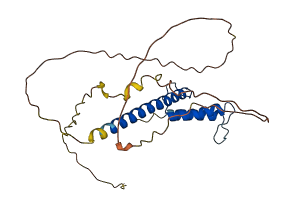
Descriptions
The autoinhibited protein was predicted that may have potential autoinhibitory elements via cis-regPred.
Autoinhibitory domains (AIDs)
Target domain |
|
Relief mechanism |
|
Assay |
cis-regPred |
Accessory elements
No accessory elements
Autoinhibited structure

Activated structure
1 structures for D2CLZ9
| Entry ID | Method | Resolution | Chain | Position | Source |
|---|---|---|---|---|---|
| AF-D2CLZ9-F1 | Predicted | AlphaFoldDB |
No variants for D2CLZ9
| Variant ID(s) | Position | Change | Description | Diseaes Association | Provenance |
|---|---|---|---|---|---|
| No variants for D2CLZ9 | |||||
No associated diseases with D2CLZ9
3 GO annotations of cellular component
| Name | Definition |
|---|---|
| cytoplasm | The contents of a cell excluding the plasma membrane and nucleus, but including other subcellular structures. |
| nuclear speck | A discrete extra-nucleolar subnuclear domain, 20-50 in number, in which splicing factors are seen to be localized by immunofluorescence microscopy. |
| nucleus | A membrane-bounded organelle of eukaryotic cells in which chromosomes are housed and replicated. In most cells, the nucleus contains all of the cell's chromosomes except the organellar chromosomes, and is the site of RNA synthesis and processing. In some species, or in specialized cell types, RNA metabolism or DNA replication may be absent. |
3 GO annotations of molecular function
| Name | Definition |
|---|---|
| DNA-binding transcription factor activity, RNA polymerase II-specific | A DNA-binding transcription factor activity that modulates the transcription of specific gene sets transcribed by RNA polymerase II. |
| protein dimerization activity | The formation of a protein dimer, a macromolecular structure consists of two noncovalently associated identical or nonidentical subunits. |
| RNA polymerase II cis-regulatory region sequence-specific DNA binding | Binding to a specific upstream regulatory DNA sequence (transcription factor recognition sequence or binding site) located in cis relative to the transcription start site (i.e., on the same strand of DNA) of a gene transcribed by RNA polymerase II. |
7 GO annotations of biological process
| Name | Definition |
|---|---|
| heart development | The process whose specific outcome is the progression of the heart over time, from its formation to the mature structure. The heart is a hollow, muscular organ, which, by contracting rhythmically, keeps up the circulation of the blood. |
| heart looping | The tube morphogenesis process in which the primitive heart tube loops asymmetrically. This looping brings the primitive heart chambers into alignment preceding their future integration. Heart looping begins with dextral-looping and ends when the main regional divisions of the mature heart and primordium of the great arterial trunks become established preceeding septation. |
| neuron differentiation | The process in which a relatively unspecialized cell acquires specialized features of a neuron. |
| regulation of neural retina development | Any process that modulates the rate, frequency, or extent of neural retina development, the progression of the neural retina over time from its initial formation to the mature structure. The neural retina is the part of the retina that contains neurons and photoreceptor cells. |
| regulation of skeletal muscle cell differentiation | Any process that modulates the frequency, rate or extent of skeletal muscle cell differentiation. |
| regulation of transcription by RNA polymerase II | Any process that modulates the frequency, rate or extent of transcription mediated by RNA polymerase II. |
| swim bladder formation | The process that gives rise to the swim bladder. This process pertains to the initial formation of a structure from unspecified parts. The swim bladder is used by some fishes to maintain buoyancy and may function in addition as a sound producing organ, a sound receptor, and a respiratory organ. |
| 10 | 20 | 30 | 40 | 50 | 60 |
| MKNPHLNSPC | KILNTVSGDK | KMKRKAREPI | KHVSEDHYPY | FKLYKNPHLM | AETLGDGSPQ |
| 70 | 80 | 90 | 100 | 110 | 120 |
| ETHRSEIITS | RDDSVRNDVL | NTAVDMRINT | ITAAEVPDSK | LRSVSEKTVN | SKIVQASPQV |
| 130 | 140 | 150 | 160 | 170 | 180 |
| SVLSAPQVFP | LERVVLSQRA | ASQAPAGGSE | RAESPRKRAG | EPSGVVTEIK | AIQQTRRLLA |
| 190 | 200 | 210 | 220 | 230 | 240 |
| NARERTRVHT | ISAAFEALRK | QVPCYSYGQK | LSKLAILRIA | CNYILSLAQL | ADLDYTPDHR |
| 250 | 260 | ||||
| NMSFRECVEQ | CTRTLQAEGR | SKKRKE |