Q9Z2E5
Gene name |
Atoh7 |
Protein name |
Transcription factor Atoh7 |
Names |
Atonal bHLH transcription factor 7, Helix-loop-helix protein mATH-5, mATH5, Protein atonal homolog 7 |
Species |
Mus musculus (Mouse) |
KEGG Pathway |
mmu:53404 |
EC number |
|
Protein Class |
|
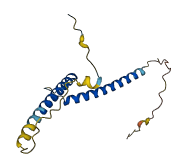
Descriptions
The autoinhibited protein was predicted that may have potential autoinhibitory elements via cis-regPred.
Autoinhibitory domains (AIDs)
Target domain |
|
Relief mechanism |
|
Assay |
cis-regPred |
Accessory elements
No accessory elements
Autoinhibited structure

Activated structure
1 structures for Q9Z2E5
| Entry ID | Method | Resolution | Chain | Position | Source |
|---|---|---|---|---|---|
| AF-Q9Z2E5-F1 | Predicted | AlphaFoldDB |
4 variants for Q9Z2E5
| Variant ID(s) | Position | Change | Description | Diseaes Association | Provenance |
|---|---|---|---|---|---|
| rs254897531 | 14 | A>P | No | EVA | |
| rs236000749 | 16 | G>V | No | EVA | |
| rs256117038 | 19 | P>A | No | EVA | |
| rs231438363 | 124 | A>S | No | EVA |
No associated diseases with Q9Z2E5
1 regional properties for Q9Z2E5
| Type | Name | Position | InterPro Accession |
|---|---|---|---|
| conserved_site | Di-trans-poly-cis-decaprenylcistransferase-like, conserved site | 245 - 262 | IPR018520 |
3 GO annotations of cellular component
| Name | Definition |
|---|---|
| axon | The long process of a neuron that conducts nerve impulses, usually away from the cell body to the terminals and varicosities, which are sites of storage and release of neurotransmitter. |
| nucleus | A membrane-bounded organelle of eukaryotic cells in which chromosomes are housed and replicated. In most cells, the nucleus contains all of the cell's chromosomes except the organellar chromosomes, and is the site of RNA synthesis and processing. In some species, or in specialized cell types, RNA metabolism or DNA replication may be absent. |
| perikaryon | The portion of the cell soma (neuronal cell body) that excludes the nucleus. |
5 GO annotations of molecular function
| Name | Definition |
|---|---|
| DNA-binding transcription factor activity, RNA polymerase II-specific | A DNA-binding transcription factor activity that modulates the transcription of specific gene sets transcribed by RNA polymerase II. |
| protein dimerization activity | The formation of a protein dimer, a macromolecular structure consists of two noncovalently associated identical or nonidentical subunits. |
| RNA polymerase II cis-regulatory region sequence-specific DNA binding | Binding to a specific upstream regulatory DNA sequence (transcription factor recognition sequence or binding site) located in cis relative to the transcription start site (i.e., on the same strand of DNA) of a gene transcribed by RNA polymerase II. |
| sequence-specific double-stranded DNA binding | Binding to double-stranded DNA of a specific nucleotide composition, e.g. GC-rich DNA binding, or with a specific sequence motif or type of DNA, e.g. promotor binding or rDNA binding. |
| transcription cis-regulatory region binding | Binding to a specific sequence of DNA that is part of a regulatory region that controls transcription of that section of the DNA. The transcribed region might be described as a gene, cistron, or operon. |
10 GO annotations of biological process
| Name | Definition |
|---|---|
| circadian rhythm | Any biological process in an organism that recurs with a regularity of approximately 24 hours. |
| entrainment of circadian clock | The synchronization of a circadian rhythm to environmental time cues such as light. |
| entrainment of circadian clock by photoperiod | The synchronization of a circadian rhythm to photoperiod, the intermittent cycle of light (day) and dark (night). |
| neural retina development | The progression of the neural retina over time from its initial formation to the mature structure. The neural retina is the part of the retina that contains neurons and photoreceptor cells. |
| neuron differentiation | The process in which a relatively unspecialized cell acquires specialized features of a neuron. |
| optic nerve development | The process whose specific outcome is the progression of the optic nerve over time, from its formation to the mature structure. The sensory optic nerve originates from the bipolar cells of the retina and conducts visual information to the brainstem. The optic nerve exits the back of the eye in the orbit, enters the optic canal, and enters the central nervous system at the optic chiasm (crossing) where the nerve fibers become the optic tract just prior to entering the hindbrain. |
| positive regulation of retinal ganglion cell axon guidance | Any process that activates or increases the frequency, rate or extent of retinal ganglion cell axon guidance. |
| positive regulation of transcription by RNA polymerase II | Any process that activates or increases the frequency, rate or extent of transcription from an RNA polymerase II promoter. |
| regulation of transcription by RNA polymerase II | Any process that modulates the frequency, rate or extent of transcription mediated by RNA polymerase II. |
| response to auditory stimulus | Any process that results in a change in state or activity of a cell or an organism (in terms of movement, secretion, enzyme production, gene expression, etc.) as a result of an auditory stimulus. |
1 homologous proteins in AiPD
| UniProt AC | Gene Name | Protein Name | Species | Evidence Code |
|---|---|---|---|---|
| P70447 | Neurog2 | Neurogenin-2 | Mus musculus (Mouse) | PR |
| 10 | 20 | 30 | 40 | 50 | 60 |
| MKSACKPHGP | PAGARGAPPC | AGAAERAVSC | AGPGRLESAA | RRRLAANARE | RRRMQGLNTA |
| 70 | 80 | 90 | 100 | 110 | 120 |
| FDRLRRVVPQ | WGQDKKLSKY | ETLQMALSYI | IALTRILAEA | ERDWVGLRCE | QRGRDHPYLP |
| 130 | 140 | ||||
| FPGARLQVDP | EPYGQRLFGF | QPEPFPMAS |