P61812
Gene name |
TGFB2 |
Protein name |
Transforming growth factor beta-2 proprotein |
Names |
Cetermin, Glioblastoma-derived T-cell suppressor factor, G-TSF |
Species |
Homo sapiens (Human) |
KEGG Pathway |
hsa:7042 |
EC number |
|
Protein Class |
|
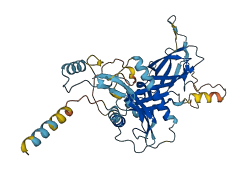
Descriptions
The autoinhibited protein was predicted that may have potential autoinhibitory elements via cis-regPred.
Autoinhibitory domains (AIDs)
Target domain |
|
Relief mechanism |
|
Assay |
cis-regPred |
Accessory elements
No accessory elements
Autoinhibited structure

Activated structure
12 structures for P61812
| Entry ID | Method | Resolution | Chain | Position | Source |
|---|---|---|---|---|---|
| 1TFG | X-ray | 195 A | A | 303-414 | PDB |
| 2TGI | X-ray | 180 A | A | 303-414 | PDB |
| 4KXZ | X-ray | 283 A | A/B/D/E | 303-414 | PDB |
| 5TX4 | X-ray | 188 A | B | 303-414 | PDB |
| 5TY4 | EM | 290 A | B | 317-413 | PDB |
| 6I9J | X-ray | 200 A | A | 303-414 | PDB |
| 6XM2 | X-ray | 191 A | I/J/K/L | 303-414 | PDB |
| 7RCO | X-ray | 290 A | A/B | 303-414 | PDB |
| 8DC0 | X-ray | 193 A | B | 303-414 | PDB |
| 8FXS | X-ray | 315 A | A/B | 21-414 | PDB |
| 8FXV | X-ray | 220 A | A | 21-414 | PDB |
| AF-P61812-F1 | Predicted | AlphaFoldDB |
330 variants for P61812
| Variant ID(s) | Position | Change | Description | Diseaes Association | Provenance |
|---|---|---|---|---|---|
|
rs1571820552 RCV001824377 CA344725097 |
5 | V>L | Loeys-Dietz syndrome 4 [ClinVar] | Yes |
ClinGen ClinVar Ensembl dbSNP |
|
rs1553292060 CA344725105 RCV001824352 |
6 | L>P | Loeys-Dietz syndrome 4 [ClinVar] | Yes |
ClinGen ClinVar Ensembl dbSNP |
|
RCV001824440 rs765477784 |
7 | S>T | Loeys-Dietz syndrome 4 [ClinVar] | Yes |
ClinVar dbSNP |
|
CA1398364 rs763918203 RCV000347838 |
13 | H>N | Loeys-Dietz syndrome 4 [ClinVar] | Yes |
ClinGen ClinVar ExAC TOPMed dbSNP gnomAD |
|
RCV000395786 rs886045975 CA10609115 |
18 | A>T | Loeys-Dietz syndrome 4 [ClinVar] | Yes |
ClinGen ClinVar TOPMed dbSNP |
|
rs1656695125 RCV001824402 |
20 | S>N | Loeys-Dietz syndrome 4 [ClinVar] | Yes |
ClinVar dbSNP |
|
rs1558220002 CA344725281 RCV000769553 |
33 | M>R | Familial thoracic aortic aneurysm and aortic dissection [ClinVar] | Yes |
ClinGen ClinVar Ensembl dbSNP |
|
rs1571820734 RCV001824381 CA344725286 |
34 | R>C | Loeys-Dietz syndrome 4 [ClinVar] | Yes |
ClinGen ClinVar Ensembl dbSNP |
|
RCV000484113 RCV003139685 rs1064796462 CA16617062 |
34 | R>H | Loeys-Dietz syndrome 4 [ClinVar] | Yes |
ClinGen ClinVar Ensembl dbSNP |
|
RCV000786410 CA344725383 RCV002315236 RCV001824351 rs1553292088 |
48 | L>R | Familial thoracic aortic aneurysm and aortic dissection Loeys-Dietz syndrome 4 [ClinVar] | Yes |
ClinGen ClinVar Ensembl dbSNP |
|
RCV000524041 CA1398374 rs771351240 RCV002497016 |
52 | S>G | Loeys-Dietz syndrome 4 [ClinVar] | Yes |
ClinGen ClinVar ExAC dbSNP gnomAD |
|
CA324601 RCV000200048 RCV000765072 rs750324465 RCV002415844 |
65 | P>L | Familial thoracic aortic aneurysm and aortic dissection Loeys-Dietz syndrome 4 [ClinVar] | Yes |
ClinGen ClinVar ExAC TOPMed dbSNP gnomAD |
|
RCV001824330 RCV002413476 CA1398383 rs747128130 |
65 | P>S | Familial thoracic aortic aneurysm and aortic dissection Loeys-Dietz syndrome 4 [ClinVar] | Yes |
ClinGen ClinVar ExAC TOPMed dbSNP gnomAD |
|
RCV002000043 rs863223794 |
66 | E>missing | Loeys-Dietz syndrome 4 [ClinVar] | Yes |
ClinVar dbSNP |
|
rs201761868 RCV000765073 RCV001532946 CA325359 RCV002310795 RCV002277544 RCV000200774 |
67 | V>M | Ehlers-Danlos syndrome Loeys-Dietz syndrome 4 Familial thoracic aortic aneurysm and aortic dissection [ClinVar] | Yes |
ClinGen ClinVar ESP ExAC TOPMed dbSNP gnomAD |
|
RCV001824320 rs1027195424 CA16610001 RCV002418380 |
70 | I>T | Familial thoracic aortic aneurysm and aortic dissection Loeys-Dietz syndrome 4 [ClinVar] | Yes |
ClinGen ClinVar TOPMed dbSNP gnomAD |
|
RCV001824442 rs1656702743 |
70 | I>V | Loeys-Dietz syndrome 4 [ClinVar] | Yes |
ClinVar dbSNP |
|
rs1553292105 RCV000623776 |
77 | L>missing | Inborn genetic diseases [ClinVar] | Yes |
ClinVar dbSNP |
|
RCV000196118 RCV002315624 RCV001824298 rs371241859 CA320534 |
79 | Q>R | Familial thoracic aortic aneurysm and aortic dissection Loeys-Dietz syndrome 4 [ClinVar] | Yes |
ClinGen ClinVar 1000Genomes ESP ExAC TOPMed dbSNP gnomAD |
|
rs1571821003 RCV001824386 |
80 | E>missing | Loeys-Dietz syndrome 4 [ClinVar] | Yes |
ClinVar dbSNP |
|
CA344725610 RCV000994256 rs1571821016 RCV001824395 |
82 | A>V | Loeys-Dietz syndrome 4 [ClinVar] | Yes |
ClinGen ClinVar Ensembl dbSNP |
|
RCV001824317 rs1553292112 |
85 | R>missing | Loeys-Dietz syndrome 4 [ClinVar] | Yes |
ClinVar dbSNP |
|
RCV001824422 rs749309877 |
90 | E>Q | Loeys-Dietz syndrome 4 [ClinVar] | Yes |
ClinVar dbSNP |
|
RCV000508622 VAR_012708 rs10482721 CA320886 RCV000986553 RCV002277542 RCV000586534 RCV000196473 RCV001000016 RCV001171173 |
91 | R>H | Ehlers-Danlos syndrome Familial thoracic aortic aneurysm and aortic dissection Loeys-Dietz syndrome 4 Hirschsprung disease, susceptibility to, 1 Holt-Oram syndrome [ClinVar] | Yes |
ClinGen ClinVar UniProt 1000Genomes ESP ExAC TOPMed dbSNP gnomAD |
|
rs1553292123 RCV002315234 |
94 | S>missing | Familial thoracic aortic aneurysm and aortic dissection [ClinVar] | Yes |
ClinVar dbSNP |
|
CA353619 RCV001824401 RCV000210467 rs760759052 |
99 | Y>* | Loeys-Dietz syndrome 4 [ClinVar] | Yes |
ClinVar dbSNP ClinGen ExAC TOPMed gnomAD |
|
rs398122883 RCV000030733 |
100 | A>missing | Loeys-Dietz syndrome 4 [ClinVar] | Yes |
ClinVar dbSNP |
| VAR_068931 | 100 | A>del | LDS4 [UniProt] | Yes | UniProt |
|
RCV001586076 RCV001824431 rs1656708526 |
102 | E>missing | Loeys-Dietz syndrome 4 [ClinVar] | Yes |
ClinVar dbSNP |
| VAR_080342 | 102 | E>del | LDS4 [UniProt] | Yes | UniProt |
|
rs1060501982 CA16609977 RCV001824319 |
108 | M>L | Loeys-Dietz syndrome 4 [ClinVar] | Yes |
ClinGen ClinVar Ensembl dbSNP |
|
CA344725808 rs1553292141 RCV001824332 |
112 | F>L | Loeys-Dietz syndrome 4 [ClinVar] | Yes |
ClinGen ClinVar Ensembl dbSNP |
|
RCV001093207 RCV002277545 CA321277 RCV000415640 RCV000769556 RCV000583868 RCV000196866 rs149533093 |
119 | P>L | Ehlers-Danlos syndrome Familial thoracic aortic aneurysm and aortic dissection Loeys-Dietz syndrome 4 Aortic aneurysm [ClinVar] | Yes |
ClinGen ClinVar ESP ExAC TOPMed dbSNP gnomAD |
|
CA344725883 RCV001824326 RCV002456017 rs1300823855 RCV000520853 |
121 | T>S | Familial thoracic aortic aneurysm and aortic dissection Loeys-Dietz syndrome 4 [ClinVar] | Yes |
ClinGen ClinVar TOPMed dbSNP gnomAD |
|
RCV000208163 rs869025533 |
124 | R>missing | Loeys-Dietz syndrome [ClinVar] | Yes |
ClinVar dbSNP |
|
RCV000200239 rs863223789 CA324799 RCV001853165 |
124 | R>K | Loeys-Dietz syndrome 4 [ClinVar] | Yes |
ClinGen ClinVar TOPMed dbSNP |
|
RCV000993706 CA1398449 RCV001759417 rs752823052 |
129 | I>T | Loeys-Dietz syndrome 4 [ClinVar] | Yes |
ClinGen ClinVar ExAC TOPMed dbSNP gnomAD |
|
rs869025531 RCV003221862 RCV000208340 CA351959 COSM3418767 RCV002321824 COSM173859 RCV001824300 |
131 | R>* | Loeys-Dietz syndrome Familial thoracic aortic aneurysm and aortic dissection Loeys-Dietz syndrome 4 large_intestine Variant assessed as Somatic; impact. [ClinVar, Cosmic, NCI-TCGA] | Yes |
ClinGen cosmic curated ClinVar Ensembl NCI-TCGA dbSNP |
|
COSM209977 RCV002375221 COSM209976 RCV001824427 rs758366080 CA1398450 |
131 | R>Q | Variant assessed as Somatic; 0.0 impact. Loeys-Dietz syndrome 4 Familial thoracic aortic aneurysm and aortic dissection large_intestine endometrium [NCI-TCGA, ClinVar, Cosmic] | Yes |
ClinGen cosmic curated ClinVar ExAC NCI-TCGA TOPMed dbSNP gnomAD |
|
RCV001824429 rs1658868781 |
132 | F>S | Loeys-Dietz syndrome 4 [ClinVar] | Yes |
ClinVar dbSNP |
|
CA1398453 RCV001592974 COSM219374 COSM219375 RCV001824371 rs757551766 |
134 | V>I | Loeys-Dietz syndrome 4 breast [ClinVar, Cosmic] | Yes |
ClinGen cosmic curated ClinVar ExAC TOPMed dbSNP gnomAD |
|
rs1264824521 RCV002315237 CA344726008 |
137 | M>T | Familial thoracic aortic aneurysm and aortic dissection [ClinVar] | Yes |
ClinGen ClinVar dbSNP gnomAD |
|
RCV001824382 rs141548795 CA1398455 |
143 | N>S | Loeys-Dietz syndrome 4 [ClinVar] | Yes |
ClinGen ClinVar ESP ExAC TOPMed dbSNP gnomAD |
|
RCV001824420 rs1658870968 |
149 | F>missing | Loeys-Dietz syndrome 4 [ClinVar] | Yes |
ClinVar dbSNP |
|
rs896156575 CA37597444 RCV001824334 |
149 | F>V | Loeys-Dietz syndrome 4 [ClinVar] | Yes |
ClinGen ClinVar Ensembl dbSNP |
|
rs1658871071 RCV001824444 |
150 | R>K | Loeys-Dietz syndrome 4 [ClinVar] | Yes |
ClinVar dbSNP |
|
CA16043643 COSM904010 rs1057518684 COSM904009 RCV000414990 |
153 | R>H | Loeys-Dietz syndrome 4 endometrium [ClinVar, Cosmic] | Yes |
ClinGen cosmic curated ClinVar TOPMed dbSNP |
|
RCV002259356 rs775251473 CA1398457 RCV002506510 RCV002315239 |
158 | K>N | Familial thoracic aortic aneurysm and aortic dissection Loeys-Dietz syndrome 4 [ClinVar] | Yes |
ClinGen ClinVar ExAC dbSNP gnomAD |
|
rs1658873227 RCV001824432 |
164 | Q>* | Loeys-Dietz syndrome 4 [ClinVar] | Yes |
ClinVar dbSNP |
|
RCV002244936 RCV001824318 RCV002313165 CA1398460 rs773820426 |
165 | R>W | Familial thoracic aortic aneurysm and aortic dissection Loeys-Dietz syndrome 4 [ClinVar] | Yes |
ClinGen ClinVar ExAC TOPMed dbSNP gnomAD |
|
rs1291056000 RCV001824446 CA344726426 |
172 | L>F | Loeys-Dietz syndrome 4 [ClinVar] | Yes |
ClinGen ClinVar dbSNP gnomAD |
|
rs749692412 RCV001751651 CA1398535 RCV002341683 RCV001333114 |
173 | K>R | Familial thoracic aortic aneurysm and aortic dissection Loeys-Dietz syndrome 4 [ClinVar] | Yes |
ClinGen ClinVar ExAC TOPMed dbSNP gnomAD |
|
rs1571901046 RCV002344388 CA344726451 |
176 | D>N | Familial thoracic aortic aneurysm and aortic dissection [ClinVar] | Yes |
ClinGen ClinVar Ensembl dbSNP |
|
RCV001824290 CA346685 RCV000157514 RCV001008708 rs730880221 |
182 | Q>* | Loeys-Dietz syndrome Loeys-Dietz syndrome 4 Loeys-dietz syndrome 4 (lds4) [ClinVar, Ensembl] | Yes |
ClinGen ClinVar Ensembl dbSNP |
|
CA344726494 rs1436552875 RCV000660311 |
183 | R>C | Loeys-Dietz syndrome 4 [ClinVar] | Yes |
ClinGen ClinVar TOPMed dbSNP gnomAD |
|
RCV002315235 RCV001571546 RCV001824350 rs773177511 CA1398540 |
183 | R>H | Familial thoracic aortic aneurysm and aortic dissection Loeys-Dietz syndrome 4 [ClinVar] | Yes |
ClinGen ClinVar ExAC dbSNP gnomAD |
|
rs1558262183 CA344726508 RCV001824362 |
185 | I>V | Loeys-Dietz syndrome 4 [ClinVar] | Yes |
ClinGen ClinVar Ensembl dbSNP |
|
rs759729701 CA1398544 RCV001824441 |
187 | S>G | Loeys-Dietz syndrome 4 [ClinVar] | Yes |
ClinGen ClinVar ExAC TOPMed dbSNP gnomAD |
|
RCV000482233 RCV002313256 RCV001851246 rs1064796256 |
193 | R>missing | Familial thoracic aortic aneurysm and aortic dissection Loeys-Dietz syndrome 4 [ClinVar] | Yes |
ClinVar dbSNP |
|
RCV001824294 RCV000199064 rs863223790 CA323602 |
195 | E>* | Loeys-Dietz syndrome 4 Loeys-dietz syndrome 4 (lds4) [ClinVar, Ensembl] | Yes |
ClinGen ClinVar Ensembl dbSNP |
|
CA1398548 RCV000275080 RCV002356404 rs764028978 |
197 | E>K | Familial thoracic aortic aneurysm and aortic dissection Loeys-Dietz syndrome 4 [ClinVar] | Yes |
ClinGen ClinVar ExAC dbSNP gnomAD |
|
RCV001824428 RCV002356981 rs1659896577 |
204 | T>I | Loeys-Dietz syndrome 4 Familial thoracic aortic aneurysm and aortic dissection [ClinVar] | Yes |
ClinVar dbSNP |
|
rs1659896680 RCV001170225 |
205 | D>missing | Familial thoracic aortic aneurysm and aortic dissection [ClinVar] | Yes |
ClinVar dbSNP |
|
RCV000514721 RCV002277284 rs10482810 VAR_018923 RCV000415676 RCV000143953 CA321408 RCV000986554 RCV000196984 |
207 | V>L | Ehlers-Danlos syndrome Loeys-Dietz syndrome 4 Familial thoracic aortic aneurysm and aortic dissection Holt-Oram syndrome [ClinVar] | Yes |
ClinGen ClinVar UniProt 1000Genomes ESP ExAC TOPMed dbSNP gnomAD |
|
RCV001256943 rs1659897581 |
208 | H>missing | Marfan syndrome [ClinVar] | Yes |
ClinVar dbSNP |
|
rs1571901234 RCV001824439 CA344726707 |
215 | D>N | Loeys-Dietz syndrome 4 [ClinVar] | Yes |
ClinGen ClinVar Ensembl dbSNP |
|
RCV000389271 CA10609935 rs886045978 |
224 | L>V | Loeys-Dietz syndrome 4 [ClinVar] | Yes |
ClinGen ClinVar TOPMed dbSNP |
|
rs398122885 RCV000030735 CA281904 |
229 | C>* | Loeys-Dietz syndrome 4 Loeys-dietz syndrome 4 (lds4) [ClinVar, Ensembl] | Yes |
ClinGen ClinVar dbSNP gnomAD |
|
RCV001550488 rs1185241582 CA344726820 RCV001824376 |
229 | C>F | Loeys-Dietz syndrome 4 [ClinVar] | Yes |
ClinGen ClinVar TOPMed dbSNP |
| VAR_080343 | 229 | C>del | LDS4 [UniProt] | Yes | UniProt |
|
rs753572174 CA1398585 RCV001824408 |
233 | P>S | Loeys-Dietz syndrome 4 [ClinVar] | Yes |
ClinGen ClinVar ExAC dbSNP gnomAD |
|
RCV001101516 rs1659906438 |
245 | E>V | Loeys-Dietz syndrome 4 [ClinVar] | Yes |
ClinVar dbSNP |
|
CA344726942 rs1558262454 RCV000826057 RCV001824360 |
247 | E>K | Loeys-Dietz syndrome 4 Variant assessed as Somatic; impact. [ClinVar, NCI-TCGA] | Yes |
ClinGen ClinVar Ensembl NCI-TCGA dbSNP |
|
RCV001824445 rs769911912 CA1398592 |
251 | A>S | Loeys-Dietz syndrome 4 [ClinVar] | Yes |
ClinGen ClinVar ExAC dbSNP gnomAD |
|
rs1553303162 CA658795610 RCV001824353 |
254 | D>Y | Loeys-Dietz syndrome 4 [ClinVar] | Yes |
ClinGen ClinVar Ensembl dbSNP |
|
rs781514831 CA1398608 RCV002315240 RCV001868130 |
255 | G>D | Loeys-Dietz syndrome 4 Familial thoracic aortic aneurysm and aortic dissection [ClinVar] | Yes |
ClinGen ClinVar ExAC dbSNP gnomAD |
|
RCV001101517 RCV002402181 RCV000419049 CA1398609 rs373352179 |
258 | T>I | Familial thoracic aortic aneurysm and aortic dissection Loeys-Dietz syndrome 4 [ClinVar] | Yes |
ClinGen ClinVar ESP ExAC TOPMed dbSNP gnomAD |
|
RCV000769560 CA344727030 rs1212341043 |
259 | Y>D | Familial thoracic aortic aneurysm and aortic dissection [ClinVar] | Yes |
ClinGen ClinVar TOPMed dbSNP |
|
RCV001170226 rs1659957362 |
260 | T>A | Familial thoracic aortic aneurysm and aortic dissection [ClinVar] | Yes |
ClinVar dbSNP |
|
RCV002310890 rs886038965 CA10587423 |
265 | K>E | Familial thoracic aortic aneurysm and aortic dissection [ClinVar] | Yes |
ClinGen ClinVar Ensembl dbSNP |
|
COSM1229082 rs1467391590 CA344727123 RCV001824424 COSM1229083 |
273 | K>E | Loeys-Dietz syndrome 4 large_intestine [ClinVar, Cosmic] | Yes |
ClinGen cosmic curated ClinVar TOPMed dbSNP gnomAD |
|
rs863223796 RCV000197799 RCV001824297 RCV000507174 RCV001170227 |
274 | N>missing | Loeys-Dietz syndrome 4 Familial thoracic aortic aneurysm and aortic dissection [ClinVar] | Yes |
ClinVar dbSNP |
|
RCV001824425 CA1398616 rs559315266 |
274 | N>T | Loeys-Dietz syndrome 4 [ClinVar] | Yes |
ClinGen ClinVar 1000Genomes ExAC dbSNP gnomAD |
|
RCV002311061 rs139825195 CA321837 RCV001580467 RCV001824295 |
275 | S>G | Familial thoracic aortic aneurysm and aortic dissection Loeys-Dietz syndrome 4 [ClinVar] | Yes |
ClinGen ClinVar 1000Genomes ESP ExAC TOPMed dbSNP gnomAD |
|
RCV001824443 CA344727156 rs1304484008 |
277 | K>N | Variant assessed as Somatic; 0.0 impact. Loeys-Dietz syndrome 4 [NCI-TCGA, ClinVar] | Yes |
ClinGen ClinVar NCI-TCGA dbSNP gnomAD |
|
rs1659961526 RCV001824405 |
279 | P>S | Loeys-Dietz syndrome 4 [ClinVar] | Yes |
ClinVar dbSNP |
|
RCV001824359 CA344727186 rs1558263254 |
282 | L>P | Loeys-Dietz syndrome 4 [ClinVar] | Yes |
ClinGen ClinVar Ensembl dbSNP |
|
rs1553303203 RCV001824337 |
298 | R>missing | Loeys-Dietz syndrome 4 [ClinVar] | Yes |
ClinVar dbSNP |
|
RCV001824296 RCV000198949 CA323488 rs762561484 |
298 | R>Q | Loeys-Dietz syndrome 4 [ClinVar] | Yes |
ClinGen ClinVar ExAC TOPMed dbSNP gnomAD |
|
RCV001170228 RCV000418728 RCV000660312 rs1057521150 CA16603488 |
299 | R>Q | Familial thoracic aortic aneurysm and aortic dissection Loeys-Dietz syndrome 4 Loeys-dietz syndrome 4 (lds4) [ClinVar, Ensembl] | Yes |
ClinGen ClinVar Ensembl dbSNP |
|
rs863223792 RCV002372177 RCV001174570 RCV000195710 CA320073 RCV000210465 VAR_068932 |
299 | R>W | Familial aortopathy Familial thoracic aortic aneurysm and aortic dissection Loeys-Dietz syndrome 4 Loeys-dietz syndrome 4 (lds4) LDS4 [ClinVar, Ensembl, UniProt] | Yes |
ClinGen ClinVar UniProt Ensembl dbSNP |
|
RCV001267069 RCV000255040 RCV001824688 VAR_068933 RCV000210476 RCV002372209 rs869312903 CA354091 |
302 | R>C | Aortic aneurysm, familial thoracic, TGFB2 related Familial thoracic aortic aneurysm and aortic dissection Loeys-Dietz syndrome 4 Inborn genetic diseases Loeys-dietz syndrome 4 (lds4) LDS4 [ClinVar, Ensembl, UniProt] | Yes |
ClinGen ClinVar UniProt Ensembl dbSNP |
|
RCV002314891 CA344727314 RCV001824325 rs1553303213 RCV000509486 |
302 | R>H | Familial thoracic aortic aneurysm and aortic dissection Loeys-Dietz syndrome 4 [ClinVar] | Yes |
ClinGen ClinVar Ensembl dbSNP |
|
rs869312903 CA10581764 RCV001824303 RCV001589185 |
302 | R>S | Loeys-Dietz syndrome 4 Loeys-dietz syndrome 4 (lds4) [ClinVar, Ensembl] | Yes |
ClinGen ClinVar Ensembl dbSNP |
|
rs1553303217 RCV001824338 CA344727336 |
305 | D>E | Loeys-Dietz syndrome 4 [ClinVar] | Yes |
ClinGen ClinVar Ensembl dbSNP |
|
RCV001824426 rs1659965467 |
308 | Y>* | Loeys-Dietz syndrome 4 [ClinVar] | Yes |
ClinVar dbSNP |
|
RCV001824410 rs1660004413 |
317 | C>R | Loeys-Dietz syndrome 4 [ClinVar] | Yes |
ClinVar dbSNP |
|
rs1553303351 RCV001824339 CA344727427 |
317 | C>S | Loeys-Dietz syndrome 4 [ClinVar] | Yes |
ClinGen ClinVar Ensembl dbSNP |
|
RCV000585795 RCV002225683 rs1553303352 CA344727446 VAR_072740 |
320 | R>C | Loeys-Dietz syndrome 4 Loeys-dietz syndrome 4 (lds4) probable disease-associated variant found in a family with non-syndromic aortic disease [ClinVar, Ensembl, UniProt] | Yes |
ClinGen ClinVar UniProt Ensembl dbSNP |
|
CA37622239 RCV000756773 RCV002493379 rs866788278 |
324 | I>V | Loeys-Dietz syndrome 4 [ClinVar] | Yes |
ClinGen ClinVar Ensembl dbSNP |
|
RCV001824430 rs1660005627 |
326 | F>L | Loeys-Dietz syndrome 4 [ClinVar] | Yes |
ClinVar dbSNP |
|
RCV001824373 rs1571904218 |
331 | G>missing | Loeys-Dietz syndrome 4 [ClinVar] | Yes |
ClinVar dbSNP |
|
RCV001824375 RCV002424850 rs1476361240 CA344727562 |
337 | E>K | Loeys-Dietz syndrome 4 Familial thoracic aortic aneurysm and aortic dissection [ClinVar] | Yes |
ClinGen ClinVar Ensembl dbSNP |
|
RCV000030732 rs387907278 VAR_068934 CA281898 |
338 | P>H | Loeys-Dietz syndrome 4 Loeys-dietz syndrome 4 (lds4) LDS4 [ClinVar, Ensembl, UniProt] | Yes |
ClinGen ClinVar UniProt Ensembl dbSNP |
|
RCV000210478 rs398122884 |
341 | Y>missing | Loeys-Dietz syndrome 4 [ClinVar] | Yes |
ClinVar dbSNP |
|
RCV002315238 rs1553303357 CA344727592 |
341 | Y>* | Familial thoracic aortic aneurysm and aortic dissection [ClinVar] | Yes |
ClinGen ClinVar Ensembl dbSNP |
|
rs779554274 CA1398663 RCV001824365 |
343 | A>T | Loeys-Dietz syndrome 4 [ClinVar] | Yes |
ClinGen ClinVar ExAC TOPMed dbSNP gnomAD |
|
RCV001824434 rs1660008608 |
348 | G>E | Loeys-Dietz syndrome 4 [ClinVar] | Yes |
ClinVar dbSNP |
|
CA344727648 rs1558264109 RCV001824363 |
350 | C>Y | Loeys-Dietz syndrome 4 [ClinVar] | Yes |
ClinGen ClinVar Ensembl dbSNP |
|
rs773943154 RCV001824387 CA1398666 |
351 | P>L | Loeys-Dietz syndrome 4 [ClinVar] | Yes |
ClinGen ClinVar ExAC TOPMed dbSNP gnomAD |
|
RCV001824433 rs777045186 RCV002402763 CA1398669 |
353 | L>V | Loeys-Dietz syndrome 4 Familial thoracic aortic aneurysm and aortic dissection [ClinVar] | Yes |
ClinGen ClinVar ExAC dbSNP gnomAD |
|
rs1558264130 CA344727678 RCV001824366 |
354 | W>* | Loeys-Dietz syndrome 4 [ClinVar] | Yes |
ClinGen ClinVar Ensembl dbSNP |
|
RCV001824409 RCV002462298 rs1660141597 |
379 | C>F | Loeys-Dietz syndrome 4 [ClinVar] | Yes |
ClinVar dbSNP |
|
CA344727869 RCV002315242 rs1553303745 |
380 | C>F | Familial thoracic aortic aneurysm and aortic dissection [ClinVar] | Yes |
ClinGen ClinVar Ensembl dbSNP |
|
rs376159002 RCV002483736 RCV002315241 RCV000624548 CA1398688 RCV002274072 |
381 | V>M | Variant assessed as Somatic; 0.0 impact. Familial thoracic aortic aneurysm and aortic dissection Loeys-Dietz syndrome 4 Inborn genetic diseases [NCI-TCGA, ClinVar] | Yes |
ClinGen ClinVar ESP ExAC NCI-TCGA dbSNP gnomAD |
|
RCV000994259 CA10609965 rs886045980 RCV000380797 |
394 | I>T | Loeys-Dietz syndrome 4 [ClinVar] | Yes |
ClinGen ClinVar TOPMed dbSNP gnomAD |
|
RCV002339210 rs751650226 RCV001824403 CA1398693 |
396 | K>Q | Loeys-Dietz syndrome 4 Familial thoracic aortic aneurysm and aortic dissection [ClinVar] | Yes |
ClinGen ClinVar ExAC dbSNP gnomAD |
|
RCV001170229 rs1660144102 |
399 | K>T | Familial thoracic aortic aneurysm and aortic dissection [ClinVar] | Yes |
ClinVar dbSNP |
|
RCV000656710 CA344728078 rs1553303761 |
411 | C>S | Loeys-Dietz syndrome 4 [ClinVar] | Yes |
ClinGen ClinVar Ensembl dbSNP |
|
rs869025532 CA351708 RCV000208019 |
413 | C>S | Familial thoracic aortic aneurysm and aortic dissection [ClinVar] | Yes |
ClinGen ClinVar Ensembl dbSNP |
|
rs187697359 CA1398357 |
2 | H>R | No |
ClinGen 1000Genomes ExAC gnomAD |
|
|
rs555397495 CA37544445 |
4 | C>S | No |
ClinGen Ensembl |
|
|
CA1398359 rs776628524 |
4 | C>Y | No |
ClinGen ExAC gnomAD |
|
|
CA1398361 rs765477784 |
7 | S>N | No |
ClinGen ExAC gnomAD |
|
|
rs752870701 CA1398362 |
8 | A>S | No |
ClinGen ExAC TOPMed |
|
|
CA1398363 rs763141894 |
8 | A>V | No |
ClinGen ExAC TOPMed |
|
|
CA344725162 rs1423446403 |
16 | T>A | No |
ClinGen TOPMed |
|
|
rs1173342696 CA344725166 |
16 | T>M | No |
ClinGen TOPMed |
|
|
CA344725167 rs1334873734 |
17 | V>I | No |
ClinGen gnomAD |
|
|
CA1398366 rs757201195 |
18 | A>V | No |
ClinGen ExAC TOPMed gnomAD |
|
|
rs1305579825 CA344725179 |
19 | L>F | No |
ClinGen gnomAD |
|
|
CA344725231 rs1209272897 |
27 | L>F | No |
ClinGen TOPMed |
|
| TCGA novel | 28 | D>G | Variant assessed as Somatic; impact. [NCI-TCGA] | No | NCI-TCGA |
|
rs1571820699 TCGA novel CA344725253 |
30 | D>N | Variant assessed as Somatic; impact. [NCI-TCGA] | No |
ClinGen NCI-TCGA Ensembl |
|
CA1398370 rs779872141 |
32 | F>L | No |
ClinGen ExAC gnomAD |
|
|
CA1398371 rs748995213 |
33 | M>I | No |
ClinGen ExAC gnomAD |
|
|
rs1558220033 CA344725341 |
42 | G>E | No |
ClinGen Ensembl |
|
|
CA344725369 rs1318854254 |
46 | S>N | No |
ClinGen TOPMed |
|
|
rs1431335293 CA344725410 |
52 | S>R | No |
ClinGen gnomAD |
|
|
rs777159486 CA1398375 |
52 | S>T | No |
ClinGen ExAC gnomAD |
|
|
rs745960678 CA1398376 |
53 | P>L | Variant assessed as Somatic; 0.0 impact. [NCI-TCGA] | No |
ClinGen ExAC NCI-TCGA gnomAD |
| TCGA novel | 53 | P>S | Variant assessed as Somatic; impact. [NCI-TCGA] | No | NCI-TCGA |
|
RCV000493273 rs1131691744 |
54 | P>missing | No |
ClinVar dbSNP |
|
| TCGA novel | 55 | E>R | Variant assessed as Somatic; impact. [NCI-TCGA] | No | NCI-TCGA |
|
CA344725448 rs1359839189 |
58 | P>S | No |
ClinGen gnomAD |
|
|
rs763228811 CA1398379 |
61 | E>K | No |
ClinGen ExAC gnomAD |
|
|
rs1317014757 CA344725491 |
64 | P>L | No |
ClinGen gnomAD |
|
|
rs761602500 CA1398382 |
64 | P>S | No |
ClinGen ExAC gnomAD |
|
|
CA344725493 rs747128130 |
65 | P>A | No |
ClinGen ExAC TOPMed gnomAD |
|
|
CA344725499 rs1202024276 |
66 | E>A | No |
ClinGen gnomAD |
|
|
CA16603523 rs766024374 RCV000428017 |
71 | Y>* | No |
ClinGen ClinVar ExAC dbSNP |
|
|
CA1398385 rs753391734 |
73 | S>G | No |
ClinGen ExAC gnomAD |
|
|
CA37544621 rs920940168 |
73 | S>T | No |
ClinGen Ensembl |
|
|
rs1400029652 CA344725551 |
74 | T>S | No |
ClinGen TOPMed |
|
|
CA344725602 rs1358538309 |
81 | K>R | No |
ClinGen gnomAD |
|
|
CA344725608 rs1426532619 |
82 | A>S | No |
ClinGen gnomAD |
|
|
CA344725618 CA1398388 rs757596095 |
83 | S>R | No |
ClinGen ExAC gnomAD |
|
|
CA344725621 rs781392453 |
84 | R>L | No |
ClinGen ExAC gnomAD |
|
|
CA1398389 rs781392453 |
84 | R>Q | No |
ClinGen ExAC gnomAD |
|
|
CA344725637 rs1558220233 |
87 | A>T | No |
ClinGen Ensembl |
|
|
CA1398393 rs775606572 |
89 | C>F | No |
ClinGen ExAC gnomAD |
|
|
rs770283888 CA1398392 |
89 | C>R | No |
ClinGen ExAC gnomAD |
|
|
CA1398394 COSM678498 rs749309877 COSM678499 |
90 | E>K | lung Variant assessed as Somatic; 0.0 impact. [Cosmic, NCI-TCGA] | No |
ClinGen cosmic curated ExAC NCI-TCGA gnomAD |
|
rs774592518 CA1398395 |
92 | E>A | No |
ClinGen ExAC gnomAD |
|
|
CA1398396 rs761533776 |
93 | R>T | No |
ClinGen ExAC gnomAD |
|
|
CA1398397 CA1398398 rs767393318 |
95 | D>E | No |
ClinGen ExAC TOPMed gnomAD |
|
|
rs1571821144 CA344725694 |
96 | E>K | No |
ClinGen Ensembl |
|
|
RCV000788200 rs1571821161 |
100 | A>missing | No |
ClinVar dbSNP |
|
|
CA37544738 rs992485773 |
100 | A>G | No |
ClinGen TOPMed |
|
|
CA37544737 rs959815933 |
100 | A>P | No |
ClinGen TOPMed |
|
|
rs766401610 CA1398400 |
101 | K>Q | No |
ClinGen ExAC gnomAD |
|
|
rs967581444 CA37544741 |
102 | E>G | No |
ClinGen TOPMed gnomAD |
|
|
CA344725753 rs1403363066 |
104 | Y>C | No |
ClinGen gnomAD |
|
|
CA344725784 rs1571821225 |
108 | M>R | No |
ClinGen Ensembl |
|
|
rs1354740126 CA344725797 |
110 | P>H | No |
ClinGen gnomAD |
|
| TCGA novel | 111 | F>S | Variant assessed as Somatic; impact. [NCI-TCGA] | No | NCI-TCGA |
|
rs757959311 CA1398405 |
111 | F>V | No |
ClinGen ExAC gnomAD |
|
|
rs370808888 CA1398406 |
112 | F>L | No |
ClinGen ESP ExAC TOPMed gnomAD |
|
|
rs895735813 CA37544794 |
113 | P>A | No |
ClinGen Ensembl |
|
|
rs1057524627 CA16603487 RCV000444603 |
113 | P>L | Variant assessed as Somatic; 0.0 impact. [NCI-TCGA] | No |
ClinGen ClinVar NCI-TCGA TOPMed dbSNP gnomAD |
|
CA344725820 rs1316319151 |
114 | S>P | No |
ClinGen gnomAD |
|
|
rs146933799 CA37597355 |
117 | A>V | No |
ClinGen 1000Genomes |
|
|
rs863223797 RCV000198360 |
119 | P>missing | No |
ClinVar dbSNP |
|
|
rs755563719 CA1398447 |
123 | Y>C | No |
ClinGen ExAC gnomAD |
|
|
rs779228043 CA1398448 |
125 | P>R | No |
ClinGen ExAC gnomAD |
|
|
rs888058937 CA37597384 |
125 | P>T | No |
ClinGen Ensembl |
|
|
rs777980933 CA1398451 |
132 | F>I | No |
ClinGen ExAC gnomAD |
|
|
rs1209069485 CA344725989 |
136 | A>T | Variant assessed as Somatic; 0.0 impact. [NCI-TCGA] | No |
ClinGen NCI-TCGA gnomAD |
|
rs967408802 CA37597413 |
137 | M>I | No |
ClinGen TOPMed |
|
|
RCV000414052 rs1057518597 |
140 | N>missing | No |
ClinVar dbSNP |
|
|
CA37597427 rs11557794 |
140 | N>Y | No |
ClinGen Ensembl |
|
|
CA344726118 rs1362716412 |
144 | L>F | No |
ClinGen gnomAD |
|
|
rs1439580016 CA344726123 |
145 | V>M | No |
ClinGen gnomAD |
|
|
rs1558248455 CA344726148 |
146 | K>N | No |
ClinGen Ensembl |
|
| TCGA novel | 150 | R>I | Variant assessed as Somatic; impact. [NCI-TCGA] | No | NCI-TCGA |
|
rs1425658948 CA344726270 |
155 | Q>K | No |
ClinGen TOPMed gnomAD |
|
|
rs1293375727 CA344726276 |
155 | Q>P | No |
ClinGen gnomAD |
|
|
rs1445749036 CA344726318 |
158 | K>E | No |
ClinGen gnomAD |
|
|
rs748852886 CA1398458 |
160 | R>T | No |
ClinGen ExAC gnomAD |
|
|
rs1160416926 CA344726342 |
161 | V>G | No |
ClinGen TOPMed |
|
|
CA1398459 rs768202434 |
162 | P>L | No |
ClinGen ExAC gnomAD |
|
|
rs866659136 CA37597461 |
162 | P>T | No |
ClinGen Ensembl |
|
| TCGA novel | 172 | L>I | Variant assessed as Somatic; impact. [NCI-TCGA] | No | NCI-TCGA |
|
rs769281540 CA37619021 |
176 | D>G | No |
ClinGen Ensembl |
|
|
CA1398537 rs774826853 |
178 | T>I | No |
ClinGen ExAC gnomAD |
|
|
CA37619023 rs929597621 |
179 | S>C | No |
ClinGen TOPMed gnomAD |
|
| TCGA novel | 179 | S>F | Variant assessed as Somatic; impact. [NCI-TCGA] | No | NCI-TCGA |
|
rs772616801 CA1398539 |
181 | T>I | No |
ClinGen ExAC gnomAD |
|
|
rs754008150 CA1398543 |
186 | D>G | No |
ClinGen ExAC gnomAD |
|
|
COSM209979 CA1398542 COSM209978 rs766536496 |
186 | D>N | large_intestine [Cosmic] | No |
ClinGen cosmic curated ExAC TOPMed gnomAD |
| TCGA novel | 189 | V>A | Variant assessed as Somatic; impact. [NCI-TCGA] | No | NCI-TCGA |
|
rs765086663 CA1398545 |
193 | R>T | No |
ClinGen ExAC gnomAD |
|
|
rs1375258583 CA344726568 |
194 | A>S | No |
ClinGen gnomAD |
|
|
rs1015033324 CA37619107 |
200 | S>F | No |
ClinGen TOPMed |
|
|
CA344726620 rs1275341384 COSM904011 COSM904012 |
202 | D>N | Variant assessed as Somatic; 0.0 impact. endometrium [NCI-TCGA, Cosmic] | No |
ClinGen cosmic curated NCI-TCGA gnomAD |
|
CA37619137 rs796790344 |
205 | D>H | No |
ClinGen gnomAD |
|
|
rs1571901168 CA344726648 |
206 | A>P | No |
ClinGen Ensembl |
|
|
rs745557994 CA1398551 |
207 | V>A | No |
ClinGen ExAC gnomAD |
|
|
CA344726663 rs755821914 |
208 | H>Q | No |
ClinGen ExAC TOPMed gnomAD |
|
|
CA37619147 rs916820522 |
208 | H>Y | No |
ClinGen TOPMed |
|
|
CA1398553 rs779476673 |
211 | L>I | No |
ClinGen ExAC TOPMed gnomAD |
|
|
rs1571901210 CA344726689 |
212 | H>P | No |
ClinGen Ensembl |
|
|
TCGA novel CA344726694 rs1571901222 |
213 | H>N | Variant assessed as Somatic; impact. [NCI-TCGA] | No |
ClinGen NCI-TCGA Ensembl |
|
CA1398556 CA1398557 rs773724269 |
213 | H>Q | No |
ClinGen ExAC gnomAD |
|
|
CA1398555 rs772460840 |
213 | H>R | No |
ClinGen ExAC gnomAD |
|
|
rs1342706944 CA344726724 |
215 | D>E | No |
ClinGen TOPMed gnomAD |
|
|
rs863223795 RCV000195595 |
216 | R>missing | No |
ClinVar dbSNP |
|
|
CA320250 rs863223791 RCV000195866 |
221 | K>N | No |
ClinGen ClinVar Ensembl dbSNP |
|
|
rs957164399 CA37619410 |
223 | S>I | No |
ClinGen TOPMed gnomAD |
|
|
CA344726776 rs957164399 |
223 | S>N | No |
ClinGen TOPMed gnomAD |
|
|
CA1398584 rs766148763 |
227 | P>A | No |
ClinGen ExAC gnomAD |
|
|
CA344726823 rs1197477871 |
230 | T>A | No |
ClinGen gnomAD |
|
|
CA344726841 rs1558262430 |
232 | V>G | No |
ClinGen Ensembl |
|
|
CA344726845 rs1477299082 |
233 | P>L | No |
ClinGen gnomAD |
|
|
RCV000494411 rs1131691445 CA344726885 |
239 | I>F | No |
ClinGen ClinVar Ensembl dbSNP |
|
| TCGA novel | 240 | P>S | Variant assessed as Somatic; impact. [NCI-TCGA] | No | NCI-TCGA |
| TCGA novel | 248 | A>E | Variant assessed as Somatic; impact. [NCI-TCGA] | No | NCI-TCGA |
|
CA1398587 rs778265133 |
248 | A>T | No |
ClinGen ExAC gnomAD |
|
|
rs751816387 CA1398588 |
248 | A>V | No |
ClinGen ExAC gnomAD |
|
|
CA1398590 rs781637645 |
249 | R>I | No |
ClinGen ExAC gnomAD |
|
| TCGA novel | 250 | F>S | Variant assessed as Somatic; impact. [NCI-TCGA] | No | NCI-TCGA |
|
CA344726971 rs1309844427 |
251 | A>G | No |
ClinGen gnomAD |
|
|
rs1322126863 CA344726995 |
253 | I>T | No |
ClinGen gnomAD |
|
|
CA344727020 rs1263309543 |
257 | S>F | No |
ClinGen gnomAD |
|
|
rs191509998 CA1398610 |
261 | S>N | No |
ClinGen 1000Genomes ExAC gnomAD |
|
| TCGA novel | 262 | G>C | Variant assessed as Somatic; impact. [NCI-TCGA] | No | NCI-TCGA |
|
CA344727062 rs1256878861 |
263 | D>E | No |
ClinGen gnomAD |
|
|
rs1356922676 CA344727082 |
266 | T>N | Variant assessed as Somatic; impact. [NCI-TCGA] | No |
ClinGen NCI-TCGA TOPMed |
|
rs1571902862 RCV001009322 |
267 | I>missing | No |
ClinVar dbSNP |
|
|
rs1300063075 CA344727086 |
267 | I>V | No |
ClinGen gnomAD |
|
|
CA1398613 rs749266746 |
270 | T>A | No |
ClinGen ExAC gnomAD |
|
|
rs749266746 CA1398612 |
270 | T>P | No |
ClinGen ExAC gnomAD |
|
|
CA37620928 rs947761185 |
270 | T>S | No |
ClinGen TOPMed gnomAD |
|
|
rs370439281 CA37620935 |
271 | R>K | No |
ClinGen ESP TOPMed gnomAD |
|
|
rs1187360350 CA344727115 |
272 | K>E | No |
ClinGen gnomAD |
|
|
rs1415933135 CA344727121 |
272 | K>N | No |
ClinGen gnomAD |
|
|
CA1398615 rs747979194 |
273 | K>R | No |
ClinGen ExAC gnomAD |
|
| rs863223796 | 274 | N>K | Variant assessed as Somatic; 0.0 impact. [NCI-TCGA] | No | NCI-TCGA |
|
rs559315266 CA344727133 |
274 | N>S | No |
ClinGen 1000Genomes ExAC gnomAD |
|
| rs863223796 | 274 | N>T | Variant assessed as Somatic; 0.0 impact. [NCI-TCGA] | No | NCI-TCGA |
|
CA344727143 rs1169804851 |
276 | G>R | No |
ClinGen TOPMed |
|
|
CA1398617 rs760758897 |
278 | T>A | No |
ClinGen ExAC gnomAD |
|
|
CA344727161 rs1395226344 |
278 | T>I | No |
ClinGen TOPMed gnomAD |
|
|
CA344727177 rs1310329224 |
281 | L>F | No |
ClinGen gnomAD |
|
|
CA37620954 rs771319501 |
284 | M>I | No |
ClinGen Ensembl |
|
|
CA344727231 rs1276969502 |
289 | Y>C | No |
ClinGen gnomAD |
|
|
rs1373735073 CA344727238 |
290 | R>I | No |
ClinGen gnomAD |
|
|
CA344727248 rs1420202420 |
292 | E>K | No |
ClinGen TOPMed |
|
|
rs758931687 CA1398620 |
293 | S>L | No |
ClinGen ExAC gnomAD |
|
|
CA344727265 rs1165937586 |
294 | Q>R | No |
ClinGen TOPMed |
|
|
CA37620977 rs575861642 |
296 | T>I | No |
ClinGen Ensembl |
|
|
CA344727291 rs1200175663 |
298 | R>W | No |
ClinGen TOPMed gnomAD |
|
|
rs1478901182 CA344727324 |
304 | L>V | No |
ClinGen gnomAD |
|
|
CA344727342 rs989462091 |
306 | A>E | No |
ClinGen TOPMed gnomAD |
|
|
CA37621003 rs989462091 |
306 | A>V | Variant assessed as Somatic; 0.0 impact. [NCI-TCGA] | No |
ClinGen NCI-TCGA TOPMed gnomAD |
|
COSM1689867 COSM1689866 CA344727343 rs1178400838 |
307 | A>T | skin [Cosmic] | No |
ClinGen cosmic curated gnomAD |
|
CA1398624 rs750774144 |
308 | Y>S | No |
ClinGen ExAC gnomAD |
|
|
rs1064793278 RCV000479243 CA16617065 |
311 | R>K | No |
ClinGen ClinVar Ensembl dbSNP |
|
|
CA344727387 rs1241255536 |
311 | R>S | No |
ClinGen gnomAD |
|
|
CA529219375 rs1194682711 |
312 | N>C | No |
ClinGen gnomAD |
|
|
CA1398650 rs200149375 |
313 | V>L | No |
ClinGen 1000Genomes ExAC TOPMed gnomAD |
|
|
CA1398649 rs200149375 |
313 | V>M | No |
ClinGen 1000Genomes ExAC TOPMed gnomAD |
|
|
CA1398652 rs754350645 |
316 | N>S | No |
ClinGen ExAC gnomAD |
|
|
CA322411 RCV000197949 rs863223793 |
318 | C>F | No |
ClinGen ClinVar Ensembl dbSNP |
|
|
rs896426406 CA37622220 |
320 | R>H | No |
ClinGen TOPMed gnomAD |
|
| TCGA novel | 320 | R>P | Variant assessed as Somatic; impact. [NCI-TCGA] | No | NCI-TCGA |
|
CA1398654 rs765295855 |
321 | P>T | No |
ClinGen ExAC TOPMed gnomAD |
|
|
rs752807885 CA1398655 |
323 | Y>H | No |
ClinGen ExAC TOPMed gnomAD |
|
|
rs1085307561 RCV000489022 CA344727496 |
327 | K>N | No |
ClinGen ClinVar Ensembl dbSNP |
|
|
rs758704356 CA1398656 |
328 | R>K | No |
ClinGen ExAC gnomAD |
|
|
rs1348984007 CA344727504 |
329 | D>H | No |
ClinGen gnomAD |
|
|
CA1398658 rs746826425 |
331 | G>R | No |
ClinGen ExAC gnomAD |
|
|
rs1190246942 CA344727537 |
333 | K>N | No |
ClinGen TOPMed |
|
|
CA1398659 rs575279686 |
337 | E>G | No |
ClinGen 1000Genomes ExAC gnomAD |
|
|
rs745859904 CA1398661 |
340 | G>E | No |
ClinGen ExAC gnomAD |
|
|
CA1398660 rs781013995 |
340 | G>R | No |
ClinGen ExAC gnomAD |
|
|
CA37622322 rs968289881 |
342 | N>S | No |
ClinGen TOPMed |
|
|
CA1398665 rs768326808 |
345 | F>L | No |
ClinGen ExAC TOPMed |
|
|
rs748732392 CA1398664 |
345 | F>L | No |
ClinGen ExAC gnomAD |
|
|
rs1000597477 CA37622363 |
349 | A>T | No |
ClinGen TOPMed |
|
|
CA344727684 rs1373261825 |
355 | S>N | No |
ClinGen TOPMed |
|
|
rs889768224 CA37622385 |
362 | R>K | No |
ClinGen Ensembl |
|
|
CA344727754 rs1423949415 |
363 | V>L | No |
ClinGen gnomAD |
|
|
CA1398683 rs768202390 |
367 | Y>H | No |
ClinGen ExAC gnomAD |
|
|
rs1417916795 CA344727787 |
368 | N>D | No |
ClinGen gnomAD |
|
|
CA37625508 rs868322320 |
368 | N>I | No |
ClinGen Ensembl |
|
|
CA37625534 rs374045359 |
369 | T>I | No |
ClinGen ESP |
|
|
CA344727803 rs1335224039 |
370 | I>R | No |
ClinGen gnomAD |
|
|
CA344727807 rs1375241926 |
371 | N>Y | No |
ClinGen gnomAD |
|
|
CA1398685 rs577318480 |
373 | E>D | No |
ClinGen 1000Genomes ExAC gnomAD |
|
| TCGA novel | 375 | S>Y | Variant assessed as Somatic; impact. [NCI-TCGA] | No | NCI-TCGA |
|
rs201788738 CA344727839 |
376 | A>S | No |
ClinGen TOPMed gnomAD |
|
|
rs201788738 CA37625557 |
376 | A>T | No |
ClinGen TOPMed gnomAD |
|
|
rs1571907630 CA344727855 |
378 | P>L | No |
ClinGen Ensembl |
|
|
CA16603492 rs201129153 RCV000441929 |
380 | C>W | No |
ClinGen ClinVar 1000Genomes ESP ExAC TOPMed dbSNP gnomAD |
|
|
CA344727880 rs1217563256 |
382 | S>F | No |
ClinGen gnomAD |
|
|
rs1558266093 CA344727878 |
382 | S>P | No |
ClinGen Ensembl |
|
|
rs1187112343 CA344727882 |
383 | Q>K | No |
ClinGen Ensembl |
|
|
CA344727886 rs1411651558 |
383 | Q>R | No |
ClinGen TOPMed |
|
|
CA344727917 rs1167424381 |
387 | P>R | No |
ClinGen TOPMed |
|
|
rs776191174 CA1398690 |
389 | T>I | No |
ClinGen ExAC gnomAD |
|
| TCGA novel | 391 | L>R | Variant assessed as Somatic; impact. [NCI-TCGA] | No | NCI-TCGA |
|
rs1218609815 CA344727946 |
392 | Y>C | No |
ClinGen gnomAD |
|
|
CA344727967 rs1190307366 |
395 | G>D | No |
ClinGen gnomAD |
|
| TCGA novel | 395 | G>V | Variant assessed as Somatic; impact. [NCI-TCGA] | No | NCI-TCGA |
|
rs1571907728 CA344728005 |
401 | E>K | No |
ClinGen Ensembl |
|
|
CA344728020 rs1447245776 |
403 | L>V | No |
ClinGen TOPMed |
|
| TCGA novel | 406 | M>V | Variant assessed as Somatic; impact. [NCI-TCGA] | No | NCI-TCGA |
|
rs1183873092 CA344728049 |
407 | I>V | No |
ClinGen TOPMed |
|
|
rs750218692 CA1398696 |
409 | K>R | No |
ClinGen ExAC gnomAD |
3 associated diseases with P61812
[MIM: 614816]: Loeys-Dietz syndrome 4 (LDS4)
An aortic aneurysm syndrome with widespread systemic involvement. LDS4 is characterized by arterial tortuosity, aortic dissection, intracranial aneurysm and subarachnoid hemorrhage, hypertelorism, bifid uvula, pectus deformity, bicuspid aortic valve, arachnodactyly, scoliosis, foot deformities, dural ectasia, joint hyperflexibility, and thin skin with easy bruising and striae. {ECO:0000269|PubMed:22772368, ECO:0000269|PubMed:22772371}. Note=The disease is caused by variants affecting the gene represented in this entry.
Without disease ID
- An aortic aneurysm syndrome with widespread systemic involvement. LDS4 is characterized by arterial tortuosity, aortic dissection, intracranial aneurysm and subarachnoid hemorrhage, hypertelorism, bifid uvula, pectus deformity, bicuspid aortic valve, arachnodactyly, scoliosis, foot deformities, dural ectasia, joint hyperflexibility, and thin skin with easy bruising and striae. {ECO:0000269|PubMed:22772368, ECO:0000269|PubMed:22772371}. Note=The disease is caused by variants affecting the gene represented in this entry.
No regional properties for P61812
| Type | Name | Position | InterPro Accession |
|---|---|---|---|
| No domain, repeats, and functional sites for P61812 | |||
8 GO annotations of cellular component
| Name | Definition |
|---|---|
| axon | The long process of a neuron that conducts nerve impulses, usually away from the cell body to the terminals and varicosities, which are sites of storage and release of neurotransmitter. |
| collagen-containing extracellular matrix | An extracellular matrix consisting mainly of proteins (especially collagen) and glycosaminoglycans (mostly as proteoglycans) that provides not only essential physical scaffolding for the cellular constituents but can also initiate crucial biochemical and biomechanical cues required for tissue morphogenesis, differentiation and homeostasis. The components are secreted by cells in the vicinity and form a sheet underlying or overlying cells such as endothelial and epithelial cells. |
| extracellular region | The space external to the outermost structure of a cell. For cells without external protective or external encapsulating structures this refers to space outside of the plasma membrane. This term covers the host cell environment outside an intracellular parasite. |
| extracellular space | That part of a multicellular organism outside the cells proper, usually taken to be outside the plasma membranes, and occupied by fluid. |
| neuronal cell body | The portion of a neuron that includes the nucleus, but excludes cell projections such as axons and dendrites. |
| plasma membrane | The membrane surrounding a cell that separates the cell from its external environment. It consists of a phospholipid bilayer and associated proteins. |
| platelet alpha granule lumen | The volume enclosed by the membrane of the platelet alpha granule. |
| transforming growth factor beta complex | A protein complex acting as ligand of the transforming growth factor beta receptor complex, typically a homodimer of any of the TFGbeta isoforms. The precursor of TGFbeta proteins is cleaved into mature TGFbeta and the latency-associated peptide (LAP), which remains non-covalently linked to mature TGFbeta rendering it inactive. TGFbeta is activated by dimerisation and dissociation of the LAP. |
8 GO annotations of molecular function
| Name | Definition |
|---|---|
| amyloid-beta binding | Binding to an amyloid-beta peptide/protein. |
| cytokine activity | The activity of a soluble extracellular gene product that interacts with a receptor to effect a change in the activity of the receptor to control the survival, growth, differentiation and effector function of tissues and cells. |
| growth factor activity | The function that stimulates a cell to grow or proliferate. Most growth factors have other actions besides the induction of cell growth or proliferation. |
| protein homodimerization activity | Binding to an identical protein to form a homodimer. |
| signaling receptor binding | Binding to one or more specific sites on a receptor molecule, a macromolecule that undergoes combination with a hormone, neurotransmitter, drug or intracellular messenger to initiate a change in cell function. |
| transforming growth factor beta receptor binding | Binding to a transforming growth factor beta receptor. |
| type II transforming growth factor beta receptor binding | Binding to a type II transforming growth factor beta receptor. |
| type III transforming growth factor beta receptor binding | Binding to a type III transforming growth factor beta receptor. |
97 GO annotations of biological process
| Name | Definition |
|---|---|
| activation of protein kinase activity | Any process that initiates the activity of an inactive protein kinase. |
| ascending aorta morphogenesis | The process in which the anatomical structures of the ascending aorta are generated and organized. The ascending aorta is the portion of the aorta in a two-pass circulatory system that lies between the heart and the arch of aorta. In a two-pass circulatory system blood passes twice through the heart to supply the body once. |
| atrial septum morphogenesis | The developmental process in which atrial septum is generated and organized. The atrial septum separates the upper chambers (the atria) of the heart from one another. |
| atrial septum primum morphogenesis | The process in which anatomical structure of an atrial septum primum is generated and organized. |
| atrioventricular valve morphogenesis | The process in which the structure of the atrioventricular valve is generated and organized. |
| BMP signaling pathway | The series of molecular signals initiated by the binding of a member of the BMP (bone morphogenetic protein) family to a receptor on the surface of a target cell, and ending with the regulation of a downstream cellular process, e.g. transcription. |
| cardiac epithelial to mesenchymal transition | A transition where a cardiac epithelial cell loses apical/basolateral polarity, severs intercellular adhesive junctions, degrades basement membrane components and becomes a migratory mesenchymal cell. |
| cardiac muscle cell proliferation | The expansion of a cardiac muscle cell population by cell division. |
| cardiac right ventricle morphogenesis | The process in which the right cardiac ventricle is generated and organized. |
| cardioblast differentiation | The process in which a relatively unspecialized mesodermal cell acquires the specialized structural and/or functional features of a cardioblast. A cardioblast is a cardiac precursor cell. It is a cell that has been committed to a cardiac fate, but will undergo more cell division rather than terminally differentiating. |
| cell death | Any biological process that results in permanent cessation of all vital functions of a cell. A cell should be considered dead when any one of the following molecular or morphological criteria is met: (1) the cell has lost the integrity of its plasma membrane; (2) the cell, including its nucleus, has undergone complete fragmentation into discrete bodies (frequently referred to as apoptotic bodies). The cell corpse (or its fragments) may be engulfed by an adjacent cell in vivo, but engulfment of whole cells should not be considered a strict criteria to define cell death as, under some circumstances, live engulfed cells can be released from phagosomes (see PMID:18045538). |
| cell migration | The controlled self-propelled movement of a cell from one site to a destination guided by molecular cues. Cell migration is a central process in the development and maintenance of multicellular organisms. |
| cell morphogenesis | The developmental process in which the size or shape of a cell is generated and organized. |
| cell-cell junction organization | A process that is carried out at the cellular level which results in the assembly, arrangement of constituent parts, or disassembly of a cell-cell junction. A cell-cell junction is a specialized region of connection between two cells. |
| collagen fibril organization | Any process that determines the size and arrangement of collagen fibrils within an extracellular matrix. |
| cranial skeletal system development | The process whose specific outcome is the progression of a cranial skeletal system over time, from its formation to the mature structure. The cranial skeletal system is the skeletal subdivision of the head, and includes the skull (cranium plus mandible), pharyngeal and/or hyoid apparatus. |
| dopamine biosynthetic process | The chemical reactions and pathways resulting in the formation of dopamine, a catecholamine neurotransmitter and a metabolic precursor of noradrenaline and adrenaline. |
| embryo development ending in birth or egg hatching | The process whose specific outcome is the progression of an embryo over time, from zygote formation until the end of the embryonic life stage. The end of the embryonic life stage is organism-specific and may be somewhat arbitrary; for mammals it is usually considered to be birth, for insects the hatching of the first instar larva from the eggshell. |
| embryonic digestive tract development | The process whose specific outcome is the progression of the gut over time, from its formation to the mature structure during embryonic development. The gut is the region of the digestive tract extending from the beginning of the intestines to the anus. |
| embryonic limb morphogenesis | The process, occurring in the embryo, by which the anatomical structures of the limb are generated and organized. A limb is an appendage of an animal used for locomotion or grasping. |
| endocardial cushion fusion | The cell-cell adhesion process of mesenchymal cardiac cushion cells that contributes to the process of cushion shaping. |
| endocardial cushion morphogenesis | The process in which the anatomical structure of the endocardial cushion is generated and organized. The endocardial cushion is a specialized region of mesenchymal cells that will give rise to the heart septa and valves. |
| epithelial to mesenchymal transition | A transition where an epithelial cell loses apical/basolateral polarity, severs intercellular adhesive junctions, degrades basement membrane components and becomes a migratory mesenchymal cell. |
| extrinsic apoptotic signaling pathway | The series of molecular signals in which a signal is conveyed from the cell surface to trigger the apoptotic death of a cell. The pathway starts with either a ligand binding to a cell surface receptor, or a ligand being withdrawn from a cell surface receptor (e.g. in the case of signaling by dependence receptors), and ends when the execution phase of apoptosis is triggered. |
| eye development | The process whose specific outcome is the progression of the eye over time, from its formation to the mature structure. The eye is the organ of sight. |
| generation of neurons | The process in which nerve cells are generated. This includes the production of neuroblasts and their differentiation into neurons. |
| glial cell migration | The orderly movement of a glial cell, non-neuronal cells that provide support and nutrition, maintain homeostasis, form myelin, and participate in signal transmission in the nervous system. |
| hair follicle development | The process whose specific outcome is the progression of the hair follicle over time, from its formation to the mature structure. A hair follicle is a tube-like opening in the epidermis where the hair shaft develops and into which the sebaceous glands open. |
| hair follicle morphogenesis | The process in which the anatomical structures of the hair follicle are generated and organized. |
| heart development | The process whose specific outcome is the progression of the heart over time, from its formation to the mature structure. The heart is a hollow, muscular organ, which, by contracting rhythmically, keeps up the circulation of the blood. |
| heart morphogenesis | The developmental process in which the heart is generated and organized. The heart is a hollow, muscular organ, which, by contracting rhythmically, keeps up the circulation of the blood. |
| heart valve morphogenesis | The process in which the structure of a heart valve is generated and organized. |
| hemopoiesis | The process whose specific outcome is the progression of the myeloid and lymphoid derived organ/tissue systems of the blood and other parts of the body over time, from formation to the mature structure. The site of hemopoiesis is variable during development, but occurs primarily in bone marrow or kidney in many adult vertebrates. |
| inner ear development | The process whose specific outcome is the progression of the inner ear over time, from its formation to the mature structure. |
| kidney development | The process whose specific outcome is the progression of the kidney over time, from its formation to the mature structure. The kidney is an organ that filters the blood and/or excretes the end products of body metabolism in the form of urine. |
| male gonad development | The process whose specific outcome is the progression of the male gonad over time, from its formation to the mature structure. |
| membranous septum morphogenesis | The process in which the membranous septum is generated and organized. The membranous septum is the upper part of ventricular septum. |
| negative regulation of alkaline phosphatase activity | Any process that decreases the frequency, rate or extent of alkaline phosphatase activity, the catalysis of the reaction: an orthophosphoric monoester + H2O = an alcohol + phosphate, with an alkaline pH optimum. |
| negative regulation of angiogenesis | Any process that stops, prevents, or reduces the frequency, rate or extent of angiogenesis. |
| negative regulation of cell growth | Any process that stops, prevents, or reduces the frequency, rate, extent or direction of cell growth. |
| negative regulation of cell population proliferation | Any process that stops, prevents or reduces the rate or extent of cell proliferation. |
| negative regulation of epithelial cell proliferation | Any process that stops, prevents or reduces the rate or extent of epithelial cell proliferation. |
| negative regulation of epithelial to mesenchymal transition involved in endocardial cushion formation | Any process that stops, prevents or reduces the frequency, rate or extent of epithelial to mesenchymal transition involved in endocardial cushion formation. |
| negative regulation of gene expression | Any process that decreases the frequency, rate or extent of gene expression. Gene expression is the process in which a gene's coding sequence is converted into a mature gene product (protein or RNA). |
| negative regulation of macrophage cytokine production | Any process that decreases the rate, frequency or extent of macrophage cytokine production. Macrophage cytokine production is the appearance of a chemokine due to biosynthesis or secretion following a cellular stimulus, resulting in an increase in its intracellular or extracellular levels. |
| negative regulation of Ras protein signal transduction | Any process that stops, prevents, or reduces the frequency, rate or extent of Ras protein signal transduction. |
| neural retina development | The progression of the neural retina over time from its initial formation to the mature structure. The neural retina is the part of the retina that contains neurons and photoreceptor cells. |
| neural tube closure | The last step in the formation of the neural tube, where the paired neural folds are brought together and fuse at the dorsal midline. |
| neuron development | The process whose specific outcome is the progression of a neuron over time, from initial commitment of the cell to a specific fate, to the fully functional differentiated cell. |
| neutrophil chemotaxis | The directed movement of a neutrophil cell, the most numerous polymorphonuclear leukocyte found in the blood, in response to an external stimulus, usually an infection or wounding. |
| odontogenesis | The process whose specific outcome is the progression of a tooth or teeth over time, from formation to the mature structure(s). A tooth is any hard bony, calcareous, or chitinous organ found in the mouth or pharynx of an animal and used in procuring or masticating food. |
| outflow tract septum morphogenesis | The process in which the anatomical structures of the outflow tract septum are generated and organized. The outflow tract septum is a partition in the outflow tract. |
| pathway-restricted SMAD protein phosphorylation | The process of introducing a phosphate group on to a pathway restricted SMAD protein. A pathway restricted SMAD protein is an effector protein that acts directly downstream of the transforming growth factor family receptor. |
| pharyngeal arch artery morphogenesis | The process in which the anatomical structures of a pharyngeal arch artery is generated and organized. The pharyngeal arch arteries are a series of six paired embryological vascular structures, the development of which give rise to several major arteries, such as the stapedial artery, the middle meningeal artery, the internal carotid artery and the pulmonary artery. |
| positive regulation of cardioblast differentiation | Any process that activates or increases the frequency, rate or extent of cardioblast differentiation, the process in which a relatively unspecialized mesodermal cell acquires the specialized structural and/or functional features of a cardioblast. A cardioblast is a cardiac precursor cell. It is a cell that has been committed to a cardiac fate, but will undergo more cell division rather than terminally differentiating. |
| positive regulation of cell adhesion mediated by integrin | Any process that activates or increases the frequency, rate, or extent of cell adhesion mediated by integrin. |
| positive regulation of cell cycle | Any process that activates or increases the rate or extent of progression through the cell cycle. |
| positive regulation of cell division | Any process that activates or increases the frequency, rate or extent of cell division. |
| positive regulation of cell growth | Any process that activates or increases the frequency, rate, extent or direction of cell growth. |
| positive regulation of cell population proliferation | Any process that activates or increases the rate or extent of cell proliferation. |
| positive regulation of epithelial cell migration | Any process that activates or increases the frequency, rate or extent of epithelial cell migration. |
| positive regulation of epithelial to mesenchymal transition | Any process that increases the rate, frequency, or extent of epithelial to mesenchymal transition. Epithelial to mesenchymal transition is where an epithelial cell loses apical/basolateral polarity, severs intercellular adhesive junctions, degrades basement membrane components and becomes a migratory mesenchymal cell. |
| positive regulation of epithelial to mesenchymal transition involved in endocardial cushion formation | Any process that activates or increases the frequency, rate or extent of epithelial to mesenchymal transition involved in endocardial cushion formation. |
| positive regulation of heart contraction | Any process that activates or increases the frequency, rate or extent of heart contraction. |
| positive regulation of immune response | Any process that activates or increases the frequency, rate or extent of the immune response, the immunological reaction of an organism to an immunogenic stimulus. |
| positive regulation of integrin biosynthetic process | Any process that activates or increases the frequency, rate or extent of the chemical reactions and pathways resulting in the formation of integrins. |
| positive regulation of miRNA transcription | Any process that activates or increases the frequency, rate or extent of microRNA (miRNA) gene transcription. |
| positive regulation of neuron apoptotic process | Any process that activates or increases the frequency, rate or extent of cell death of neurons by apoptotic process. |
| positive regulation of Notch signaling pathway | Any process that activates or increases the frequency, rate or extent of the Notch signaling pathway. |
| positive regulation of ossification | Any process that activates or increases the frequency, rate or extent of ossification, the formation of bone or of a bony substance or the conversion of fibrous tissue or of cartilage into bone or a bony substance. |
| positive regulation of pathway-restricted SMAD protein phosphorylation | Any process that increases the rate, frequency or extent of pathway-restricted SMAD protein phosphorylation. Pathway-restricted SMAD proteins and common-partner SMAD proteins are involved in the transforming growth factor beta receptor signaling pathways. |
| positive regulation of phosphatidylinositol 3-kinase signaling | Any process that activates or increases the frequency, rate or extent of signal transduction mediated by the phosphatidylinositol 3-kinase cascade. |
| positive regulation of protein secretion | Any process that activates or increases the frequency, rate or extent of the controlled release of a protein from a cell. |
| positive regulation of stress-activated MAPK cascade | Any process that activates or increases the frequency, rate or extent of signal transduction mediated by the stress-activated MAPK cascade. |
| positive regulation of timing of catagen | Any process that activates or increases the frequency, rate or extent of timing of catagen, the regression phase of the hair cycle. |
| protein phosphorylation | The process of introducing a phosphate group on to a protein. |
| pulmonary valve morphogenesis | The process in which the structure of the pulmonary valve is generated and organized. |
| regulation of apoptotic process involved in outflow tract morphogenesis | Any process that modulates the frequency, rate or extent of apoptotic process involved in outflow tract morphogenesis. |
| regulation of cell population proliferation | Any process that modulates the frequency, rate or extent of cell proliferation. |
| regulation of timing of catagen | Any process that modulates the frequency, rate or extent of timing of catagen, the regression phase of the hair cycle. |
| regulation of transforming growth factor beta2 production | Any process that modulates the frequency, rate, or extent of production of transforming growth factor-beta2. |
| response to hypoxia | Any process that results in a change in state or activity of a cell or an organism (in terms of movement, secretion, enzyme production, gene expression, etc.) as a result of a stimulus indicating lowered oxygen tension. Hypoxia, defined as a decline in O2 levels below normoxic levels of 20.8 - 20.95%, results in metabolic adaptation at both the cellular and organismal level. |
| response to progesterone | Any process that results in a change in state or activity of a cell or an organism (in terms of movement, secretion, enzyme production, gene expression, etc.) as a result of a progesterone stimulus. |
| response to wounding | Any process that results in a change in state or activity of a cell or an organism (in terms of movement, secretion, enzyme production, gene expression, etc.) as a result of a stimulus indicating damage to the organism. |
| response to xenobiotic stimulus | Any process that results in a change in state or activity of a cell or an organism (in terms of movement, secretion, enzyme production, gene expression, etc.) as a result of a stimulus from a xenobiotic, a compound foreign to the organim exposed to it. It may be synthesized by another organism (like ampicilin) or it can be a synthetic chemical. |
| salivary gland morphogenesis | The process in which the anatomical structures of the salivary gland are generated and organized. |
| secondary palate development | The biological process whose specific outcome is the progression of the secondary palate from an initial condition to its mature state. This process begins with the formation of the structure and ends with the mature structure. The secondary palate is the part of the palate formed from the fusion of the two palatine shelves, extensions of the maxillary prominences. |
| skeletal system development | The process whose specific outcome is the progression of the skeleton over time, from its formation to the mature structure. The skeleton is the bony framework of the body in vertebrates (endoskeleton) or the hard outer envelope of insects (exoskeleton or dermoskeleton). |
| SMAD protein signal transduction | The cascade of processes by which a signal interacts with a receptor, causing a change in the activity of a SMAD protein, and ultimately effecting a change in the functioning of the cell. |
| somatic stem cell division | The self-renewing division of a somatic stem cell, a stem cell that can give rise to cell types of the body other than those of the germ-line. |
| substantia propria of cornea development | The process whose specific outcome is the progression of a substantia propria of cornea over time, from its formation to the mature structure. |
| transforming growth factor beta receptor signaling pathway | The series of molecular signals initiated by an extracellular ligand binding to a transforming growth factor beta receptor on the surface of a target cell, and ending with the regulation of a downstream cellular process, e.g. transcription. |
| uterine wall breakdown | The sloughing of the endometrium and blood vessels during menstruation that results from a drop in progesterone levels. |
| uterus development | The reproductive developmental process whose specific outcome is the progression of the uterus over time, from its formation to the mature structure. |
| ventricular septum morphogenesis | The developmental process in which a ventricular septum is generated and organized. A ventricular septum is an anatomical structure that separates the lower chambers (ventricles) of the heart from one another. |
| ventricular trabecula myocardium morphogenesis | The process in which the anatomical structures of the trabecular cardiac ventricle muscle are generated and organized. |
| wound healing | The series of events that restore integrity to a damaged tissue, following an injury. |
7 homologous proteins in AiPD
| UniProt AC | Gene Name | Protein Name | Species | Evidence Code |
|---|---|---|---|---|
| P21214 | TGFB2 | Transforming growth factor beta-2 proprotein | Bos taurus (Bovine) | PR |
| P30371 | TGFB2 | Transforming growth factor beta-2 proprotein | Gallus gallus (Chicken) | PR |
| P05111 | INHA | Inhibin alpha chain | Homo sapiens (Human) | PR |
| Q99988 | GDF15 | Growth/differentiation factor 15 | Homo sapiens (Human) | PR |
| P27090 | Tgfb2 | Transforming growth factor beta-2 proprotein | Mus musculus (Mouse) | PR |
| P09858 | TGFB2 | Transforming growth factor beta-2 proprotein | Sus scrofa (Pig) | PR |
| Q07257 | Tgfb2 | Transforming growth factor beta-2 proprotein | Rattus norvegicus (Rat) | PR |
| 10 | 20 | 30 | 40 | 50 | 60 |
| MHYCVLSAFL | ILHLVTVALS | LSTCSTLDMD | QFMRKRIEAI | RGQILSKLKL | TSPPEDYPEP |
| 70 | 80 | 90 | 100 | 110 | 120 |
| EEVPPEVISI | YNSTRDLLQE | KASRRAAACE | RERSDEEYYA | KEVYKIDMPP | FFPSENAIPP |
| 130 | 140 | 150 | 160 | 170 | 180 |
| TFYRPYFRIV | RFDVSAMEKN | ASNLVKAEFR | VFRLQNPKAR | VPEQRIELYQ | ILKSKDLTSP |
| 190 | 200 | 210 | 220 | 230 | 240 |
| TQRYIDSKVV | KTRAEGEWLS | FDVTDAVHEW | LHHKDRNLGF | KISLHCPCCT | FVPSNNYIIP |
| 250 | 260 | 270 | 280 | 290 | 300 |
| NKSEELEARF | AGIDGTSTYT | SGDQKTIKST | RKKNSGKTPH | LLLMLLPSYR | LESQQTNRRK |
| 310 | 320 | 330 | 340 | 350 | 360 |
| KRALDAAYCF | RNVQDNCCLR | PLYIDFKRDL | GWKWIHEPKG | YNANFCAGAC | PYLWSSDTQH |
| 370 | 380 | 390 | 400 | 410 | |
| SRVLSLYNTI | NPEASASPCC | VSQDLEPLTI | LYYIGKTPKI | EQLSNMIVKS | CKCS |