P56213
Gene name |
Gfer (Alr, MNCb-0663) |
Protein name |
FAD-linked sulfhydryl oxidase ALR |
Names |
Augmenter of liver regeneration |
Species |
Mus musculus (Mouse) |
KEGG Pathway |
mmu:11692 |
EC number |
1.8.3.2: With oxygen as acceptor |
Protein Class |
|
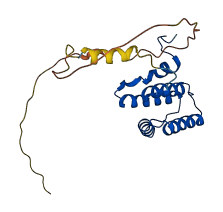
Descriptions
The autoinhibited protein was predicted that may have potential autoinhibitory elements via cis-regPred.
Autoinhibitory domains (AIDs)
Target domain |
|
Relief mechanism |
|
Assay |
cis-regPred |
Accessory elements
No accessory elements
Autoinhibited structure

Activated structure
1 structures for P56213
| Entry ID | Method | Resolution | Chain | Position | Source |
|---|---|---|---|---|---|
| AF-P56213-F1 | Predicted | AlphaFoldDB |
8 variants for P56213
| Variant ID(s) | Position | Change | Description | Diseaes Association | Provenance |
|---|---|---|---|---|---|
| rs3407556680 | 4 | P>A | No | EVA | |
| rs3407581773 | 4 | P>R | No | EVA | |
| rs3407556767 | 6 | E>G | No | EVA | |
| rs13460801 | 49 | A>S | No | EVA | |
| rs50774450 | 140 | E>G | No | EVA | |
| rs3389409672 | 164 | C>Y | No | EVA | |
| rs13460804 | 165 | R>H | No | EVA | |
| rs231778305 | 198 | D>N | No | EVA |
No associated diseases with P56213
1 regional properties for P56213
| Type | Name | Position | InterPro Accession |
|---|---|---|---|
| domain | ERV/ALR sulfhydryl oxidase domain | 88 - 189 | IPR017905 |
Functions
| Description | ||
|---|---|---|
| EC Number | 1.8.3.2 | With oxygen as acceptor |
| Subcellular Localization |
|
|
| PANTHER Family | ||
| PANTHER Subfamily | ||
| PANTHER Protein Class | ||
| PANTHER Pathway Category | No pathway information available | |
4 GO annotations of cellular component
| Name | Definition |
|---|---|
| cytosol | The part of the cytoplasm that does not contain organelles but which does contain other particulate matter, such as protein complexes. |
| extracellular space | That part of a multicellular organism outside the cells proper, usually taken to be outside the plasma membranes, and occupied by fluid. |
| mitochondrial intermembrane space | The region between the inner and outer lipid bilayers of the mitochondrial envelope. |
| mitochondrion | A semiautonomous, self replicating organelle that occurs in varying numbers, shapes, and sizes in the cytoplasm of virtually all eukaryotic cells. It is notably the site of tissue respiration. |
4 GO annotations of molecular function
| Name | Definition |
|---|---|
| flavin adenine dinucleotide binding | Binding to FAD, flavin-adenine dinucleotide, the coenzyme or the prosthetic group of various flavoprotein oxidoreductase enzymes, in either the oxidized form, FAD, or the reduced form, FADH2. |
| flavin-linked sulfhydryl oxidase activity | Catalysis of the formation of disulfide bridges in proteins using FAD as the electron acceptor. |
| growth factor activity | The function that stimulates a cell to grow or proliferate. Most growth factors have other actions besides the induction of cell growth or proliferation. |
| protein-disulfide reductase activity | Catalysis of the reaction: a protein with reduced sulfide groups = a protein with oxidized disulfide bonds. |
10 GO annotations of biological process
| Name | Definition |
|---|---|
| cellular response to actinomycin D | Any process that results in a change in state or activity of a cell (in terms of movement, secretion, enzyme production, gene expression, etc.) as a result of an actinomycin D stimulus. |
| cellular response to lipopolysaccharide | Any process that results in a change in state or activity of a cell (in terms of movement, secretion, enzyme production, gene expression, etc.) as a result of a lipopolysaccharide stimulus; lipopolysaccharide is a major component of the cell wall of gram-negative bacteria. |
| cellular response to toxic substance | Any process that results in a change in state or activity of a cell (in terms of movement, secretion, enzyme production, gene expression, etc.) as a result of a toxic stimulus. |
| cellular response to tumor necrosis factor | Any process that results in a change in state or activity of a cell (in terms of movement, secretion, enzyme production, gene expression, etc.) as a result of a tumor necrosis factor stimulus. |
| liver development | The process whose specific outcome is the progression of the liver over time, from its formation to the mature structure. The liver is an exocrine gland which secretes bile and functions in metabolism of protein and carbohydrate and fat, synthesizes substances involved in the clotting of the blood, synthesizes vitamin A, detoxifies poisonous substances, stores glycogen, and breaks down worn-out erythrocytes. |
| liver regeneration | The regrowth of lost or destroyed liver. |
| negative regulation of apoptotic process | Any process that stops, prevents, or reduces the frequency, rate or extent of cell death by apoptotic process. |
| negative regulation of natural killer cell mediated cytotoxicity | Any process that stops, prevents, or reduces the rate of natural killer mediated cytotoxicity. |
| negative regulation of oxidative stress-induced neuron death | Any process that stops, prevents or reduces the frequency, rate or extent of oxidative stress-induced neuron death. |
| positive regulation of DNA biosynthetic process | Any process that activates or increases the frequency, rate or extent of DNA biosynthetic process. |
3 homologous proteins in AiPD
| UniProt AC | Gene Name | Protein Name | Species | Evidence Code |
|---|---|---|---|---|
| Q12284 | ERV2 | FAD-linked sulfhydryl oxidase ERV2 | Saccharomyces cerevisiae (strain ATCC 204508 / S288c) (Baker's yeast) | PR |
| P55789 | GFER | FAD-linked sulfhydryl oxidase ALR | Homo sapiens (Human) | PR |
| Q63042 | Gfer | FAD-linked sulfhydryl oxidase ALR | Rattus norvegicus (Rat) | PR |
| 10 | 20 | 30 | 40 | 50 | 60 |
| MAAPSEPAGF | PRGSRFSFLP | GGARSEMTDD | LVTDARGRGA | RHRDDTTPAA | APAPQGLEHG |
| 70 | 80 | 90 | 100 | 110 | 120 |
| KRPCRACVDF | KSWMRTQQKR | DIKFREDCPQ | DREELGRHTW | AFLHTLAAYY | PDRPTPEQQQ |
| 130 | 140 | 150 | 160 | 170 | 180 |
| DMAQFIHIFS | KFYPCEECAE | DIRKRIGRNQ | PDTSTRVSFS | QWLCRLHNEV | NRKLGKPDFD |
| 190 | |||||
| CSRVDERWRD | GWKDGSCD |