P54811
Gene name |
cdc-48.1 |
Protein name |
Transitional endoplasmic reticulum ATPase homolog 1 |
Names |
Cell division cycle-related protein 48.1, p97/CDC48 homolog 1 |
Species |
Caenorhabditis elegans |
KEGG Pathway |
cel:CELE_C06A1.1 |
EC number |
|
Protein Class |
|
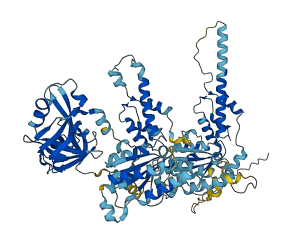
Descriptions
The autoinhibited protein was predicted that may have potential autoinhibitory elements via cis-regPred.
Autoinhibitory domains (AIDs)
Target domain |
|
Relief mechanism |
|
Assay |
cis-regPred |
Accessory elements
No accessory elements
Autoinhibited structure

Activated structure
1 structures for P54811
| Entry ID | Method | Resolution | Chain | Position | Source |
|---|---|---|---|---|---|
| AF-P54811-F1 | Predicted | AlphaFoldDB |
No variants for P54811
| Variant ID(s) | Position | Change | Description | Diseaes Association | Provenance |
|---|---|---|---|---|---|
| No variants for P54811 | |||||
No associated diseases with P54811
11 regional properties for P54811
| Type | Name | Position | InterPro Accession |
|---|---|---|---|
| domain | CDC48, N-terminal subdomain | 31 - 114 | IPR003338 |
| domain | AAA+ ATPase domain | 243 - 379 | IPR003593-1 |
| domain | AAA+ ATPase domain | 516 - 656 | IPR003593-2 |
| domain | ATPase, AAA-type, core | 247 - 376 | IPR003959-1 |
| domain | ATPase, AAA-type, core | 520 - 654 | IPR003959-2 |
| conserved_site | ATPase, AAA-type, conserved site | 347 - 365 | IPR003960-1 |
| conserved_site | ATPase, AAA-type, conserved site | 624 - 642 | IPR003960-2 |
| domain | CDC48, domain 2 | 131 - 197 | IPR004201 |
| domain | Spastin/Vps4, C-terminal | 732 - 771 | IPR015415 |
| domain | AAA ATPase, AAA+ lid domain | 399 - 440 | IPR041569-1 |
| domain | AAA ATPase, AAA+ lid domain | 676 - 715 | IPR041569-2 |
Functions
6 GO annotations of cellular component
| Name | Definition |
|---|---|
| cytoplasm | The contents of a cell excluding the plasma membrane and nucleus, but including other subcellular structures. |
| cytosol | The part of the cytoplasm that does not contain organelles but which does contain other particulate matter, such as protein complexes. |
| nucleoplasm | That part of the nuclear content other than the chromosomes or the nucleolus. |
| nucleus | A membrane-bounded organelle of eukaryotic cells in which chromosomes are housed and replicated. In most cells, the nucleus contains all of the cell's chromosomes except the organellar chromosomes, and is the site of RNA synthesis and processing. In some species, or in specialized cell types, RNA metabolism or DNA replication may be absent. |
| perinuclear region of cytoplasm | Cytoplasm situated near, or occurring around, the nucleus. |
| VCP-NPL4-UFD1 AAA ATPase complex | A multiprotein ATPase complex required for the efficient dislocation of ER-lumenal degradation substrates, and their subsequent proteolysis by the proteasome. In budding yeast, this complex includes Cdc48p, Npl4p and Ufd1p proteins. In mammals, this complex includes a hexamer of VCP/p97 (a cytosolic ATPase) and trimers of each of its cofactors UFD1L and NPL4 (NPLOC4) (e.g. a 6:3:3 stoichiometry). |
5 GO annotations of molecular function
| Name | Definition |
|---|---|
| ATP binding | Binding to ATP, adenosine 5'-triphosphate, a universally important coenzyme and enzyme regulator. |
| ATP hydrolysis activity | Catalysis of the reaction: ATP + H2O = ADP + H+ phosphate. ATP hydrolysis is used in some reactions as an energy source, for example to catalyze a reaction or drive transport against a concentration gradient. |
| identical protein binding | Binding to an identical protein or proteins. |
| polyubiquitin modification-dependent protein binding | Binding to a protein upon poly-ubiquitination of the target protein. |
| protein-containing complex binding | Binding to a macromolecular complex. |
10 GO annotations of biological process
| Name | Definition |
|---|---|
| autophagosome maturation | Removal of PI3P and Atg8/LC3 after the closure of the phagophore and before the fusion with the endosome/lysosome (e.g. mammals and insects) or vacuole (yeast), and that very likely destabilizes other Atg proteins and thus enables their efficient dissociation and recycling. |
| determination of adult lifespan | The pathways that regulate the duration of the adult phase of the life-cycle of an animal. |
| embryo development ending in birth or egg hatching | The process whose specific outcome is the progression of an embryo over time, from zygote formation until the end of the embryonic life stage. The end of the embryonic life stage is organism-specific and may be somewhat arbitrary; for mammals it is usually considered to be birth, for insects the hatching of the first instar larva from the eggshell. |
| ER-associated misfolded protein catabolic process | The chemical reactions and pathways resulting in the breakdown of misfolded proteins transported from the endoplasmic reticulum and targeted to cytoplasmic proteasomes for degradation. |
| mitotic spindle disassembly | The controlled breakdown of the spindle during a mitotic cell cycle. |
| positive regulation of mitotic cell cycle, embryonic | Any process that activates or increases the frequency, rate or extent of progression through the embryonic mitotic cell cycle. |
| positive regulation of proteasomal ubiquitin-dependent protein catabolic process | Any process that activates or increases the frequency, rate or extent of the breakdown of a protein or peptide by hydrolysis of its peptide bonds, initiated by the covalent attachment of ubiquitin, and mediated by the proteasome. |
| regulation of protein localization to chromatin | Any process that modulates the frequency, rate or extent of protein localization to chromatin. |
| retrograde protein transport, ER to cytosol | The directed movement of unfolded or misfolded proteins from the endoplasmic reticulum to the cytosol through the translocon. |
| ubiquitin-dependent ERAD pathway | The series of steps necessary to target endoplasmic reticulum (ER)-resident proteins for degradation by the cytoplasmic proteasome. Begins with recognition of the ER-resident protein, includes retrotranslocation (dislocation) of the protein from the ER to the cytosol, protein ubiquitination necessary for correct substrate transfer, transport of the protein to the proteasome, and ends with degradation of the protein by the cytoplasmic proteasome. |
4 homologous proteins in AiPD
| UniProt AC | Gene Name | Protein Name | Species | Evidence Code |
|---|---|---|---|---|
| Q8NB90 | SPATA5 | Ribosome biogenesis protein SPATA5 | Homo sapiens (Human) | PR |
| P55072 | VCP | Transitional endoplasmic reticulum ATPase | Homo sapiens (Human) | PR |
| Q01853 | Vcp | Transitional endoplasmic reticulum ATPase | Mus musculus (Mouse) | PR |
| P54812 | cdc-48.2 | Transitional endoplasmic reticulum ATPase homolog 2 | Caenorhabditis elegans | PR |
| 10 | 20 | 30 | 40 | 50 | 60 |
| MASVPTHQSE | KEKKNDELST | AILKDKVKPN | RLIVDQSEQD | DNSVIAVSQA | KMDELGLFRG |
| 70 | 80 | 90 | 100 | 110 | 120 |
| DAVILKGKKR | KESVAIIVSD | ESCPNEKVRM | NRVVRNNLRI | RLGDVVSITP | APNLSYGTRI |
| 130 | 140 | 150 | 160 | 170 | 180 |
| HVLPIDDTIE | GLTGNLFDVF | LKPYFLEAYR | PLHKGDIFTV | QAAMRTVEFK | VVETEPAPAC |
| 190 | 200 | 210 | 220 | 230 | 240 |
| IVSPDTMIHY | EGDPIKREEE | EESMNDIGYD | DLGGVRKQLA | QIKEMVELPL | RHPQLFKAIG |
| 250 | 260 | 270 | 280 | 290 | 300 |
| IKPPRGILLF | GPPGTGKTLI | ARAVANETGS | FFFLINGPEV | MSKMSGESES | NLRKAFEECE |
| 310 | 320 | 330 | 340 | 350 | 360 |
| KNQPAILFID | EIDAIAPKRE | KTNGEVERRI | VSQLLTLMDG | VKGRSNLVVI | AATNRPNSID |
| 370 | 380 | 390 | 400 | 410 | 420 |
| GALRRFGRFD | REIDIGIPDA | VGRLEILRIH | TKNMKLADDV | DLEQIANECH | GFVGADLASL |
| 430 | 440 | 450 | 460 | 470 | 480 |
| CSEAALQQIR | EKMELIDLED | DQIDAEVLNS | LAVTMENFRF | AQGKSSPSAL | REAVVETPNT |
| 490 | 500 | 510 | 520 | 530 | 540 |
| TWSDIGGLQN | VKRELQELVQ | YPVEHPEKYL | KFGMQPSRGV | LFYGPPGCGK | TLLAKAIANE |
| 550 | 560 | 570 | 580 | 590 | 600 |
| CQANFISIKG | PELLTMWFGE | SEANVRDVFD | KARAAAPCVL | FFDELDSIAK | ARGGGAGGDG |
| 610 | 620 | 630 | 640 | 650 | 660 |
| GGASDRVINQ | VLTEMDGMNA | KKNVFIIGAT | NRPDIIDPAV | LRPGRLDQLI | YIPLPDEASR |
| 670 | 680 | 690 | 700 | 710 | 720 |
| HQILKASLRK | TPLSKDLDLT | FLAKNTVGFS | GADLTEICQR | ACKLAIRESI | EKEIRIEKER |
| 730 | 740 | 750 | 760 | 770 | 780 |
| QDRQARGEEL | MEDDAVDPVP | EITRAHFEEA | MKFARRSVTD | NDIRKYEMFA | QTLQQSRGFG |
| 790 | 800 | ||||
| NNFKFPGEQR | GSDAPSAPVP | AQDDDDLYN |