P54726
Gene name |
Rad23a (Mhr23a) |
Protein name |
UV excision repair protein RAD23 homolog A |
Names |
HR23A, mHR23A |
Species |
Mus musculus (Mouse) |
KEGG Pathway |
mmu:19358 |
EC number |
|
Protein Class |
|
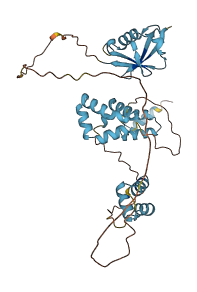
Descriptions
The autoinhibited protein was predicted that may have potential autoinhibitory elements via cis-regPred.
Autoinhibitory domains (AIDs)
Target domain |
|
Relief mechanism |
|
Assay |
cis-regPred |
Accessory elements
No accessory elements
Autoinhibited structure

Activated structure
1 structures for P54726
| Entry ID | Method | Resolution | Chain | Position | Source |
|---|---|---|---|---|---|
| AF-P54726-F1 | Predicted | AlphaFoldDB |
11 variants for P54726
| Variant ID(s) | Position | Change | Description | Diseaes Association | Provenance |
|---|---|---|---|---|---|
| rs3388997006 | 6 | T>I | No | EVA | |
| rs3388997058 | 9 | T>R | No | EVA | |
| rs3388983304 | 50 | Y>N | No | EVA | |
| rs3399423955 | 63 | E>V | No | EVA | |
| rs47906887 | 67 | D>V | No | EVA | |
| rs3399343839 | 68 | E>G | No | EVA | |
| rs47003347 | 75 | M>V | No | EVA | |
| rs3388966004 | 195 | V>M | No | EVA | |
| rs3388994106 | 204 | G>* | No | EVA | |
| rs3388977579 | 258 | L>M | No | EVA | |
| rs3388972390 | 326 | R>K | No | EVA |
No associated diseases with P54726
6 regional properties for P54726
| Type | Name | Position | InterPro Accession |
|---|---|---|---|
| domain | Ubiquitin-like domain | 3 - 81 | IPR000626 |
| domain | Heat shock chaperonin-binding | 230 - 273 | IPR006636 |
| domain | XPC-binding domain | 232 - 287 | IPR015360 |
| domain | Ubiquitin-associated domain | 161 - 201 | IPR015940-1 |
| domain | Ubiquitin-associated domain | 318 - 358 | IPR015940-2 |
| domain | RAD23A/RAD23B, UBA1 domain | 162 - 201 | IPR041811 |
8 GO annotations of cellular component
| Name | Definition |
|---|---|
| cytoplasm | The contents of a cell excluding the plasma membrane and nucleus, but including other subcellular structures. |
| cytosol | The part of the cytoplasm that does not contain organelles but which does contain other particulate matter, such as protein complexes. |
| Golgi apparatus | A membrane-bound cytoplasmic organelle of the endomembrane system that further processes the core oligosaccharides (e.g. N-glycans) added to proteins in the endoplasmic reticulum and packages them into membrane-bound vesicles. The Golgi apparatus operates at the intersection of the secretory, lysosomal, and endocytic pathways. |
| intracellular membrane-bounded organelle | Organized structure of distinctive morphology and function, bounded by a single or double lipid bilayer membrane and occurring within the cell. Includes the nucleus, mitochondria, plastids, vacuoles, and vesicles. Excludes the plasma membrane. |
| nucleoplasm | That part of the nuclear content other than the chromosomes or the nucleolus. |
| nucleus | A membrane-bounded organelle of eukaryotic cells in which chromosomes are housed and replicated. In most cells, the nucleus contains all of the cell's chromosomes except the organellar chromosomes, and is the site of RNA synthesis and processing. In some species, or in specialized cell types, RNA metabolism or DNA replication may be absent. |
| proteasome complex | A large multisubunit complex which catalyzes protein degradation, found in eukaryotes, archaea and some bacteria. In eukaryotes, this complex consists of the barrel shaped proteasome core complex and one or two associated proteins or complexes that act in regulating entry into or exit from the core. |
| protein-containing complex | A stable assembly of two or more macromolecules, i.e. proteins, nucleic acids, carbohydrates or lipids, in which at least one component is a protein and the constituent parts function together. |
6 GO annotations of molecular function
| Name | Definition |
|---|---|
| damaged DNA binding | Binding to damaged DNA. |
| kinase binding | Binding to a kinase, any enzyme that catalyzes the transfer of a phosphate group. |
| polyubiquitin modification-dependent protein binding | Binding to a protein upon poly-ubiquitination of the target protein. |
| proteasome binding | Binding to a proteasome, a large multisubunit protein complex that catalyzes protein degradation. |
| ubiquitin binding | Binding to ubiquitin, a protein that when covalently bound to other cellular proteins marks them for proteolytic degradation. |
| ubiquitin-specific protease binding | Binding to a ubiquitin-specific protease. |
8 GO annotations of biological process
| Name | Definition |
|---|---|
| cellular response to DNA damage stimulus | Any process that results in a change in state or activity of a cell (in terms of movement, secretion, enzyme production, gene expression, etc.) as a result of a stimulus indicating damage to its DNA from environmental insults or errors during metabolism. |
| nucleotide-excision repair | A DNA repair process in which a small region of the strand surrounding the damage is removed from the DNA helix as an oligonucleotide. The small gap left in the DNA helix is filled in by the sequential action of DNA polymerase and DNA ligase. Nucleotide excision repair recognizes a wide range of substrates, including damage caused by UV irradiation (pyrimidine dimers and 6-4 photoproducts) and chemicals (intrastrand cross-links and bulky adducts). |
| positive regulation of cell cycle | Any process that activates or increases the rate or extent of progression through the cell cycle. |
| positive regulation of proteasomal ubiquitin-dependent protein catabolic process | Any process that activates or increases the frequency, rate or extent of the breakdown of a protein or peptide by hydrolysis of its peptide bonds, initiated by the covalent attachment of ubiquitin, and mediated by the proteasome. |
| positive regulation of viral genome replication | Any process that activates or increases the frequency, rate or extent of viral genome replication. |
| proteasome-mediated ubiquitin-dependent protein catabolic process | The chemical reactions and pathways resulting in the breakdown of a protein or peptide by hydrolysis of its peptide bonds, initiated by the covalent attachment of ubiquitin, and mediated by the proteasome. |
| protein destabilization | Any process that decreases the stability of a protein, making it more vulnerable to degradative processes or aggregation. |
| regulation of proteasomal ubiquitin-dependent protein catabolic process | Any process that modulates the frequency, rate or extent of the breakdown of a protein or peptide by hydrolysis of its peptide bonds, initiated by the covalent attachment of ubiquitin, and mediated by the proteasome. |
3 homologous proteins in AiPD
| UniProt AC | Gene Name | Protein Name | Species | Evidence Code |
|---|---|---|---|---|
| P32628 | RAD23 | UV excision repair protein RAD23 | Saccharomyces cerevisiae (strain ATCC 204508 / S288c) (Baker's yeast) | PR |
| A3KMV2 | RAD23A | UV excision repair protein RAD23 homolog A | Bos taurus (Bovine) | PR |
| P54725 | RAD23A | UV excision repair protein RAD23 homolog A | Homo sapiens (Human) | PR |
| 10 | 20 | 30 | 40 | 50 | 60 |
| MAVTITLKTL | QQQTFKIRME | PDETVKVLKE | KIEAEKGRDA | FPVAGQKLIY | AGKILSDDVP |
| 70 | 80 | 90 | 100 | 110 | 120 |
| IKEYHIDEKN | FVVVMVTKAK | AGQGIPAPPE | ASPTAVPEPS | TPFPPVLASG | MSHPPPTSRE |
| 130 | 140 | 150 | 160 | 170 | 180 |
| DKSPSEESTT | TTSPESISGS | VPSSGSSGRE | EDAASTLVTG | SEYETMLTEI | MSMGYERERV |
| 190 | 200 | 210 | 220 | 230 | 240 |
| VAALRASYNN | PHRAVEYLLT | GIPGSPEPEH | GSVQESQAPE | QPATEAAGEN | PLEFLRDQPQ |
| 250 | 260 | 270 | 280 | 290 | 300 |
| FQNMRQVIQQ | NPALLPALLQ | QLGQENPQLL | QQISRHQEQF | IQMLNEPPGE | LADISDVEGE |
| 310 | 320 | 330 | 340 | 350 | 360 |
| VGAIGEEAPQ | MNYIQVTPQE | KEAIERLKAL | GFPESLVIQA | YFACEKNENL | AANFLLSQNF |
| DDE |