P32628
Gene name |
RAD23 (YEL037C, SYGP-ORF29) |
Protein name |
UV excision repair protein RAD23 |
Names |
|
Species |
Saccharomyces cerevisiae (strain ATCC 204508 / S288c) (Baker's yeast) |
KEGG Pathway |
sce:YEL037C |
EC number |
|
Protein Class |
|
Descriptions
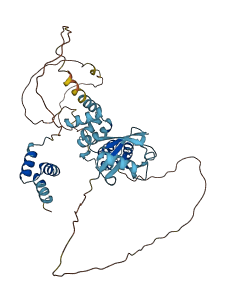
The autoinhibited protein was predicted that may have potential autoinhibitory elements via cis-regPred.
Autoinhibitory domains (AIDs)
Target domain |
|
Relief mechanism |
|
Assay |
cis-regPred |
Accessory elements
No accessory elements
Autoinhibited structure

Activated structure
15 structures for P32628
| Entry ID | Method | Resolution | Chain | Position | Source |
|---|---|---|---|---|---|
| 1X3W | X-ray | 300 A | B | 238-309 | PDB |
| 1X3Z | X-ray | 280 A | B | 238-309 | PDB |
| 2NBU | NMR | - | A | 1-78 | PDB |
| 2NBW | NMR | - | B | 1-78 | PDB |
| 2QSF | X-ray | 235 A | X | 230-398 | PDB |
| 2QSG | X-ray | 310 A | X | 230-398 | PDB |
| 2QSH | X-ray | 281 A | X | 230-398 | PDB |
| 3ESW | X-ray | 340 A | B | 254-308 | PDB |
| 3M62 | X-ray | 240 A | B | 1-84 | PDB |
| 4YIR | X-ray | 305 A | X | 230-398 | PDB |
| 6CFI | X-ray | 336 A | X | 230-398 | PDB |
| 6UBF | X-ray | 460 A | X | 230-398 | PDB |
| 6UG1 | X-ray | 283 A | X | 256-311 | PDB |
| 6UIN | X-ray | 335 A | X | 230-398 | PDB |
| AF-P32628-F1 | Predicted | AlphaFoldDB |
3 variants for P32628
| Variant ID(s) | Position | Change | Description | Diseaes Association | Provenance |
|---|---|---|---|---|---|
| s05-82513 | 31 | L>V | No | SGRP | |
| s05-82402 | 68 | V>I | No | SGRP | |
| s05-81642 | 321 | D>G | No | SGRP |
No associated diseases with P32628
5 regional properties for P32628
| Type | Name | Position | InterPro Accession |
|---|---|---|---|
| domain | Ubiquitin-like domain | 2 - 77 | IPR000626 |
| domain | Heat shock chaperonin-binding | 251 - 294 | IPR006636 |
| domain | XPC-binding domain | 264 - 308 | IPR015360 |
| domain | Ubiquitin-associated domain | 146 - 186 | IPR015940-1 |
| domain | Ubiquitin-associated domain | 355 - 395 | IPR015940-2 |
6 GO annotations of cellular component
| Name | Definition |
|---|---|
| cytoplasm | The contents of a cell excluding the plasma membrane and nucleus, but including other subcellular structures. |
| cytosol | The part of the cytoplasm that does not contain organelles but which does contain other particulate matter, such as protein complexes. |
| mitochondrion | A semiautonomous, self replicating organelle that occurs in varying numbers, shapes, and sizes in the cytoplasm of virtually all eukaryotic cells. It is notably the site of tissue respiration. |
| nucleoplasm | That part of the nuclear content other than the chromosomes or the nucleolus. |
| nucleotide-excision repair factor 2 complex | One of several protein complexes involved in nucleotide-excision repair; possesses damaged DNA binding activity. In S. cerevisiae, it is composed of Rad4p and Rad23p. |
| PNGase complex | A protein complex responsible for the catalysis of the reaction: 4-N-(N-acetyl-D-glucosaminyl)-protein + H2O = N-acetyl-beta-D-glucosaminylamine + peptide L-aspartate. This reaction is the hydrolysis of an N4-(acetyl-beta-D-glucosaminyl)asparagine residue in which the N-acetyl-D-glucosamine residue may be further glycosylated, to yield a (substituted) N-acetyl-beta-D-glucosaminylamine and the peptide containing an aspartic residue. |
5 GO annotations of molecular function
| Name | Definition |
|---|---|
| damaged DNA binding | Binding to damaged DNA. |
| polyubiquitin modification-dependent protein binding | Binding to a protein upon poly-ubiquitination of the target protein. |
| proteasome binding | Binding to a proteasome, a large multisubunit protein complex that catalyzes protein degradation. |
| protein-macromolecule adaptor activity | The binding activity of a protein that brings together two or more macromolecules in contact, permitting those molecules to function in a coordinated way. The adaptor can bring together two proteins, or a protein and another macromolecule such as a lipid or a nucleic acid. |
| ubiquitin binding | Binding to ubiquitin, a protein that when covalently bound to other cellular proteins marks them for proteolytic degradation. |
7 GO annotations of biological process
| Name | Definition |
|---|---|
| negative regulation of transcription by RNA polymerase II | Any process that stops, prevents, or reduces the frequency, rate or extent of transcription mediated by RNA polymerase II. |
| nucleotide-excision repair, DNA damage recognition | The identification of lesions in DNA, such as pyrimidine-dimers, intrastrand cross-links, and bulky adducts. The wide range of substrate specificity suggests the repair complex recognizes distortions in the DNA helix. |
| proteasome-mediated ubiquitin-dependent protein catabolic process | The chemical reactions and pathways resulting in the breakdown of a protein or peptide by hydrolysis of its peptide bonds, initiated by the covalent attachment of ubiquitin, and mediated by the proteasome. |
| protein deglycosylation | The removal of sugar residues from a glycosylated protein. |
| protein deglycosylation involved in glycoprotein catabolic process | The removal of sugar residues from a glycosylated protein that contributes to the breakdown of a glycoprotein. |
| ubiquitin-dependent ERAD pathway | The series of steps necessary to target endoplasmic reticulum (ER)-resident proteins for degradation by the cytoplasmic proteasome. Begins with recognition of the ER-resident protein, includes retrotranslocation (dislocation) of the protein from the ER to the cytosol, protein ubiquitination necessary for correct substrate transfer, transport of the protein to the proteasome, and ends with degradation of the protein by the cytoplasmic proteasome. |
| ubiquitin-dependent glycoprotein ERAD pathway | An ERAD pathway whereby endoplasmic reticulum (ER)-resident glycoproteins are targeted for degradation. Includes differential processing of the glycoprotein sugar chains, retrotranslocation to the cytosol and degradation by the ubiquitin-proteasome pathway. A glycoprotein is a compound in which a carbohydrate component is covalently bound to a protein component. |
3 homologous proteins in AiPD
| 10 | 20 | 30 | 40 | 50 | 60 |
| MVSLTFKNFK | KEKVPLDLEP | SNTILETKTK | LAQSISCEES | QIKLIYSGKV | LQDSKTVSEC |
| 70 | 80 | 90 | 100 | 110 | 120 |
| GLKDGDQVVF | MVSQKKSTKT | KVTEPPIAPE | SATTPGRENS | TEASPSTDAS | AAPAATAPEG |
| 130 | 140 | 150 | 160 | 170 | 180 |
| SQPQEEQTAT | TERTESASTP | GFVVGTERNE | TIERIMEMGY | QREEVERALR | AAFNNPDRAV |
| 190 | 200 | 210 | 220 | 230 | 240 |
| EYLLMGIPEN | LRQPEPQQQT | AAAAEQPSTA | ATTAEQPAED | DLFAQAAQGG | NASSGALGTT |
| 250 | 260 | 270 | 280 | 290 | 300 |
| GGATDAAQGG | PPGSIGLTVE | DLLSLRQVVS | GNPEALAPLL | ENISARYPQL | REHIMANPEV |
| 310 | 320 | 330 | 340 | 350 | 360 |
| FVSMLLEAVG | DNMQDVMEGA | DDMVEGEDIE | VTGEAAAAGL | GQGEGEGSFQ | VDYTPEDDQA |
| 370 | 380 | 390 | |||
| ISRLCELGFE | RDLVIQVYFA | CDKNEEAAAN | ILFSDHAD |