P53917
Gene name |
FAR11 (YNL127W, N1221, N1875) |
Protein name |
Factor arrest protein 11 |
Names |
|
Species |
Saccharomyces cerevisiae (strain ATCC 204508 / S288c) (Baker's yeast) |
KEGG Pathway |
sce:YNL127W |
EC number |
|
Protein Class |
|
Descriptions
The autoinhibited protein was predicted that may have potential autoinhibitory elements via cis-regPred.
Autoinhibitory domains (AIDs)
Target domain |
|
Relief mechanism |
|
Assay |
cis-regPred |
Accessory elements
No accessory elements
Autoinhibited structure

Activated structure
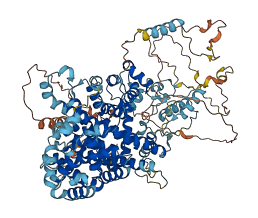
1 structures for P53917
| Entry ID | Method | Resolution | Chain | Position | Source |
|---|---|---|---|---|---|
| AF-P53917-F1 | Predicted | AlphaFoldDB |
15 variants for P53917
| Variant ID(s) | Position | Change | Description | Diseaes Association | Provenance |
|---|---|---|---|---|---|
| s14-384022 | 12 | P>S | No | SGRP | |
| s14-384104 | 39 | T>I | No | SGRP | |
| s14-384103 | 39 | T>P | No | SGRP | |
| s14-384243 | 85 | I>M | No | SGRP | |
| s14-384244 | 86 | S>R | No | SGRP | |
| s14-384352 | 122 | G>S | No | SGRP | |
| s14-384509 | 174 | G>D | No | SGRP | |
| s14-384994 | 336 | I>V | No | SGRP | |
| s14-385523 | 512 | I>N | No | SGRP | |
| s14-385704 | 572 | L>F | No | SGRP | |
| s14-385810 | 608 | L>F | No | SGRP | |
| s14-385906 | 640 | A>T | No | SGRP | |
| s14-386231 | 748 | R>L | No | SGRP | |
| s14-386249 | 754 | A>V | No | SGRP | |
| s14-386542 | 852 | H>D | No | SGRP |
No associated diseases with P53917
5 GO annotations of cellular component
| Name | Definition |
|---|---|
| cytosol | The part of the cytoplasm that does not contain organelles but which does contain other particulate matter, such as protein complexes. |
| endoplasmic reticulum | The irregular network of unit membranes, visible only by electron microscopy, that occurs in the cytoplasm of many eukaryotic cells. The membranes form a complex meshwork of tubular channels, which are often expanded into slitlike cavities called cisternae. The ER takes two forms, rough (or granular), with ribosomes adhering to the outer surface, and smooth (with no ribosomes attached). |
| endoplasmic reticulum membrane | The lipid bilayer surrounding the endoplasmic reticulum. |
| FAR/SIN/STRIPAK complex | A conserved protein phosphatase type 2A complex which contains a protein phosphatase type 2A, a protein phosphatase regulatory subunit, a striatin, an FHA domain protein and other subunits (at least six proteins). In fission yeast this complex negatively regulate the septation initiation network at the spindle pole body. |
| Golgi trans cisterna | The Golgi cisterna farthest from the endoplasmic reticulum; the final processing compartment through which proteins pass before exiting the Golgi apparatus; the compartment in which N-linked protein glycosylation is completed. |
No GO annotations of molecular function
| Name | Definition |
|---|---|
| No GO annotations for molecular function |
6 GO annotations of biological process
| Name | Definition |
|---|---|
| cellular response to pheromone | Any process that results in a change in state or activity of a cell (in terms of movement, secretion, enzyme production, gene expression, etc.) as a result of a pheromone stimulus. |
| cytoskeleton organization | A process that is carried out at the cellular level which results in the assembly, arrangement of constituent parts, or disassembly of cytoskeletal structures. |
| mitotic intra-S DNA damage checkpoint signaling | A mitotic cell cycle checkpoint that slows DNA synthesis in response to DNA damage by the prevention of new origin firing and the stabilization of slow replication fork progression. |
| positive regulation of macroautophagy | Any process, such as recognition of nutrient depletion, that activates or increases the rate of macroautophagy to bring cytosolic macromolecules to the vacuole/lysosome for degradation. |
| re-entry into mitotic cell cycle after pheromone arrest | The resumption of the mitotic cell division cycle by pheromone-arrested cells that have not mated. An example of this process is found in Saccharomyces cerevisiae. |
| regulation of cell cycle | Any process that modulates the rate or extent of progression through the cell cycle. |
6 homologous proteins in AiPD
| UniProt AC | Gene Name | Protein Name | Species | Evidence Code |
|---|---|---|---|---|
| Q0P5J8 | STRIP1 | Striatin-interacting protein 1 | Bos taurus (Bovine) | PR |
| Q9ULQ0 | STRIP2 | Striatin-interacting protein 2 | Homo sapiens (Human) | PR |
| Q5VSL9 | STRIP1 | Striatin-interacting protein 1 | Homo sapiens (Human) | PR |
| Q8C9H6 | Strip2 | Striatin-interacting proteins 2 | Mus musculus (Mouse) | PR |
| Q8C079 | Strip1 | Striatin-interacting protein 1 | Mus musculus (Mouse) | PR |
| Q803T2 | strip1 | Striatin-interacting protein 1 homolog | Danio rerio (Zebrafish) (Brachydanio rerio) | PR |
| 10 | 20 | 30 | 40 | 50 | 60 |
| MNASGRSHSK | GPIIRSVSLE | DLKRNSSFKG | NLKYKDEVTS | HKEPQVGTLS | NEELLKDLDN |
| 70 | 80 | 90 | 100 | 110 | 120 |
| MLRGKLNMGR | NSFHADKRNK | SDGNISALTF | KARSGLEGDI | RTIDIQQDSS | DENDNFKFSD |
| 130 | 140 | 150 | 160 | 170 | 180 |
| DGVNKDRNNE | KDNNTDNAVE | FQDDAEEAEE | ENEDESFANV | DELDGFDLNK | VSDGKHVPIN |
| 190 | 200 | 210 | 220 | 230 | 240 |
| EKGEVDYNMP | VDKEFQKSLD | QCAASLEERS | SAPYALQRAV | DWELKMFYSL | EDELSEWFCS |
| 250 | 260 | 270 | 280 | 290 | 300 |
| SDYMHFGQTQ | TLFKQKITQP | QLFFDDENYA | ASVVECLIED | IPNSLASNLL | ALSYISMGCF |
| 310 | 320 | 330 | 340 | 350 | 360 |
| AFTNSKSEHT | KIIRRNNLML | VPHIQEIVHA | FKKIAISCRD | DNRNLKKQTI | LLFHSSTILY |
| 370 | 380 | 390 | 400 | 410 | 420 |
| FICSICIEGR | GENPEAVNVV | IDAFEKTDLL | EFLTKYIENW | RWNSRLAMRI | RNMISLLFKL |
| 430 | 440 | 450 | 460 | 470 | 480 |
| IVLQFGDSSV | YKQTKSSIYN | LHGLTYPSKH | PEKLSISPLH | YQAFREDITS | RFPDYNMPSS |
| 490 | 500 | 510 | 520 | 530 | 540 |
| GLPKDVDKSE | SLSQFLEIPR | PKSKNPLNMA | LIVPEKHIAT | PAPSPPSSPQ | LMHLGEGPRP |
| 550 | 560 | 570 | 580 | 590 | 600 |
| RKSFQTNMAY | PCLYPSDNEG | SEDDTLEDRI | DLNIERKPDN | DIVIPFSTEE | AARILSESLE |
| 610 | 620 | 630 | 640 | 650 | 660 |
| IKLSTKQLWY | ERDLFMITER | GWKQQLENEP | YDYAALNHDA | NSSKEEKSAI | CIMQRIDKYY |
| 670 | 680 | 690 | 700 | 710 | 720 |
| KSCLSSFNSL | VFVLLQTMES | SLTNNFHRKS | EVSDKNLLNM | LTPQLEIVRA | KELSLKSAAG |
| 730 | 740 | 750 | 760 | 770 | 780 |
| ILHALLKWFK | LSHILKFEHL | AVVIHDSRYI | NTCASILSKY | SEVYPERVFN | KYVQTPNSFW |
| 790 | 800 | 810 | 820 | 830 | 840 |
| KECSLSNESY | RESYSVDDSG | EVDTEIMPSF | AYLLRILRKV | TGNKTQRLKE | LPLSIGILFK |
| 850 | 860 | 870 | 880 | 890 | 900 |
| RYYRLFNLDM | YHPILKITRE | LTPFKNKRWK | SEHMELISGV | YLYEKLELTD | NWVTGKDISG |
| 910 | 920 | 930 | 940 | 950 | |
| ELSDACGQEI | ALRALLQFYN | FQHYEISMED | LGYGHRNSSS | QDLLNKESEY | LNI |