P52555
Gene name |
Erp29 |
Protein name |
Endoplasmic reticulum resident protein 29 |
Names |
ERp29, Endoplasmic reticulum resident protein 31, ERp31 |
Species |
Rattus norvegicus (Rat) |
KEGG Pathway |
rno:117030 |
EC number |
|
Protein Class |
|
Descriptions
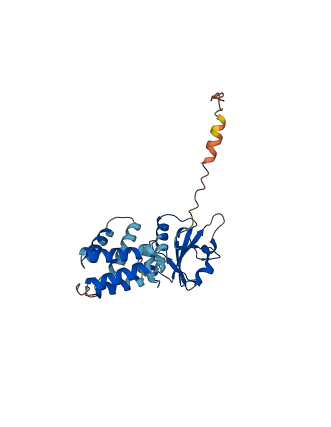
The autoinhibited protein was predicted that may have potential autoinhibitory elements via cis-regPred.
Autoinhibitory domains (AIDs)
Target domain |
|
Relief mechanism |
|
Assay |
cis-regPred |
Accessory elements
No accessory elements
Autoinhibited structure

Activated structure
5 structures for P52555
| Entry ID | Method | Resolution | Chain | Position | Source |
|---|---|---|---|---|---|
| 1G7D | NMR | - | A | 155-260 | PDB |
| 1G7E | NMR | - | A | 33-154 | PDB |
| 2M66 | NMR | - | A | 155-260 | PDB |
| 6O6I | NMR | - | A | 155-260 | PDB |
| AF-P52555-F1 | Predicted | AlphaFoldDB |
1 variants for P52555
| Variant ID(s) | Position | Change | Description | Diseaes Association | Provenance |
|---|---|---|---|---|---|
| rs8157445 | 174 | R>I | No | EVA |
No associated diseases with P52555
5 regional properties for P52555
| Type | Name | Position | InterPro Accession |
|---|---|---|---|
| domain | Sterile alpha motif domain | 705 - 772 | IPR001660 |
| repeat | Zinc finger, C2H2C-type | 549 - 593 | IPR002515 |
| repeat | Mbt repeat | 232 - 336 | IPR004092-1 |
| repeat | Mbt repeat | 340 - 442 | IPR004092-2 |
| repeat | Mbt repeat | 448 - 544 | IPR004092-3 |
6 GO annotations of cellular component
| Name | Definition |
|---|---|
| cell surface | The external part of the cell wall and/or plasma membrane. |
| endoplasmic reticulum | The irregular network of unit membranes, visible only by electron microscopy, that occurs in the cytoplasm of many eukaryotic cells. The membranes form a complex meshwork of tubular channels, which are often expanded into slitlike cavities called cisternae. The ER takes two forms, rough (or granular), with ribosomes adhering to the outer surface, and smooth (with no ribosomes attached). |
| endoplasmic reticulum lumen | The volume enclosed by the membranes of the endoplasmic reticulum. |
| melanosome | A tissue-specific, membrane-bounded cytoplasmic organelle within which melanin pigments are synthesized and stored. Melanosomes are synthesized in melanocyte cells. |
| smooth endoplasmic reticulum | The smooth endoplasmic reticulum (smooth ER or SER) has no ribosomes attached to it. The smooth ER is the recipient of the proteins synthesized in the rough ER. Those proteins to be exported are passed to the Golgi complex, the resident proteins are returned to the rough ER and the lysosomal proteins after phosphorylation of their mannose residues are passed to the lysosomes. Glycosylation of the glycoproteins also continues. The smooth ER is the site of synthesis of lipids, including the phospholipids. The membranes of the smooth ER also contain enzymes that catalyze a series of reactions to detoxify both lipid-soluble drugs and harmful products of metabolism. Large quantities of certain compounds such as phenobarbital cause an increase in the amount of the smooth ER. |
| transport vesicle | Any of the vesicles of the constitutive secretory pathway, which carry cargo from the endoplasmic reticulum to the Golgi, between Golgi cisternae, from the Golgi to the ER (retrograde transport) or to destinations within or outside the cell. |
2 GO annotations of molecular function
| Name | Definition |
|---|---|
| chaperone binding | Binding to a chaperone protein, a class of proteins that bind to nascent or unfolded polypeptides and ensure correct folding or transport. |
| protein homodimerization activity | Binding to an identical protein to form a homodimer. |
10 GO annotations of biological process
| Name | Definition |
|---|---|
| intracellular protein transport | The directed movement of proteins in a cell, including the movement of proteins between specific compartments or structures within a cell, such as organelles of a eukaryotic cell. |
| negative regulation of gene expression | Any process that decreases the frequency, rate or extent of gene expression. Gene expression is the process in which a gene's coding sequence is converted into a mature gene product (protein or RNA). |
| negative regulation of protein secretion | Any process that stops, prevents, or reduces the frequency, rate or extent of the controlled release of a protein from a cell. |
| positive regulation of gene expression | Any process that increases the frequency, rate or extent of gene expression. Gene expression is the process in which a gene's coding sequence is converted into a mature gene product (protein or RNA). |
| positive regulation of MAP kinase activity | Any process that activates or increases the frequency, rate or extent of MAP kinase activity. |
| positive regulation of protein phosphorylation | Any process that activates or increases the frequency, rate or extent of addition of phosphate groups to amino acids within a protein. |
| protein folding | The process of assisting in the covalent and noncovalent assembly of single chain polypeptides or multisubunit complexes into the correct tertiary structure. |
| protein secretion | The controlled release of proteins from a cell. |
| regulation of endoplasmic reticulum stress-induced intrinsic apoptotic signaling pathway | Any process that modulates the frequency, rate or extent of an endoplasmic reticulum stress-induced intrinsic apoptotic signaling pathway. |
| response to endoplasmic reticulum stress | Any process that results in a change in state or activity of a cell (in terms of movement, secretion, enzyme production, gene expression, etc.) as a result of a stress acting at the endoplasmic reticulum. ER stress usually results from the accumulation of unfolded or misfolded proteins in the ER lumen. |
| 10 | 20 | 30 | 40 | 50 | 60 |
| MAAAVPGAVS | LSPLLSVLLG | LLLLSAPHGA | SGLHTKGALP | LDTVTFYKVI | PKSKFVLVKF |
| 70 | 80 | 90 | 100 | 110 | 120 |
| DTQYPYGEKQ | DEFKRLAENS | ASSDDLLVAE | VGISDYGDKL | NMELSEKYKL | DKESYPVFYL |
| 130 | 140 | 150 | 160 | 170 | 180 |
| FRDGDFENPV | PYSGAVKVGA | IQRWLKGQGV | YLGMPGCLPA | YDALAGQFIE | ASSREARQAI |
| 190 | 200 | 210 | 220 | 230 | 240 |
| LKQGQDGLSG | VKETDKKWAS | QYLKIMGKIL | DQGEDFPASE | LARISKLIEN | KMSEGKKEEL |
| 250 | |||||
| QRSLNILTAF | RKKGAEKEEL |