P52020
Gene name |
Sqle (Erg1) |
Protein name |
Squalene monooxygenase |
Names |
Squalene epoxidase, SE |
Species |
Rattus norvegicus (Rat) |
KEGG Pathway |
rno:29230 |
EC number |
1.14.14.17: With reduced flavin or flavoprotein as one donor, and incorporation of one atom of oxygen |
Protein Class |
|
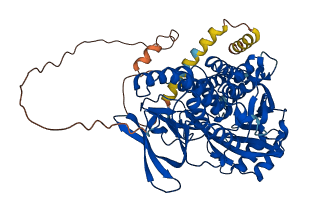
Descriptions
The autoinhibited protein was predicted that may have potential autoinhibitory elements via cis-regPred.
Autoinhibitory domains (AIDs)
Target domain |
|
Relief mechanism |
|
Assay |
cis-regPred |
Accessory elements
No accessory elements
Autoinhibited structure

Activated structure
1 structures for P52020
| Entry ID | Method | Resolution | Chain | Position | Source |
|---|---|---|---|---|---|
| AF-P52020-F1 | Predicted | AlphaFoldDB |
No variants for P52020
| Variant ID(s) | Position | Change | Description | Diseaes Association | Provenance |
|---|---|---|---|---|---|
| No variants for P52020 | |||||
No associated diseases with P52020
8 regional properties for P52020
| Type | Name | Position | InterPro Accession |
|---|---|---|---|
| domain | RNA recognition motif domain | 4 - 72 | IPR000504-1 |
| domain | RNA recognition motif domain | 155 - 230 | IPR000504-2 |
| domain | RNA recognition motif domain | 284 - 360 | IPR000504-3 |
| domain | RNA recognition motif domain | 400 - 477 | IPR000504-4 |
| domain | RNA recognition motif domain | 925 - 1001 | IPR000504-5 |
| domain | RBM12B, RNA recognition motif 2 | 153 - 238 | IPR034588 |
| domain | RBM12B, RNA recognition motif 3 | 284 - 363 | IPR034858 |
| domain | RNA-binding protein 12B, RNA recognition motif 4 | 400 - 475 | IPR047188 |
Functions
| Description | ||
|---|---|---|
| EC Number | 1.14.14.17 | With reduced flavin or flavoprotein as one donor, and incorporation of one atom of oxygen |
| Subcellular Localization |
|
|
| PANTHER Family | ||
| PANTHER Subfamily | ||
| PANTHER Protein Class | ||
| PANTHER Pathway Category | No pathway information available | |
4 GO annotations of cellular component
| Name | Definition |
|---|---|
| endoplasmic reticulum | The irregular network of unit membranes, visible only by electron microscopy, that occurs in the cytoplasm of many eukaryotic cells. The membranes form a complex meshwork of tubular channels, which are often expanded into slitlike cavities called cisternae. The ER takes two forms, rough (or granular), with ribosomes adhering to the outer surface, and smooth (with no ribosomes attached). |
| endoplasmic reticulum membrane | The lipid bilayer surrounding the endoplasmic reticulum. |
| integral component of membrane | The component of a membrane consisting of the gene products and protein complexes having at least some part of their peptide sequence embedded in the hydrophobic region of the membrane. |
| intracellular membrane-bounded organelle | Organized structure of distinctive morphology and function, bounded by a single or double lipid bilayer membrane and occurring within the cell. Includes the nucleus, mitochondria, plastids, vacuoles, and vesicles. Excludes the plasma membrane. |
2 GO annotations of molecular function
| Name | Definition |
|---|---|
| FAD binding | Binding to the oxidized form, FAD, of flavin-adenine dinucleotide, the coenzyme or the prosthetic group of various flavoprotein oxidoreductase enzymes. |
| squalene monooxygenase activity | Catalysis of the reaction: H(+) + NADPH + O(2) + squalene = (S)-2,3-epoxysqualene + H(2)O + NADP(+). |
6 GO annotations of biological process
| Name | Definition |
|---|---|
| cellular aromatic compound metabolic process | The chemical reactions and pathways involving aromatic compounds, any organic compound characterized by one or more planar rings, each of which contains conjugated double bonds and delocalized pi electrons, as carried out by individual cells. |
| cholesterol metabolic process | The chemical reactions and pathways involving cholesterol, cholest-5-en-3 beta-ol, the principal sterol of vertebrates and the precursor of many steroids, including bile acids and steroid hormones. It is a component of the plasma membrane lipid bilayer and of plasma lipoproteins and can be found in all animal tissues. |
| lipid droplet formation | A process that results in the assembly, arrangement of constituent parts of a lipid droplet. |
| regulation of cell population proliferation | Any process that modulates the frequency, rate or extent of cell proliferation. |
| response to organic substance | Any process that results in a change in state or activity of a cell or an organism (in terms of movement, secretion, enzyme production, gene expression, etc.) as a result of an organic substance stimulus. |
| sterol biosynthetic process | The chemical reactions and pathways resulting in the formation of sterols, steroids with one or more hydroxyl groups and a hydrocarbon side-chain in the molecule. |
3 homologous proteins in AiPD
| 10 | 20 | 30 | 40 | 50 | 60 |
| MWTFLGIATF | TYFYKKCGDV | TLANKELLLC | VLVFLSLGLV | LSYRCRHRNG | GLLGRHQSGS |
| 70 | 80 | 90 | 100 | 110 | 120 |
| QFAAFSDILS | ALPLIGFFWA | KSPPESEKKE | QLESKRRRKE | VNLSETTLTG | AATSVSTSSV |
| 130 | 140 | 150 | 160 | 170 | 180 |
| TDPEVIIIGS | GVLGSALATV | LSRDGRTVTV | IERDLKEPDR | ILGECLQPGG | YRVLRELGLG |
| 190 | 200 | 210 | 220 | 230 | 240 |
| DTVESLNAHH | IHGYVIHDCE | SRSEVQIPYP | VSENNQVQSG | VAFHHGKFIM | SLRKAAMAEP |
| 250 | 260 | 270 | 280 | 290 | 300 |
| NVKFIEGVVL | RLLEEDDAVI | GVQYKDKETG | DTKELHAPLT | VVADGLFSKF | RKNLISNKVS |
| 310 | 320 | 330 | 340 | 350 | 360 |
| VSSHFVGFIM | KDAPQFKANF | AELVLVDPSP | VLIYQISPSE | TRVLVDIRGE | LPRNLREYMT |
| 370 | 380 | 390 | 400 | 410 | 420 |
| EQIYPQIPDH | LKESFLEACQ | NARLRTMPAS | FLPPSSVNKR | GVLLLGDAYN | LRHPLTGGGM |
| 430 | 440 | 450 | 460 | 470 | 480 |
| TVALKDIKIW | RQLLKDIPDL | YDDAAIFQAK | KSFFWSRKRS | HSFVVNVLAQ | ALYELFSATD |
| 490 | 500 | 510 | 520 | 530 | 540 |
| DSLRQLRKAC | FLYFKLGGEC | LTGPVGLLSI | LSPDPLLLIR | HFFSVAVYAT | YFCFKSEPWA |
| 550 | 560 | 570 | |||
| TKPRALFSSG | AILYKACSII | FPLIYSEMKY | LVH |