P51791
Gene name |
Clcn3 (Clc3) |
Protein name |
H(+)/Cl(-) exchange transporter 3 |
Names |
Chloride channel protein 3, ClC-3, Chloride transporter ClC-3 |
Species |
Mus musculus (Mouse) |
KEGG Pathway |
mmu:12725 |
EC number |
|
Protein Class |
|
Descriptions
The autoinhibited protein was predicted that may have potential autoinhibitory elements via cis-regPred.
Autoinhibitory domains (AIDs)
Target domain |
|
Relief mechanism |
|
Assay |
cis-regPred |
Accessory elements
No accessory elements
Autoinhibited structure

Activated structure
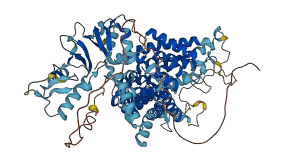
1 structures for P51791
| Entry ID | Method | Resolution | Chain | Position | Source |
|---|---|---|---|---|---|
| AF-P51791-F1 | Predicted | AlphaFoldDB |
No variants for P51791
| Variant ID(s) | Position | Change | Description | Diseaes Association | Provenance |
|---|---|---|---|---|---|
| No variants for P51791 | |||||
No associated diseases with P51791
2 regional properties for P51791
| Type | Name | Position | InterPro Accession |
|---|---|---|---|
| domain | CBS domain | 656 - 722 | IPR000644-1 |
| domain | CBS domain | 755 - 812 | IPR000644-2 |
30 GO annotations of cellular component
| Name | Definition |
|---|---|
| apical plasma membrane | The region of the plasma membrane located at the apical end of the cell. |
| axon terminus | Terminal inflated portion of the axon, containing the specialized apparatus necessary to release neurotransmitters. The axon terminus is considered to be the whole region of thickening and the terminal button is a specialized region of it. |
| cytoplasmic vesicle | A vesicle found in the cytoplasm of a cell. |
| early endosome | A membrane-bounded organelle that receives incoming material from primary endocytic vesicles that have been generated by clathrin-dependent and clathrin-independent endocytosis; vesicles fuse with the early endosome to deliver cargo for sorting into recycling or degradation pathways. |
| early endosome membrane | The lipid bilayer surrounding an early endosome. |
| endosome | A vacuole to which materials ingested by endocytosis are delivered. |
| endosome membrane | The lipid bilayer surrounding an endosome. |
| external side of plasma membrane | The leaflet of the plasma membrane that faces away from the cytoplasm and any proteins embedded or anchored in it or attached to its surface. |
| GABA-ergic synapse | A synapse that uses GABA as a neurotransmitter. These synapses are typically inhibitory. |
| glutamatergic synapse | A synapse that uses glutamate as a neurotransmitter. |
| Golgi apparatus | A membrane-bound cytoplasmic organelle of the endomembrane system that further processes the core oligosaccharides (e.g. N-glycans) added to proteins in the endoplasmic reticulum and packages them into membrane-bound vesicles. The Golgi apparatus operates at the intersection of the secretory, lysosomal, and endocytic pathways. |
| inhibitory synapse | A synapse in which an action potential in the presynaptic cell reduces the probability of an action potential occurring in the postsynaptic cell. |
| integral component of membrane | The component of a membrane consisting of the gene products and protein complexes having at least some part of their peptide sequence embedded in the hydrophobic region of the membrane. |
| integral component of plasma membrane | The component of the plasma membrane consisting of the gene products and protein complexes having at least some part of their peptide sequence embedded in the hydrophobic region of the membrane. |
| integral component of postsynaptic membrane | The component of the postsynaptic membrane consisting of the gene products and protein complexes having at least some part of their peptide sequence embedded in the hydrophobic region of the membrane. |
| integral component of synaptic vesicle membrane | The component of the synaptic vesicle membrane consisting of the gene products and protein complexes having at least some part of their peptide sequence embedded in the hydrophobic region of the membrane. |
| intracellular membrane-bounded organelle | Organized structure of distinctive morphology and function, bounded by a single or double lipid bilayer membrane and occurring within the cell. Includes the nucleus, mitochondria, plastids, vacuoles, and vesicles. Excludes the plasma membrane. |
| late endosome | A prelysosomal endocytic organelle differentiated from early endosomes by lower lumenal pH and different protein composition. Late endosomes are more spherical than early endosomes and are mostly juxtanuclear, being concentrated near the microtubule organizing center. |
| late endosome membrane | The lipid bilayer surrounding a late endosome. |
| lysosomal membrane | The lipid bilayer surrounding the lysosome and separating its contents from the cell cytoplasm. |
| membrane | A lipid bilayer along with all the proteins and protein complexes embedded in it an attached to it. |
| phagocytic vesicle | A membrane-bounded intracellular vesicle that arises from the ingestion of particulate material by phagocytosis. |
| plasma membrane | The membrane surrounding a cell that separates the cell from its external environment. It consists of a phospholipid bilayer and associated proteins. |
| recycling endosome | An organelle consisting of a network of tubules that functions in targeting molecules, such as receptors transporters and lipids, to the plasma membrane. |
| recycling endosome membrane | The lipid bilayer surrounding a recycling endosome. |
| secretory granule | A small subcellular vesicle, surrounded by a membrane, that is formed from the Golgi apparatus and contains a highly concentrated protein destined for secretion. Secretory granules move towards the periphery of the cell and upon stimulation, their membranes fuse with the cell membrane, and their protein load is exteriorized. Processing of the contained protein may take place in secretory granules. |
| specific granule | Granule with a membranous, tubular internal structure, found primarily in mature neutrophil cells. Most are released into the extracellular fluid. Specific granules contain lactoferrin, lysozyme, vitamin B12 binding protein and elastase. |
| synapse | The junction between an axon of one neuron and a dendrite of another neuron, a muscle fiber or a glial cell. As the axon approaches the synapse it enlarges into a specialized structure, the presynaptic terminal bouton, which contains mitochondria and synaptic vesicles. At the tip of the terminal bouton is the presynaptic membrane; facing it, and separated from it by a minute cleft (the synaptic cleft) is a specialized area of membrane on the receiving cell, known as the postsynaptic membrane. In response to the arrival of nerve impulses, the presynaptic terminal bouton secretes molecules of neurotransmitters into the synaptic cleft. These diffuse across the cleft and transmit the signal to the postsynaptic membrane. |
| synaptic vesicle | A secretory organelle, typically 50 nm in diameter, of presynaptic nerve terminals; accumulates in high concentrations of neurotransmitters and secretes these into the synaptic cleft by fusion with the 'active zone' of the presynaptic plasma membrane. |
| vesicle membrane | The lipid bilayer surrounding any membrane-bounded vesicle in the cell. |
9 GO annotations of molecular function
| Name | Definition |
|---|---|
| antiporter activity | Enables the active transport of a solute across a membrane by a mechanism whereby two or more species are transported in opposite directions in a tightly coupled process not directly linked to a form of energy other than chemiosmotic energy. The reaction is: solute A(out) + solute B(in) = solute A(in) + solute B(out). |
| ATP binding | Binding to ATP, adenosine 5'-triphosphate, a universally important coenzyme and enzyme regulator. |
| chloride channel activity | Enables the facilitated diffusion of a chloride (by an energy-independent process) involving passage through a transmembrane aqueous pore or channel without evidence for a carrier-mediated mechanism. |
| ion channel activity | Enables the facilitated diffusion of an ion (by an energy-independent process) by passage through a transmembrane aqueous pore or channel without evidence for a carrier-mediated mechanism. May be either selective (it enables passage of a specific ion only) or non-selective (it enables passage of two or more ions of same charge but different size). |
| PDZ domain binding | Binding to a PDZ domain of a protein, a domain found in diverse signaling proteins. |
| solute:proton antiporter activity | Enables the transfer of a solute or solutes from one side of a membrane to the other according to the reaction: solute(out) + H+(in) = solute(in) + H+(out). |
| voltage-gated chloride channel activity | Enables the transmembrane transfer of a chloride ion by a voltage-gated channel. A voltage-gated channel is a channel whose open state is dependent on the voltage across the membrane in which it is embedded. |
| voltage-gated ion channel activity | Enables the transmembrane transfer of an ion by a voltage-gated channel. An ion is an atom or group of atoms carrying an electric charge by virtue of having gained or lost one or more electrons. A voltage-gated channel is a channel whose open state is dependent on the voltage across the membrane in which it is embedded. |
| volume-sensitive chloride channel activity | Enables the transmembrane transfer of a chloride ion by a volume-sensitive channel. A volume-sensitive channel is a channel that responds to changes in the volume of a cell. |
12 GO annotations of biological process
| Name | Definition |
|---|---|
| adult locomotory behavior | Locomotory behavior in a fully developed and mature organism. |
| chloride transmembrane transport | The process in which chloride is transported across a membrane. |
| chloride transport | The directed movement of chloride into, out of or within a cell, or between cells, by means of some agent such as a transporter or pore. |
| ion transport | The directed movement of charged atoms or small charged molecules into, out of or within a cell, or between cells, by means of some agent such as a transporter or pore. |
| negative regulation of cell volume | Any process that decreases cell volume. |
| neuron cellular homeostasis | The cellular homeostatic process that preserves a neuron in a stable, differentiated functional and structural state. |
| phagocytosis, engulfment | The internalization of bacteria, immune complexes and other particulate matter or of an apoptotic cell by phagocytosis, including the membrane and cytoskeletal processes required, which involves one of three mechanisms: zippering of pseudopods around a target via repeated receptor-ligand interactions, sinking of the target directly into plasma membrane of the phagocytosing cell, or induced uptake via an enhanced membrane ruffling of the phagocytosing cell similar to macropinocytosis. |
| photoreceptor cell maintenance | Any process preventing the degeneration of the photoreceptor, a specialized cell type that is sensitive to light. |
| positive regulation of reactive oxygen species biosynthetic process | Any process that activates or increases the frequency, rate or extent of reactive oxygen species biosynthetic process. |
| synaptic transmission, GABAergic | The vesicular release of gamma-aminobutyric acid (GABA). from a presynapse, across a chemical synapse, the subsequent activation of GABA receptors at the postsynapse of a target cell (neuron, muscle, or secretory cell) and the effects of this activation on the postsynaptic membrane potential and ionic composition of the postsynaptic cytosol. This process encompasses both spontaneous and evoked release of neurotransmitter and all parts of synaptic vesicle exocytosis. Evoked transmission starts with the arrival of an action potential at the presynapse. |
| synaptic transmission, glutamatergic | The vesicular release of glutamate from a presynapse, across a chemical synapse, the subsequent activation of glutamate receptors at the postsynapse of a target cell (neuron, muscle, or secretory cell) and the effects of this activation on the postsynaptic membrane potential and ionic composition of the postsynaptic cytosol. This process encompasses both spontaneous and evoked release of neurotransmitter and all parts of synaptic vesicle exocytosis. Evoked transmission starts with the arrival of an action potential at the presynapse. |
| synaptic vesicle lumen acidification | The acidification of the synaptic vesicle lumen via transport of protons into the vesicle. The resulting electrochemical gradient powers neurotransmitter loading. |
4 homologous proteins in AiPD
| UniProt AC | Gene Name | Protein Name | Species | Evidence Code |
|---|---|---|---|---|
| P37020 | GEF1 | Anion/proton exchange transporter GEF1 | Saccharomyces cerevisiae (strain ATCC 204508 / S288c) (Baker's yeast) | PR |
| P51790 | CLCN3 | H(+)/Cl(-) exchange transporter 3 | Homo sapiens (Human) | PR |
| Q61418 | Clcn4 | H(+)/Cl(-) exchange transporter 4 | Mus musculus (Mouse) | PR |
| P51792 | Clcn3 | H(+)/Cl(-) exchange transporter 3 | Rattus norvegicus (Rat) | PR |
| 10 | 20 | 30 | 40 | 50 | 60 |
| MESEQLFHRG | YYRNSYNSIT | SASSDEELLD | GAGAIMDFQT | SEDDNLLDGD | TAAGTHYTMT |
| 70 | 80 | 90 | 100 | 110 | 120 |
| NGGSINSSTH | LLDLLDEPIP | GVGTYDDFHT | IDWVREKCKD | RERHRRINSK | KKESAWEMTK |
| 130 | 140 | 150 | 160 | 170 | 180 |
| SLYDAWSGWL | VVTLTGLASG | ALAGLIDIAA | DWMTDLKEGI | CLSALWYNHE | QCCWGSNETT |
| 190 | 200 | 210 | 220 | 230 | 240 |
| FEERDKCPQW | KTWAELIIGQ | AEGPGSYIMN | YIMYIFWALS | FAFLAVSLVK | VFAPYACGSG |
| 250 | 260 | 270 | 280 | 290 | 300 |
| IPEIKTILSG | FIIRGYLGKW | TLMIKTITLV | LAVASGLSLG | KEGPLVHVAC | CCGNIFSYLF |
| 310 | 320 | 330 | 340 | 350 | 360 |
| PKYSTNEAKK | REVLSAASAA | GVSVAFGAPI | GGVLFSLEEV | SYYFPLKTLW | RSFFAALVAA |
| 370 | 380 | 390 | 400 | 410 | 420 |
| FVLRSINPFG | NSRLVLFYVE | YHTPWYLFEL | FPFILLGVFG | GLWGAFFIRA | NIAWCRRRKS |
| 430 | 440 | 450 | 460 | 470 | 480 |
| TKFGKYPVLE | VIIVAAITAV | IAFPNPYTRL | NTSELIKELF | TDCGPLESSS | LCDYRNDMNA |
| 490 | 500 | 510 | 520 | 530 | 540 |
| SKIVDDIPDR | PAGVGVYSAI | WQLCLALIFK | IIMTVFTFGI | KVPSGLFIPS | MAIGAIAGRI |
| 550 | 560 | 570 | 580 | 590 | 600 |
| VGIAVEQLAY | YHHDWFIFKE | WCEVGADCIT | PGLYAMVGAA | ACLGGVTRMT | VSLVVIVFEL |
| 610 | 620 | 630 | 640 | 650 | 660 |
| TGGLEYIVPL | MAAVMTSKWV | GDAFGREGIY | EAHIRLNGYP | FLDAKEEFTH | TTLAADVMRP |
| 670 | 680 | 690 | 700 | 710 | 720 |
| RRSDPPLAVL | TQDNMTVDDI | ENMINETSYN | GFPVIMSKES | QRLVGFALRR | DLTIAIESAR |
| 730 | 740 | 750 | 760 | 770 | 780 |
| KKQEGIVGSS | RVCFAQHTPS | LPAESPRPLK | LRSILDMSPF | TVTDHTPMEI | VVDIFRKLGL |
| 790 | 800 | 810 | |||
| RQCLVTHNGI | VLGIITKKDI | LRHMAQTANQ | DPASIMFN |