P50580
Gene name |
Pa2g4 (Ebp1, Plfap) |
Protein name |
Proliferation-associated protein 2G4 |
Names |
IRES-specific cellular trans-acting factor 45 kDa, ITAF45, Mpp1, Proliferation-associated protein 1, Protein p38-2G4 |
Species |
Mus musculus (Mouse) |
KEGG Pathway |
mmu:18813 |
EC number |
|
Protein Class |
|
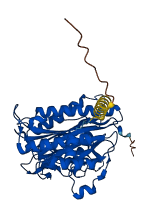
Descriptions
The autoinhibited protein was predicted that may have potential autoinhibitory elements via cis-regPred.
Autoinhibitory domains (AIDs)
Target domain |
|
Relief mechanism |
|
Assay |
cis-regPred |
Accessory elements
No accessory elements
Autoinhibited structure

Activated structure
3 structures for P50580
| Entry ID | Method | Resolution | Chain | Position | Source |
|---|---|---|---|---|---|
| 2V6C | X-ray | 250 A | A | 9-360 | PDB |
| 6SWA | EM | 310 A | t | 1-394 | PDB |
| AF-P50580-F1 | Predicted | AlphaFoldDB |
15 variants for P50580
| Variant ID(s) | Position | Change | Description | Diseaes Association | Provenance |
|---|---|---|---|---|---|
| rs3389145735 | 34 | S>T | No | EVA | |
| rs3389135173 | 52 | G>C | No | EVA | |
| rs3389111001 | 55 | M>L | No | EVA | |
| rs3389135023 | 120 | N>S | No | EVA | |
| rs3389129395 | 200 | T>M | No | EVA | |
| rs3389140001 | 233 | G>R | No | EVA | |
| rs3389135029 | 240 | A>P | No | EVA | |
| rs3389129454 | 265 | F>L | No | EVA | |
| rs3389135036 | 270 | E>K | No | EVA | |
| rs3401835251 | 307 | V>L | No | EVA | |
| rs3389129429 | 339 | E>* | No | EVA | |
| rs3389131141 | 350 | Q>H | No | EVA | |
| rs3389146626 | 359 | Q>H | No | EVA | |
| rs3389129431 | 374 | A>T | No | EVA | |
| rs264898195 | 378 | V>A | No | EVA |
No associated diseases with P50580
4 GO annotations of cellular component
| Name | Definition |
|---|---|
| cytoplasm | The contents of a cell excluding the plasma membrane and nucleus, but including other subcellular structures. |
| nucleolus | A small, dense body one or more of which are present in the nucleus of eukaryotic cells. It is rich in RNA and protein, is not bounded by a limiting membrane, and is not seen during mitosis. Its prime function is the transcription of the nucleolar DNA into 45S ribosomal-precursor RNA, the processing of this RNA into 5.8S, 18S, and 28S components of ribosomal RNA, and the association of these components with 5S RNA and proteins synthesized outside the nucleolus. This association results in the formation of ribonucleoprotein precursors; these pass into the cytoplasm and mature into the 40S and 60S subunits of the ribosome. |
| nucleus | A membrane-bounded organelle of eukaryotic cells in which chromosomes are housed and replicated. In most cells, the nucleus contains all of the cell's chromosomes except the organellar chromosomes, and is the site of RNA synthesis and processing. In some species, or in specialized cell types, RNA metabolism or DNA replication may be absent. |
| ribonucleoprotein complex | A macromolecular complex that contains both RNA and protein molecules. |
4 GO annotations of molecular function
| Name | Definition |
|---|---|
| nucleic acid binding | Binding to a nucleic acid. |
| RNA binding | Binding to an RNA molecule or a portion thereof. |
| transcription corepressor activity | A transcription coregulator activity that represses or decreases the transcription of specific gene sets via binding to a DNA-bound DNA-binding transcription factor, either on its own or as part of a complex. Corepressors often act by altering chromatin structure and modifications. For example, one class of transcription corepressors modifies chromatin structure through covalent modification of histones. A second class remodels the conformation of chromatin in an ATP-dependent fashion. A third class modulates interactions of DNA-bound DNA-binding transcription factors with other transcription coregulators. |
| ubiquitin protein ligase binding | Binding to a ubiquitin protein ligase enzyme, any of the E3 proteins. |
5 GO annotations of biological process
| Name | Definition |
|---|---|
| negative regulation of apoptotic process | Any process that stops, prevents, or reduces the frequency, rate or extent of cell death by apoptotic process. |
| negative regulation of DNA-templated transcription | Any process that stops, prevents, or reduces the frequency, rate or extent of cellular DNA-templated transcription. |
| positive regulation of cell differentiation | Any process that activates or increases the frequency, rate or extent of cell differentiation. |
| regulation of translation | Any process that modulates the frequency, rate or extent of the chemical reactions and pathways resulting in the formation of proteins by the translation of mRNA or circRNA. |
| rRNA processing | Any process involved in the conversion of a primary ribosomal RNA (rRNA) transcript into one or more mature rRNA molecules. |
| 10 | 20 | 30 | 40 | 50 | 60 |
| MSGEDEQQEQ | TIAEDLVVTK | YKMGGDIANR | VLRSLVEASS | SGVSVLSLCE | KGDAMIMEET |
| 70 | 80 | 90 | 100 | 110 | 120 |
| GKIFKKEKEM | KKGIAFPTSI | SVNNCVCHFS | PLKSDQDYIL | KEGDLVKIDL | GVHVDGFIAN |
| 130 | 140 | 150 | 160 | 170 | 180 |
| VAHTFVIGVA | QGTQVTGRKA | DVIKAAHLCA | EAALRLVKPG | NQNTQVTEAW | NKVAHSFNCT |
| 190 | 200 | 210 | 220 | 230 | 240 |
| PIEGMLSHQL | KQHVIDGEKT | IIQNPTDQQK | KDHEKAEFEV | HEVYAVDVLV | SSGEGKAKDA |
| 250 | 260 | 270 | 280 | 290 | 300 |
| GQRTTIYKRD | PSKQYGLKMK | TSRAFFSEVE | RRFDAMPFTL | RAFEDEKKAR | MGVVECAKHE |
| 310 | 320 | 330 | 340 | 350 | 360 |
| LLQPFNVLYE | KEGEFVAQFK | FTVLLMPNGP | MRITSGPFEP | DLYKSEMEVQ | DAELKALLQS |
| 370 | 380 | 390 | |||
| SASRKTQKKK | KKKASKTVEN | ATSGETLEEN | GAGD |