P50132
Gene name |
GPR4 |
Protein name |
G-protein coupled receptor 4 |
Names |
|
Species |
Sus scrofa (Pig) |
KEGG Pathway |
ssc:100144489 |
EC number |
|
Protein Class |
|
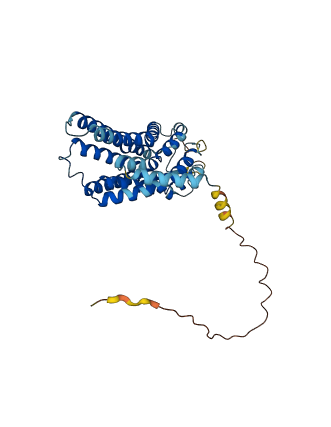
Descriptions
The autoinhibited protein was predicted that may have potential autoinhibitory elements via cis-regPred.
Autoinhibitory domains (AIDs)
Target domain |
|
Relief mechanism |
|
Assay |
cis-regPred |
Accessory elements
No accessory elements
Autoinhibited structure

Activated structure
1 structures for P50132
| Entry ID | Method | Resolution | Chain | Position | Source |
|---|---|---|---|---|---|
| AF-P50132-F1 | Predicted | AlphaFoldDB |
2 variants for P50132
| Variant ID(s) | Position | Change | Description | Diseaes Association | Provenance |
|---|---|---|---|---|---|
| rs702392451 | 275 | T>N | No | EVA | |
| rs695591045 | 361 | P>A | No | EVA |
No associated diseases with P50132
1 regional properties for P50132
| Type | Name | Position | InterPro Accession |
|---|---|---|---|
| domain | GPCR, rhodopsin-like, 7TM | 34 - 286 | IPR017452 |
2 GO annotations of cellular component
| Name | Definition |
|---|---|
| integral component of membrane | The component of a membrane consisting of the gene products and protein complexes having at least some part of their peptide sequence embedded in the hydrophobic region of the membrane. |
| plasma membrane | The membrane surrounding a cell that separates the cell from its external environment. It consists of a phospholipid bilayer and associated proteins. |
1 GO annotations of molecular function
| Name | Definition |
|---|---|
| G protein-coupled receptor activity | Combining with an extracellular signal and transmitting the signal across the membrane by activating an associated G-protein; promotes the exchange of GDP for GTP on the alpha subunit of a heterotrimeric G-protein complex. |
5 GO annotations of biological process
| Name | Definition |
|---|---|
| adenylate cyclase-activating G protein-coupled receptor signaling pathway | A G protein-coupled receptor signaling pathway in which the signal is transmitted via the activation of adenylyl cyclase activity and a subsequent increase in the intracellular concentration of cyclic AMP (cAMP). |
| positive regulation of inflammatory response | Any process that activates or increases the frequency, rate or extent of the inflammatory response. |
| regulation of cell adhesion | Any process that modulates the frequency, rate or extent of attachment of a cell to another cell or to the extracellular matrix. |
| regulation of vascular permeability | Any process that modulates the extent to which blood vessels can be pervaded by fluid. |
| response to acidic pH | Any process that results in a change in state or activity of a cell or an organism (in terms of movement, secretion, enzyme production, gene expression, etc.) as a result of a pH stimulus with pH < 7. pH is a measure of the acidity or basicity of an aqueous solution. |
4 homologous proteins in AiPD
| UniProt AC | Gene Name | Protein Name | Species | Evidence Code |
|---|---|---|---|---|
| Q1JQB3 | GPR4 | G-protein coupled receptor 4 | Bos taurus (Bovine) | PR |
| P46093 | GPR4 | G-protein coupled receptor 4 | Homo sapiens (Human) | PR |
| Q8BUD0 | Gpr4 | G-protein coupled receptor 4 | Mus musculus (Mouse) | PR |
| Q4KLH9 | Gpr4 | G-protein coupled receptor 4 | Rattus norvegicus (Rat) | PR |
| 10 | 20 | 30 | 40 | 50 | 60 |
| MGNGTWEGCH | VDSRVDHLFP | PSLYIFVIGV | GLPTNCLALW | AAYRQVRQRN | ELGVYLMNLS |
| 70 | 80 | 90 | 100 | 110 | 120 |
| IADLLYICTL | PLWVDYFLHH | DNWIHGPGSC | KLFGFIFYTN | IYISIAFLCC | ISVDRYLAVA |
| 130 | 140 | 150 | 160 | 170 | 180 |
| HPLRFARLRR | VKTAVAVSSV | VWATELGANS | VPLFHDELFR | DRYNHTFCFE | KFPMEGWVAW |
| 190 | 200 | 210 | 220 | 230 | 240 |
| MNLYRVFVGF | LFPWALMLLS | YRGILRAVRG | SVSTERQEKA | KIKRLALSLI | AIVLVCFAPY |
| 250 | 260 | 270 | 280 | 290 | 300 |
| HVLLLSRSAV | YLGHPWDCGF | EERVFSAYHS | SLAFTSLNCV | ADPILYCLVN | EGARSDVAKA |
| 310 | 320 | 330 | 340 | 350 | 360 |
| LHNLLRFLTS | DKPQEMASAS | LTLDTPLTSK | RNSMARAVAA | GWVASPPSQG | DQVQLKMLPP |
| PAP |