P49768
Gene name |
PSEN1 (AD3, PS1, PSNL1) |
Protein name |
Presenilin-1 |
Names |
PS-1, Protein S182 |
Species |
Homo sapiens (Human) |
KEGG Pathway |
hsa:5663 |
EC number |
|
Protein Class |
|
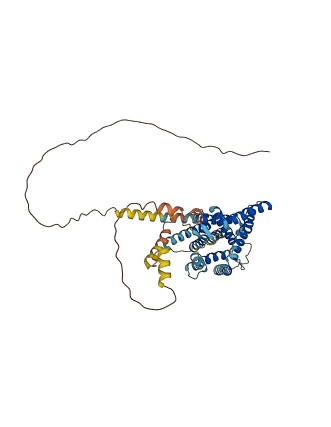
Descriptions
The autoinhibited protein was predicted that may have potential autoinhibitory elements via cis-regPred.
Autoinhibitory domains (AIDs)
Target domain |
|
Relief mechanism |
|
Assay |
cis-regPred |
Accessory elements
No accessory elements
Autoinhibited structure

Activated structure
17 structures for P49768
| Entry ID | Method | Resolution | Chain | Position | Source |
|---|---|---|---|---|---|
| 2KR6 | NMR | - | A | 292-467 | PDB |
| 4UIS | EM | 440 A | B | 81-463 | PDB |
| 5A63 | EM | 340 A | B | 1-467 | PDB |
| 5FN2 | EM | 420 A | B | 1-467 | PDB |
| 5FN3 | EM | 410 A | B | 1-467 | PDB |
| 5FN4 | EM | 400 A | B | 1-467 | PDB |
| 5FN5 | EM | 430 A | B | 1-467 | PDB |
| 6IDF | EM | 270 A | B | 1-467 | PDB |
| 6IYC | EM | 260 A | B | 1-467 | PDB |
| 6LQG | EM | 310 A | B | 1-467 | PDB |
| 6LR4 | EM | 300 A | B | 1-467 | PDB |
| 7C9I | EM | 310 A | B | 1-467 | PDB |
| 7D8X | EM | 260 A | B | 1-467 | PDB |
| 7Y5T | EM | 290 A | B | 1-467 | PDB |
| 8IM7 | EM | 340 A | B | 1-467 | PDB |
| 8K8E | EM | 260 A | B | 1-467 | PDB |
| AF-P49768-F1 | Predicted | AlphaFoldDB |
499 variants for P49768
| Variant ID(s) | Position | Change | Description | Diseaes Association | Provenance |
|---|---|---|---|---|---|
|
RCV000274293 CA10635145 rs886050663 RCV000357249 RCV001313651 |
27 | R>C | Alzheimer disease 3 Dilated cardiomyopathy 1U [ClinVar] | Yes |
ClinGen ClinVar dbSNP gnomAD |
|
rs149562759 RCV001120055 RCV001120056 CA7256652 |
27 | R>H | Alzheimer disease 3 Variant assessed as Somatic; 0.0 impact. Dilated cardiomyopathy 1U [ClinVar, NCI-TCGA] | Yes |
ClinGen ClinVar ESP ExAC NCI-TCGA TOPMed dbSNP gnomAD |
|
RCV000172094 RCV001120057 VAR_075260 RCV001120058 CA224981 RCV000084280 RCV000640608 rs63750592 |
35 | R>Q | Alzheimer disease 3 Alzheimer disease Dilated cardiomyopathy 1U AD3; unknown pathological significance; decreased protease activity with APP [ClinVar, UniProt] | Yes |
ClinGen ClinVar UniProt ESP ExAC TOPMed dbSNP gnomAD |
|
rs746691776 RCV001090096 CA7256673 |
35 | R>W | Frontotemporal dementia [ClinVar] | Yes |
ClinGen ClinVar ExAC TOPMed dbSNP gnomAD |
|
RCV001120059 RCV001120060 CA7256686 rs367775281 RCV001856575 |
42 | R>Q | Alzheimer disease 3 Dilated cardiomyopathy 1U [ClinVar] | Yes |
ClinGen ClinVar 1000Genomes ESP ExAC TOPMed dbSNP gnomAD |
|
RCV001296368 rs777427451 CA7256694 |
60 | R>W | Alzheimer disease 3 [ClinVar] | Yes |
ClinGen ClinVar ExAC TOPMed dbSNP gnomAD |
|
RCV000019787 RCV000084281 rs63749824 VAR_006413 RCV000529477 CA224983 |
79 | A>V | Alzheimer disease 3 AD3; also found in late-onset Alzheimer disease; impaired protease activity with APP; results in altered amyloid-beta production and increased amyloid-beta 42/amyloid-beta 40 ratio; no effect on interaction with GFAP [ClinVar, UniProt] | Yes |
ClinGen ClinVar UniProt ExAC dbSNP gnomAD |
|
CA224984 rs63749967 RCV000084282 VAR_006414 |
82 | V>L | AD3; decreased protease activity with APP; no effect on interaction with GFAP [UniProt] | Yes |
ClinGen ClinVar UniProt Ensembl dbSNP |
| VAR_075261 | 83 | I>T | AD3 [UniProt] | Yes | UniProt |
|
RCV000084284 VAR_081228 rs63750599 CA127841 RCV000019783 |
85 | L>P | Alzheimer disease, familial, 3, with spastic paraparesis and apraxia AD3; the patient also manifest spastic paraparesis and apraxia; loss of protease activity with APP in vitro; altered amyloid-beta production in cells transfected with the mutant and increased amyloid-beta 42/amyloid-beta 40 ratio [ClinVar, UniProt] | Yes |
ClinGen ClinVar UniProt Ensembl dbSNP |
|
CA390303263 rs1594998354 RCV000853575 |
86 | F>C | Alzheimer disease 3 [ClinVar] | Yes |
ClinGen ClinVar Ensembl dbSNP |
|
rs1897874329 RCV001261949 |
88 | P>R | Frontotemporal dementia [ClinVar] | Yes |
ClinVar dbSNP |
|
rs1897874234 RCV001208063 |
88 | P>T | Alzheimer disease 3 [ClinVar] | Yes |
ClinVar dbSNP |
|
RCV000084285 CA224987 RCV000020083 VAR_081229 rs63750815 |
89 | V>L | Alzheimer disease 3 AD3; decreased protease activity with APP; increased amyloid-beta 42/amyloid-beta 40 ratio [ClinVar, UniProt] | Yes |
ClinGen ClinVar UniProt Ensembl dbSNP |
|
RCV001043730 rs1007193620 CA262614455 |
90 | T>S | Alzheimer disease 3 [ClinVar] | Yes |
ClinGen ClinVar Ensembl dbSNP |
|
rs63751141 RCV000084286 CA224989 VAR_016214 RCV000019772 |
92 | C>S | Alzheimer disease 3 AD3; loss of protease activity with APP [ClinVar, UniProt] | Yes |
ClinGen ClinVar UniProt Ensembl dbSNP |
|
rs63750831 RCV000084287 CA224990 VAR_081230 RCV001854471 |
94 | V>M | Alzheimer disease 3 AD3; unknown pathological significance; reduced protease activity with APP; no relevant change in amyloid-beta 42/amyloid-beta 40 ratio [ClinVar, UniProt] | Yes |
ClinGen ClinVar UniProt ExAC dbSNP gnomAD |
|
CA224992 VAR_006415 rs63750601 RCV000084288 |
96 | V>F | AD3; loss of protease activity with APP [UniProt] | Yes |
ClinGen ClinVar UniProt Ensembl dbSNP |
|
rs63750852 VAR_081231 RCV000084289 CA224993 |
97 | V>L | AD3; unknown pathological significance; slightly reduced protease activity with APP [UniProt] | Yes |
ClinGen ClinVar UniProt TOPMed dbSNP gnomAD |
|
RCV001230382 rs1897876766 |
103 | V>G | Alzheimer disease 3 [ClinVar] | Yes |
ClinVar dbSNP |
|
RCV000084291 VAR_009208 CA224997 rs63750321 |
105 | F>L | AD3 [UniProt] | Yes |
ClinGen ClinVar UniProt dbSNP gnomAD |
|
rs63751399 RCV000019775 RCV001228362 RCV000084292 CA224998 VAR_016215 RCV000020084 |
113 | L>P | Alzheimer disease 3 Frontotemporal dementia Frontotemporal dementia (ftd) frontotemporal dementia [ClinVar, Ensembl, UniProt] | Yes |
ClinGen ClinVar UniProt Ensembl dbSNP |
|
CA225002 VAR_006416 rs63750450 RCV000640610 RCV001199924 RCV000084295 |
115 | Y>C | Alzheimer disease 3 AD3 [ClinVar, UniProt] | Yes |
ClinGen ClinVar UniProt Ensembl dbSNP |
| VAR_006417 | 115 | Y>H | AD3; impaired protease activity with APP and increased amyloid-beta 42/amyloid-beta 40 ratio [UniProt] | Yes | UniProt |
|
RCV002514493 VAR_081232 RCV000084296 rs63750730 CA225003 |
116 | T>I | Alzheimer disease 3 AD3 [ClinVar, UniProt] | Yes |
ClinGen ClinVar UniProt Ensembl dbSNP |
|
VAR_010120 CA390304675 rs63750730 RCV000816670 |
116 | T>N | Alzheimer disease 3 AD3; unusual amyloid cotton wool plaques detected in one patient's brain; severe decrease of protease activity with APP; results in increased amyloid-beta 42/amyloid-beta 40 ratio [ClinVar, UniProt] | Yes |
ClinGen ClinVar UniProt Ensembl dbSNP |
|
RCV002272062 VAR_009209 CA225007 RCV000084298 rs63749805 |
117 | P>L | Alzheimer disease 3 AD3; impaired ability to cleave Ephb2/CTF1; results in altered amyloid-beta production and increased amyloid-beta 42/amyloid-beta 40 ratio; impaired regulation of neurite outgrowth [ClinVar, UniProt] | Yes |
ClinGen ClinVar UniProt Ensembl dbSNP |
|
rs63750550 RCV002514494 RCV000084297 CA225005 VAR_081233 |
117 | P>S | Alzheimer disease 3 AD3; results in altered amyloid-beta production and increased amyloid-beta 42/amyloid-beta 40 ratio; impaired regulation of neurite outgrowth [ClinVar, UniProt] | Yes |
ClinGen ClinVar UniProt Ensembl dbSNP |
|
RCV000782176 RCV001196175 rs1566630791 CA390304710 |
119 | T>I | Alzheimer disease 3 Frontotemporal dementia [ClinVar] | Yes |
ClinGen ClinVar Ensembl dbSNP |
|
CA225009 rs63751272 VAR_006418 RCV000019765 RCV000084300 CA390304722 |
120 | E>D | Alzheimer disease 3 AD3; impaired protease activity with APP and increased amyloid-beta 42/amyloid-beta 40 ratio [ClinVar, UniProt] | Yes |
ClinGen ClinVar UniProt Ensembl dbSNP |
|
RCV000084299 VAR_006419 rs63750800 CA225008 |
120 | E>K | AD3; impaired protease activity with APP and increased amyloid-beta 42/amyloid-beta 40 ratio [UniProt] | Yes |
ClinGen ClinVar UniProt Ensembl dbSNP |
|
rs1566630811 RCV000736265 CA390304742 |
122 | T>A | Frontotemporal dementia [ClinVar] | Yes |
ClinGen ClinVar Ensembl dbSNP |
|
rs1595002439 VAR_070023 RCV000823608 CA390304887 |
134 | L>R | Alzheimer disease 3 AD3; uncertain pathological significance; loss of protease activity with APP [ClinVar, UniProt] | Yes |
ClinGen ClinVar UniProt Ensembl dbSNP |
|
rs63750353 CA225012 VAR_010121 RCV001854472 RCV000084302 |
135 | N>D | Alzheimer disease 3 AD3; impaired protease activity with APP and increased amyloid-beta 42/amyloid-beta 40 ratio [ClinVar, UniProt] | Yes |
ClinGen ClinVar UniProt Ensembl dbSNP |
|
RCV000824341 rs63751278 CA225013 RCV000084303 |
135 | N>S | Alzheimer disease 3 [ClinVar] | Yes |
ClinGen ClinVar Ensembl dbSNP |
|
RCV000736260 CA390304909 rs1566630884 |
137 | A>T | Frontotemporal dementia [ClinVar] | Yes |
ClinGen ClinVar Ensembl dbSNP |
|
rs63750522 CA225017 VAR_006420 CA390304940 RCV000084306 |
139 | M>I | AD3 [UniProt] | Yes |
ClinGen Ensembl ClinVar UniProt dbSNP |
|
CA390304935 rs63751106 VAR_010122 |
139 | M>K | AD3 [UniProt] | Yes |
ClinGen UniProt Ensembl dbSNP |
|
VAR_006421 rs63751106 CA225016 RCV000084305 RCV001290408 |
139 | M>T | Alzheimer disease 3 AD3 [ClinVar, UniProt] | Yes |
ClinGen ClinVar UniProt Ensembl dbSNP |
|
rs63751037 CA225015 RCV000019756 RCV000084304 VAR_006422 |
139 | M>V | Alzheimer disease 3 AD3; increased amyloid-beta 42/amyloid-beta 40 ratio [ClinVar, UniProt] | Yes |
ClinGen ClinVar UniProt Ensembl dbSNP |
| VAR_081234 | 142 | V>F | AD3; unknown pathological significance [UniProt] | Yes | UniProt |
|
CA390304971 RCV000736266 rs1566630910 |
142 | V>I | Alzheimer disease [ClinVar] | Yes |
ClinGen ClinVar Ensembl dbSNP |
|
CA225018 rs63750322 VAR_006423 RCV000084307 |
143 | I>F | AD3 [UniProt] | Yes |
ClinGen ClinVar UniProt Ensembl dbSNP |
|
CA225019 VAR_006424 RCV001071503 rs63750004 RCV000084308 |
143 | I>T | Alzheimer disease 3 AD3; impaired protease activity with APP; results in altered amyloid-beta production and increased amyloid-beta 42/amyloid-beta 40 ratio [ClinVar, UniProt] | Yes |
ClinGen ClinVar UniProt Ensembl dbSNP |
|
CA258121 RCV001854473 CA390305025 VAR_006425 rs63750391 RCV000084311 CA225023 RCV000019767 |
146 | M>I | Alzheimer disease 3 AD3 [ClinVar, UniProt] | Yes |
ClinGen Ensembl ClinVar UniProt dbSNP |
|
RCV000019751 RCV003105774 RCV000084310 RCV002247483 VAR_006426 CA225022 rs63750306 CA341490 RCV001248367 |
146 | M>L | Alzheimer disease 3 Pick disease AD3; disease phenotype shows high clinical variability; founder mutation originating from Southern Italy and distributed worldwide; alters the conformation of the active site; slightly increased protease activity with APP; decreased activity for Notch1 cleavage; no loss of its ability to cleave Ephb2/CTF1 [ClinVar, UniProt] | Yes |
ClinGen ClinVar UniProt Ensembl dbSNP |
|
CA258120 RCV000019757 VAR_006427 rs63750306 |
146 | M>V | Alzheimer disease 3 AD3; loss of function as calcium-leak channel; results in calcium overload in the endoplasmic reticulum [ClinVar, UniProt] | Yes |
ClinGen ClinVar UniProt Ensembl dbSNP |
|
RCV000084312 rs63750907 CA225024 VAR_010123 |
147 | T>I | AD3; results in altered amyloid-beta production and increased amyloid-beta 42/amyloid-beta 40 ratio [UniProt] | Yes |
ClinGen ClinVar UniProt Ensembl dbSNP |
|
VAR_081235 rs63751441 RCV000084313 CA225025 |
153 | L>V | AD3; abolishes protease activity with APP resulting in decreased amyloid-beta 42 and amyloid-beta 40 production [UniProt] | Yes |
ClinGen ClinVar UniProt ExAC TOPMed dbSNP gnomAD |
|
RCV000084315 rs63751292 VAR_081236 CA225029 |
154 | Y>C | AD3; unknown pathological significance [UniProt] | Yes |
ClinGen ClinVar UniProt Ensembl dbSNP |
|
CA225027 rs63750588 RCV000084314 VAR_081237 |
154 | Y>N | AD3; disease phenotype includes spastic paraparesis; abolishes protease activity with APP resulting in decreased amyloid-beta 42 and amyloid-beta 40 production [UniProt] | Yes |
ClinGen ClinVar UniProt Ensembl dbSNP |
|
RCV002271336 RCV000084316 rs63750631 |
155 | K>FI | Alzheimer disease, familial, 3, with spastic paraparesis and unusual plaques [ClinVar] | Yes |
ClinVar dbSNP |
| VAR_075262 | 156 | Y>FTY | AD3; unknown pathological significance [UniProt] | Yes | UniProt |
|
VAR_081238 rs778630379 CA390305138 |
159 | Y>F | AD3; unknown pathological significance [UniProt] | Yes |
ClinGen UniProt ExAC dbSNP gnomAD |
|
RCV003222216 rs1897961716 RCV001067591 |
159 | Y>H | Alzheimer disease 3 [ClinVar] | Yes |
ClinVar dbSNP |
|
rs1898533490 RCV001315317 |
161 | V>I | Alzheimer disease 3 [ClinVar] | Yes |
ClinVar dbSNP |
|
rs1898533739 RCV001070299 |
162 | I>S | Alzheimer disease 3 [ClinVar] | Yes |
ClinVar dbSNP |
|
RCV002490394 CA225034 VAR_006428 RCV000019752 RCV000084318 RCV000534810 rs63750590 |
163 | H>R | Alzheimer disease 3 AD3; abolishes protease activity with APP; decreased activity for Notch cleavage [ClinVar, UniProt] | Yes |
ClinGen ClinVar UniProt Ensembl dbSNP |
|
CA225033 rs63749885 RCV000019758 VAR_006429 RCV000084317 |
163 | H>Y | Alzheimer disease 3 AD3; slightly increased protease activity with APP and slightly increased amyloid-beta 42 production [ClinVar, UniProt] | Yes |
ClinGen ClinVar UniProt Ensembl dbSNP |
|
CA225037 VAR_010124 rs63751484 RCV000084320 |
165 | W>C | AD3 [UniProt] | Yes |
ClinGen ClinVar UniProt Ensembl dbSNP |
|
VAR_016216 CA258123 rs63750265 RCV000019776 |
166 | L>P | Alzheimer disease 3 AD3; onset in adolescence; severe decrease of protease activity with APP; results in altered amyloid-beta production and increased amyloid-beta 42/amyloid-beta 40 ratio; results in reduced Notch proteolysis [ClinVar, UniProt] | Yes |
ClinGen ClinVar UniProt Ensembl dbSNP |
| VAR_081239 | 168 | I>del | AD3; unknown pathological significance; abolishes protease activity with APP resulting in decreased amyloid-beta 42 and amyloid-beta 40 production [UniProt] | Yes | UniProt |
|
RCV002513897 VAR_006430 CA225045 RCV000084325 rs63751210 |
169 | S>L | Alzheimer disease 3 AD3 [ClinVar, UniProt] | Yes |
ClinGen ClinVar UniProt Ensembl dbSNP |
|
rs63750418 RCV000084324 VAR_006431 CA225044 |
169 | S>P | AD3; results in altered amyloid-beta production and increased amyloid-beta 42/amyloid-beta 40 ratio [UniProt] | Yes |
ClinGen ClinVar UniProt Ensembl dbSNP |
|
VAR_081240 RCV000084326 CA225046 rs63750577 RCV000019788 |
170 | S>F | Alzheimer disease 3 AD3; results in altered amyloid-beta production and increased amyloid-beta 42/amyloid-beta 40 ratio [ClinVar, UniProt] | Yes |
ClinGen ClinVar UniProt Ensembl dbSNP |
|
RCV001047251 rs63750577 |
170 | S>Y | Alzheimer disease 3 [ClinVar] | Yes |
ClinVar dbSNP |
|
rs1566638673 RCV000736263 |
170 | S>Y | Alzheimer disease [ClinVar] | Yes |
ClinVar dbSNP |
|
VAR_006432 rs63750963 RCV000084327 CA225048 RCV002514495 |
171 | L>P | Alzheimer disease 3 AD3; abolishes protease activity with APP [ClinVar, UniProt] | Yes |
ClinGen ClinVar UniProt Ensembl dbSNP |
|
CA225049 RCV000084328 rs63750299 VAR_010125 |
173 | L>W | AD3; results in altered amyloid-beta production and increased amyloid-beta 42/amyloid-beta 40 ratio [UniProt] | Yes |
ClinGen ClinVar UniProt Ensembl dbSNP |
|
rs63751144 VAR_016217 CA225050 RCV000084329 RCV000019777 |
174 | L>M | Alzheimer disease 3 AD3; results in altered amyloid-beta production and increased amyloid-beta 42/amyloid-beta 40 ratio [ClinVar, UniProt] | Yes |
ClinGen ClinVar UniProt Ensembl dbSNP |
|
RCV000850226 rs1595026031 |
174 | L>missing | Alzheimer disease 3 [ClinVar] | Yes |
ClinVar dbSNP |
|
RCV000084332 rs63749911 VAR_075263 CA225055 |
177 | F>L | AD3; results in altered amyloid-beta production and increased amyloid-beta 42/amyloid-beta 40 ratio [UniProt] | Yes |
ClinGen ClinVar UniProt Ensembl dbSNP |
|
RCV002513898 VAR_075264 rs63749806 CA225057 RCV000084333 |
177 | F>S | Alzheimer disease 3 AD3; unknown pathological significance [ClinVar, UniProt] | Yes |
ClinGen ClinVar UniProt Ensembl dbSNP |
|
RCV000640607 rs63750155 CA225059 VAR_075265 RCV000084334 |
178 | S>P | Alzheimer disease 3 AD3; unknown pathological significance; abolishes protease activity with APP [ClinVar, UniProt] | Yes |
ClinGen ClinVar UniProt Ensembl dbSNP |
|
RCV000019779 VAR_081241 RCV000020085 RCV000084335 rs63751068 CA225061 |
183 | G>V | Alzheimer disease 3 Pick disease PIDB and AD3; neuropathologic examination of brain sections from the patient shows the presence of Pick bodies and absence of beta-amyloid plaques; unknown pathological significance; results in altered amyloid-beta production and increased amyloid-beta 42/amyloid-beta 40 ratio in vitro [ClinVar, UniProt] | Yes |
ClinGen ClinVar UniProt TOPMed dbSNP |
|
RCV000084336 VAR_081242 rs63750311 RCV001857411 CA225063 |
184 | E>D | Alzheimer disease 3 AD3; results in altered amyloid-beta production and increased amyloid-beta 42/amyloid-beta 40 ratio [ClinVar, UniProt] | Yes |
ClinGen ClinVar UniProt Ensembl dbSNP |
|
RCV000785875 CA390298871 rs1566641934 |
184 | E>G | Alzheimer disease 3 [ClinVar] | Yes |
ClinGen ClinVar Ensembl dbSNP |
|
rs556147068 CA7256783 RCV001325814 |
189 | Y>C | Alzheimer disease 3 [ClinVar] | Yes |
ClinGen ClinVar 1000Genomes ExAC TOPMed dbSNP gnomAD |
|
RCV000640609 RCV002482890 rs63750082 CA258122 VAR_016218 RCV000518563 RCV000019773 |
206 | G>A | Alzheimer disease 3 AD3; results in altered amyloid-beta production and increased amyloid-beta 42/amyloid-beta 40 ratio [ClinVar, UniProt] | Yes |
ClinGen ClinVar UniProt 1000Genomes ExAC TOPMed dbSNP gnomAD |
|
RCV000995615 CA390299366 VAR_081243 rs63750082 |
206 | G>D | Alzheimer disease 3 AD3; affects APP processing resulting in increased amyloid-beta 42/amyloid-beta 40 ratio; does not affect NOTCH processing; does not affect endoproteolysis; reduced interaction with PEN2; results in decreased protein levels in the endoplasmic reticulum but increased levels in early endosome; reduced ability to maintain ER calcium homeostasis [ClinVar, UniProt] | Yes |
ClinGen ClinVar UniProt 1000Genomes ExAC TOPMed dbSNP gnomAD |
|
VAR_075266 RCV000084337 CA225065 rs63750569 |
206 | G>S | AD3; results in altered amyloid-beta production and increased amyloid-beta 42/amyloid-beta 40 ratio [UniProt] | Yes |
ClinGen ClinVar UniProt Ensembl dbSNP |
|
RCV000813898 CA7256794 rs543391977 |
208 | V>L | Alzheimer disease 3 [ClinVar] | Yes |
ClinGen ClinVar 1000Genomes ExAC dbSNP gnomAD |
|
rs63750053 CA390299412 VAR_075267 RCV000821428 |
209 | G>E | Alzheimer disease 3 AD3; unknown pathological significance [ClinVar, UniProt] | Yes |
ClinGen ClinVar UniProt Ensembl dbSNP |
|
rs63749880 RCV000084339 VAR_009210 CA225069 |
209 | G>R | AD3; results in altered amyloid-beta production and increased amyloid-beta 42/amyloid-beta 40 ratio [UniProt] | Yes |
ClinGen ClinVar UniProt Ensembl dbSNP |
|
VAR_006433 rs63750053 RCV000640604 RCV000084340 CA225070 |
209 | G>V | Alzheimer disease 3 AD3; abolishes protease activity with APP [ClinVar, UniProt] | Yes |
ClinGen ClinVar UniProt Ensembl dbSNP |
|
rs1555355250 CA390299466 RCV000712873 RCV001055042 |
212 | S>Y | Alzheimer disease 3 [ClinVar] | Yes |
ClinGen ClinVar Ensembl dbSNP |
|
CA262609413 rs63750861 VAR_075268 |
213 | I>L | AD3; increases protease activity with APP resulting in altered amyloid-beta production and increased amyloid-beta 42/amyloid-beta 40 ratio [UniProt] | Yes |
ClinGen UniProt Ensembl dbSNP |
|
CA225073 VAR_006434 RCV000084342 rs63751309 |
213 | I>T | AD3; decreased protease activity with APP resulting in altered amyloid-beta production and increased amyloid-beta 42/amyloid-beta 40 ratio [UniProt] | Yes |
ClinGen ClinVar UniProt Ensembl dbSNP |
|
RCV001377214 CA127843 VAR_081244 rs267606983 RCV000019789 |
217 | G>R | Alzheimer disease 3 Alzheimer disease, familial, 3, with unusual plaques AD3; with unusual amyloid cotton wool plaques; decreased protease activity with APP resulting in altered amyloid-beta production and increased amyloid-beta 42/amyloid-beta 40 ratio [ClinVar, UniProt] | Yes |
ClinGen ClinVar UniProt Ensembl dbSNP |
|
rs63750761 VAR_010126 CA225079 RCV000084346 RCV002272063 |
219 | L>P | Familial Alzheimer disease AD3 [ClinVar, UniProt] | Yes |
ClinGen ClinVar UniProt Ensembl dbSNP |
|
RCV000803782 CA7256798 rs763831389 |
220 | R>Q | Alzheimer disease 3 [ClinVar] | Yes |
ClinGen ClinVar ExAC TOPMed dbSNP gnomAD |
|
RCV000736262 rs63750009 CA390299622 |
222 | Q>P | Alzheimer disease [ClinVar] | Yes |
ClinGen ClinVar Ensembl dbSNP |
|
CA225080 VAR_075269 RCV000084347 rs63750009 |
222 | Q>R | AD3; unknown pathological significance; slightly increased protease activity with APP and slightly increased amyloid-beta 42/amyloid-beta 40 ratio [UniProt] | Yes |
ClinGen ClinVar UniProt Ensembl dbSNP |
|
RCV001350081 rs1898776259 |
223 | Q>K | Alzheimer disease 3 [ClinVar] | Yes |
ClinVar dbSNP |
|
rs63749970 RCV000084351 CA225088 VAR_081245 |
229 | I>F | AD3; decreased protease activity with APP resulting in altered amyloid-beta production and increased amyloid-beta 42/amyloid-beta 40 ratio [UniProt] | Yes |
ClinGen ClinVar UniProt Ensembl dbSNP |
|
VAR_006435 RCV000084352 rs63749836 RCV000763347 CA225090 |
231 | A>T | Alzheimer disease 3 AD3; decreased protease activity with APP resulting in altered amyloid-beta production and increased amyloid-beta 42/amyloid-beta 40 ratio [ClinVar, UniProt] | Yes |
ClinGen ClinVar UniProt Ensembl dbSNP |
|
VAR_006436 CA225091 rs63750799 RCV000084353 |
231 | A>V | AD3; results in altered amyloid-beta production and increased amyloid-beta 42/amyloid-beta 40 ratio [UniProt] | Yes |
ClinGen ClinVar UniProt Ensembl dbSNP |
|
CA225092 VAR_009211 rs63751287 RCV000084354 |
233 | M>L | AD3; slightly decreased protease activity with APP resulting in altered amyloid-beta production and mildly increased amyloid-beta 42/amyloid-beta 40 ratio [UniProt] | Yes |
ClinGen ClinVar UniProt Ensembl dbSNP |
|
RCV000084355 CA225093 VAR_006437 rs63751024 RCV001808318 |
233 | M>T | Alzheimer disease 3 AD3; decreased protease activity with APP resulting in altered amyloid-beta production and increased amyloid-beta 42/amyloid-beta 40 ratio [ClinVar, UniProt] | Yes |
ClinGen ClinVar UniProt Ensembl dbSNP |
|
CA341527 RCV000020086 RCV000712874 COSM957594 RCV000818883 rs63751287 |
233 | M>V | Alzheimer disease 3 Variant assessed as Somatic; impact. endometrium [ClinVar, NCI-TCGA, Cosmic] | Yes |
ClinGen cosmic curated ClinVar Ensembl NCI-TCGA dbSNP |
|
VAR_006438 CA225098 rs63749835 RCV000084358 |
235 | L>P | AD3; abolishes protease activity with APP [UniProt] | Yes |
ClinGen ClinVar UniProt Ensembl dbSNP |
| VAR_081246 | 235 | L>R | AD3; abolishes protease activity with APP [UniProt] | Yes | UniProt |
|
VAR_081247 CA225096 rs63751130 RCV000084357 |
235 | L>V | AD3; reduced APP cleavage resulting in decreased amyloid-beta 42 and amyloid-beta 40 production; no relevant change in amyloid-beta 42/amyloid-beta 40 ratio [UniProt] | Yes |
ClinGen ClinVar UniProt Ensembl dbSNP |
|
CA390299710 rs63750858 VAR_081248 |
237 | F>I | AD3; disease phenotype includes spastic paraparesis; unknown pathological significance; severe decrease of protease activity with APP; results in decreased amyloid-beta 42 and amyloid-beta 40 production [UniProt] | Yes |
ClinGen UniProt Ensembl dbSNP |
|
CA225100 RCV002243711 rs63750858 RCV000084359 VAR_081249 |
237 | F>L | AD3; unknown pathological significance [UniProt] | Yes |
ClinGen ClinVar UniProt Ensembl dbSNP |
|
rs1595035030 RCV000022446 |
242 | P>missing | Acne inversa, familial, 3 [ClinVar] | Yes |
ClinVar dbSNP |
|
CA225104 rs63750526 RCV000019753 RCV000084361 VAR_006439 RCV000542870 |
246 | A>E | Alzheimer disease 3 AD3; nearly abolishes protease activity with APP; increased amyloid-beta 42/amyloid-beta 40 ratio; no loss of its ability to cleave Ephb2/CTF1 [ClinVar, UniProt] | Yes |
ClinGen ClinVar UniProt Ensembl dbSNP |
|
rs1362575880 CA390299857 RCV001378264 RCV001289155 |
249 | I>L | Alzheimer disease 3 [ClinVar] | Yes |
ClinGen ClinVar dbSNP gnomAD |
|
CA225107 RCV000019768 VAR_006440 RCV000084363 rs63751163 |
250 | L>S | Alzheimer disease 3 AD3; nearly abolishes protease activity with APP; increased amyloid-beta 42/amyloid-beta 40 ratio [ClinVar, UniProt] | Yes |
ClinGen ClinVar UniProt Ensembl dbSNP |
|
rs63751320 RCV000020087 RCV000084364 CA225108 |
256 | Y>S | Alzheimer disease 3 [ClinVar] | Yes |
ClinGen ClinVar Ensembl dbSNP |
|
rs63751420 VAR_006441 CA225110 RCV000084365 |
260 | A>V | AD3; nearly abolishes protease activity with APP; increased amyloid-beta 42/amyloid-beta 40 ratio; impaired ability to cleave Ephb2/CTF1 [UniProt] | Yes |
ClinGen ClinVar UniProt Ensembl dbSNP |
|
CA225111 RCV000084366 VAR_075270 rs63750964 |
261 | V>F | AD3; nearly abolishes protease activity with APP; increased amyloid-beta 42/amyloid-beta 40 ratio [UniProt] | Yes |
ClinGen ClinVar UniProt Ensembl dbSNP |
|
RCV000984884 CA390301925 rs63750964 |
261 | V>I | Early onset Alzheimer disease with behavioral disturbance [ClinVar] | Yes |
ClinGen ClinVar Ensembl dbSNP |
|
VAR_006442 CA225113 RCV000084367 CA7256822 rs63750248 |
262 | L>F | AD3; decreased protease activity with APP resulting in altered amyloid-beta production and increased amyloid-beta 42/amyloid-beta 40 ratio [UniProt] | Yes |
ClinGen ExAC gnomAD ClinVar UniProt dbSNP |
| VAR_070025 | 262 | L>V | AD3 [UniProt] | Yes | UniProt |
|
rs63751102 VAR_081250 CA225115 RCV000084369 |
263 | C>F | AD3; results in altered amyloid-beta production and increased amyloid-beta 42/amyloid-beta 40 ratio [UniProt] | Yes |
ClinGen ClinVar UniProt Ensembl dbSNP |
|
CA225114 RCV000084368 rs63750543 VAR_006443 |
263 | C>R | AD3; decreased protease activity with APP; increased amyloid-beta 42/amyloid-beta 40 ratio [UniProt] | Yes |
ClinGen ClinVar UniProt Ensembl dbSNP |
|
RCV000084370 rs63750301 RCV000415376 CA225117 RCV001387954 VAR_006444 |
264 | P>L | Alzheimer disease 3 AD3; decreased protease activity with APP; increased amyloid-beta 42/amyloid-beta 40 ratio; impaired ability to cleave Ephb2/CTF1 [ClinVar, UniProt] | Yes |
ClinGen ClinVar UniProt dbSNP gnomAD |
|
VAR_016219 rs121917807 RCV000019774 CA127839 |
266 | G>S | Alzheimer disease, familial, 3, with spastic paraparesis and apraxia AD3; nearly abolishes protease activity with APP; increased amyloid-beta 42/amyloid-beta 40 ratio [ClinVar, UniProt] | Yes |
ClinGen ClinVar UniProt Ensembl dbSNP |
|
rs63750779 RCV002514496 RCV001261442 CA225119 RCV000084372 |
267 | P>L | Alzheimer disease 3 [ClinVar] | Yes |
ClinGen ClinVar Ensembl dbSNP |
|
CA225118 VAR_006445 RCV000019762 RCV000084371 rs63751229 |
267 | P>S | Alzheimer disease 3 AD3; decreased protease activity with APP; increased amyloid-beta 42/amyloid-beta 40 ratio [ClinVar, UniProt] | Yes |
ClinGen ClinVar UniProt Ensembl dbSNP |
|
rs63751229 RCV001281064 |
267 | P>T | Alzheimer disease 3 [ClinVar] | Yes |
ClinVar dbSNP |
|
VAR_006447 CA225121 rs63751019 RCV000084373 |
269 | R>G | AD3; decreased protease activity with APP; increased amyloid-beta 42/amyloid-beta 40 ratio [UniProt] | Yes |
ClinGen ClinVar UniProt Ensembl dbSNP |
|
RCV000084374 VAR_006448 CA225122 RCV000689465 rs63750900 RCV000031858 |
269 | R>H | Alzheimer disease 3 Alzheimer disease 4 AD3 [ClinVar, UniProt] | Yes |
ClinGen ClinVar UniProt ExAC TOPMed dbSNP gnomAD |
|
RCV001325624 rs1899028511 |
270 | M>T | Alzheimer disease 3 [ClinVar] | Yes |
ClinVar dbSNP |
|
RCV000019778 RCV001204170 RCV000984888 RCV000084375 RCV002051789 CA127840 VAR_016220 rs63750886 |
271 | L>V | Alzheimer disease 3 Alzheimer disease, familial, 3, with unusual plaques AD3; abolishes protease activity with APP [ClinVar, UniProt] | Yes |
ClinGen ClinVar UniProt Ensembl dbSNP |
|
VAR_075271 RCV000084378 rs63750284 CA225127 RCV001857412 |
274 | T>R | Alzheimer disease 3 AD3; unknown pathological significance; abolishes protease activity with APP [ClinVar, UniProt] | Yes |
ClinGen ClinVar UniProt Ensembl dbSNP |
|
CA390302088 rs1555355869 VAR_081251 |
275 | A>V | AD3; unknown pathological significance; reduced protease activity with APP resulting in reduced amyloid-beta 40 levels but no relevant changes in amyloid-beta 42/amyloid-beta 40 ratio [UniProt] | Yes |
ClinGen UniProt Ensembl dbSNP |
|
RCV000019782 RCV000084379 RCV002513126 CA225129 rs63749891 VAR_081252 |
278 | R>I | Alzheimer disease 3 AD3; atypical phenotype presenting as language impairment, impaired frontal executive function and relative preservation of memory; severe decrease of APP and Notch proteolysis [ClinVar, UniProt] | Yes |
ClinGen ClinVar UniProt Ensembl dbSNP |
|
CA127838 RCV001814004 rs63749891 VAR_006449 RCV000019769 |
278 | R>T | Alzheimer disease, familial, with spastic paraparesis and unusual plaques AD3 [ClinVar, UniProt] | Yes |
ClinGen ClinVar UniProt Ensembl dbSNP |
|
rs63750231 RCV000701892 CA341491 VAR_006450 RCV000019759 |
280 | E>A | Alzheimer disease 3 AD3; strong deposition of amyloid-beta 42 is observed in brain regions of AD3 patients; decreased protease activity with APP resulting in altered amyloid-beta production and increased amyloid-beta 42/amyloid-beta 40 ratio; decreased activity for Notch1 cleavage [ClinVar, UniProt] | Yes |
ClinGen ClinVar UniProt Ensembl dbSNP |
|
CA127837 VAR_006451 rs63750231 RCV000019760 RCV000084381 RCV000019761 RCV002513125 |
280 | E>G | Alzheimer disease 3 Alzheimer disease, familial, with spastic paraparesis and unusual plaques AD3; some AD3 patients manifest spastic paraparesis and unusual amyloid plaques with prominent amyloid angiopathy on brain biopsy; decreased protease activity with APP; increased amyloid-beta 42/amyloid-beta 40 ratio; impaired ability to cleave Ephb2/CTF1 [ClinVar, UniProt] | Yes |
ClinGen ClinVar UniProt Ensembl dbSNP |
|
RCV000084383 rs63750050 VAR_009212 CA225135 |
282 | L>R | AD3; abolishes protease activity with APP [UniProt] | Yes |
ClinGen ClinVar UniProt Ensembl dbSNP |
|
CA225133 VAR_081253 RCV000084382 rs63749937 |
282 | L>V | AD3; results in altered amyloid-beta production and increased amyloid-beta 42/amyloid-beta 40 ratio [UniProt] | Yes |
ClinGen ClinVar UniProt Ensembl dbSNP |
|
RCV001808319 rs63751139 VAR_006452 RCV000084386 CA225140 |
285 | A>V | Early-onset autosomal dominant Alzheimer disease AD3; slightly decreased protease activity with APP and slightly decreased amyloid-beta 42/amyloid-beta 40 ratio [ClinVar, UniProt] | Yes |
ClinGen ClinVar UniProt Ensembl dbSNP |
|
RCV000084387 rs63751235 CA225141 VAR_006453 RCV000019754 |
286 | L>V | Alzheimer disease 3 AD3; results in altered amyloid-beta production and increased amyloid-beta 42/amyloid-beta 40 ratio [ClinVar, UniProt] | Yes |
ClinGen ClinVar UniProt Ensembl dbSNP |
| VAR_010127 | 289 | S>C | AD3 [UniProt] | Yes | UniProt |
|
RCV000799361 CA390304864 rs1594750510 |
303 | P>A | Alzheimer disease 3 [ClinVar] | Yes |
ClinGen ClinVar Ensembl dbSNP |
|
RCV000172776 RCV000242303 VAR_006454 RCV000290884 rs17125721 RCV000382419 CA225145 RCV000084390 RCV000559984 |
318 | E>G | Alzheimer disease 3 Alzheimer disease Dilated cardiomyopathy 1U [ClinVar] | Yes |
ClinGen ClinVar UniProt 1000Genomes ESP ExAC TOPMed dbSNP gnomAD |
|
RCV000877625 RCV000019786 VAR_064902 RCV000171844 CA258124 rs121917809 |
333 | D>G | Alzheimer disease 3 Primary dilated cardiomyopathy Dilated cardiomyopathy 1U CMD1U; results in slightly decreased protease activity with APP and slightly decreased amyloid-beta 42/amyloid-beta 40 ratio [ClinVar, UniProt] | Yes |
ClinGen ClinVar UniProt 1000Genomes ESP ExAC TOPMed dbSNP gnomAD |
|
RCV001240561 rs1018763711 CA262618707 |
345 | D>G | Alzheimer disease 3 [ClinVar] | Yes |
ClinGen ClinVar TOPMed dbSNP gnomAD |
| VAR_075272 | 352 | R>RR | AD3; unknown pathological significance [UniProt] | Yes | UniProt |
|
CA225149 VAR_075273 RCV000084392 rs63751164 |
354 | T>I | AD3; unknown pathological significance; results in decreased protease activity with APP and decreased amyloid-beta 42/amyloid-beta 40 ratio [UniProt] | Yes |
ClinGen ClinVar UniProt TOPMed dbSNP gnomAD |
|
RCV001314550 CA262618753 RCV000518371 rs63751174 |
358 | R>P | Alzheimer disease 3 [ClinVar] | Yes |
ClinGen ClinVar ExAC TOPMed dbSNP gnomAD |
|
CA225151 VAR_075274 RCV000084393 rs63751174 |
358 | R>Q | AD3; unknown pathological significance; results in altered amyloid-beta production and increased amyloid-beta 42/amyloid-beta 40 ratio [UniProt] | Yes |
ClinGen ClinVar UniProt ExAC TOPMed dbSNP gnomAD |
|
RCV001116885 RCV000797696 rs199715992 CA7256917 RCV001116884 |
360 | A>T | Alzheimer disease 3 Dilated cardiomyopathy 1U [ClinVar] | Yes |
ClinGen ClinVar ExAC TOPMed dbSNP gnomAD |
|
RCV000084394 CA225153 rs63750941 VAR_075275 |
365 | S>Y | AD3; unknown pathological significance [UniProt] | Yes |
ClinGen ClinVar UniProt Ensembl dbSNP |
|
RCV000084395 rs63751051 CA225155 VAR_081255 |
377 | R>M | AD3; unknown pathological significance [UniProt] | Yes |
ClinGen ClinVar Ensembl dbSNP UniProt |
|
rs63750323 RCV001092312 RCV002249680 VAR_006455 |
378 | G>E | Pick disease AD3; decreased protease activity with APP; results in altered amyloid-beta production and increased amyloid-beta 42/amyloid-beta 40 ratio [ClinVar, UniProt] | Yes |
ClinVar dbSNP UniProt |
|
VAR_081256 RCV000084396 rs63750323 CA225157 |
378 | G>V | AD3; abolishes protease activity with APP [UniProt] | Yes |
ClinGen ClinVar UniProt ExAC dbSNP gnomAD |
|
VAR_081257 RCV000106293 CA150766 RCV000625969 rs63750687 |
381 | L>F | Alzheimer disease 3 Alzheimer disease familial 3, with spastic paraparesis AD3 [ClinVar, UniProt] | Yes |
ClinGen ClinVar UniProt Ensembl dbSNP |
|
RCV000198517 VAR_081258 RCV000084397 CA225159 rs63750687 |
381 | L>V | Alzheimer disease 3 AD3; results in altered amyloid-beta production and increased amyloid-beta 42/amyloid-beta 40 ratio [ClinVar, UniProt] | Yes |
ClinGen ClinVar UniProt Ensembl dbSNP |
|
rs1566656647 RCV000697016 CA390305731 |
383 | L>W | Alzheimer disease 3 [ClinVar] | Yes |
ClinGen ClinVar Ensembl dbSNP |
|
VAR_006456 CA225161 RCV000084398 rs63750646 |
384 | G>A | AD3; results in reduced APP and Notch proteolysis; results in altered amyloid-beta production and increased amyloid-beta 42/amyloid-beta 40 ratio [UniProt] | Yes |
ClinGen ClinVar UniProt Ensembl dbSNP |
|
VAR_010128 CA225164 rs63750883 RCV000084400 |
390 | S>I | AD3; abolishes protease activity with APP [UniProt] | Yes |
ClinGen ClinVar UniProt Ensembl dbSNP |
|
rs63750218 CA225168 RCV002514122 RCV000084403 RCV000020082 |
392 | L>P | Alzheimer disease 3 [ClinVar] | Yes |
ClinGen ClinVar TOPMed dbSNP |
|
VAR_006457 RCV000084402 rs63751416 CA225167 RCV002513899 |
392 | L>V | Alzheimer disease 3 AD3; results in reduced APP and Notch proteolysis; results in altered amyloid-beta production and increased amyloid-beta 42/amyloid-beta 40 ratio [ClinVar, UniProt] | Yes |
ClinGen ClinVar UniProt Ensembl dbSNP |
|
CA390305793 RCV000736267 rs1566656702 |
393 | V>F | Alzheimer disease [ClinVar] | Yes |
ClinGen ClinVar Ensembl dbSNP |
|
RCV000084404 RCV002513900 VAR_075276 CA225170 rs63750929 |
394 | G>V | Alzheimer disease 3 AD3; unknown pathological significance; abolishes protease activity with APP [ClinVar, UniProt] | Yes |
ClinGen ClinVar UniProt Ensembl dbSNP |
| VAR_070026 | 396 | A>T | AD3; unknown pathological significance; decreased protease activity with APP; results in altered amyloid-beta production and increased amyloid-beta 42/amyloid-beta 40 ratio [UniProt] | Yes | UniProt |
|
CA225172 RCV000084405 VAR_010129 rs63751254 |
405 | N>S | AD3; unknown pathological significance; decreased protease activity with APP [UniProt] | Yes |
ClinGen ClinVar UniProt Ensembl dbSNP |
|
VAR_075277 CA262620274 rs906454643 |
408 | I>T | AD3 [UniProt] | Yes |
ClinGen UniProt TOPMed dbSNP gnomAD |
|
rs63750227 VAR_009213 CA225173 RCV000084406 RCV000811198 |
409 | A>T | Alzheimer disease 3 AD3; unknown pathological significance; decreased protease activity with APP [ClinVar, UniProt] | Yes |
ClinGen ClinVar UniProt TOPMed dbSNP |
|
VAR_006458 RCV000019755 RCV000084407 rs661 RCV000640605 CA225174 |
410 | C>Y | Alzheimer disease 3 AD3; results in reduced APP and Notch proteolysis [ClinVar, UniProt] | Yes |
ClinGen ClinVar UniProt ExAC dbSNP |
|
rs777734426 RCV001324627 |
414 | I>V | Alzheimer disease 3 [ClinVar] | Yes |
ClinVar dbSNP |
| VAR_081259 | 417 | G>A | AD3; unknown pathological significance [UniProt] | Yes | UniProt |
|
RCV000084408 CA225175 VAR_075278 RCV002282436 rs63751316 RCV001049005 |
418 | L>F | Alzheimer disease 3 AD3; unknown pathological significance; nearly abolishes protease activity with APP [ClinVar, UniProt] | Yes |
ClinGen ClinVar Ensembl dbSNP UniProt |
|
RCV000790841 rs1555358260 RCV000995205 CA390305997 |
424 | L>V | Alzheimer disease 3 [ClinVar] | Yes |
ClinGen ClinVar Ensembl dbSNP |
|
VAR_006459 RCV000084411 RCV000763348 CA225181 rs63751223 RCV000019766 |
426 | A>P | Alzheimer disease 3 AD3; unknown pathological significance; slightly decreased protease activity with APP [ClinVar, UniProt] | Yes |
ClinGen ClinVar UniProt Ensembl dbSNP |
|
rs63750083 VAR_025605 RCV000019785 CA341492 RCV000517533 RCV000640606 |
431 | A>E | Alzheimer disease 3 AD3; decreased protease activity with APP; results in altered amyloid-beta production and increased amyloid-beta 42/amyloid-beta 40 ratio [ClinVar, UniProt] | Yes |
ClinGen ClinVar UniProt Ensembl dbSNP |
|
RCV002288582 RCV000084412 CA225182 rs63750083 |
431 | A>V | Frontotemporal dementia [ClinVar] | Yes |
ClinGen ClinVar Ensembl dbSNP |
|
RCV000736264 CA390306056 rs1566657804 |
433 | P>S | Alzheimer disease [ClinVar] | Yes |
ClinGen ClinVar Ensembl dbSNP |
|
CA225525 rs281875357 RCV000019771 RCV000084588 |
434 | A>C | Alzheimer disease 3 [ClinVar] | Yes |
ClinGen ClinVar Ensembl dbSNP |
|
CA225184 RCV000084413 rs63750001 VAR_075280 |
435 | L>F | AD3; with unusual amyloid cotton wool plaques; almost abolishes gamma-secretase activity; no endoproteolytic cleavage; no APP nor NOTCH1 processing; no detectable amyloid-beta [UniProt] | Yes |
ClinGen ClinVar UniProt Ensembl dbSNP |
|
CA225518 RCV000084580 RCV000019780 rs121917808 VAR_006460 |
436 | P>Q | Alzheimer disease 3 AD3; severe decrease of protease activity with APP [ClinVar, UniProt] | Yes |
ClinGen ClinVar UniProt Ensembl dbSNP |
|
RCV000084414 VAR_008141 rs63749925 CA225186 |
436 | P>S | AD3; partially abolishes gamma-secretase activity; results in altered amyloid-beta production and increased amyloid-beta 42/amyloid-beta 40 ratio [UniProt] | Yes |
ClinGen ClinVar UniProt Ensembl dbSNP |
|
RCV001871727 rs764971634 RCV001289154 CA7256970 |
437 | I>V | Alzheimer disease 3 [ClinVar] | Yes |
ClinGen ClinVar ExAC TOPMed dbSNP gnomAD |
|
RCV000084415 rs63750249 VAR_075282 RCV002470762 CA225187 |
439 | I>V | Alzheimer disease 3 AD3; unknown pathological significance; no significant change of protease activity with APP [ClinVar, UniProt] | Yes |
ClinGen ClinVar UniProt TOPMed dbSNP gnomAD |
|
RCV002271337 rs63750470 RCV000084416 |
440 | T>missing | Alzheimer disease, familial, 3, with spastic paraparesis and unusual plaques [ClinVar] | Yes |
ClinVar dbSNP |
|
rs1900050658 RCV001058511 |
440 | T>N | Alzheimer disease 3 [ClinVar] | Yes |
ClinVar dbSNP |
|
rs1430581353 RCV000805834 CA390306206 |
457 | M>V | Alzheimer disease 3 Variant assessed as Somatic; impact. [ClinVar, NCI-TCGA] | Yes |
ClinGen ClinVar NCI-TCGA TOPMed dbSNP |
|
rs1171880969 CA390295546 |
5 | P>L | No |
ClinGen gnomAD |
|
| TCGA novel | 5 | P>S | Variant assessed as Somatic; impact. [NCI-TCGA] | No | NCI-TCGA |
|
rs1313248233 CA390295580 |
7 | P>L | No |
ClinGen gnomAD |
|
|
CA390295751 rs1330528266 |
15 | Q>H | No |
ClinGen gnomAD |
|
|
rs199759305 CA7256646 |
16 | M>R | No |
ClinGen ESP ExAC TOPMed gnomAD |
|
|
CA7256647 rs199759305 |
16 | M>T | No |
ClinGen ESP ExAC TOPMed gnomAD |
|
|
CA390295809 rs1555350551 |
19 | D>N | Variant assessed as Somatic; impact. [NCI-TCGA] | No |
ClinGen Ensembl NCI-TCGA |
|
CA390295864 rs1231923457 |
20 | N>S | No |
ClinGen gnomAD |
|
|
CA262604155 rs780917786 |
22 | L>P | No |
ClinGen Ensembl |
|
|
rs568497767 CA7256649 |
23 | S>N | No |
ClinGen 1000Genomes ExAC gnomAD |
|
|
rs1203994295 CA390295990 |
24 | N>D | No |
ClinGen TOPMed |
|
| TCGA novel | 24 | N>K | Variant assessed as Somatic; impact. [NCI-TCGA] | No | NCI-TCGA |
|
CA7256650 rs200598249 |
24 | N>S | No |
ClinGen ExAC TOPMed gnomAD |
|
|
rs200598249 CA262604159 |
24 | N>T | No |
ClinGen ExAC TOPMed gnomAD |
|
|
CA262604160 rs201945418 |
25 | T>I | No |
ClinGen gnomAD |
|
|
CA390296043 rs201945418 |
25 | T>S | No |
ClinGen gnomAD |
|
|
CA262604162 rs918641083 |
26 | V>A | No |
ClinGen Ensembl |
|
|
rs747750345 CA7256653 |
29 | Q>H | No |
ClinGen ExAC gnomAD |
|
|
CA7256670 rs200824179 |
32 | N>S | No |
ClinGen 1000Genomes ExAC TOPMed gnomAD |
|
|
CA7256672 rs777371921 |
33 | R>T | Variant assessed as Somatic; impact. [NCI-TCGA] | No |
ClinGen ExAC NCI-TCGA gnomAD |
|
CA390302510 rs776584385 |
36 | Q>* | No |
ClinGen ExAC TOPMed gnomAD |
|
|
rs776584385 CA7256674 |
36 | Q>E | No |
ClinGen ExAC TOPMed gnomAD |
|
|
rs200958188 CA7256676 |
37 | E>G | No |
ClinGen ExAC gnomAD |
|
|
rs1413353989 CA390302524 |
38 | H>D | No |
ClinGen gnomAD |
|
|
rs938687393 CA262614355 |
38 | H>Q | No |
ClinGen gnomAD |
|
|
CA390302539 rs775543665 |
40 | D>H | No |
ClinGen ExAC TOPMed gnomAD |
|
|
CA7256680 rs775543665 |
40 | D>N | No |
ClinGen ExAC TOPMed gnomAD |
|
|
rs1258736994 CA390302545 |
41 | R>G | No |
ClinGen gnomAD |
|
|
rs997923176 CA262614373 |
41 | R>S | No |
ClinGen TOPMed |
|
|
rs961074832 CA262614369 |
41 | R>T | No |
ClinGen TOPMed |
|
|
CA7256685 rs140189461 |
42 | R>G | No |
ClinGen ESP ExAC TOPMed gnomAD |
|
|
rs367775281 CA7256687 |
42 | R>L | No |
ClinGen 1000Genomes ESP ExAC TOPMed gnomAD |
|
|
rs367775281 CA390302550 |
42 | R>P | No |
ClinGen 1000Genomes ESP ExAC TOPMed gnomAD |
|
|
COSM1222302 rs140189461 CA7256684 |
42 | R>W | Variant assessed as Somatic; 0.0 impact. large_intestine [NCI-TCGA, Cosmic] | No |
ClinGen cosmic curated ESP ExAC NCI-TCGA TOPMed gnomAD |
|
CA390302558 rs1594997980 |
43 | S>R | No |
ClinGen Ensembl |
|
|
rs1198845230 CA390302551 |
43 | S>R | No |
ClinGen gnomAD |
|
|
rs1312532981 CA390302575 |
46 | H>R | No |
ClinGen TOPMed |
|
|
CA262614394 rs947643420 |
47 | P>L | No |
ClinGen Ensembl |
|
|
rs1377702483 CA390302584 |
48 | E>K | No |
ClinGen TOPMed |
|
|
CA7256689 rs200373970 |
49 | P>A | No |
ClinGen ESP ExAC TOPMed gnomAD |
|
|
CA390302618 rs1475323603 |
51 | S>C | No |
ClinGen TOPMed gnomAD |
|
|
CA390302623 rs1181060667 |
52 | N>D | No |
ClinGen gnomAD |
|
|
rs201216284 CA7256690 |
54 | R>Q | No |
ClinGen ExAC TOPMed gnomAD |
|
|
rs766630576 CA7256691 |
55 | P>S | No |
ClinGen ExAC TOPMed gnomAD |
|
|
CA390302701 rs755402092 |
56 | Q>H | No |
ClinGen ExAC gnomAD |
|
|
CA7256692 rs754392688 |
56 | Q>R | No |
ClinGen ExAC TOPMed gnomAD |
|
|
CA262614408 rs986331634 |
59 | S>C | No |
ClinGen TOPMed |
|
|
rs1315157428 CA390302764 |
60 | R>Q | No |
ClinGen TOPMed gnomAD |
|
|
rs1594998137 CA390302800 |
62 | V>G | No |
ClinGen Ensembl |
|
|
rs116314689 CA390302795 |
62 | V>L | No |
ClinGen 1000Genomes ExAC gnomAD |
|
|
CA7256695 rs116314689 |
62 | V>M | No |
ClinGen 1000Genomes ExAC gnomAD |
|
|
CA390302819 rs1594998144 |
63 | V>G | No |
ClinGen Ensembl |
|
|
rs1349963459 CA390302837 |
64 | E>D | No |
ClinGen Ensembl |
|
|
CA390302871 rs1594998176 |
66 | D>G | No |
ClinGen Ensembl |
|
| TCGA novel | 68 | E>D | Variant assessed as Somatic; impact. [NCI-TCGA] | No | NCI-TCGA |
|
rs756816679 CA7256696 |
68 | E>G | No |
ClinGen ExAC gnomAD |
|
|
rs1195019145 CA390302944 |
69 | E>D | No |
ClinGen TOPMed |
|
| TCGA novel | 69 | E>K | Variant assessed as Somatic; impact. [NCI-TCGA] | No | NCI-TCGA |
|
rs762907738 CA262614421 |
71 | E>D | No |
ClinGen Ensembl |
|
|
CA390303129 rs63749824 |
79 | A>G | No |
ClinGen ExAC gnomAD |
|
|
rs769650189 CA7256699 |
79 | A>T | No |
ClinGen ExAC TOPMed gnomAD |
|
|
rs1203318928 CA390303144 |
80 | K>R | No |
ClinGen gnomAD |
|
|
rs63750307 RCV000084283 |
83 | I>missing | No |
ClinVar dbSNP |
|
|
CA7256700 rs749249788 |
84 | M>L | No |
ClinGen ExAC gnomAD |
|
|
CA390303223 rs1266124242 |
84 | M>R | No |
ClinGen gnomAD |
|
|
rs1897874329 RCV001092310 |
88 | P>L | No |
ClinVar dbSNP |
|
|
CA7256704 rs146855665 |
93 | M>V | No |
ClinGen ESP ExAC gnomAD |
|
|
rs1356498068 CA390303449 |
97 | V>A | No |
ClinGen gnomAD |
|
|
rs63750852 COSM1562548 CA262614468 |
97 | V>M | large_intestine Variant assessed as Somatic; impact. [Cosmic, NCI-TCGA] | No |
ClinGen cosmic curated NCI-TCGA TOPMed gnomAD |
|
rs1335033402 CA390303486 |
100 | I>L | No |
ClinGen TOPMed |
|
|
rs760760368 CA7256705 |
100 | I>T | No |
ClinGen ExAC TOPMed gnomAD |
|
|
rs766798700 CA7256706 |
101 | K>E | No |
ClinGen ExAC TOPMed gnomAD |
|
|
rs1057518919 CA16043483 RCV000415024 |
105 | F>C | No |
ClinGen ClinVar Ensembl dbSNP |
|
|
CA224995 RCV000084290 rs63750325 |
105 | F>I | No |
ClinGen ClinVar Ensembl dbSNP |
|
|
rs200646139 CA7256709 |
108 | R>Q | No |
ClinGen ExAC TOPMed gnomAD |
|
|
RCV000172095 rs200576075 CA237495 |
108 | R>W | Variant assessed as Somatic; impact. [NCI-TCGA] | No |
ClinGen ClinVar Ensembl NCI-TCGA dbSNP |
| rs1382127121 | 113 | L>= | Variant assessed as Somatic; impact. [NCI-TCGA] | No | NCI-TCGA |
|
rs63751399 CA390303716 |
113 | L>Q | Frontotemporal dementia (ftd) [Ensembl] | No |
ClinGen Ensembl |
|
RCV000084294 CA225000 rs63749962 |
115 | Y>D | No |
ClinGen ClinVar Ensembl dbSNP |
|
|
rs63750550 CA390304680 |
117 | P>A | No |
ClinGen Ensembl |
|
|
CA390304684 rs63749805 |
117 | P>R | No |
ClinGen Ensembl |
|
|
CA390304698 rs1377123050 |
118 | F>L | No |
ClinGen TOPMed |
|
|
rs1555353066 CA390304718 |
120 | E>G | No |
ClinGen Ensembl |
|
|
CA225010 RCV000084301 rs63750378 |
123 | E>K | No |
ClinGen ClinVar dbSNP gnomAD |
|
|
CA390304753 rs63750378 |
123 | E>Q | No |
ClinGen gnomAD |
|
|
rs771002035 CA7256725 |
124 | T>A | No |
ClinGen ExAC TOPMed gnomAD |
|
|
CA262615181 rs199951212 |
129 | A>T | No |
ClinGen TOPMed |
|
|
RCV000712871 CA390304839 rs1566630838 |
130 | L>P | No |
ClinGen ClinVar Ensembl dbSNP |
|
|
CA390304853 rs1555353072 |
131 | H>R | Variant assessed as Somatic; impact. [NCI-TCGA] | No |
ClinGen Ensembl NCI-TCGA |
|
CA7256727 rs200937800 |
132 | S>A | No |
ClinGen ESP ExAC gnomAD |
|
|
CA390304870 rs1287002178 |
133 | I>V | No |
ClinGen TOPMed |
|
| TCGA novel | 135 | N>K | Variant assessed as Somatic; impact. [NCI-TCGA] | No | NCI-TCGA |
|
rs63750353 CA390304891 RCV000518263 |
135 | N>Y | No |
ClinGen ClinVar Ensembl dbSNP |
|
|
CA262615195 rs41345849 |
136 | A>G | No |
ClinGen Ensembl |
|
|
rs1206214428 CA390304924 |
138 | I>V | No |
ClinGen TOPMed |
|
|
CA7256728 rs765670175 |
140 | I>N | No |
ClinGen ExAC gnomAD |
|
|
rs63751071 CA225020 RCV000084309 |
143 | I>M | No |
ClinGen ClinVar Ensembl dbSNP |
|
|
rs63750004 CA390304987 |
143 | I>N | No |
ClinGen Ensembl |
|
|
rs63750322 CA390304983 |
143 | I>V | No |
ClinGen Ensembl |
|
|
CA390305028 rs1555353092 |
147 | T>P | No |
ClinGen Ensembl |
|
|
CA390305039 rs747363386 |
148 | I>L | No |
ClinGen ExAC TOPMed gnomAD |
|
|
CA7256731 rs747363386 |
148 | I>V | No |
ClinGen ExAC TOPMed gnomAD |
|
|
CA390305055 rs1388079504 |
149 | L>F | No |
ClinGen gnomAD |
|
|
CA390305078 rs1345768014 |
151 | V>A | No |
ClinGen TOPMed |
|
|
CA262615244 rs142093869 |
152 | V>L | No |
ClinGen ESP TOPMed |
|
|
CA262615250 rs866914724 |
153 | L>P | No |
ClinGen Ensembl |
|
|
CA7256737 rs201617677 |
157 | R>S | No |
ClinGen 1000Genomes ExAC TOPMed gnomAD |
|
|
CA390305131 rs1234812912 |
158 | C>F | No |
ClinGen gnomAD |
|
|
CA7256738 rs778630379 |
159 | Y>C | No |
ClinGen ExAC gnomAD |
|
|
RCV000595802 CA390295943 rs1555354560 |
164 | A>V | No |
ClinGen ClinVar Ensembl dbSNP |
|
|
CA225035 RCV000084319 rs63751010 |
165 | W>G | No |
ClinGen ClinVar Ensembl dbSNP |
|
|
rs1898534725 RCV001092311 |
165 | W>L | No |
ClinVar dbSNP |
|
|
rs63750265 CA390296001 |
166 | L>H | No |
ClinGen Ensembl |
|
|
rs63750265 RCV000084322 CA225040 |
166 | L>R | No |
ClinGen ClinVar Ensembl dbSNP |
|
|
rs1555354564 CA390295988 |
166 | L>V | No |
ClinGen Ensembl |
|
|
rs63751458 RCV000084321 |
166 | L>missing | No |
ClinVar dbSNP |
|
|
rs201641438 CA262604773 |
167 | I>T | No |
ClinGen Ensembl |
|
| TCGA novel | 168 | I>L | Variant assessed as Somatic; impact. [NCI-TCGA] | No | NCI-TCGA |
|
CA390296034 rs1395342213 |
168 | I>V | No |
ClinGen gnomAD |
|
|
RCV000084323 rs63750879 |
168 | I>missing | No |
ClinVar dbSNP |
|
| TCGA novel | 170 | S>missing | Variant assessed as Somatic; impact. [NCI-TCGA] | No | NCI-TCGA |
|
CA390296202 rs1555354581 |
173 | L>F | No |
ClinGen Ensembl |
|
|
rs63751025 CA225051 RCV000084330 |
174 | L>R | No |
ClinGen ClinVar Ensembl dbSNP |
|
|
CA390296275 COSM957592 rs1566638724 RCV000712872 |
175 | F>L | endometrium [Cosmic] | No |
ClinGen cosmic curated ClinVar Ensembl dbSNP |
|
RCV000084331 CA225053 rs63750771 |
175 | F>S | No |
ClinGen ClinVar Ensembl dbSNP |
|
|
rs1335871359 CA390296311 |
176 | F>C | No |
ClinGen gnomAD |
|
|
rs944088683 CA262604819 |
180 | I>V | Variant assessed as Somatic; impact. [NCI-TCGA] | No |
ClinGen Ensembl NCI-TCGA |
|
rs63751068 CA262604836 |
183 | G>A | No |
ClinGen TOPMed |
|
|
rs781376659 CA7256765 |
183 | G>W | No |
ClinGen ExAC gnomAD |
|
|
CA7256780 CA390298895 rs762700122 |
185 | V>L | No |
ClinGen ExAC TOPMed gnomAD |
|
|
rs781431904 CA7256785 |
190 | N>D | No |
ClinGen ExAC gnomAD |
|
|
rs112451138 CA262609308 |
191 | V>A | No |
ClinGen TOPMed |
|
|
CA7256786 rs750585566 |
191 | V>I | No |
ClinGen ExAC gnomAD |
|
|
rs756256461 CA7256787 |
192 | A>T | No |
ClinGen ExAC gnomAD |
|
|
CA7256788 rs780461228 |
193 | V>G | No |
ClinGen ExAC TOPMed gnomAD |
|
|
rs200065583 CA262609315 |
195 | Y>C | No |
ClinGen TOPMed gnomAD |
|
|
CA390299173 rs1162159737 |
196 | I>V | No |
ClinGen TOPMed gnomAD |
|
|
CA7256790 rs768923334 |
198 | V>D | No |
ClinGen ExAC gnomAD |
|
|
CA262609317 rs201375628 |
198 | V>L | No |
ClinGen TOPMed gnomAD |
|
|
rs779296437 CA7256791 |
202 | I>F | No |
ClinGen ExAC gnomAD |
|
|
rs748608184 CA7256792 |
202 | I>M | No |
ClinGen ExAC |
|
|
rs1384308168 CA390299309 |
203 | W>C | No |
ClinGen gnomAD |
|
|
rs1042864 VAR_011876 CA262609352 |
205 | F>L | No |
ClinGen UniProt Ensembl dbSNP |
|
|
CA7256793 rs772573771 |
205 | F>S | No |
ClinGen ExAC gnomAD |
|
|
RCV000084338 rs63750082 CA225067 |
206 | G>V | No |
ClinGen ClinVar 1000Genomes ExAC TOPMed dbSNP gnomAD |
|
|
rs1231165169 CA390299369 |
207 | V>M | No |
ClinGen TOPMed |
|
| TCGA novel | 210 | M>* | Variant assessed as Somatic; impact. [NCI-TCGA] | No | NCI-TCGA |
|
rs769265539 CA7256795 |
210 | M>I | No |
ClinGen ExAC gnomAD |
|
|
RCV000084341 rs63750861 CA225071 |
213 | I>F | No |
ClinGen ClinVar Ensembl dbSNP |
|
|
CA390299494 rs63751003 |
214 | H>D | No |
ClinGen gnomAD |
|
|
CA225074 VAR_070024 rs63751003 RCV000084343 |
214 | H>Y | probable disease-associated variant found in a patient with dementia [UniProt] | No |
ClinGen ClinVar UniProt dbSNP gnomAD |
|
CA16621660 rs1064797189 RCV000487858 |
215 | W>R | No |
ClinGen ClinVar Ensembl dbSNP |
|
|
CA225075 RCV000084344 rs63750444 |
217 | G>D | No |
ClinGen ClinVar Ensembl dbSNP |
|
|
rs140064975 CA7256796 |
218 | P>L | No |
ClinGen ESP ExAC TOPMed gnomAD |
|
|
CA225077 rs63749987 RCV000084345 |
219 | L>F | No |
ClinGen ClinVar dbSNP gnomAD |
|
|
rs63750761 CA390299607 |
219 | L>R | No |
ClinGen Ensembl |
|
|
rs1258906393 CA390299609 |
220 | R>G | No |
ClinGen TOPMed |
|
|
RCV000084348 rs63751072 CA225082 |
222 | Q>H | No |
ClinGen ClinVar Ensembl dbSNP |
|
|
rs1555355278 CA390299629 |
223 | Q>R | No |
ClinGen Ensembl |
|
|
RCV000084349 rs63750487 CA225084 |
226 | L>F | No |
ClinGen ClinVar Ensembl dbSNP |
|
|
rs63749961 RCV000084350 CA225086 |
226 | L>R | No |
ClinGen ClinVar Ensembl dbSNP |
|
|
rs199842082 CA7256799 |
227 | I>V | No |
ClinGen 1000Genomes ExAC gnomAD |
|
|
CA390299671 rs1595034903 |
229 | I>M | No |
ClinGen Ensembl |
|
|
CA390299675 rs1555355284 RCV000516980 |
230 | S>N | No |
ClinGen ClinVar Ensembl dbSNP |
|
|
CA390299679 rs1485140378 |
230 | S>R | No |
ClinGen gnomAD |
|
|
RCV000084356 CA225094 rs63751479 |
233 | M>I | No |
ClinGen ClinVar Ensembl dbSNP |
|
|
rs767625974 CA7256801 |
237 | F>S | No |
ClinGen ExAC |
|
|
CA390299722 rs1555355289 RCV000518834 |
238 | I>M | No |
ClinGen ClinVar Ensembl dbSNP |
|
|
rs1314899260 CA390299717 |
238 | I>V | No |
ClinGen TOPMed |
|
|
rs1595035012 CA390299724 RCV000992720 |
239 | K>E | No |
ClinGen ClinVar Ensembl dbSNP |
|
|
rs1555355290 CA390299729 |
239 | K>N | No |
ClinGen Ensembl |
|
| TCGA novel | 241 | L>P | Variant assessed as Somatic; impact. [NCI-TCGA] | No | NCI-TCGA |
|
CA225102 RCV000084360 rs63750888 |
245 | T>P | No |
ClinGen ClinVar Ensembl dbSNP |
|
|
rs1373228424 CA390299842 |
248 | L>F | No |
ClinGen TOPMed |
|
|
CA390299846 rs1555355302 |
248 | L>R | No |
ClinGen Ensembl |
|
|
RCV000084362 rs63750634 CA225105 |
250 | L>V | No |
ClinGen ClinVar Ensembl dbSNP |
|
|
rs755161885 CA7256806 |
252 | V>A | No |
ClinGen ExAC gnomAD |
|
|
CA390299908 rs1391776671 |
252 | V>M | No |
ClinGen TOPMed gnomAD |
|
|
rs568741200 CA7256820 |
259 | V>L | No |
ClinGen 1000Genomes ExAC gnomAD |
|
|
RCV000172775 rs199723282 CA200044 |
261 | V>G | No |
ClinGen ClinVar ExAC dbSNP gnomAD |
|
|
rs63750964 CA390301926 |
261 | V>L | No |
ClinGen Ensembl |
|
|
CA390301955 rs1203424298 |
266 | G>V | No |
ClinGen gnomAD |
|
|
CA390301959 rs63751229 RCV000516919 |
267 | P>A | No |
ClinGen ClinVar Ensembl dbSNP |
|
|
rs1179768627 CA390301967 |
268 | L>R | No |
ClinGen gnomAD |
|
| TCGA novel | 269 | R>V | Variant assessed as Somatic; impact. [NCI-TCGA] | No | NCI-TCGA |
|
CA262613168 rs114317083 |
270 | M>L | No |
ClinGen 1000Genomes ExAC TOPMed gnomAD |
|
|
rs114317083 CA7256828 |
270 | M>V | No |
ClinGen 1000Genomes ExAC TOPMed gnomAD |
|
|
rs63750680 RCV000084376 CA225123 |
272 | V>A | No |
ClinGen ClinVar Ensembl dbSNP |
|
|
CA7256830 rs200915258 |
272 | V>I | No |
ClinGen 1000Genomes ExAC TOPMed gnomAD |
|
|
rs63750772 RCV000084377 CA225125 |
273 | E>A | No |
ClinGen ClinVar Ensembl dbSNP |
|
|
RCV000518734 rs1555355866 CA390302078 |
275 | A>P | No |
ClinGen ClinVar Ensembl dbSNP |
|
|
rs748891711 CA7256831 |
276 | Q>L | No |
ClinGen ExAC gnomAD |
|
|
rs63750524 RCV000084380 CA225131 |
278 | R>S | No |
ClinGen ClinVar Ensembl dbSNP |
|
|
CA7256832 rs114378630 |
281 | T>M | No |
ClinGen 1000Genomes ExAC TOPMed gnomAD |
|
|
rs63749937 CA390302255 |
282 | L>F | No |
ClinGen Ensembl |
|
|
RCV000084385 CA225138 rs63750863 |
284 | P>L | No |
ClinGen ClinVar Ensembl dbSNP |
|
|
CA225136 RCV000084384 rs63750324 |
284 | P>S | No |
ClinGen ClinVar Ensembl dbSNP |
|
|
rs1555355888 CA390302320 |
286 | L>P | No |
ClinGen Ensembl |
|
|
CA390304682 rs63750298 |
291 | T>A | No |
ClinGen Ensembl |
|
|
rs63750298 CA225143 RCV000084389 |
291 | T>P | No |
ClinGen ClinVar Ensembl dbSNP |
|
|
TCGA novel rs1332096103 CA390304703 |
292 | M>I | Variant assessed as Somatic; impact. [NCI-TCGA] | No |
ClinGen gnomAD NCI-TCGA |
|
rs1230478062 CA390304715 |
293 | V>M | No |
ClinGen gnomAD |
|
|
rs1594750482 CA390304775 |
297 | N>T | No |
ClinGen Ensembl |
|
|
rs1428166701 CA390304797 |
298 | M>I | No |
ClinGen TOPMed |
|
|
rs1566650613 CA390304793 |
298 | M>T | No |
ClinGen Ensembl |
|
|
CA7256852 rs778244504 |
299 | A>S | No |
ClinGen ExAC gnomAD |
|
|
rs1594750501 CA390304824 |
300 | E>G | No |
ClinGen Ensembl |
|
|
CA390304837 rs1417396990 |
301 | G>R | No |
ClinGen TOPMed |
|
|
rs1195945223 CA390304858 |
302 | D>E | No |
ClinGen TOPMed |
|
|
rs147638016 CA262616821 |
303 | P>L | No |
ClinGen ESP TOPMed gnomAD |
|
|
CA7256855 rs777545298 |
305 | A>S | No |
ClinGen ExAC TOPMed gnomAD |
|
|
COSM957597 CA390304892 rs777545298 |
305 | A>T | Variant assessed as Somatic; 0.0 impact. endometrium [NCI-TCGA, Cosmic] | No |
ClinGen cosmic curated ExAC NCI-TCGA TOPMed gnomAD |
|
CA7256857 rs770625924 |
307 | R>K | No |
ClinGen ExAC gnomAD |
|
|
CA7256860 CA7256858 rs554783173 |
307 | R>S | No |
ClinGen 1000Genomes ExAC TOPMed gnomAD |
|
|
CA390304939 rs1305412719 |
308 | R>T | No |
ClinGen TOPMed |
|
|
rs1594750572 CA390304954 |
309 | V>G | No |
ClinGen Ensembl |
|
|
rs754432497 CA262616860 |
309 | V>I | No |
ClinGen Ensembl |
|
|
CA7256861 rs115865530 VAR_081254 |
311 | K>R | probable disease-associated variant found in patients with late-onset Alzheimer disease; results in altered amyloid-beta production and increased amyloid-beta 42/amyloid-beta 40 ratio [UniProt] | No |
ClinGen UniProt 1000Genomes ESP ExAC TOPMed dbSNP gnomAD |
|
CA390304988 rs1218781036 |
312 | N>T | No |
ClinGen TOPMed |
|
| TCGA novel | 313 | S>F | Variant assessed as Somatic; impact. [NCI-TCGA] | No | NCI-TCGA |
|
CA390304999 rs1400103909 |
313 | S>P | No |
ClinGen gnomAD |
|
| VAR_064747 | 315 | Y>C | found in a renal cell carcinoma sample; somatic mutation [UniProt] | No | UniProt |
|
CA390305324 rs1594754406 COSM459114 |
321 | E>K | cervix [Cosmic] | No |
ClinGen cosmic curated Ensembl |
|
CA7256894 rs745694325 |
324 | S>L | No |
ClinGen ExAC gnomAD |
|
|
CA7256896 rs774033846 |
327 | T>I | No |
ClinGen ExAC gnomAD |
|
|
CA7256897 rs774033846 |
327 | T>N | No |
ClinGen ExAC gnomAD |
|
|
CA7256895 rs755937539 |
327 | T>P | No |
ClinGen ExAC gnomAD |
|
|
rs768730001 CA7256898 |
328 | V>A | No |
ClinGen ExAC TOPMed gnomAD |
|
|
CA390305379 rs1334330042 |
329 | A>V | No |
ClinGen gnomAD |
|
|
rs121917809 CA390305410 |
333 | D>V | No |
ClinGen 1000Genomes ESP ExAC TOPMed gnomAD |
|
|
CA390305420 CA7256900 rs138871096 |
335 | G>R | Variant assessed as Somatic; 0.0 impact. [NCI-TCGA] | No |
ClinGen ESP ExAC TOPMed gnomAD NCI-TCGA |
|
rs200753166 CA7256901 |
336 | F>V | No |
ClinGen ExAC gnomAD |
|
|
CA390305438 rs761010563 |
337 | S>R | No |
ClinGen ExAC gnomAD |
|
|
rs766834989 CA7256903 |
338 | E>G | No |
ClinGen ExAC gnomAD |
|
|
CA390305454 rs1594754470 |
340 | W>R | No |
ClinGen Ensembl |
|
|
rs760051592 CA7256906 |
342 | A>G | No |
ClinGen ExAC gnomAD |
|
|
rs760051592 CA7256905 |
342 | A>V | No |
ClinGen ExAC gnomAD |
|
|
CA7256908 rs756764981 |
346 | S>N | Variant assessed as Somatic; impact. [NCI-TCGA] | No |
ClinGen ExAC NCI-TCGA |
|
rs767146336 CA7256909 |
347 | H>Q | No |
ClinGen ExAC gnomAD |
|
|
CA262618717 rs199740663 |
350 | P>S | No |
ClinGen TOPMed |
|
|
rs755878292 CA7256912 |
351 | H>P | No |
ClinGen ExAC |
|
|
CA7256910 rs750080931 |
351 | H>Y | No |
ClinGen ExAC |
|
|
RCV000084391 rs63750762 |
352 | R>missing | No |
ClinVar dbSNP |
|
|
CA7256913 rs571825723 |
352 | R>C | No |
ClinGen 1000Genomes ExAC gnomAD |
|
|
CA7256914 rs149299753 |
352 | R>H | Variant assessed as Somatic; 0.0 impact. [NCI-TCGA] | No |
ClinGen ESP ExAC NCI-TCGA TOPMed gnomAD |
|
CA390305549 rs376433615 |
355 | P>A | No |
ClinGen ESP ExAC TOPMed gnomAD |
|
|
CA7256915 rs376433615 |
355 | P>S | No |
ClinGen ESP ExAC TOPMed gnomAD |
|
|
rs143683769 CA262618737 |
356 | E>A | No |
ClinGen ESP |
|
|
rs111759355 CA262618740 |
357 | S>L | No |
ClinGen Ensembl |
|
|
CA262618748 rs1033217198 |
358 | R>* | No |
ClinGen TOPMed |
|
|
rs199715992 CA390305574 |
360 | A>S | No |
ClinGen ExAC TOPMed gnomAD |
|
|
rs1019919048 CA262618760 |
361 | V>I | No |
ClinGen TOPMed gnomAD |
|
|
rs1019919048 CA390305578 |
361 | V>L | No |
ClinGen TOPMed gnomAD |
|
|
CA390305586 rs1302810284 |
362 | Q>P | No |
ClinGen TOPMed |
|
|
rs996227958 CA262618763 |
363 | E>K | No |
ClinGen gnomAD |
|
|
CA390305592 rs996227958 |
363 | E>Q | Variant assessed as Somatic; 0.0 impact. [NCI-TCGA] | No |
ClinGen NCI-TCGA gnomAD |
|
rs966909396 CA262618766 |
364 | L>P | No |
ClinGen TOPMed gnomAD |
|
|
rs200888596 CA7256919 |
365 | S>A | No |
ClinGen ExAC TOPMed gnomAD |
|
|
CA390305616 rs1485025978 |
367 | S>G | No |
ClinGen TOPMed gnomAD |
|
|
CA7256921 rs777093611 |
367 | S>R | No |
ClinGen ExAC gnomAD |
|
|
CA262618783 rs141822345 |
370 | A>G | No |
ClinGen ESP |
|
|
CA390305635 rs760139599 |
370 | A>S | No |
ClinGen ExAC gnomAD |
|
|
CA7256922 rs760139599 |
370 | A>T | No |
ClinGen ExAC gnomAD |
|
|
rs1169974839 CA390305644 |
371 | G>V | No |
ClinGen TOPMed |
|
|
rs765890474 CA7256923 |
373 | D>H | No |
ClinGen ExAC gnomAD |
|
|
rs63751051 CA262620232 |
377 | R>K | No |
ClinGen Ensembl |
|
|
rs1555357544 CA390305683 |
377 | R>W | No |
ClinGen Ensembl |
|
|
rs63750323 CA7256941 |
378 | G>A | No |
ClinGen ExAC gnomAD |
|
|
CA390305705 rs1171109621 |
379 | V>I | No |
ClinGen TOPMed |
|
|
RCV000712869 CA390305717 rs63750687 |
381 | L>I | No |
ClinGen ClinVar Ensembl dbSNP |
|
|
rs1555358095 CA390305752 COSM3793832 RCV000992719 |
386 | F>L | Variant assessed as Somatic; impact. urinary_tract [NCI-TCGA, Cosmic] | No |
ClinGen cosmic curated ClinVar Ensembl NCI-TCGA dbSNP |
|
rs63749860 CA225162 RCV000084399 |
386 | F>S | No |
ClinGen ClinVar Ensembl dbSNP |
|
|
rs1435320764 CA615002741 |
389 | Y>* | No |
ClinGen gnomAD |
|
|
rs63751066 CA225165 RCV000084401 |
391 | V>F | No |
ClinGen ClinVar Ensembl dbSNP |
|
|
rs63750218 CA262620263 |
392 | L>R | No |
ClinGen TOPMed |
|
|
CA7256944 rs771515240 |
399 | T>P | No |
ClinGen ExAC gnomAD |
|
|
rs772731175 CA7256945 |
400 | A>S | No |
ClinGen ExAC TOPMed gnomAD |
|
| TCGA novel | 402 | G>E | Variant assessed as Somatic; impact. [NCI-TCGA] | No | NCI-TCGA |
|
rs1046703781 CA262620270 |
406 | T>P | No |
ClinGen TOPMed gnomAD |
|
|
CA7256947 rs766060557 |
407 | T>S | No |
ClinGen ExAC gnomAD |
|
|
CA7256949 rs759384156 |
408 | I>V | No |
ClinGen ExAC gnomAD |
|
|
CA7256950 rs661 |
410 | C>F | No |
ClinGen ExAC |
|
|
CA262620284 rs200525059 |
412 | V>I | No |
ClinGen ExAC TOPMed gnomAD |
|
|
rs200525059 CA7256953 |
412 | V>L | No |
ClinGen ExAC TOPMed gnomAD |
|
|
rs1168620389 CA390305922 |
414 | I>K | No |
ClinGen gnomAD |
|
|
rs777734426 CA7256954 |
414 | I>L | No |
ClinGen ExAC gnomAD |
|
|
CA7256968 rs776278107 |
420 | L>F | No |
ClinGen ExAC gnomAD |
|
|
CA225177 RCV000084409 rs63750802 |
420 | L>R | No |
ClinGen ClinVar Ensembl dbSNP |
|
|
rs1555358260 CA390305998 |
424 | L>F | No |
ClinGen Ensembl |
|
|
rs63751032 CA390306000 |
424 | L>H | No |
ClinGen Ensembl |
|
|
rs63751032 RCV000084410 CA225179 |
424 | L>R | No |
ClinGen ClinVar Ensembl dbSNP |
|
|
rs1555358265 CA390306011 |
426 | A>V | No |
ClinGen Ensembl |
|
|
CA390306012 rs1398951357 |
427 | I>V | No |
ClinGen TOPMed gnomAD |
|
|
rs1221139878 CA390306024 |
428 | F>C | No |
ClinGen TOPMed gnomAD |
|
| TCGA novel | 428 | F>S | Variant assessed as Somatic; impact. [NCI-TCGA] | No | NCI-TCGA |
|
rs1295994514 CA390306031 |
429 | K>R | No |
ClinGen gnomAD |
|
|
CA390306062 rs1555358268 |
434 | A>S | No |
ClinGen Ensembl |
|
|
CA390306067 rs63750001 RCV000995206 |
435 | L>V | No |
ClinGen ClinVar Ensembl dbSNP |
|
|
CA262620910 rs764971634 |
437 | I>F | No |
ClinGen ExAC TOPMed gnomAD |
|
|
rs1555358271 CA390306090 |
439 | I>S | No |
ClinGen Ensembl |
|
|
rs1377617803 CA390306094 |
440 | T>A | No |
ClinGen gnomAD |
|
|
CA390306118 rs764128019 |
444 | V>I | No |
ClinGen ExAC gnomAD |
|
|
rs764128019 CA7256973 |
444 | V>L | No |
ClinGen ExAC gnomAD |
|
|
CA262620926 rs1054251214 |
446 | Y>C | No |
ClinGen TOPMed gnomAD |
|
|
rs1353469692 CA390306151 |
448 | A>V | No |
ClinGen gnomAD |
|
|
rs200644664 CA262620928 |
450 | D>G | No |
ClinGen Ensembl |
|
| TCGA novel | 450 | D>Y | Variant assessed as Somatic; impact. [NCI-TCGA] | No | NCI-TCGA |
|
rs1372132329 CA390306174 |
452 | L>V | No |
ClinGen TOPMed |
|
|
rs1064797190 RCV000488276 CA16621661 |
453 | V>I | No |
ClinGen ClinVar Ensembl dbSNP |
|
|
CA7256975 rs140169796 |
455 | P>S | No |
ClinGen ESP ExAC TOPMed gnomAD |
|
| TCGA novel | 456 | F>L | Variant assessed as Somatic; impact. [NCI-TCGA] | No | NCI-TCGA |
|
CA390306217 rs1488771168 |
458 | D>G | No |
ClinGen gnomAD |
|
|
rs1186921147 CA390306239 |
461 | A>S | No |
ClinGen gnomAD |
|
|
CA390306242 rs1235843749 |
461 | A>V | No |
ClinGen gnomAD |
|
|
rs780119074 CA7256979 |
463 | H>R | No |
ClinGen ExAC TOPMed gnomAD |
|
|
rs779764234 CA262620944 |
464 | Q>* | No |
ClinGen Ensembl |
|
|
CA390306260 rs1257458181 |
464 | Q>P | No |
ClinGen TOPMed |
|
|
CA390306278 rs1566657960 |
466 | Y>C | No |
ClinGen Ensembl |
5 associated diseases with P49768
[MIM: 607822]: Alzheimer disease 3 (AD3)
A familial early-onset form of Alzheimer disease. Alzheimer disease is a neurodegenerative disorder characterized by progressive dementia, loss of cognitive abilities, and deposition of fibrillar amyloid proteins as intraneuronal neurofibrillary tangles, extracellular amyloid plaques and vascular amyloid deposits. The major constituents of these plaques are neurotoxic amyloid-beta protein 40 and amyloid-beta protein 42, that are produced by the proteolysis of the transmembrane APP protein. The cytotoxic C-terminal fragments (CTFs) and the caspase-cleaved products, such as C31, are also implicated in neuronal death. {ECO:0000269|PubMed:10025789, ECO:0000269|PubMed:10090481, ECO:0000269|PubMed:10200054, ECO:0000269|PubMed:10208579, ECO:0000269|PubMed:10439444, ECO:0000269|PubMed:10441572, ECO:0000269|PubMed:10447269, ECO:0000269|PubMed:10533070, ECO:0000269|PubMed:10631141, ECO:0000269|PubMed:10644793, ECO:0000269|PubMed:11027672, ECO:0000269|PubMed:11524469, ECO:0000269|PubMed:11561050, ECO:0000269|PubMed:11568920, ECO:0000269|PubMed:11701593, ECO:0000269|PubMed:11710891, ECO:0000269|PubMed:11796781, ECO:0000269|PubMed:11920851, ECO:0000269|PubMed:12048239, ECO:0000269|PubMed:12058025, ECO:0000269|PubMed:12370477, ECO:0000269|PubMed:12484344, ECO:0000269|PubMed:12493737, ECO:0000269|PubMed:12552037, ECO:0000269|PubMed:15004326, ECO:0000269|PubMed:15122701, ECO:0000269|PubMed:15364419, ECO:0000269|PubMed:15534188, ECO:0000269|PubMed:15534260, ECO:0000269|PubMed:15851849, ECO:0000269|PubMed:16305624, ECO:0000269|PubMed:16344340, ECO:0000269|PubMed:16628450, ECO:0000269|PubMed:16752394, ECO:0000269|PubMed:16897084, ECO:0000269|PubMed:16959576, ECO:0000269|PubMed:17366635, ECO:0000269|PubMed:17428795, ECO:0000269|PubMed:17502474, ECO:0000269|PubMed:18430735, ECO:0000269|PubMed:19667325, ECO:0000269|PubMed:19797784, ECO:0000269|PubMed:20164095, ECO:0000269|PubMed:20460383, ECO:0000269|PubMed:21335660, ECO:0000269|PubMed:21501661, ECO:0000269|PubMed:22461631, ECO:0000269|PubMed:22503161, ECO:0000269|PubMed:22529981, ECO:0000269|PubMed:23123781, ECO:0000269|PubMed:23843529, ECO:0000269|PubMed:24121961, ECO:0000269|PubMed:24495933, ECO:0000269|PubMed:24582897, ECO:0000269|PubMed:25394380, ECO:0000269|PubMed:26145164, ECO:0000269|PubMed:26280335, ECO:0000269|PubMed:26549787, ECO:0000269|PubMed:27073747, ECO:0000269|PubMed:27930341, ECO:0000269|PubMed:29175279, ECO:0000269|PubMed:29404783, ECO:0000269|PubMed:29466804, ECO:0000269|PubMed:30180983, ECO:0000269|PubMed:30200536, ECO:0000269|PubMed:7550356, ECO:0000269|PubMed:7596406, ECO:0000269|PubMed:7651536, ECO:0000269|PubMed:8634711, ECO:0000269|PubMed:8634712, ECO:0000269|PubMed:8733303, ECO:0000269|PubMed:8837617, ECO:0000269|PubMed:9172170, ECO:0000269|PubMed:9225696, ECO:0000269|PubMed:9298817, ECO:0000269|PubMed:9384602, ECO:0000269|PubMed:9507958, ECO:0000269|PubMed:9521423, ECO:0000269|PubMed:9719376, ECO:0000269|PubMed:9831473, ECO:0000269|PubMed:9833068, ECO:0000269|Ref.93}. Note=The disease is caused by variants affecting the gene represented in this entry.
[MIM: 600274]: Frontotemporal dementia (FTD)
A form of dementia characterized by pathologic finding of frontotemporal lobar degeneration, presenile dementia with behavioral changes, deterioration of cognitive capacities and loss of memory. In some cases, parkinsonian symptoms are prominent. Neuropathological changes include frontotemporal atrophy often associated with atrophy of the basal ganglia, substantia nigra, amygdala. In most cases, protein tau deposits are found in glial cells and/or neurons. {ECO:0000269|PubMed:11094121}. Note=The disease is caused by variants affecting the gene represented in this entry.
[MIM: 613694]: Cardiomyopathy, dilated 1U (CMD1U)
A disorder characterized by ventricular dilation and impaired systolic function, resulting in congestive heart failure and arrhythmia. Patients are at risk of premature death. {ECO:0000269|PubMed:17186461, ECO:0000269|PubMed:27930341}. Note=The disease is caused by variants affecting the gene represented in this entry.
[MIM: 613737]: Acne inversa, familial, 3 (ACNINV3)
A chronic relapsing inflammatory disease of the hair follicles characterized by recurrent draining sinuses, painful skin abscesses, and disfiguring scars. Manifestations typically appear after puberty. {ECO:0000269|PubMed:20929727}. Note=The disease is caused by variants affecting the gene represented in this entry.
[MIM: 172700]: Pick disease of the brain (PIDB)
A rare form of dementia pathologically defined by severe atrophy, neuronal loss and gliosis. It is characterized by the occurrence of tau-positive inclusions, swollen neurons (Pick cells) and argentophilic neuronal inclusions known as Pick bodies that disproportionally affect the frontal and temporal cortical regions. Clinical features include aphasia, apraxia, confusion, anomia, memory loss and personality deterioration. {ECO:0000269|PubMed:15122701}. Note=The gene represented in this entry may be involved in disease pathogenesis.
Without disease ID
- A familial early-onset form of Alzheimer disease. Alzheimer disease is a neurodegenerative disorder characterized by progressive dementia, loss of cognitive abilities, and deposition of fibrillar amyloid proteins as intraneuronal neurofibrillary tangles, extracellular amyloid plaques and vascular amyloid deposits. The major constituents of these plaques are neurotoxic amyloid-beta protein 40 and amyloid-beta protein 42, that are produced by the proteolysis of the transmembrane APP protein. The cytotoxic C-terminal fragments (CTFs) and the caspase-cleaved products, such as C31, are also implicated in neuronal death. {ECO:0000269|PubMed:10025789, ECO:0000269|PubMed:10090481, ECO:0000269|PubMed:10200054, ECO:0000269|PubMed:10208579, ECO:0000269|PubMed:10439444, ECO:0000269|PubMed:10441572, ECO:0000269|PubMed:10447269, ECO:0000269|PubMed:10533070, ECO:0000269|PubMed:10631141, ECO:0000269|PubMed:10644793, ECO:0000269|PubMed:11027672, ECO:0000269|PubMed:11524469, ECO:0000269|PubMed:11561050, ECO:0000269|PubMed:11568920, ECO:0000269|PubMed:11701593, ECO:0000269|PubMed:11710891, ECO:0000269|PubMed:11796781, ECO:0000269|PubMed:11920851, ECO:0000269|PubMed:12048239, ECO:0000269|PubMed:12058025, ECO:0000269|PubMed:12370477, ECO:0000269|PubMed:12484344, ECO:0000269|PubMed:12493737, ECO:0000269|PubMed:12552037, ECO:0000269|PubMed:15004326, ECO:0000269|PubMed:15122701, ECO:0000269|PubMed:15364419, ECO:0000269|PubMed:15534188, ECO:0000269|PubMed:15534260, ECO:0000269|PubMed:15851849, ECO:0000269|PubMed:16305624, ECO:0000269|PubMed:16344340, ECO:0000269|PubMed:16628450, ECO:0000269|PubMed:16752394, ECO:0000269|PubMed:16897084, ECO:0000269|PubMed:16959576, ECO:0000269|PubMed:17366635, ECO:0000269|PubMed:17428795, ECO:0000269|PubMed:17502474, ECO:0000269|PubMed:18430735, ECO:0000269|PubMed:19667325, ECO:0000269|PubMed:19797784, ECO:0000269|PubMed:20164095, ECO:0000269|PubMed:20460383, ECO:0000269|PubMed:21335660, ECO:0000269|PubMed:21501661, ECO:0000269|PubMed:22461631, ECO:0000269|PubMed:22503161, ECO:0000269|PubMed:22529981, ECO:0000269|PubMed:23123781, ECO:0000269|PubMed:23843529, ECO:0000269|PubMed:24121961, ECO:0000269|PubMed:24495933, ECO:0000269|PubMed:24582897, ECO:0000269|PubMed:25394380, ECO:0000269|PubMed:26145164, ECO:0000269|PubMed:26280335, ECO:0000269|PubMed:26549787, ECO:0000269|PubMed:27073747, ECO:0000269|PubMed:27930341, ECO:0000269|PubMed:29175279, ECO:0000269|PubMed:29404783, ECO:0000269|PubMed:29466804, ECO:0000269|PubMed:30180983, ECO:0000269|PubMed:30200536, ECO:0000269|PubMed:7550356, ECO:0000269|PubMed:7596406, ECO:0000269|PubMed:7651536, ECO:0000269|PubMed:8634711, ECO:0000269|PubMed:8634712, ECO:0000269|PubMed:8733303, ECO:0000269|PubMed:8837617, ECO:0000269|PubMed:9172170, ECO:0000269|PubMed:9225696, ECO:0000269|PubMed:9298817, ECO:0000269|PubMed:9384602, ECO:0000269|PubMed:9507958, ECO:0000269|PubMed:9521423, ECO:0000269|PubMed:9719376, ECO:0000269|PubMed:9831473, ECO:0000269|PubMed:9833068, ECO:0000269|Ref.93}. Note=The disease is caused by variants affecting the gene represented in this entry.
- A form of dementia characterized by pathologic finding of frontotemporal lobar degeneration, presenile dementia with behavioral changes, deterioration of cognitive capacities and loss of memory. In some cases, parkinsonian symptoms are prominent. Neuropathological changes include frontotemporal atrophy often associated with atrophy of the basal ganglia, substantia nigra, amygdala. In most cases, protein tau deposits are found in glial cells and/or neurons. {ECO:0000269|PubMed:11094121}. Note=The disease is caused by variants affecting the gene represented in this entry.
- A disorder characterized by ventricular dilation and impaired systolic function, resulting in congestive heart failure and arrhythmia. Patients are at risk of premature death. {ECO:0000269|PubMed:17186461, ECO:0000269|PubMed:27930341}. Note=The disease is caused by variants affecting the gene represented in this entry.
- A chronic relapsing inflammatory disease of the hair follicles characterized by recurrent draining sinuses, painful skin abscesses, and disfiguring scars. Manifestations typically appear after puberty. {ECO:0000269|PubMed:20929727}. Note=The disease is caused by variants affecting the gene represented in this entry.
- A rare form of dementia pathologically defined by severe atrophy, neuronal loss and gliosis. It is characterized by the occurrence of tau-positive inclusions, swollen neurons (Pick cells) and argentophilic neuronal inclusions known as Pick bodies that disproportionally affect the frontal and temporal cortical regions. Clinical features include aphasia, apraxia, confusion, anomia, memory loss and personality deterioration. {ECO:0000269|PubMed:15122701}. Note=The gene represented in this entry may be involved in disease pathogenesis.
No regional properties for P49768
| Type | Name | Position | InterPro Accession |
|---|---|---|---|
| No domain, repeats, and functional sites for P49768 | |||
Functions
41 GO annotations of cellular component
| Name | Definition |
|---|---|
| aggresome | An inclusion body formed by dynein-dependent retrograde transport of an aggregated protein on microtubules. |
| anchoring junction | A cell junction that mechanically attaches a cell (and its cytoskeleton) to neighboring cells or to the extracellular matrix. |
| apical plasma membrane | The region of the plasma membrane located at the apical end of the cell. |
| azurophil granule membrane | The lipid bilayer surrounding an azurophil granule, a primary lysosomal granule found in neutrophil granulocytes that contains a wide range of hydrolytic enzymes and is released into the extracellular fluid. |
| cell cortex | The region of a cell that lies just beneath the plasma membrane and often, but not always, contains a network of actin filaments and associated proteins. |
| cell junction | A cellular component that forms a specialized region of connection between two or more cells, or between a cell and the extracellular matrix, or between two membrane-bound components of a cell, such as flagella. |
| cell surface | The external part of the cell wall and/or plasma membrane. |
| centrosome | A structure comprised of a core structure (in most organisms, a pair of centrioles) and peripheral material from which a microtubule-based structure, such as a spindle apparatus, is organized. Centrosomes occur close to the nucleus during interphase in many eukaryotic cells, though in animal cells it changes continually during the cell-division cycle. |
| ciliary rootlet | A cytoskeleton-like structure, originating from the basal body at the proximal end of a cilium, and extending proximally toward the cell nucleus. Rootlets are typically 80-100 nm in diameter and contain cross striae distributed at regular intervals of approximately 55-70 nm. |
| dendritic shaft | Cylindric portion of the dendrite, directly stemming from the perikaryon, and carrying the dendritic spines. |
| early endosome membrane | The lipid bilayer surrounding an early endosome. |
| endoplasmic reticulum | The irregular network of unit membranes, visible only by electron microscopy, that occurs in the cytoplasm of many eukaryotic cells. The membranes form a complex meshwork of tubular channels, which are often expanded into slitlike cavities called cisternae. The ER takes two forms, rough (or granular), with ribosomes adhering to the outer surface, and smooth (with no ribosomes attached). |
| endoplasmic reticulum membrane | The lipid bilayer surrounding the endoplasmic reticulum. |
| gamma-secretase complex | A protein complex that has aspartic-type endopeptidase activity and contains a presenilin catalytic subunit (either PSEN1 or PSEN2), an APH1 subunit (multiple genes and splice variants exist), nicastrin (NCT), and presenilin enhancer (aka PEN-2 or Psenen), as the core complex. Variants of the complex with different subunit compositions differ in localization and specific substrates. Additionally, variants of the complex exist that contain a additional regulatory subunit as well as the four core subunits; known regulatory subunits include gamma-secretase-activating protein (aka gSAP), TMP1 (aka TMED10), and CD147 antigen (aka basigin). Gamma-secretase cleaves type I transmembrane protein substrates, including the cell surface receptor Notch and the amyloid-beta precursor protein. |
| Golgi apparatus | A membrane-bound cytoplasmic organelle of the endomembrane system that further processes the core oligosaccharides (e.g. N-glycans) added to proteins in the endoplasmic reticulum and packages them into membrane-bound vesicles. The Golgi apparatus operates at the intersection of the secretory, lysosomal, and endocytic pathways. |
| Golgi membrane | The lipid bilayer surrounding any of the compartments of the Golgi apparatus. |
| growth cone | The migrating motile tip of a growing neuron projection, where actin accumulates, and the actin cytoskeleton is the most dynamic. |
| integral component of membrane | The component of a membrane consisting of the gene products and protein complexes having at least some part of their peptide sequence embedded in the hydrophobic region of the membrane. |
| integral component of plasma membrane | The component of the plasma membrane consisting of the gene products and protein complexes having at least some part of their peptide sequence embedded in the hydrophobic region of the membrane. |
| integral component of presynaptic membrane | The component of the presynaptic membrane consisting of the gene products and protein complexes having at least some part of their peptide sequence embedded in the hydrophobic region of the membrane. |
| kinetochore | A multisubunit complex that is located at the centromeric region of DNA and provides an attachment point for the spindle microtubules. |
| lysosomal membrane | The lipid bilayer surrounding the lysosome and separating its contents from the cell cytoplasm. |
| membrane | A lipid bilayer along with all the proteins and protein complexes embedded in it an attached to it. |
| membrane raft | Any of the small (10-200 nm), heterogeneous, highly dynamic, sterol- and sphingolipid-enriched membrane domains that compartmentalize cellular processes. Small rafts can sometimes be stabilized to form larger platforms through protein-protein and protein-lipid interactions. |
| mitochondrial inner membrane | The inner, i.e. lumen-facing, lipid bilayer of the mitochondrial envelope. It is highly folded to form cristae. |
| mitochondrion | A semiautonomous, self replicating organelle that occurs in varying numbers, shapes, and sizes in the cytoplasm of virtually all eukaryotic cells. It is notably the site of tissue respiration. |
| neuromuscular junction | The junction between the axon of a motor neuron and a muscle fiber. In response to the arrival of action potentials, the presynaptic button releases molecules of neurotransmitters into the synaptic cleft. These diffuse across the cleft and transmit the signal to the postsynaptic membrane of the muscle fiber, leading to a change in post-synaptic potential. |
| neuron projection | A prolongation or process extending from a nerve cell, e.g. an axon or dendrite. |
| neuronal cell body | The portion of a neuron that includes the nucleus, but excludes cell projections such as axons and dendrites. |
| nuclear membrane | Either of the lipid bilayers that surround the nucleus and form the nuclear envelope; excludes the intermembrane space. |
| nuclear outer membrane | The outer, i.e. cytoplasm-facing, lipid bilayer of the nuclear envelope; continuous with the endoplasmic reticulum of the cell and sometimes studded with ribosomes. |
| nucleoplasm | That part of the nuclear content other than the chromosomes or the nucleolus. |
| nucleus | A membrane-bounded organelle of eukaryotic cells in which chromosomes are housed and replicated. In most cells, the nucleus contains all of the cell's chromosomes except the organellar chromosomes, and is the site of RNA synthesis and processing. In some species, or in specialized cell types, RNA metabolism or DNA replication may be absent. |
| perinuclear region of cytoplasm | Cytoplasm situated near, or occurring around, the nucleus. |
| plasma membrane | The membrane surrounding a cell that separates the cell from its external environment. It consists of a phospholipid bilayer and associated proteins. |
| protein-containing complex | A stable assembly of two or more macromolecules, i.e. proteins, nucleic acids, carbohydrates or lipids, in which at least one component is a protein and the constituent parts function together. |
| rough endoplasmic reticulum | The rough (or granular) endoplasmic reticulum (ER) has ribosomes adhering to the outer surface; the ribosomes are the site of translation of the mRNA for those proteins which are either to be retained within the cisternae (ER-resident proteins), the proteins of the lysosomes, or the proteins destined for export from the cell. Glycoproteins undergo their initial glycosylation within the cisternae. |
| sarcolemma | The outer membrane of a muscle cell, consisting of the plasma membrane, a covering basement membrane (about 100 nm thick and sometimes common to more than one fiber), and the associated loose network of collagen fibers. |
| smooth endoplasmic reticulum | The smooth endoplasmic reticulum (smooth ER or SER) has no ribosomes attached to it. The smooth ER is the recipient of the proteins synthesized in the rough ER. Those proteins to be exported are passed to the Golgi complex, the resident proteins are returned to the rough ER and the lysosomal proteins after phosphorylation of their mannose residues are passed to the lysosomes. Glycosylation of the glycoproteins also continues. The smooth ER is the site of synthesis of lipids, including the phospholipids. The membranes of the smooth ER also contain enzymes that catalyze a series of reactions to detoxify both lipid-soluble drugs and harmful products of metabolism. Large quantities of certain compounds such as phenobarbital cause an increase in the amount of the smooth ER. |
| synaptic vesicle | A secretory organelle, typically 50 nm in diameter, of presynaptic nerve terminals; accumulates in high concentrations of neurotransmitters and secretes these into the synaptic cleft by fusion with the 'active zone' of the presynaptic plasma membrane. |
| Z disc | Platelike region of a muscle sarcomere to which the plus ends of actin filaments are attached. |
9 GO annotations of molecular function
| Name | Definition |
|---|---|
| aspartic endopeptidase activity, intramembrane cleaving | Catalysis of the hydrolysis of nonterminal peptide bonds in a polypeptide chain, occurring within a membrane. |
| aspartic-type endopeptidase activity | Catalysis of the hydrolysis of internal, alpha-peptide bonds in a polypeptide chain by a mechanism in which a water molecule bound by the side chains of aspartic residues at the active center acts as a nucleophile. |
| ATPase binding | Binding to an ATPase, any enzyme that catalyzes the hydrolysis of ATP. |
| beta-catenin binding | Binding to a catenin beta subunit. |
| cadherin binding | Binding to cadherin, a type I membrane protein involved in cell adhesion. |
| calcium channel activity | Enables the facilitated diffusion of a calcium ion (by an energy-independent process) involving passage through a transmembrane aqueous pore or channel without evidence for a carrier-mediated mechanism. |
| endopeptidase activity | Catalysis of the hydrolysis of internal, alpha-peptide bonds in a polypeptide chain. |
| growth factor receptor binding | Binding to a growth factor receptor. |
| PDZ domain binding | Binding to a PDZ domain of a protein, a domain found in diverse signaling proteins. |
90 GO annotations of biological process
| Name | Definition |
|---|---|
| amyloid precursor protein catabolic process | The chemical reactions and pathways resulting in the breakdown of amyloid precursor protein (APP), the precursor of amyloid-beta, a glycoprotein associated with Alzheimer's disease. |
| amyloid precursor protein metabolic process | The chemical reactions and pathways involving amyloid precursor protein (APP), the precursor of amyloid-beta, a glycoprotein associated with Alzheimer's disease. |
| amyloid-beta formation | The generation of amyloid-beta by cleavage of the amyloid precursor protein (APP). |
| amyloid-beta metabolic process | The chemical reactions and pathways involving amyloid-beta, a glycoprotein associated with Alzheimer's disease, and its precursor, amyloid precursor protein (APP). |
| apoptotic signaling pathway | The series of molecular signals which triggers the apoptotic death of a cell. The pathway starts with reception of a signal, and ends when the execution phase of apoptosis is triggered. |
| astrocyte activation | A change in morphology and behavior of an astrocyte resulting from exposure to a cytokine, chemokine, cellular ligand, or soluble factor. |
| astrocyte activation involved in immune response | A change in the morphology or behavior of an astrocyte resulting from exposure to an activating factor such as a cellular or soluble ligand, leading to the initiation or perpetuation of an immune response. |
| autophagosome assembly | The formation of a double membrane-bounded structure, the autophagosome, that occurs when a specialized membrane sac, called the isolation membrane, starts to enclose a portion of the cytoplasm. |
| blood vessel development | The process whose specific outcome is the progression of a blood vessel over time, from its formation to the mature structure. The blood vessel is the vasculature carrying blood. |
| brain morphogenesis | The process in which the anatomical structures of the brain are generated and organized. The brain is one of the two components of the central nervous system and is the center of thought and emotion. It is responsible for the coordination and control of bodily activities and the interpretation of information from the senses (sight, hearing, smell, etc.). |
| Cajal-Retzius cell differentiation | The process in which a neuroblast acquires specialized structural and/or functional features of a Cajal-Retzius cell, one of a transient population of pioneering neurons in the cerebral cortex. These cells are slender bipolar cells of the developing marginal zone. One feature of these cells in mammals is that they express the Reelin gene. |
| calcium ion transport | The directed movement of calcium (Ca) ions into, out of or within a cell, or between cells, by means of some agent such as a transporter or pore. |
| cell fate specification | The process involved in the specification of cell identity. Once specification has taken place, a cell will be committed to differentiate down a specific pathway if left in its normal environment. |
| cell-cell adhesion | The attachment of one cell to another cell via adhesion molecules. |
| cellular response to amyloid-beta | Any process that results in a change in state or activity of a cell (in terms of movement, secretion, enzyme production, gene expression, etc.) as a result of a amyloid-beta stimulus. |
| cellular response to DNA damage stimulus | Any process that results in a change in state or activity of a cell (in terms of movement, secretion, enzyme production, gene expression, etc.) as a result of a stimulus indicating damage to its DNA from environmental insults or errors during metabolism. |
| cerebellum development | The process whose specific outcome is the progression of the cerebellum over time, from its formation to the mature structure. The cerebellum is the portion of the brain in the back of the head between the cerebrum and the pons. In mice, the cerebellum controls balance for walking and standing, modulates the force and range of movement and is involved in the learning of motor skills. |
| cerebral cortex cell migration | The orderly movement of cells from one site to another in the cerebral cortex. |
| choline transport | The directed movement of choline into, out of or within a cell, or between cells, by means of some agent such as a transporter or pore. Choline (2-hydroxyethyltrimethylammonium) is an amino alcohol that occurs widely in living organisms as a constituent of certain types of phospholipids and in the neurotransmitter acetylcholine. |
| dorsal/ventral neural tube patterning | The process in which the neural tube is regionalized in the dorsoventral axis. |
| embryonic limb morphogenesis | The process, occurring in the embryo, by which the anatomical structures of the limb are generated and organized. A limb is an appendage of an animal used for locomotion or grasping. |
| endoplasmic reticulum calcium ion homeostasis | Any process involved in the maintenance of an internal steady state of calcium ions within the endoplasmic reticulum of a cell or between the endoplasmic reticulum and its surroundings. |
| epithelial cell proliferation | The multiplication or reproduction of epithelial cells, resulting in the expansion of a cell population. Epithelial cells make up the epithelium, the covering of internal and external surfaces of the body, including the lining of vessels and other small cavities. It consists of cells joined by small amounts of cementing substances. |
| heart looping | The tube morphogenesis process in which the primitive heart tube loops asymmetrically. This looping brings the primitive heart chambers into alignment preceding their future integration. Heart looping begins with dextral-looping and ends when the main regional divisions of the mature heart and primordium of the great arterial trunks become established preceeding septation. |
| hematopoietic progenitor cell differentiation | The process in which precursor cell type acquires the specialized features of a hematopoietic progenitor cell, a class of cell types including myeloid progenitor cells and lymphoid progenitor cells. |
| intracellular signal transduction | The process in which a signal is passed on to downstream components within the cell, which become activated themselves to further propagate the signal and finally trigger a change in the function or state of the cell. |
| L-glutamate import across plasma membrane | The directed movement of L-glutamate from outside of a cell, across the plasma membrane and into the cytosol. |
| learning or memory | The acquisition and processing of information and/or the storage and retrieval of this information over time. |
| locomotion | Self-propelled movement of a cell or organism from one location to another. |
| membrane protein ectodomain proteolysis | The proteolytic cleavage of transmembrane proteins and release of their ectodomain (extracellular domain). |
| membrane protein intracellular domain proteolysis | The proteolytic cleavage of a transmembrane protein leading to the release of an intracellular domain. |
| memory | The activities involved in the mental information processing system that receives (registers), modifies, stores, and retrieves informational stimuli. The main stages involved in the formation and retrieval of memory are encoding (processing of received information by acquisition), storage (building a permanent record of received information as a result of consolidation) and retrieval (calling back the stored information and use it in a suitable way to execute a given task). |
| mitochondrial transport | Transport of substances into, out of or within a mitochondrion. |
| myeloid dendritic cell differentiation | The process in which a monocyte acquires the specialized features of a dendritic cell, an immunocompetent cell of the lymphoid and hemopoietic systems and skin. |
| negative regulation of apoptotic process | Any process that stops, prevents, or reduces the frequency, rate or extent of cell death by apoptotic process. |
| negative regulation of apoptotic signaling pathway | Any process that stops, prevents or reduces the frequency, rate or extent of apoptotic signaling pathway. |
| negative regulation of axonogenesis | Any process that stops, prevents, or reduces the frequency, rate or extent of axonogenesis. |
| negative regulation of core promoter binding | Any process that stops, prevents or reduces the frequency, rate or extent of core promoter binding. |
| negative regulation of epidermal growth factor-activated receptor activity | Any process that stops, prevents, or reduces the frequency, rate or extent of EGF-activated receptor activity. |
| negative regulation of gene expression | Any process that decreases the frequency, rate or extent of gene expression. Gene expression is the process in which a gene's coding sequence is converted into a mature gene product (protein or RNA). |
| negative regulation of neuron apoptotic process | Any process that stops, prevents, or reduces the frequency, rate or extent of cell death by apoptotic process in neurons. |
| negative regulation of transcription by RNA polymerase II | Any process that stops, prevents, or reduces the frequency, rate or extent of transcription mediated by RNA polymerase II. |
| negative regulation of ubiquitin-dependent protein catabolic process | Any process that stops, prevents, or reduces the frequency, rate or extent of ubiquitin-dependent protein catabolic process. |
| negative regulation of ubiquitin-protein transferase activity | Any process that stops, prevents, or reduces the frequency, rate or extent of ubiquitin transferase activity. |
| neural retina development | The progression of the neural retina over time from its initial formation to the mature structure. The neural retina is the part of the retina that contains neurons and photoreceptor cells. |
| neuron apoptotic process | Any apoptotic process in a neuron, the basic cellular unit of nervous tissue. Each neuron consists of a body, an axon, and dendrites. Their purpose is to receive, conduct, and transmit impulses in the nervous system. |
| neuron cellular homeostasis | The cellular homeostatic process that preserves a neuron in a stable, differentiated functional and structural state. |
| neuron development | The process whose specific outcome is the progression of a neuron over time, from initial commitment of the cell to a specific fate, to the fully functional differentiated cell. |
| neuron migration | The characteristic movement of an immature neuron from germinal zones to specific positions where they will reside as they mature. |
| neuron projection maintenance | The organization process that preserves a neuron projection in a stable functional or structural state. A neuron projection is a prolongation or process extending from a nerve cell, e.g. an axon or dendrite. |
| Notch receptor processing | The series of successive proteolytic cleavages of the Notch protein, which result in an active form of the receptor. |
| Notch signaling pathway | The series of molecular signals initiated by an extracellular ligand binding to the receptor Notch on the surface of a target cell, and ending with the regulation of a downstream cellular process, e.g. transcription. |
| positive regulation of amyloid fibril formation | Any process that activates or increases the frequency, rate or extent of amyloid fibril formation. |
| positive regulation of apoptotic process | Any process that activates or increases the frequency, rate or extent of cell death by apoptotic process. |
| positive regulation of catalytic activity | Any process that activates or increases the activity of an enzyme. |
| positive regulation of coagulation | Any process that activates or increases the frequency, rate or extent of coagulation. |
| positive regulation of dendritic spine development | Any process that increases the rate, frequency, or extent of dendritic spine development, the process whose specific outcome is the progression of the dendritic spine over time, from its formation to the mature structure. |
| positive regulation of DNA-templated transcription | Any process that activates or increases the frequency, rate or extent of cellular DNA-templated transcription. |
| positive regulation of gene expression | Any process that increases the frequency, rate or extent of gene expression. Gene expression is the process in which a gene's coding sequence is converted into a mature gene product (protein or RNA). |
| positive regulation of glycolytic process | Any process that activates or increases the frequency, rate or extent of glycolysis. |
| positive regulation of L-glutamate import across plasma membrane | Any process that activates or increases the frequency, rate or extent of L-glutamate import into a cell. |
| positive regulation of MAP kinase activity | Any process that activates or increases the frequency, rate or extent of MAP kinase activity. |
| positive regulation of phosphorylation | Any process that activates or increases the frequency, rate or extent of addition of phosphate groups to a molecule. |
| positive regulation of proteasomal ubiquitin-dependent protein catabolic process | Any process that activates or increases the frequency, rate or extent of the breakdown of a protein or peptide by hydrolysis of its peptide bonds, initiated by the covalent attachment of ubiquitin, and mediated by the proteasome. |
| positive regulation of protein binding | Any process that activates or increases the frequency, rate or extent of protein binding. |
| positive regulation of protein import into nucleus | Any process that activates or increases the frequency, rate or extent of movement of proteins from the cytoplasm into the nucleus. |
| positive regulation of receptor recycling | Any process that activates or increases the frequency, rate or extent of receptor recycling. |
| positive regulation of tumor necrosis factor production | Any process that activates or increases the frequency, rate or extent of tumor necrosis factor production. |
| post-embryonic development | The process whose specific outcome is the progression of the organism over time, from the completion of embryonic development to the mature structure. See embryonic development. |
| protein glycosylation | A protein modification process that results in the addition of a carbohydrate or carbohydrate derivative unit to a protein amino acid, e.g. the addition of glycan chains to proteins. |
| protein processing | Any protein maturation process achieved by the cleavage of a peptide bond or bonds within a protein. Protein maturation is the process leading to the attainment of the full functional capacity of a protein. |
| protein transport | The directed movement of proteins into, out of or within a cell, or between cells, by means of some agent such as a transporter or pore. |
| regulation of canonical Wnt signaling pathway | Any process that modulates the rate, frequency, or extent of the Wnt signaling pathway through beta-catenin, the series of molecular signals initiated by binding of a Wnt protein to a frizzled family receptor on the surface of the target cell, followed by propagation of the signal via beta-catenin, and ending with a change in transcription of target genes. |
| regulation of gene expression | Any process that modulates the frequency, rate or extent of gene expression. Gene expression is the process in which a gene's coding sequence is converted into a mature gene product (protein or RNA). |
| regulation of neuron projection development | Any process that modulates the rate, frequency or extent of neuron projection development. Neuron projection development is the process whose specific outcome is the progression of a neuron projection over time, from its formation to the mature structure. A neuron projection is any process extending from a neural cell, such as axons or dendrites (collectively called neurites). |
| regulation of phosphorylation | Any process that modulates the frequency, rate or extent of addition of phosphate groups into a molecule. |
| regulation of resting membrane potential | Any process that modulates the establishment or extent of a resting potential, the electrical charge across the plasma membrane, with the interior of the cell negative with respect to the exterior. The resting potential is the membrane potential of a cell that is not stimulated to be depolarized or hyperpolarized. |
| regulation of synaptic plasticity | A process that modulates synaptic plasticity, the ability of synapses to change as circumstances require. They may alter function, such as increasing or decreasing their sensitivity, or they may increase or decrease in actual numbers. |
| regulation of synaptic transmission, glutamatergic | Any process that modulates the frequency, rate or extent of glutamatergic synaptic transmission, the process of communication from a neuron to another neuron across a synapse using the neurotransmitter glutamate. |
| response to oxidative stress | Any process that results in a change in state or activity of a cell or an organism (in terms of movement, secretion, enzyme production, gene expression, etc.) as a result of oxidative stress, a state often resulting from exposure to high levels of reactive oxygen species, e.g. superoxide anions, hydrogen peroxide (H2O2), and hydroxyl radicals. |
| sequestering of calcium ion | The process of binding or confining calcium ions such that they are separated from other components of a biological system. |
| skeletal system morphogenesis | The process in which the anatomical structures of the skeleton are generated and organized. |
| skin morphogenesis | The process in which the anatomical structures of the skin are generated and organized. The skin is the external membranous integument of an animal. In vertebrates the skin generally consists of two layers, an outer nonsensitive and nonvascular epidermis (cuticle or skarfskin) composed of cells which are constantly growing and multiplying in the deeper, and being thrown off in the superficial layers, as well as an inner, sensitive and vascular dermis (cutis, corium or true skin) composed mostly of connective tissue. |
| smooth endoplasmic reticulum calcium ion homeostasis | Any process involved in the maintenance of an internal steady state of calcium ions within the smooth endoplasmic reticulum of a cell or between the smooth endoplasmic reticulum and its surroundings. |
| somitogenesis | The formation of mesodermal clusters that are arranged segmentally along the anterior posterior axis of an embryo. |
| synapse organization | A process that is carried out at the cellular level which results in the assembly, arrangement of constituent parts, or disassembly of a synapse, the junction between a neuron and a target (neuron, muscle, or secretory cell). |
| synaptic vesicle targeting | The process in which synaptic vesicles are directed to specific destination membranes, mediated by molecules at the vesicle membrane and target membrane surfaces. |
| T cell activation involved in immune response | The change in morphology and behavior of a mature or immature T cell resulting from exposure to a mitogen, cytokine, chemokine, cellular ligand, or an antigen for which it is specific, leading to the initiation or perpetuation of an immune response. |
| T cell receptor signaling pathway | The series of molecular signals initiated by the cross-linking of an antigen receptor on a T cell. |
| thymus development | The process whose specific outcome is the progression of the thymus over time, from its formation to the mature structure. The thymus is a symmetric bi-lobed organ involved primarily in the differentiation of immature to mature T cells, with unique vascular, nervous, epithelial, and lymphoid cell components. |
| 10 | 20 | 30 | 40 | 50 | 60 |
| MTELPAPLSY | FQNAQMSEDN | HLSNTVRSQN | DNRERQEHND | RRSLGHPEPL | SNGRPQGNSR |
| 70 | 80 | 90 | 100 | 110 | 120 |
| QVVEQDEEED | EELTLKYGAK | HVIMLFVPVT | LCMVVVVATI | KSVSFYTRKD | GQLIYTPFTE |
| 130 | 140 | 150 | 160 | 170 | 180 |
| DTETVGQRAL | HSILNAAIMI | SVIVVMTILL | VVLYKYRCYK | VIHAWLIISS | LLLLFFFSFI |
| 190 | 200 | 210 | 220 | 230 | 240 |
| YLGEVFKTYN | VAVDYITVAL | LIWNFGVVGM | ISIHWKGPLR | LQQAYLIMIS | ALMALVFIKY |
| 250 | 260 | 270 | 280 | 290 | 300 |
| LPEWTAWLIL | AVISVYDLVA | VLCPKGPLRM | LVETAQERNE | TLFPALIYSS | TMVWLVNMAE |
| 310 | 320 | 330 | 340 | 350 | 360 |
| GDPEAQRRVS | KNSKYNAEST | ERESQDTVAE | NDDGGFSEEW | EAQRDSHLGP | HRSTPESRAA |
| 370 | 380 | 390 | 400 | 410 | 420 |
| VQELSSSILA | GEDPEERGVK | LGLGDFIFYS | VLVGKASATA | SGDWNTTIAC | FVAILIGLCL |
| 430 | 440 | 450 | 460 | ||
| TLLLLAIFKK | ALPALPISIT | FGLVFYFATD | YLVQPFMDQL | AFHQFYI |