P40530
Gene name |
PKP1 |
Protein name |
[Pyruvate dehydrogenase (acetyl-transferring)] kinase 1, mitochondrial |
Names |
PDK 1, Pyruvate dehydrogenase kinase 1, Protein kinase of PDH protein 1, Pyruvate dehydrogenase complex kinase 1, PDC kinase 1, [Pyruvate dehydrogenase [lipoamide]] kinase 1 |
Species |
Saccharomyces cerevisiae (strain ATCC 204508 / S288c) (Baker's yeast) |
KEGG Pathway |
sce:YIL042C |
EC number |
|
Protein Class |
|
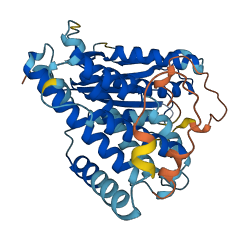
Descriptions
The autoinhibited protein was predicted that may have potential autoinhibitory elements via cis-regPred.
Autoinhibitory domains (AIDs)
Target domain |
|
Relief mechanism |
|
Assay |
cis-regPred |
Accessory elements
No accessory elements
Autoinhibited structure

Activated structure
1 structures for P40530
| Entry ID | Method | Resolution | Chain | Position | Source |
|---|---|---|---|---|---|
| AF-P40530-F1 | Predicted | AlphaFoldDB |
5 variants for P40530
| Variant ID(s) | Position | Change | Description | Diseaes Association | Provenance |
|---|---|---|---|---|---|
| s09-276023 | 90 | K>R | No | SGRP | |
| s09-275300 | 331 | D>G | No | SGRP | |
| s09-275130 | 388 | T>A | No | SGRP | |
| s09-275127 | 389 | A>T | No | SGRP | |
| s09-275111 | 394 | K>R | No | SGRP |
No associated diseases with P40530
6 regional properties for P40530
| Type | Name | Position | InterPro Accession |
|---|---|---|---|
| domain | Histidine kinase/HSP90-like ATPase | 260 - 386 | IPR003594 |
| domain | Signal transduction histidine kinase-related protein, C-terminal | 298 - 312 | IPR004358-1 |
| domain | Signal transduction histidine kinase-related protein, C-terminal | 346 - 364 | IPR004358-2 |
| domain | Signal transduction histidine kinase-related protein, C-terminal | 370 - 383 | IPR004358-3 |
| domain | Histidine kinase domain | 126 - 386 | IPR005467 |
| domain | Branched-chain alpha-ketoacid dehydrogenase kinase/Pyruvate dehydrogenase kinase, N-terminal | 58 - 211 | IPR018955 |
2 GO annotations of cellular component
| Name | Definition |
|---|---|
| mitochondrial matrix | The gel-like material, with considerable fine structure, that lies in the matrix space, or lumen, of a mitochondrion. It contains the enzymes of the tricarboxylic acid cycle and, in some organisms, the enzymes concerned with fatty acid oxidation. |
| mitochondrion | A semiautonomous, self replicating organelle that occurs in varying numbers, shapes, and sizes in the cytoplasm of virtually all eukaryotic cells. It is notably the site of tissue respiration. |
3 GO annotations of molecular function
| Name | Definition |
|---|---|
| ATP binding | Binding to ATP, adenosine 5'-triphosphate, a universally important coenzyme and enzyme regulator. |
| protein kinase activity | Catalysis of the phosphorylation of an amino acid residue in a protein, usually according to the reaction: a protein + ATP = a phosphoprotein + ADP. |
| pyruvate dehydrogenase (acetyl-transferring) kinase activity | Catalysis of the reaction: ATP + pyruvate dehydrogenase (acetyl-transferring) = ADP + pyruvate dehydrogenase (acetyl-transferring) phosphate. |
6 GO annotations of biological process
| Name | Definition |
|---|---|
| carbon utilization | A series of processes that forms an integrated mechanism by which a cell or an organism detects the depletion of primary carbon sources and then activates genes to scavenge the last traces of the primary carbon source and to transport and metabolize alternative carbon sources such as carbon dioxide or carbonic acid. The utilization process begins when the cell or organism detects carbon levels, includes the activation of genes whose products detect, transport or metabolize carbon-containing substances, and ends when carbon is incorporated into the cell or organism's metabolism. |
| glucose metabolic process | The chemical reactions and pathways involving glucose, the aldohexose gluco-hexose. D-glucose is dextrorotatory and is sometimes known as dextrose; it is an important source of energy for living organisms and is found free as well as combined in homo- and hetero-oligosaccharides and polysaccharides. |
| protein phosphorylation | The process of introducing a phosphate group on to a protein. |
| protein-containing complex assembly | The aggregation, arrangement and bonding together of a set of macromolecules to form a protein-containing complex. |
| regulation of glucose metabolic process | Any process that modulates the rate, frequency or extent of glucose metabolism. Glucose metabolic processes are the chemical reactions and pathways involving glucose, the aldohexose gluco-hexose. |
| regulation of mitophagy | Any process that modulates the frequency, rate or extent of macromitophagy. |
3 homologous proteins in AiPD
| UniProt AC | Gene Name | Protein Name | Species | Evidence Code |
|---|---|---|---|---|
| P53170 | PKP2 | [Pyruvate dehydrogenase (acetyl-transferring)] kinase 2, mitochondrial | Saccharomyces cerevisiae (strain ATCC 204508 / S288c) (Baker's yeast) | PR |
| O55028 | Bckdk | [3-methyl-2-oxobutanoate dehydrogenase [lipoamide]] kinase, mitochondrial | Mus musculus (Mouse) | PR |
| Q00972 | Bckdk | [3-methyl-2-oxobutanoate dehydrogenase [lipoamide]] kinase, mitochondrial | Rattus norvegicus (Rat) | PR |
| 10 | 20 | 30 | 40 | 50 | 60 |
| MWKIMRSWKC | GGMRWAHRQR | PSHELLSQLS | FDQHYKIRSN | IELLIQDYAS | KPIAPLNYEY |
| 70 | 80 | 90 | 100 | 110 | 120 |
| FLQYRPPLTK | KEEYMLTIKT | INLLLSLTCK | RLNAIQRLPY | NAVINPHIER | TNSLYLKSLQ |
| 130 | 140 | 150 | 160 | 170 | 180 |
| TLLSIAYPYE | LHNPPKIQAK | FTELLDDHED | AIVVLAKGLQ | EIQSCYPKFQ | ISQFLNFHLK |
| 190 | 200 | 210 | 220 | 230 | 240 |
| ERITMKLLVT | HYLSLMAQNK | GDTNKRMIGI | LHRDLPIAQL | IKHVSDYVND | ICFVKFNTQR |
| 250 | 260 | 270 | 280 | 290 | 300 |
| TPVLIHPPSQ | DITFTCIPPI | LEYIMTEVFK | NAFEAQIALG | KEHMPIEINL | LKPDDDELYL |
| 310 | 320 | 330 | 340 | 350 | 360 |
| RIRDHGGGIT | PEVEALMFNY | SYSTHTQQSA | DSESTDLPGE | QINNVSGMGF | GLPMCKTYLE |
| 370 | 380 | 390 | |||
| LFGGKIDVQS | LLGWGTDVYI | KLKGPSKTAL | LSKK |