P38129
Gene name |
TAF5 (TAF90, YBR198C, YBR1410) |
Protein name |
Transcription initiation factor TFIID subunit 5 |
Names |
TAFII-90, TBP-associated factor 5, TBP-associated factor 90 kDa |
Species |
Saccharomyces cerevisiae (strain ATCC 204508 / S288c) (Baker's yeast) |
KEGG Pathway |
sce:YBR198C |
EC number |
|
Protein Class |
|
Descriptions
The autoinhibited protein was predicted that may have potential autoinhibitory elements via cis-regPred.
Autoinhibitory domains (AIDs)
Target domain |
|
Relief mechanism |
|
Assay |
cis-regPred |
Accessory elements
No accessory elements
Autoinhibited structure

Activated structure
4 structures for P38129
| Entry ID | Method | Resolution | Chain | Position | Source |
|---|---|---|---|---|---|
| 2J49 | X-ray | 230 A | A | 147-290 | PDB |
| 6T9I | EM | 390 A | D | 1-798 | PDB |
| 6T9K | EM | 330 A | D | 1-798 | PDB |
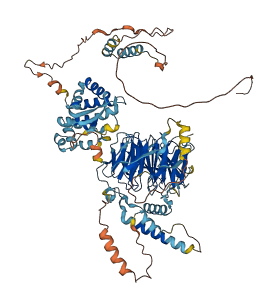
| AF-P38129-F1 | Predicted | AlphaFoldDB |
12 variants for P38129
| Variant ID(s) | Position | Change | Description | Diseaes Association | Provenance |
|---|---|---|---|---|---|
| s02-618419 | 34 | G>S | No | SGRP | |
| s02-618391 | 43 | G>D | No | SGRP | |
| s02-617645 | 292 | A>T | No | SGRP | |
| s02-617384 | 379 | T>A | No | SGRP | |
| s02-617360 | 387 | I>L | No | SGRP | |
| s02-617308 | 404 | V>A | No | SGRP | |
| s02-617291 | 410 | D>N | No | SGRP | |
| s02-617102 | 473 | D>N | No | SGRP | |
| s02-616718 | 601 | P>S | No | SGRP | |
| s02-616649 | 624 | V>M | No | SGRP | |
| s02-616555 | 655 | I>T | No | SGRP | |
| s02-616298 | 741 | Y>D | No | SGRP |
No associated diseases with P38129
11 regional properties for P38129
| Type | Name | Position | InterPro Accession |
|---|---|---|---|
| repeat | WD40 repeat | 455 - 503 | IPR001680-1 |
| repeat | WD40 repeat | 514 - 595 | IPR001680-2 |
| repeat | WD40 repeat | 598 - 731 | IPR001680-3 |
| domain | LIS1 homology motif | 56 - 88 | IPR006594 |
| domain | TFIID subunit TAF5, NTD2 domain | 148 - 283 | IPR007582 |
| conserved_site | WD40 repeat, conserved site | 624 - 638 | IPR019775-1 |
| conserved_site | WD40 repeat, conserved site | 666 - 680 | IPR019775-2 |
| conserved_site | WD40 repeat, conserved site | 709 - 723 | IPR019775-3 |
| repeat | G-protein beta WD-40 repeat | 540 - 554 | IPR020472-1 |
| repeat | G-protein beta WD-40 repeat | 624 - 638 | IPR020472-2 |
| repeat | G-protein beta WD-40 repeat | 709 - 723 | IPR020472-3 |
4 GO annotations of cellular component
| Name | Definition |
|---|---|
| nucleus | A membrane-bounded organelle of eukaryotic cells in which chromosomes are housed and replicated. In most cells, the nucleus contains all of the cell's chromosomes except the organellar chromosomes, and is the site of RNA synthesis and processing. In some species, or in specialized cell types, RNA metabolism or DNA replication may be absent. |
| SAGA complex | A SAGA-type histone acetyltransferase complex that deubiquitinates H2A and/or H2B. This complex is organized into several functional submodules: a structural core including the activator binding module and consisting of ADA1 or a homolog, members of the SPT and TAF protein families as well as promotor recruitment factor TRRAP/TRA1, a histone acetyltransferase (HAT) module consisting of GCN5/KAT2A or PCAF/KAT2B, ADA2, ADA3/NGG1, and SGF29 or homologues thereof, a histone deubiquitinase (DUB) module consisting of ATXN7/SGF73, ATXN7L3/SGF11, ENY2/SUS1 and USP22/UBP8 or homologues thereof, and in some taxa a splicing module consisting of SF3B3 and SF3B5 or homologues thereof (not in fungi). In budding yeast also contains Spt8 which distinguishes it from SAGA-like (SLIK) complex (GO:0046695). |
| SLIK (SAGA-like) complex | A SAGA-type histone acetyltransferase complex that contains a smaller form of Spt7 (lacking the SPT8 binding region) than the fungal SAGA complex, and consequently lacks Spt8. The complex is involved in the yeast retrograde response pathway, which is important for gene expression changes during mitochondrial dysfunction. |
| transcription factor TFIID complex | A complex composed of TATA binding protein (TBP) and TBP associated factors (TAFs); the total mass is typically about 800 kDa. Most of the TAFs are conserved across species. In TATA-containing promoters for RNA polymerase II (Pol II), TFIID is believed to recognize at least two distinct elements, the TATA element and a downstream promoter element. TFIID is also involved in recognition of TATA-less Pol II promoters. Binding of TFIID to DNA is necessary but not sufficient for transcription initiation from most RNA polymerase II promoters. |
4 GO annotations of molecular function
| Name | Definition |
|---|---|
| chromatin binding | Binding to chromatin, the network of fibers of DNA, protein, and sometimes RNA, that make up the chromosomes of the eukaryotic nucleus during interphase. |
| identical protein binding | Binding to an identical protein or proteins. |
| molecular adaptor activity | The binding activity of a molecule that brings together two or more molecules through a selective, non-covalent, often stoichiometric interaction, permitting those molecules to function in a coordinated way. |
| ubiquitin binding | Binding to ubiquitin, a protein that when covalently bound to other cellular proteins marks them for proteolytic degradation. |
8 GO annotations of biological process
| Name | Definition |
|---|---|
| chromatin organization | The assembly or remodeling of chromatin composed of DNA complexed with histones, other associated proteins, and sometimes RNA. |
| histone acetylation | The modification of a histone by the addition of an acetyl group. |
| histone deubiquitination | The modification of histones by removal of ubiquitin groups. |
| positive regulation of transcription by RNA polymerase II | Any process that activates or increases the frequency, rate or extent of transcription from an RNA polymerase II promoter. |
| regulation of transcription by RNA polymerase II | Any process that modulates the frequency, rate or extent of transcription mediated by RNA polymerase II. |
| RNA polymerase II preinitiation complex assembly | The aggregation, arrangement and bonding together of proteins on an RNA polymerase II promoter DNA to form the transcriptional preinitiation complex (PIC), the formation of which is a prerequisite for transcription by RNA polymerase. |
| transcription by RNA polymerase II | The synthesis of RNA from a DNA template by RNA polymerase II (RNAP II), originating at an RNA polymerase II promoter. Includes transcription of messenger RNA (mRNA) and certain small nuclear RNAs (snRNAs). |
| transcription initiation at RNA polymerase II promoter | A transcription initiation process that takes place at a RNA polymerase II gene promoter. Messenger RNAs (mRNA) genes, as well as some non-coding RNAs, are transcribed by RNA polymerase II. |
| 10 | 20 | 30 | 40 | 50 | 60 |
| MSQKQSTNQN | QNGTHQPQPV | KNQRTNNAAG | ANSGQQPQQQ | SQGQSQQQGR | SNGPFSASDL |
| 70 | 80 | 90 | 100 | 110 | 120 |
| NRIVLEYLNK | KGYHRTEAML | RAESGRTLTP | QNKQSPANTK | TGKFPEQSSI | PPNPGKTAKP |
| 130 | 140 | 150 | 160 | 170 | 180 |
| ISNPTNLSSK | RDAEGGIVSS | GRLEGLNAPE | NYIRAYSMLK | NWVDSSLEIY | KPELSYIMYP |
| 190 | 200 | 210 | 220 | 230 | 240 |
| IFIYLFLNLV | AKNPVYARRF | FDRFSPDFKD | FHGSEINRLF | SVNSIDHIKE | NEVASAFQSH |
| 250 | 260 | 270 | 280 | 290 | 300 |
| KYRITMSKTT | LNLLLYFLNE | NESIGGSLII | SVINQHLDPN | IVESVTAREK | LADGIKVLSD |
| 310 | 320 | 330 | 340 | 350 | 360 |
| SENGNGKQNL | EMNSVPVKLG | PFPKDEEFVK | EIETELKIKD | DQEKQLNQQT | AGDNYSGANN |
| 370 | 380 | 390 | 400 | 410 | 420 |
| RTLLQEYKAM | NNEKFKDNTG | DDDKDKIKDK | IAKDEEKKES | ELKVDGEKKD | SNLSSPARDI |
| 430 | 440 | 450 | 460 | 470 | 480 |
| LPLPPKTALD | LKLEIQKVKE | SRDAIKLDNL | QLALPSVCMY | TFQNTNKDMS | CLDFSDDCRI |
| 490 | 500 | 510 | 520 | 530 | 540 |
| AAAGFQDSYI | KIWSLDGSSL | NNPNIALNNN | DKDEDPTCKT | LVGHSGTVYS | TSFSPDNKYL |
| 550 | 560 | 570 | 580 | 590 | 600 |
| LSGSEDKTVR | LWSMDTHTAL | VSYKGHNHPV | WDVSFSPLGH | YFATASHDQT | ARLWSCDHIY |
| 610 | 620 | 630 | 640 | 650 | 660 |
| PLRIFAGHLN | DVDCVSFHPN | GCYVFTGSSD | KTCRMWDVST | GDSVRLFLGH | TAPVISIAVC |
| 670 | 680 | 690 | 700 | 710 | 720 |
| PDGRWLSTGS | EDGIINVWDI | GTGKRLKQMR | GHGKNAIYSL | SYSKEGNVLI | SGGADHTVRV |
| 730 | 740 | 750 | 760 | 770 | 780 |
| WDLKKATTEP | SAEPDEPFIG | YLGDVTASIN | QDIKEYGRRR | TVIPTSDLVA | SFYTKKTPVF |
| 790 | |||||
| KVKFSRSNLA | LAGGAFRP |