P37089
Gene name |
Scnn1a (Renac) |
Protein name |
Amiloride-sensitive sodium channel subunit alpha |
Names |
Alpha-NaCH, Epithelial Na(+) channel subunit alpha, Alpha-ENaC, Nonvoltage-gated sodium channel 1 subunit alpha, SCNEA |
Species |
Rattus norvegicus (Rat) |
KEGG Pathway |
rno:25122 |
EC number |
|
Protein Class |
|
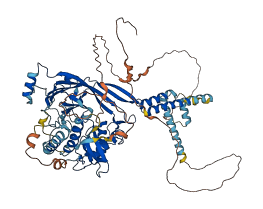
Descriptions
The autoinhibited protein was predicted that may have potential autoinhibitory elements via cis-regPred.
Autoinhibitory domains (AIDs)
Target domain |
|
Relief mechanism |
|
Assay |
cis-regPred |
Accessory elements
No accessory elements
Autoinhibited structure

Activated structure
1 structures for P37089
| Entry ID | Method | Resolution | Chain | Position | Source |
|---|---|---|---|---|---|
| AF-P37089-F1 | Predicted | AlphaFoldDB |
No variants for P37089
| Variant ID(s) | Position | Change | Description | Diseaes Association | Provenance |
|---|---|---|---|---|---|
| No variants for P37089 | |||||
No associated diseases with P37089
1 regional properties for P37089
| Type | Name | Position | InterPro Accession |
|---|---|---|---|
| conserved_site | Epithelial sodium channel, conserved site | 438 - 458 | IPR020903 |
Functions
15 GO annotations of cellular component
| Name | Definition |
|---|---|
| acrosomal vesicle | A structure in the head of a spermatozoon that contains acid hydrolases, and is concerned with the breakdown of the outer membrane of the ovum during fertilization. It lies just beneath the plasma membrane and is derived from the lysosome. |
| apical plasma membrane | The region of the plasma membrane located at the apical end of the cell. |
| ciliary membrane | The portion of the plasma membrane surrounding a cilium. |
| cortical actin cytoskeleton | The portion of the actin cytoskeleton, comprising filamentous actin and associated proteins, that lies just beneath the plasma membrane. |
| cytoplasm | The contents of a cell excluding the plasma membrane and nucleus, but including other subcellular structures. |
| cytosol | The part of the cytoplasm that does not contain organelles but which does contain other particulate matter, such as protein complexes. |
| external side of plasma membrane | The leaflet of the plasma membrane that faces away from the cytoplasm and any proteins embedded or anchored in it or attached to its surface. |
| extracellular exosome | A vesicle that is released into the extracellular region by fusion of the limiting endosomal membrane of a multivesicular body with the plasma membrane. Extracellular exosomes, also simply called exosomes, have a diameter of about 40-100 nm. |
| integral component of membrane | The component of a membrane consisting of the gene products and protein complexes having at least some part of their peptide sequence embedded in the hydrophobic region of the membrane. |
| integral component of plasma membrane | The component of the plasma membrane consisting of the gene products and protein complexes having at least some part of their peptide sequence embedded in the hydrophobic region of the membrane. |
| membrane | A lipid bilayer along with all the proteins and protein complexes embedded in it an attached to it. |
| motile cilium | A cilium which may have a variable arrangement of axonemal microtubules and also contains molecular motors. It may beat with a whip-like pattern that promotes cell motility or transport of fluids and other cells across a cell surface, such as on epithelial cells that line the lumenal ducts of various tissues; or they may display a distinct twirling motion that directs fluid flow asymmetrically across the cellular surface to affect asymmetric body plan organization. Motile cilia can be found in single as well as multiple copies per cell. |
| plasma membrane | The membrane surrounding a cell that separates the cell from its external environment. It consists of a phospholipid bilayer and associated proteins. |
| sodium channel complex | An ion channel complex through which sodium ions pass. |
| sperm principal piece | The segment of the sperm flagellum where the mitochondrial sheath ends, and the outer dense fibers (ODFs) associated with outer axonemal doublets 3 and 8 are replaced by the 2 longitudinal columns of the fibrous sheath (FS) which run the length of the principal piece and are stabilized by circumferential ribs. The principal piece makes up ~2/3 of the length of the sperm flagellum and is defined by the presence of the FS and of only 7 (rather than 9) ODFs which taper and then terminate near the distal end of the principal piece. |
3 GO annotations of molecular function
| Name | Definition |
|---|---|
| actin binding | Binding to monomeric or multimeric forms of actin, including actin filaments. |
| ligand-gated sodium channel activity | Enables the transmembrane transfer of a sodium ion by a channel that opens when a specific ligand has been bound by the channel complex or one of its constituent parts. |
| WW domain binding | Binding to a WW domain of a protein, a small module composed of 40 amino acids and plays a role in mediating protein-protein interactions via proline-rich regions. |
14 GO annotations of biological process
| Name | Definition |
|---|---|
| cellular response to acidic pH | Any process that results in a change in state or activity of a cell (in terms of movement, secretion, enzyme production, gene expression, etc.) as a result of a pH stimulus with pH < 7. pH is a measure of the acidity or basicity of an aqueous solution. |
| cellular response to aldosterone | Any process that results in a change in state or activity of a cell (in terms of movement, secretion, enzyme production, gene expression, etc.) as a result of an aldosterone stimulus. |
| cellular response to amiloride | Any process that results in a change in state or activity of a cell (in terms of movement, secretion, enzyme production, gene expression, etc.) as a result of an amiloride stimulus. |
| cellular response to vasopressin | Any process that results in a change in state or activity of a cell (in terms of movement, secretion, enzyme production, gene expression, etc.) as a result of a vasopressin stimulus. |
| cellular sodium ion homeostasis | Any process involved in the maintenance of an internal steady state of sodium ions at the level of a cell. |
| multicellular organismal water homeostasis | Any process involved in the maintenance of an internal steady state of water within a tissue, organ, or a multicellular organism. |
| regulation of blood pressure | Any process that modulates the force with which blood travels through the circulatory system. The process is controlled by a balance of processes that increase pressure and decrease pressure. |
| regulation of body fluid levels | Any process that modulates the levels of body fluids. |
| sensory perception of salty taste | The series of events required to receive a salty taste stimulus, convert it to a molecular signal, and recognize and characterize the signal. This is a neurological process. |
| sensory perception of sour taste | The series of events required to receive a sour taste stimulus, convert it to a molecular signal, and recognize and characterize the signal. This is a neurological process. |
| sodium ion homeostasis | Any process involved in the maintenance of an internal steady state of sodium ions within an organism or cell. |
| sodium ion import across plasma membrane | The directed movement of sodium ions from outside of a cell, across the plasma membrane and into the cytosol. |
| sodium ion transmembrane transport | A process in which a sodium ion is transported from one side of a membrane to the other by means of some agent such as a transporter or pore. |
| sodium ion transport | The directed movement of sodium ions (Na+) into, out of or within a cell, or between cells, by means of some agent such as a transporter or pore. |
6 homologous proteins in AiPD
| UniProt AC | Gene Name | Protein Name | Species | Evidence Code |
|---|---|---|---|---|
| F1MJW3 | SCNN1G | Amiloride-sensitive sodium channel subunit gamma | Bos taurus (Bovine) | PR |
| H2QAR5 | SCNN1G | Amiloride-sensitive sodium channel subunit gamma | Pan troglodytes (Chimpanzee) | PR |
| P51170 | SCNN1G | Amiloride-sensitive sodium channel subunit gamma | Homo sapiens (Human) | PR |
| P37088 | SCNN1A | Amiloride-sensitive sodium channel subunit alpha | Homo sapiens (Human) | PR |
| Q61180 | Scnn1a | Amiloride-sensitive sodium channel subunit alpha | Mus musculus (Mouse) | PR |
| Q10025 | del-10 | Degenerin-like protein del-10 | Caenorhabditis elegans | PR |
| 10 | 20 | 30 | 40 | 50 | 60 |
| MLDHTRAPEL | NIDLDLHASN | SPKGSMKGNQ | FKEQDPCPPQ | PMQGLGKGDK | REEQGLGPEP |
| 70 | 80 | 90 | 100 | 110 | 120 |
| SAPRQPTEEE | EALIEFHRSY | RELFQFFCNN | TTIHGAIRLV | CSKHNRMKTA | FWAVLWLCTF |
| 130 | 140 | 150 | 160 | 170 | 180 |
| GMMYWQFALL | FEEYLSYPVS | LNINLNSDKL | VFPAVTVCTL | NPYRYTEIKE | ELEELDRITE |
| 190 | 200 | 210 | 220 | 230 | 240 |
| QTLFDLYKYN | SSYTRQAGAR | RRSSRDLLGA | FPHPLQRLRT | PPPPYSGRTA | RSGSSSVRDN |
| 250 | 260 | 270 | 280 | 290 | 300 |
| NPQVDRKDWK | IGFQLCNQNK | SDCFYQTYSS | GVDAVREWYR | FHYINILSRL | SDTSPALEEE |
| 310 | 320 | 330 | 340 | 350 | 360 |
| ALGNFIFTCR | FNQAPCNQAN | YSKFHHPMYG | NCYTFNDKNN | SNLWMSSMPG | VNNGLSLTLR |
| 370 | 380 | 390 | 400 | 410 | 420 |
| TEQNDFIPLL | STVTGARVMV | HGQDEPAFMD | DGGFNLRPGV | ETSISMRKEA | LDSLGGNYGD |
| 430 | 440 | 450 | 460 | 470 | 480 |
| CTENGSDVPV | KNLYPSKYTQ | QVCIHSCFQE | NMIKKCGCAY | IFYPKPKGVE | FCDYRKQSSW |
| 490 | 500 | 510 | 520 | 530 | 540 |
| GYCYYKLQGA | FSLDSLGCFS | KCRKPCSVIN | YKLSAGYSRW | PSVKSQDWIF | EMLSLQNNYT |
| 550 | 560 | 570 | 580 | 590 | 600 |
| INNKRNGVAK | LNIFFKELNY | KTNSESPSVT | MVSLLSNLGS | QWSLWFGSSV | LSVVEMAELI |
| 610 | 620 | 630 | 640 | 650 | 660 |
| FDLLVITLLM | LLRRFRSRYW | SPGRGARGAR | EVASTPASSF | PSRFCPHPTS | PPPSLPQQGM |
| 670 | 680 | 690 | |||
| TPPLALTAPP | PAYATLGPSA | PPLDSAAPDC | SACALAAL |