P33611
Gene name |
Pola2 |
Protein name |
DNA polymerase alpha subunit B |
Names |
DNA polymerase alpha 70 kDa subunit |
Species |
Mus musculus (Mouse) |
KEGG Pathway |
mmu:18969 |
EC number |
|
Protein Class |
|
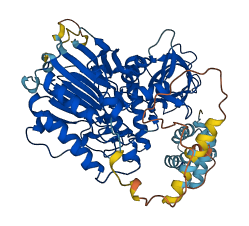
Descriptions
The autoinhibited protein was predicted that may have potential autoinhibitory elements via cis-regPred.
Autoinhibitory domains (AIDs)
Target domain |
|
Relief mechanism |
|
Assay |
cis-regPred |
Accessory elements
No accessory elements
Autoinhibited structure

Activated structure
1 structures for P33611
| Entry ID | Method | Resolution | Chain | Position | Source |
|---|---|---|---|---|---|
| AF-P33611-F1 | Predicted | AlphaFoldDB |
30 variants for P33611
| Variant ID(s) | Position | Change | Description | Diseaes Association | Provenance |
|---|---|---|---|---|---|
| rs3389520980 | 12 | L>P | No | EVA | |
| rs3389521002 | 23 | L>M | No | EVA | |
| rs3389429085 | 69 | V>I | No | EVA | |
| rs36911197 | 90 | T>A | No | EVA | |
| rs3389514685 | 93 | I>N | No | EVA | |
| rs3389519982 | 135 | R>G | No | EVA | |
| rs3389512888 | 168 | G>E | No | EVA | |
| rs37481512 | 180 | L>V | No | EVA | |
| rs39525324 | 184 | G>R | No | EVA | |
| rs3389525309 | 187 | G>D | No | EVA | |
| rs215603600 | 196 | V>M | No | EVA | |
| rs3389529062 | 253 | L>F | No | EVA | |
| rs219041009 | 271 | I>V | No | EVA | |
| rs3389525345 | 281 | G>R | No | EVA | |
| rs3389525287 | 315 | T>S | No | EVA | |
| rs36292020 | 317 | T>I | No | EVA | |
| rs3389518912 | 350 | T>N | No | EVA | |
| rs3389429071 | 362 | D>A | No | EVA | |
| rs3389521036 | 408 | T>I | No | EVA | |
| rs3389518840 | 409 | V>L | No | EVA | |
| rs3389535393 | 424 | P>L | No | EVA | |
| rs3389468285 | 435 | Y>* | No | EVA | |
| rs3389499880 | 456 | V>L | No | EVA | |
| rs3413090673 | 464 | I>K | No | EVA | |
| rs3407824842 | 474 | T>M | No | EVA | |
| rs3389525296 | 477 | L>V | No | EVA | |
| rs3389525352 | 483 | E>D | No | EVA | |
| rs3389514634 | 501 | H>Q | No | EVA | |
| rs3389512013 | 532 | P>S | No | EVA | |
| rs3389519912 | 584 | D>E | No | EVA |
No associated diseases with P33611
4 GO annotations of cellular component
| Name | Definition |
|---|---|
| alpha DNA polymerase:primase complex | A complex of four polypeptides, comprising large and small DNA polymerase alpha subunits and two primase subunits, which are capable of catalyzing the synthesis of an RNA primer on the lagging strand of replicating DNA and the subsequent synthesis of a smal stretch of DNA. The smaller of the two primase subunits alone can catalyze oligoribonucleotide synthesis. |
| cytosol | The part of the cytoplasm that does not contain organelles but which does contain other particulate matter, such as protein complexes. |
| nucleoplasm | That part of the nuclear content other than the chromosomes or the nucleolus. |
| nucleus | A membrane-bounded organelle of eukaryotic cells in which chromosomes are housed and replicated. In most cells, the nucleus contains all of the cell's chromosomes except the organellar chromosomes, and is the site of RNA synthesis and processing. In some species, or in specialized cell types, RNA metabolism or DNA replication may be absent. |
2 GO annotations of molecular function
| Name | Definition |
|---|---|
| DNA binding | Any molecular function by which a gene product interacts selectively and non-covalently with DNA (deoxyribonucleic acid). |
| DNA-directed DNA polymerase activity | Catalysis of the reaction: deoxynucleoside triphosphate + DNA(n) = diphosphate + DNA(n+1); the synthesis of DNA from deoxyribonucleotide triphosphates in the presence of a DNA template and a 3'hydroxyl group. |
4 GO annotations of biological process
| Name | Definition |
|---|---|
| DNA replication | The cellular metabolic process in which a cell duplicates one or more molecules of DNA. DNA replication begins when specific sequences, known as origins of replication, are recognized and bound by initiation proteins, and ends when the original DNA molecule has been completely duplicated and the copies topologically separated. The unit of replication usually corresponds to the genome of the cell, an organelle, or a virus. The template for replication can either be an existing DNA molecule or RNA. |
| DNA replication initiation | The process in which DNA-dependent DNA replication is started; this begins with the ATP dependent loading of an initiator complex onto the DNA, this is followed by DNA melting and helicase activity. In bacteria, the gene products that enable the helicase activity are loaded after the initial melting and in archaea and eukaryotes, the gene products that enable the helicase activity are inactive when they are loaded and subsequently activate. |
| DNA replication, synthesis of RNA primer | The synthesis of a short RNA polymer, usually 4-15 nucleotides long, using one strand of unwound DNA as a template; the RNA then serves as a primer from which DNA polymerases extend synthesis. |
| protein import into nucleus | The directed movement of a protein from the cytoplasm to the nucleus. |
3 homologous proteins in AiPD
| UniProt AC | Gene Name | Protein Name | Species | Evidence Code |
|---|---|---|---|---|
| P38121 | POL12 | DNA polymerase alpha subunit B | Saccharomyces cerevisiae (strain ATCC 204508 / S288c) (Baker's yeast) | PR |
| Q14181 | POLA2 | DNA polymerase alpha subunit B | Homo sapiens (Human) | PR |
| O89043 | Pola2 | DNA polymerase alpha subunit B | Rattus norvegicus (Rat) | PR |
| 10 | 20 | 30 | 40 | 50 | 60 |
| MAVSTQQLAE | ELQIFGLDYE | DSLLEKLAEL | CVLYRQTEDG | MVSELIAFCT | SAGKTCLTVD |
| 70 | 80 | 90 | 100 | 110 | 120 |
| ILNSFEYEVL | NKKLSKAWHS | ASKDSGHAGT | RDIVSIQELI | EAEEEEETLL | SSYTTPSKGP |
| 130 | 140 | 150 | 160 | 170 | 180 |
| LKRVSSTPET | PLTKRSVAAR | SPRQLLSPSS | FSPSATPSQK | YTSRTNRGEV | VTTFGSAQGL |
| 190 | 200 | 210 | 220 | 230 | 240 |
| SWSGRGGSGS | VSLKVVGDPE | PLTGSYKAMF | QQLMGVREVL | TSKIEELGSE | LKEHHKIEAF |
| 250 | 260 | 270 | 280 | 290 | 300 |
| TPLLVPAQEP | VILLGQIGCD | SNGKLNSKSV | ILEGDQEHSY | GAQIPVDLSE | LKEYSLFPGQ |
| 310 | 320 | 330 | 340 | 350 | 360 |
| VVIMEGFNTT | GRRLTATKLY | EGVPLPFYQP | TEEEGASEQT | MVVVACGPYT | TSDSITYDPL |
| 370 | 380 | 390 | 400 | 410 | 420 |
| LDLIAIINRD | QPDVCILFGP | FLDAKHEQVE | NCKLTSPFED | VFKQCLRTVI | EGTRSSGSHL |
| 430 | 440 | 450 | 460 | 470 | 480 |
| VFVPSLRDVH | HEPVYPQPPF | TFSELSREDK | KRVQFVSEPC | SLSINGVMFG | LTSTDLLFHI |
| 490 | 500 | 510 | 520 | 530 | 540 |
| GAEEIFSSSG | TSDRFSRVLK | HILTQRSYYP | LYPPHEDMAI | DYENFYTYAQ | LPVTPDVFIV |
| 550 | 560 | 570 | 580 | 590 | |
| PSELRYFVKD | IFGCVCVNPG | RLTKGQVGGT | FGRLYLRRQP | KAMDGGGRQG | LSVAAQVVRI |