P31384
Gene name |
CCR4 (YAL021C, FUN27) |
Protein name |
CCR4-Not complex 3'-5'-exoribonuclease subunit Ccr4 |
Names |
Carbon catabolite repressor protein 4, Cytoplasmic deadenylase, Glucose-repressible alcohol dehydrogenase transcriptional effector |
Species |
Saccharomyces cerevisiae (strain ATCC 204508 / S288c) (Baker's yeast) |
KEGG Pathway |
sce:YAL021C |
EC number |
3.1.13.4: Exoribonucleases producing 5'-phosphomonoesters |
Protein Class |
|
Descriptions
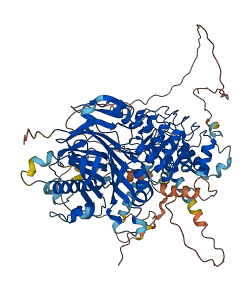
The autoinhibited protein was predicted that may have potential autoinhibitory elements via cis-regPred.
Autoinhibitory domains (AIDs)
Target domain |
|
Relief mechanism |
|
Assay |
cis-regPred |
Accessory elements
No accessory elements
Autoinhibited structure

Activated structure
2 structures for P31384
| Entry ID | Method | Resolution | Chain | Position | Source |
|---|---|---|---|---|---|
| 4B8C | X-ray | 341 A | D/J/K/L | 111-837 | PDB |
| AF-P31384-F1 | Predicted | AlphaFoldDB |
16 variants for P31384
| Variant ID(s) | Position | Change | Description | Diseaes Association | Provenance |
|---|---|---|---|---|---|
| s01-113327 | 12 | V>L | No | SGRP | |
| s01-113260 | 34 | P>Q | No | SGRP | |
| s01-113227 | 45 | Q>R | No | SGRP | |
| s01-112743 | 206 | Q>H | No | SGRP | |
| s01-112685 | 226 | D>N | No | SGRP | |
| s01-112550 | 271 | P>S | No | SGRP | |
| s01-112238 | 375 | E>K | No | SGRP | |
| s01-112137 | 408 | F>L | No | SGRP | |
| s01-112118 | 415 | V>I | No | SGRP | |
| s01-112064 | 433 | V>I | No | SGRP | |
| s01-111181 | 727 | N>S | No | SGRP | |
| s01-111061 | 767 | P>Q | No | SGRP | |
| s01-111000 | 787 | H>Q | No | SGRP | |
| s01-110999 | 788 | A>T | No | SGRP | |
| s01-110976 | 795 | L>F | No | SGRP | |
| s01-110857 | 835 | K>R | No | SGRP |
No associated diseases with P31384
1 regional properties for P31384
| Type | Name | Position | InterPro Accession |
|---|---|---|---|
| domain | Ion transport domain | 106 - 348 | IPR005821 |
Functions
| Description | ||
|---|---|---|
| EC Number | 3.1.13.4 | Exoribonucleases producing 5'-phosphomonoesters |
| Subcellular Localization |
|
|
| PANTHER Family | ||
| PANTHER Subfamily | ||
| PANTHER Protein Class | ||
| PANTHER Pathway Category | No pathway information available | |
6 GO annotations of cellular component
| Name | Definition |
|---|---|
| CCR4-NOT complex | The Ccr4-Not complex is an eukaryotically conserved deadenylase that can initiate cytoplasmic mRNA decay, and reduce translation by releasing poly(A)-binding protein (Pab1/PABPC1). Ccr4-Not contains seven core subunits, including two poly(A)-specific exonucleases, Ccr4/CNOT6/CNOT6L and Caf1/Pop2/CNOT7/CNOT8. |
| CCR4-NOT core complex | The core of the CCR4-NOT complex. In Saccharomyces the CCR4-NOT core complex comprises Ccr4p, Caf1p, Caf40p, Caf130p, Not1p, Not2p, Not3p, Not4p, and Not5p. |
| Cdc73/Paf1 complex | A multiprotein complex that associates with RNA polymerase II and general RNA polymerase II transcription factor complexes and may be involved in both transcriptional initiation and elongation. In Saccharomyces the complex contains Paf1p, Cdc73p, Ctr9p, Rtf1p, and Leo1p. |
| cytoplasm | The contents of a cell excluding the plasma membrane and nucleus, but including other subcellular structures. |
| nucleus | A membrane-bounded organelle of eukaryotic cells in which chromosomes are housed and replicated. In most cells, the nucleus contains all of the cell's chromosomes except the organellar chromosomes, and is the site of RNA synthesis and processing. In some species, or in specialized cell types, RNA metabolism or DNA replication may be absent. |
| P-body | A focus in the cytoplasm where mRNAs may become inactivated by decapping or some other mechanism. Protein and RNA localized to these foci are involved in mRNA degradation, nonsense-mediated mRNA decay (NMD), translational repression, and RNA-mediated gene silencing. |
4 GO annotations of molecular function
| Name | Definition |
|---|---|
| 3'-5'-exoribonuclease activity | Catalysis of the sequential cleavage of mononucleotides from a free 3' terminus of an RNA molecule. |
| metal ion binding | Binding to a metal ion. |
| poly(A)-specific ribonuclease activity | Catalysis of the exonucleolytic cleavage of poly(A) to 5'-AMP. |
| RNA binding | Binding to an RNA molecule or a portion thereof. |
9 GO annotations of biological process
| Name | Definition |
|---|---|
| DNA replication | The cellular metabolic process in which a cell duplicates one or more molecules of DNA. DNA replication begins when specific sequences, known as origins of replication, are recognized and bound by initiation proteins, and ends when the original DNA molecule has been completely duplicated and the copies topologically separated. The unit of replication usually corresponds to the genome of the cell, an organelle, or a virus. The template for replication can either be an existing DNA molecule or RNA. |
| DNA replication checkpoint signaling | A signal transduction process that contributes to a DNA replication checkpoint, that prevents the initiation of nuclear division until DNA replication is complete, thereby ensuring that progeny inherit a full complement of the genome. |
| nuclear-transcribed mRNA catabolic process, deadenylation-dependent decay | A major pathway of degradation of nuclear-transcribed mRNAs that proceeds through a series of ordered steps that includes poly(A) tail shortening and that can regulate mRNA stability. |
| nuclear-transcribed mRNA poly(A) tail shortening | Shortening of the poly(A) tail of a nuclear-transcribed mRNA from full length to an oligo(A) length. |
| positive regulation of transcription elongation by RNA polymerase II | Any process that activates or increases the frequency, rate or extent of transcription elongation, the extension of an RNA molecule after transcription initiation and promoter clearance by the addition of ribonucleotides, catalyzed by RNA polymerase II. |
| regulation of transcription by RNA polymerase II | Any process that modulates the frequency, rate or extent of transcription mediated by RNA polymerase II. |
| replication fork protection | Any process that prevents the collapse of stalled replication forks. |
| transcription elongation by RNA polymerase II promoter | The extension of an RNA molecule after transcription initiation and promoter clearance at an RNA polymerase II promoter by the addition of ribonucleotides catalyzed by RNA polymerase II. |
| traversing start control point of mitotic cell cycle | A cell cycle process by which a cell commits to entering S phase via a positive feedback mechanism between the regulation of transcription and G1 CDK activity. |
2 homologous proteins in AiPD
| 10 | 20 | 30 | 40 | 50 | 60 |
| MNDPSLLGYP | NVGPQQQQQQ | QQQQHAGLLG | KGTPNALQQQ | LHMNQLTGIP | PPGLMNNSDV |
| 70 | 80 | 90 | 100 | 110 | 120 |
| HTSSNNNSRQ | LLDQLANGNA | NMLNMNMDNN | NNNNNNNNNN | NNNGGGSGVM | MNASTAAVNS |
| 130 | 140 | 150 | 160 | 170 | 180 |
| IGMVPTVGTP | VNINVNASNP | LLHPHLDDPS | LLNNPIWKLQ | LHLAAVSAQS | LGQPNIYARQ |
| 190 | 200 | 210 | 220 | 230 | 240 |
| NAMKKYLATQ | QAQQAQQQAQ | QQAQQQVPGP | FGPGPQAAPP | ALQPTDFQQS | HIAEASKSLV |
| 250 | 260 | 270 | 280 | 290 | 300 |
| DCTKQALMEM | ADTLTDSKTA | KKQQPTGDST | PSGTATNSAV | STPLTPKIEL | FANGKDEANQ |
| 310 | 320 | 330 | 340 | 350 | 360 |
| ALLQHKKLSQ | YSIDEDDDIE | NRMVMPKDSK | YDDQLWHALD | LSNLQIFNIS | ANIFKYDFLT |
| 370 | 380 | 390 | 400 | 410 | 420 |
| RLYLNGNSLT | ELPAEIKNLS | NLRVLDLSHN | RLTSLPAELG | SCFQLKYFYF | FDNMVTTLPW |
| 430 | 440 | 450 | 460 | 470 | 480 |
| EFGNLCNLQF | LGVEGNPLEK | QFLKILTEKS | VTGLIFYLRD | NRPEIPLPHE | RRFIEINTDG |
| 490 | 500 | 510 | 520 | 530 | 540 |
| EPQREYDSLQ | QSTEHLATDL | AKRTFTVLSY | NTLCQHYATP | KMYRYTPSWA | LSWDYRRNKL |
| 550 | 560 | 570 | 580 | 590 | 600 |
| KEQILSYDSD | LLCLQEVESK | TFEEYWVPLL | DKHGYTGIFH | AKARAKTMHS | KDSKKVDGCC |
| 610 | 620 | 630 | 640 | 650 | 660 |
| IFFKRDQFKL | ITKDAMDFSG | AWMKHKKFQR | TEDYLNRAMN | KDNVALFLKL | QHIPSGDTIW |
| 670 | 680 | 690 | 700 | 710 | 720 |
| AVTTHLHWDP | KFNDVKTFQV | GVLLDHLETL | LKEETSHNFR | QDIKKFPVLI | CGDFNSYINS |
| 730 | 740 | 750 | 760 | 770 | 780 |
| AVYELINTGR | VQIHQEGNGR | DFGYMSEKNF | SHNLALKSSY | NCIGELPFTN | FTPSFTDVID |
| 790 | 800 | 810 | 820 | 830 | |
| YIWFSTHALR | VRGLLGEVDP | EYVSKFIGFP | NDKFPSDHIP | LLARFEFMKT | NTGSKKV |