P30750
Gene name |
metN |
Protein name |
Methionine import ATP-binding protein MetN |
Names |
|
Species |
Escherichia coli (strain K12) |
KEGG Pathway |
eco:b0199 |
EC number |
7.4.2.11: Linked to the hydrolysis of a nucleoside triphosphate |
Protein Class |
|
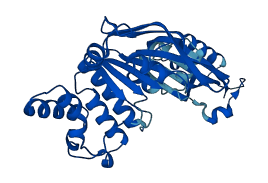
Descriptions
The autoinhibited protein was predicted that may have potential autoinhibitory elements via cis-regPred.
Autoinhibitory domains (AIDs)
Target domain |
|
Relief mechanism |
|
Assay |
cis-regPred |
Accessory elements
No accessory elements
Autoinhibited structure

Activated structure
7 structures for P30750
No variants for P30750
| Variant ID(s) | Position | Change | Description | Diseaes Association | Provenance |
|---|---|---|---|---|---|
| No variants for P30750 | |||||
No associated diseases with P30750
5 regional properties for P30750
| Type | Name | Position | InterPro Accession |
|---|---|---|---|
| domain | ABC transporter-like, ATP-binding domain | 2 - 241 | IPR003439 |
| domain | AAA+ ATPase domain | 30 - 218 | IPR003593 |
| conserved_site | ABC transporter-like, conserved site | 141 - 155 | IPR017871 |
| domain | NIL domain | 265 - 340 | IPR018449 |
| domain | Methionine import ATP-binding protein MetN, ATP-binding domain | 1 - 233 | IPR041701 |
Functions
| Description | ||
|---|---|---|
| EC Number | 7.4.2.11 | Linked to the hydrolysis of a nucleoside triphosphate |
| Subcellular Localization |
|
|
| PANTHER Family | ||
| PANTHER Subfamily | ||
| PANTHER Protein Class | ||
| PANTHER Pathway Category | No pathway information available | |
4 GO annotations of cellular component
| Name | Definition |
|---|---|
| ATP-binding cassette (ABC) transporter complex, substrate-binding subunit-containing | A complex for the transport of metabolites into the cell, consisting of 5 subunits: two ATP-binding subunits, two membrane spanning subunits, and one substrate-binding subunit. In organisms with two membranes, the substrate-binding protein moves freely in the periplasmic space and joins the other subunits only when bound with substrate. In organisms with only one membrane the substrate-binding protein is tethered to the cytoplasmic membrane and associated with the other subunits. Transport of the substrate across the membrane is driven by the hydrolysis of ATP. |
| Gram-negative-bacterium-type cell wall | The peptidoglycan layer of the Gram-negative cell envelope. In Gram-negative cells the peptidoglycan is relatively thin (1-2nm) and is linked to the outer membrane by lipoproteins. In Gram-negative cells the peptidoglycan is too thin to retain the primary stain in the Gram staining procedure and therefore cells appear red after Gram stain. |
| membrane | A lipid bilayer along with all the proteins and protein complexes embedded in it an attached to it. |
| methionine-importing ABC transporter complex | An ATP-binding cassette (ABC) transporter complex that is capable of methionine-importing activity. An example is the bacterial MetNIQ methionine transporter, that consists of the dimeric ATPase subunit MetN located at the cytoplasmic side of the plasma membrane and the dimeric transmembrane subunit MetI. MetQ is regarded as the periplasmic methionine-binding chaperon subunit, and is capable of transporting methionine from the periplasm into the cytoplasm in an ATP-dependent manner. |
5 GO annotations of molecular function
| Name | Definition |
|---|---|
| ABC-type D-methionine transporter activity | Enables the transfer of a solute or solutes from one side of a membrane to the other according to the reaction: ATP + H2O + D-methionine(out/in) = ADP + phosphate + D-methionine(in/out). |
| ATP binding | Binding to ATP, adenosine 5'-triphosphate, a universally important coenzyme and enzyme regulator. |
| ATP hydrolysis activity | Catalysis of the reaction: ATP + H2O = ADP + H+ phosphate. ATP hydrolysis is used in some reactions as an energy source, for example to catalyze a reaction or drive transport against a concentration gradient. |
| ATPase-coupled transmembrane transporter activity | Primary active transporter of a solute across a membrane, via the reaction: ATP + H2O = ADP + phosphate, to directly drive the transport of a substance across a membrane. The transport protein may be transiently phosphorylated (P-type transporters), or not (ABC-type transporters and other families of transporters). Primary active transport occurs up the solute's concentration gradient and is driven by a primary energy source. |
| L-methionine transmembrane transporter activity | Enables the transfer of L-methionine from one side of a membrane to the other. L-methionine is 2-amino-4-(methylthio)butanoic acid. |
3 GO annotations of biological process
| Name | Definition |
|---|---|
| D-methionine transport | The directed movement of D-methionine into, out of, within, or between cells. |
| metabolic process | The chemical reactions and pathways, including anabolism and catabolism, by which living organisms transform chemical substances. Metabolic processes typically transform small molecules, but also include macromolecular processes such as DNA repair and replication, and protein synthesis and degradation. |
| methionine import across plasma membrane | The directed movement of methionine from outside of a cell, across the plasma membrane and into the cytosol. |
3 homologous proteins in AiPD
| UniProt AC | Gene Name | Protein Name | Species | Evidence Code |
|---|---|---|---|---|
| P07109 | hisP | Histidine transport ATP-binding protein HisP | Escherichia coli (strain K12) | PR |
| P37774 | tcyN | L-cystine transport system ATP-binding protein TcyN | Escherichia coli (strain K12) | PR |
| P10346 | glnQ | Glutamine transport ATP-binding protein GlnQ | Escherichia coli (strain K12) | PR |
| 10 | 20 | 30 | 40 | 50 | 60 |
| MIKLSNITKV | FHQGTRTIQA | LNNVSLHVPA | GQIYGVIGAS | GAGKSTLIRC | VNLLERPTEG |
| 70 | 80 | 90 | 100 | 110 | 120 |
| SVLVDGQELT | TLSESELTKA | RRQIGMIFQH | FNLLSSRTVF | GNVALPLELD | NTPKDEVKRR |
| 130 | 140 | 150 | 160 | 170 | 180 |
| VTELLSLVGL | GDKHDSYPSN | LSGGQKQRVA | IARALASNPK | VLLCDEATSA | LDPATTRSIL |
| 190 | 200 | 210 | 220 | 230 | 240 |
| ELLKDINRRL | GLTILLITHE | MDVVKRICDC | VAVISNGELI | EQDTVSEVFS | HPKTPLAQKF |
| 250 | 260 | 270 | 280 | 290 | 300 |
| IQSTLHLDIP | EDYQERLQAE | PFTDCVPMLR | LEFTGQSVDA | PLLSETARRF | NVNNNIISAQ |
| 310 | 320 | 330 | 340 | ||
| MDYAGGVKFG | IMLTEMHGTQ | QDTQAAIAWL | QEHHVKVEVL | GYV |