P28236
Gene name |
Gja8 |
Protein name |
Gap junction alpha-8 protein |
Names |
Connexin-50, Cx50, Lens fiber protein MP70 |
Species |
Mus musculus (Mouse) |
KEGG Pathway |
mmu:14616 |
EC number |
|
Protein Class |
|
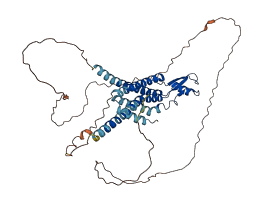
Descriptions
The autoinhibited protein was predicted that may have potential autoinhibitory elements via cis-regPred.
Autoinhibitory domains (AIDs)
Target domain |
|
Relief mechanism |
|
Assay |
cis-regPred |
Accessory elements
No accessory elements
Autoinhibited structure

Activated structure
1 structures for P28236
| Entry ID | Method | Resolution | Chain | Position | Source |
|---|---|---|---|---|---|
| AF-P28236-F1 | Predicted | AlphaFoldDB |
21 variants for P28236
| Variant ID(s) | Position | Change | Description | Diseaes Association | Provenance |
|---|---|---|---|---|---|
| rs3388654106 | 65 | C>* | No | EVA | |
| rs3388632035 | 132 | Q>K | No | EVA | |
| rs3388645899 | 134 | S>I | No | EVA | |
| rs3388632036 | 170 | V>M | No | EVA | |
| rs3388652110 | 242 | A>T | No | EVA | |
| rs3388638359 | 252 | G>R | No | EVA | |
| rs3388653973 | 255 | A>V | No | EVA | |
| rs3388654053 | 262 | I>N | No | EVA | |
| rs3388652105 | 294 | V>* | No | EVA | |
| rs3388632071 | 296 | T>I | No | EVA | |
| rs3393344522 | 311 | I>F | No | EVA | |
| rs3388639971 | 311 | I>N | No | EVA | |
| rs3388654040 | 316 | L>P | No | EVA | |
| rs3388654069 | 335 | V>I | No | EVA | |
| rs3388650353 | 344 | P>S | No | EVA | |
| rs244331207 | 345 | I>V | No | EVA | |
| rs3388643945 | 351 | P>S | No | EVA | |
| rs3388640055 | 361 | E>V | No | EVA | |
| rs239844791 | 384 | V>M | No | EVA | |
| rs3388645565 | 391 | E>* | No | EVA | |
| rs3393369771 | 436 | D>Y | No | EVA |
No associated diseases with P28236
No regional properties for P28236
| Type | Name | Position | InterPro Accession |
|---|---|---|---|
| No domain, repeats, and functional sites for P28236 | |||
4 GO annotations of cellular component
| Name | Definition |
|---|---|
| connexin complex | An assembly of six molecules of connexin, made in the Golgi apparatus and subsequently transported to the plasma membrane, where docking of two connexons on apposed plasma membranes across the extracellular space forms a gap junction. |
| integral component of membrane | The component of a membrane consisting of the gene products and protein complexes having at least some part of their peptide sequence embedded in the hydrophobic region of the membrane. |
| integral component of plasma membrane | The component of the plasma membrane consisting of the gene products and protein complexes having at least some part of their peptide sequence embedded in the hydrophobic region of the membrane. |
| plasma membrane | The membrane surrounding a cell that separates the cell from its external environment. It consists of a phospholipid bilayer and associated proteins. |
2 GO annotations of molecular function
| Name | Definition |
|---|---|
| gap junction channel activity | A wide pore channel activity that enables a direct cytoplasmic connection from one cell to an adjacent cell. The gap junction can pass large solutes as well as electrical signals between cells. Gap junctions consist of two gap junction hemi-channels, or connexons, one contributed by each membrane through which the gap junction passes. |
| identical protein binding | Binding to an identical protein or proteins. |
7 GO annotations of biological process
| Name | Definition |
|---|---|
| camera-type eye development | The process whose specific outcome is the progression of the camera-type eye over time, from its formation to the mature structure. The camera-type eye is an organ of sight that receives light through an aperture and focuses it through a lens, projecting it on a photoreceptor field. |
| cell-cell signaling | Any process that mediates the transfer of information from one cell to another. This process includes signal transduction in the receiving cell and, where applicable, release of a ligand and any processes that actively facilitate its transport and presentation to the receiving cell. Examples include signaling via soluble ligands, via cell adhesion molecules and via gap junctions. |
| gap junction-mediated intercellular transport | The movement of substances between cells via gap junctions. A gap junction is a fine cytoplasmic channel, found in animal cells, that connects the cytoplasm of one cell to that of an adjacent cell, allowing ions and other molecules to pass freely between the two cells. |
| lens development in camera-type eye | The process whose specific outcome is the progression of the lens over time, from its formation to the mature structure. The lens is a transparent structure in the eye through which light is focused onto the retina. An example of this process is found in Mus musculus. |
| regulation of catalase activity | Any process that modulates the frequency, rate or extent of catalase activity. |
| regulation of glutathione peroxidase activity | Any process that modulates the frequency, rate or extent of glutathione peroxidase activity. |
| regulation of granulocyte macrophage colony-stimulating factor production | Any process that modulates the frequency, rate, or extent of granulocyte macrophage colony-stimulating factor production. |
| 10 | 20 | 30 | 40 | 50 | 60 |
| MGDWSFLGNI | LEEVNEHSTV | IGRVWLTVLF | IFRILILGTA | AEFVWGDEQS | DFVCNTQQPG |
| 70 | 80 | 90 | 100 | 110 | 120 |
| CENVCYDEAF | PISHIRLWVL | QIIFVSTPSL | MYVGHAVHHV | RMEEKRKDRE | AEELCQQSRS |
| 130 | 140 | 150 | 160 | 170 | 180 |
| NGGERVPIAP | DQASIRKSSS | SSKGTKKFRL | EGTLLRTYVC | HIIFKTLFEV | GFIVGHYFLY |
| 190 | 200 | 210 | 220 | 230 | 240 |
| GFRILPLYRC | SRWPCPNVVD | CFVSRPTEKT | IFILFMLSVA | FVSLFLNIME | MSHLGMKGIR |
| 250 | 260 | 270 | 280 | 290 | 300 |
| SAFKRPVEQP | LGEIAEKSLH | SIAVSSIQKA | KGYQLLEEEK | IVSHYFPLTE | VGMVETSPLS |
| 310 | 320 | 330 | 340 | 350 | 360 |
| AKPFSQFEEK | IGTGPLADMS | RSYQETLPSY | AQVGVQEVER | EEPPIEEAVE | PEVGEKKQEA |
| 370 | 380 | 390 | 400 | 410 | 420 |
| EKVAPEGQET | VAVPDRERVE | TPGVGKEDEK | EELQAEKVTK | QGLSAEKAPS | LCPELTTDDN |
| 430 | |||||
| RPLSRLSKAS | SRARSDDLTI |