P22437
Gene name |
Ptgs1 |
Protein name |
Prostaglandin G/H synthase 1 |
Names |
Cyclooxygenase-1, COX-1, Prostaglandin H2 synthase 1, PGH synthase 1, PGHS-1, PHS 1, Prostaglandin-endoperoxide synthase 1 |
Species |
Mus musculus (Mouse) |
KEGG Pathway |
mmu:19224 |
EC number |
1.14.99.1: Miscellaneous |
Protein Class |
|
Descriptions
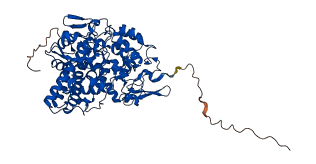
The autoinhibited protein was predicted that may have potential autoinhibitory elements via cis-regPred.
Autoinhibitory domains (AIDs)
Target domain |
|
Relief mechanism |
|
Assay |
cis-regPred |
Accessory elements
No accessory elements
Autoinhibited structure

Activated structure
1 structures for P22437
| Entry ID | Method | Resolution | Chain | Position | Source |
|---|---|---|---|---|---|
| AF-P22437-F1 | Predicted | AlphaFoldDB |
33 variants for P22437
| Variant ID(s) | Position | Change | Description | Diseaes Association | Provenance |
|---|---|---|---|---|---|
| rs212908359 | 29 | P>R | No | EVA | |
| rs3388544833 | 33 | S>L | No | EVA | |
| rs3388552389 | 92 | H>L | No | EVA | |
| rs8238813 | 113 | V>I | No | EVA | |
| rs3388546124 | 159 | K>N | No | EVA | |
| rs3388551533 | 169 | G>W | No | EVA | |
| rs3388550573 | 176 | V>A | No | EVA | |
| rs3388547765 | 194 | Q>P | No | EVA | |
| rs3388545875 | 195 | G>A | No | EVA | |
| rs3388545866 | 210 | Q>H | No | EVA | |
| rs3388544820 | 211 | F>L | No | EVA | |
| rs3388548847 | 212 | F>L | No | EVA | |
| rs3388545846 | 212 | F>Y | No | EVA | |
| rs3388544788 | 213 | K>N | No | EVA | |
| rs3388550784 | 213 | K>T | No | EVA | |
| rs3388547415 | 240 | L>Q | No | EVA | |
| rs3388546174 | 247 | R>Q | No | EVA | |
| rs3388550840 | 262 | E>D | No | EVA | |
| rs3388548514 | 273 | V>M | No | EVA | |
| rs3388547413 | 286 | Q>L | No | EVA | |
| rs3388551514 | 328 | E>K | No | EVA | |
| rs3388545913 | 335 | R>C | No | EVA | |
| rs3388544834 | 342 | T>I | No | EVA | |
| rs3388550344 | 369 | F>I | No | EVA | |
| rs8238822 | 381 | M>L | No | EVA | |
| rs3388544823 | 452 | D>G | No | EVA | |
| rs3388547775 | 461 | R>H | No | EVA | |
| rs3388549779 | 474 | L>F | No | EVA | |
| rs3388548920 | 482 | E>* | No | EVA | |
| rs3388548870 | 519 | I>V | No | EVA | |
| rs3388544818 | 539 | N>I | No | EVA | |
| rs3388547860 | 554 | G>V | No | EVA | |
| rs3388547390 | 567 | K>T | No | EVA |
No associated diseases with P22437
7 regional properties for P22437
| Type | Name | Position | InterPro Accession |
|---|---|---|---|
| domain | C2 domain | 94 - 216 | IPR000008-1 |
| domain | C2 domain | 256 - 389 | IPR000008-2 |
| domain | Synaptotagmin | 260 - 275 | IPR001565-1 |
| domain | Synaptotagmin | 275 - 288 | IPR001565-2 |
| domain | Synaptotagmin | 332 - 347 | IPR001565-3 |
| domain | Synaptotagmin | 352 - 362 | IPR001565-4 |
| domain | Rabphilin/Doc2, first C2 domain | 95 - 218 | IPR047022 |
Functions
| Description | ||
|---|---|---|
| EC Number | 1.14.99.1 | Miscellaneous |
| Subcellular Localization |
|
|
| PANTHER Family | ||
| PANTHER Subfamily | ||
| PANTHER Protein Class | ||
| PANTHER Pathway Category | No pathway information available | |
7 GO annotations of cellular component
| Name | Definition |
|---|---|
| cytoplasm | The contents of a cell excluding the plasma membrane and nucleus, but including other subcellular structures. |
| endoplasmic reticulum membrane | The lipid bilayer surrounding the endoplasmic reticulum. |
| Golgi apparatus | A membrane-bound cytoplasmic organelle of the endomembrane system that further processes the core oligosaccharides (e.g. N-glycans) added to proteins in the endoplasmic reticulum and packages them into membrane-bound vesicles. The Golgi apparatus operates at the intersection of the secretory, lysosomal, and endocytic pathways. |
| intracellular membrane-bounded organelle | Organized structure of distinctive morphology and function, bounded by a single or double lipid bilayer membrane and occurring within the cell. Includes the nucleus, mitochondria, plastids, vacuoles, and vesicles. Excludes the plasma membrane. |
| neuron projection | A prolongation or process extending from a nerve cell, e.g. an axon or dendrite. |
| nuclear envelope | The double lipid bilayer enclosing the nucleus and separating its contents from the rest of the cytoplasm; includes the intermembrane space, a gap of width 20-40 nm (also called the perinuclear space). |
| photoreceptor outer segment | The outer segment of a vertebrate photoreceptor that contains a stack of membrane discs embedded with photoreceptor proteins. |
5 GO annotations of molecular function
| Name | Definition |
|---|---|
| heme binding | Binding to a heme, a compound composed of iron complexed in a porphyrin (tetrapyrrole) ring. |
| metal ion binding | Binding to a metal ion. |
| oxidoreductase activity, acting on single donors with incorporation of molecular oxygen, incorporation of two atoms of oxygen | Catalysis of an oxidation-reduction (redox) reaction in which hydrogen or electrons are transferred from one donor, and two oxygen atoms is incorporated into a donor. |
| peroxidase activity | Catalysis of the reaction: a donor + a peroxide = an oxidized donor + 2 H2O. |
| prostaglandin-endoperoxide synthase activity | Catalysis of the reaction: arachidonate + donor-H2 + 2 O2 = prostaglandin H2 + acceptor + H2O. |
16 GO annotations of biological process
| Name | Definition |
|---|---|
| cyclooxygenase pathway | The chemical reactions and pathways by which prostaglandins are formed from arachidonic acid, and in which prostaglandin-endoperoxide synthase (cyclooxygenase) catalyzes the committed step in the conversion of arachidonic acid to the prostaglandin-endoperoxides PGG2 and PGH2. |
| inflammatory response | The immediate defensive reaction (by vertebrate tissue) to infection or injury caused by chemical or physical agents. The process is characterized by local vasodilation, extravasation of plasma into intercellular spaces and accumulation of white blood cells and macrophages. |
| keratinocyte differentiation | The process in which a relatively unspecialized cell acquires specialized features of a keratinocyte. |
| learning | Any process in an organism in which a relatively long-lasting adaptive behavioral change occurs as the result of experience. |
| maintenance of blood-brain barrier | Maintaining the structure and function of the blood-brain barrier, thus ensuring specific regulated transport of substances (e.g. macromolecules, small molecules, ions) into the brain, and out of the brain into the blood circulation. |
| memory | The activities involved in the mental information processing system that receives (registers), modifies, stores, and retrieves informational stimuli. The main stages involved in the formation and retrieval of memory are encoding (processing of received information by acquisition), storage (building a permanent record of received information as a result of consolidation) and retrieval (calling back the stored information and use it in a suitable way to execute a given task). |
| negative regulation of epinephrine secretion | Any process that stops, prevents, or reduces the frequency, rate or extent of the regulated release of epinephrine. |
| negative regulation of norepinephrine secretion | Any process that decreases the frequency, rate or extent of the regulated release of norepinephrine. |
| positive regulation of smooth muscle contraction | Any process that activates or increases the frequency, rate or extent of smooth muscle contraction. |
| positive regulation of vasoconstriction | Any process that activates or increases the frequency, rate or extent of vasoconstriction. |
| prostaglandin biosynthetic process | The chemical reactions and pathways resulting in the formation of prostaglandins, any of a group of biologically active metabolites which contain a cyclopentane ring. |
| prostaglandin metabolic process | The chemical reactions and pathways involving prostaglandins, any of a group of biologically active metabolites which contain a cyclopentane ring due to the formation of a bond between two carbons of a fatty acid. They have a wide range of biological activities. |
| regulation of blood pressure | Any process that modulates the force with which blood travels through the circulatory system. The process is controlled by a balance of processes that increase pressure and decrease pressure. |
| regulation of cell population proliferation | Any process that modulates the frequency, rate or extent of cell proliferation. |
| response to oxidative stress | Any process that results in a change in state or activity of a cell or an organism (in terms of movement, secretion, enzyme production, gene expression, etc.) as a result of oxidative stress, a state often resulting from exposure to high levels of reactive oxygen species, e.g. superoxide anions, hydrogen peroxide (H2O2), and hydroxyl radicals. |
| sensory perception of pain | The series of events required for an organism to receive a painful stimulus, convert it to a molecular signal, and recognize and characterize the signal. Pain is medically defined as the physical sensation of discomfort or distress caused by injury or illness, so can hence be described as a harmful stimulus which signals current (or impending) tissue damage. Pain may come from extremes of temperature, mechanical damage, electricity or from noxious chemical substances. This is a neurological process. |
7 homologous proteins in AiPD
| UniProt AC | Gene Name | Protein Name | Species | Evidence Code |
|---|---|---|---|---|
| O62664 | PTGS1 | Prostaglandin G/H synthase 1 | Bos taurus (Bovine) | PR |
| Q8HZR1 | PTGS1 | Prostaglandin G/H synthase 1 | Canis lupus familiaris (Dog) (Canis familiaris) | PR |
| Q9UPX0 | IGSF9B | Protein turtle homolog B | Homo sapiens (Human) | PR |
| P35354 | PTGS2 | Prostaglandin G/H synthase 2 | Homo sapiens (Human) | PR |
| P23219 | PTGS1 | Prostaglandin G/H synthase 1 | Homo sapiens (Human) | PR |
| Q05769 | Ptgs2 | Prostaglandin G/H synthase 2 | Mus musculus (Mouse) | PR |
| Q9C9U3 | DOX2 | Alpha-dioxygenase 2 | Arabidopsis thaliana (Mouse-ear cress) | PR |
| 10 | 20 | 30 | 40 | 50 | 60 |
| MSRRSLSLWF | PLLLLLLLPP | TPSVLLADPG | VPSPVNPCCY | YPCQNQGVCV | RFGLDNYQCD |
| 70 | 80 | 90 | 100 | 110 | 120 |
| CTRTGYSGPN | CTIPEIWTWL | RNSLRPSPSF | THFLLTHGYW | LWEFVNATFI | REVLMRLVLT |
| 130 | 140 | 150 | 160 | 170 | 180 |
| VRSNLIPSPP | TYNSAHDYIS | WESFSNVSYY | TRILPSVPKD | CPTPMGTKGK | KQLPDVQLLA |
| 190 | 200 | 210 | 220 | 230 | 240 |
| QQLLLRREFI | PAPQGTNILF | AFFAQHFTHQ | FFKTSGKMGP | GFTKALGHGV | DLGHIYGDNL |
| 250 | 260 | 270 | 280 | 290 | 300 |
| ERQYHLRLFK | DGKLKYQVLD | GEVYPPSVEQ | ASVLMRYPPG | VPPERQMAVG | QEVFGLLPGL |
| 310 | 320 | 330 | 340 | 350 | 360 |
| MLFSTIWLRE | HNRVCDLLKE | EHPTWDDEQL | FQTTRLILIG | ETIKIVIEEY | VQHLSGYFLQ |
| 370 | 380 | 390 | 400 | 410 | 420 |
| LKFDPELLFR | AQFQYRNRIA | MEFNHLYHWH | PLMPNSFQVG | SQEYSYEQFL | FNTSMLVDYG |
| 430 | 440 | 450 | 460 | 470 | 480 |
| VEALVDAFSR | QRAGRIGGGR | NFDYHVLHVA | VDVIKESREM | RLQPFNEYRK | RFGLKPYTSF |
| 490 | 500 | 510 | 520 | 530 | 540 |
| QELTGEKEMA | AELEELYGDI | DALEFYPGLL | LEKCQPNSIF | GESMIEMGAP | FSLKGLLGNP |
| 550 | 560 | 570 | 580 | 590 | 600 |
| ICSPEYWKPS | TFGGDVGFNL | VNTASLKKLV | CLNTKTCPYV | SFRVPDYPGD | DGSVLVRRST |
| EL |