P20424
Gene name |
SRP54 (SRH1, YPR088C, P9513.14) |
Protein name |
Signal recognition particle subunit SRP54 |
Names |
Signal recognition particle 54 kDa protein homolog |
Species |
Saccharomyces cerevisiae (strain ATCC 204508 / S288c) (Baker's yeast) |
KEGG Pathway |
sce:YPR088C |
EC number |
3.6.5.4: Acting on GTP; involved in cellular and subcellular movement |
Protein Class |
|
Descriptions
The autoinhibited protein was predicted that may have potential autoinhibitory elements via cis-regPred.
Autoinhibitory domains (AIDs)
Target domain |
|
Relief mechanism |
|
Assay |
cis-regPred |
Accessory elements
No accessory elements
Autoinhibited structure

Activated structure
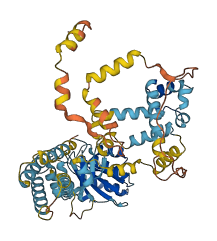
1 structures for P20424
| Entry ID | Method | Resolution | Chain | Position | Source |
|---|---|---|---|---|---|
| AF-P20424-F1 | Predicted | AlphaFoldDB |
6 variants for P20424
| Variant ID(s) | Position | Change | Description | Diseaes Association | Provenance |
|---|---|---|---|---|---|
| s16-712849 | 60 | Q>K | No | SGRP | |
| s16-712750 | 93 | T>S | No | SGRP | |
| s16-712726 | 101 | A>T | No | SGRP | |
| s16-712712 | 105 | K>N | No | SGRP | |
| s16-711685 | 448 | P>S | No | SGRP | |
| s16-711629 | 466 | M>I | No | SGRP |
No associated diseases with P20424
4 regional properties for P20424
| Type | Name | Position | InterPro Accession |
|---|---|---|---|
| domain | Signal recognition particle, SRP54 subunit, GTPase domain | 109 - 304 | IPR000897 |
| domain | AAA+ ATPase domain | 108 - 294 | IPR003593 |
| domain | Signal recognition particle, SRP54 subunit, M-domain | 335 - 436 | IPR004125 |
| domain | Signal recognition particle SRP54, helical bundle | 2 - 92 | IPR013822 |
Functions
| Description | ||
|---|---|---|
| EC Number | 3.6.5.4 | Acting on GTP; involved in cellular and subcellular movement |
| Subcellular Localization |
|
|
| PANTHER Family | ||
| PANTHER Subfamily | ||
| PANTHER Protein Class | ||
| PANTHER Pathway Category | No pathway information available | |
3 GO annotations of cellular component
| Name | Definition |
|---|---|
| cytosol | The part of the cytoplasm that does not contain organelles but which does contain other particulate matter, such as protein complexes. |
| endoplasmic reticulum | The irregular network of unit membranes, visible only by electron microscopy, that occurs in the cytoplasm of many eukaryotic cells. The membranes form a complex meshwork of tubular channels, which are often expanded into slitlike cavities called cisternae. The ER takes two forms, rough (or granular), with ribosomes adhering to the outer surface, and smooth (with no ribosomes attached). |
| signal recognition particle, endoplasmic reticulum targeting | A ribonucleoprotein particle of 325 kDa composed of a 7S (300 nucleotide) RNA molecule and a complex of six different polypeptides. This binds both to the N-terminal signal peptide for proteins destined for the endoplasmic reticulum as they emerge from the large ribosomal subunit and also to the ribosome. This binding arrests further translation thereby preventing the proteins from being released into the cytosol. The SRP-ribosome complex then diffuses to the endoplasmic reticulum where it is bound to the signal recognition particle receptor, which allows resumption of protein synthesis and facilitates the passage of the growing polypeptide chain through the translocon. Through a process involving GTP hydrolysis, the SRP-SRP receptor complex dissociates and SRP returns to the cytosol. Of the six polypeptides of SRP the 54 kDa subunit (SRP54) is the central player. It contains an N-terminal GTPase domain and a C-terminal domain that binds directly to the signal peptide and the SRP RNA. Examples of this component are found in Mus musculus, Saccharomyces cerevisiae and Arabidopsis thaliana. |
5 GO annotations of molecular function
| Name | Definition |
|---|---|
| 7S RNA binding | Binding to a 7S RNA, the RNA component of the signal recognition particle (SRP). |
| endoplasmic reticulum signal peptide binding | Binding to an endoplasmic reticulum signal peptide, a specific peptide sequence that acts as a signal to localize the protein within the endoplasmic reticulum. |
| GTP binding | Binding to GTP, guanosine triphosphate. |
| GTPase activator activity | Binds to and increases the activity of a GTPase, an enzyme that catalyzes the hydrolysis of GTP. |
| GTPase activity | Catalysis of the reaction: GTP + H2O = GDP + H+ + phosphate. |
3 GO annotations of biological process
| Name | Definition |
|---|---|
| SRP-dependent cotranslational protein targeting to membrane | The targeting of proteins to a membrane that occurs during translation and is dependent upon two key components, the signal-recognition particle (SRP) and the SRP receptor. SRP is a cytosolic particle that transiently binds to the endoplasmic reticulum (ER) signal sequence in a nascent protein, to the large ribosomal unit, and to the SRP receptor in the ER membrane. |
| SRP-dependent cotranslational protein targeting to membrane, signal sequence recognition | The process in which SRP binds to the signal peptide in a nascent protein, causing protein elongation to pause, during cotranslational membrane targeting. |
| SRP-dependent cotranslational protein targeting to membrane, translocation | The process during cotranslational membrane targeting wherein proteins move across a membrane. SRP and its receptor initiate the transfer of the nascent chain across the endoplasmic reticulum (ER) membrane; they then dissociate from the chain, which is transferred to a set of transmembrane proteins, collectively called the translocon. Once the nascent chain translocon complex is assembled, the elongating chain passes directly from the large ribosomal subunit into the centers of the translocon, a protein-lined channel within the membrane. The growing chain is never exposed to the cytosol and does not fold until it reaches the ER lumen. |
8 homologous proteins in AiPD
| UniProt AC | Gene Name | Protein Name | Species | Evidence Code |
|---|---|---|---|---|
| Q2T9U1 | SRP54 | Signal recognition particle 54 kDa protein | Bos taurus (Bovine) | PR |
| P61010 | SRP54 | Signal recognition particle 54 kDa protein | Canis lupus familiaris (Dog) (Canis familiaris) | PR |
| P61011 | SRP54 | Signal recognition particle 54 kDa protein | Homo sapiens (Human) | PR |
| P14576 | Srp54 | Signal recognition particle 54 kDa protein | Mus musculus (Mouse) | PR |
| Q6AYB5 | Srp54 | Signal recognition particle 54 kDa protein | Rattus norvegicus (Rat) | PR |
| P49966 | SRP-54B | Signal recognition particle 54 kDa protein 2 | Arabidopsis thaliana (Mouse-ear cress) | PR |
| P49971 | Signal recognition particle 54 kDa protein 1 | Solanum lycopersicum (Tomato) (Lycopersicon esculentum) | PR | |
| P49972 | Signal recognition particle 54 kDa protein 2 | Solanum lycopersicum (Tomato) (Lycopersicon esculentum) | PR |
| 10 | 20 | 30 | 40 | 50 | 60 |
| MVLADLGKRI | NSAVNNAISN | TQDDFTTSVD | VMLKGIVTAL | LESDVNIALV | SKLRNNIRSQ |
| 70 | 80 | 90 | 100 | 110 | 120 |
| LLSENRSEKS | TTNAQTKKLI | QKTVFDELCK | LVTCEGSEEK | AFVPKKRKTN | IIMFVGLQGS |
| 130 | 140 | 150 | 160 | 170 | 180 |
| GKTTSCTKLA | VYYSKRGFKV | GLVCADTFRA | GAFDQLKQNA | IRARIPFYGS | YTETDPAKVA |
| 190 | 200 | 210 | 220 | 230 | 240 |
| EEGINKFKKE | KFDIIIVDTS | GRHHQEEELF | QEMIEISNVI | KPNQTIMVLD | ASIGQAAEQQ |
| 250 | 260 | 270 | 280 | 290 | 300 |
| SKAFKESSDF | GAIILTKMDG | HARGGGAISA | VAATNTPIIF | IGTGEHIHDL | EKFSPKSFIS |
| 310 | 320 | 330 | 340 | 350 | 360 |
| KLLGIGDIES | LFEQLQTVSN | KEDAKATMEN | IQKGKFTLLD | FKKQMQTIMK | MGPLSNIAQM |
| 370 | 380 | 390 | 400 | 410 | 420 |
| IPGMSNMMNQ | VGEEETSQKM | KKMVYVLDSM | TKEELESDGR | MFIEEPTRMV | RVAKGSGTSV |
| 430 | 440 | 450 | 460 | 470 | 480 |
| FEVEMILMQQ | QMMARMAQTA | TQQQPGAPGA | NARMPGMPNM | PGMPNMPGMP | NMPGMPKVTP |
| 490 | 500 | 510 | 520 | 530 | 540 |
| QMMQQAQQKL | KQNPGLMQNM | MNMFGGGMGG | GMGGGMPDMN | EMMKMMQDPQ | MQQMAKQFGM |
| G |