P19145
Gene name |
GAP1 |
Protein name |
General amino-acid permease GAP1 |
Names |
|
Species |
Saccharomyces cerevisiae (strain ATCC 204508 / S288c) (Baker's yeast) |
KEGG Pathway |
sce:YKR039W |
EC number |
|
Protein Class |
|
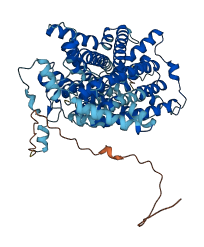
Descriptions
The autoinhibited protein was predicted that may have potential autoinhibitory elements via cis-regPred.
Autoinhibitory domains (AIDs)
Target domain |
|
Relief mechanism |
|
Assay |
cis-regPred |
Accessory elements
No accessory elements
Autoinhibited structure

Activated structure
1 structures for P19145
| Entry ID | Method | Resolution | Chain | Position | Source |
|---|---|---|---|---|---|
| AF-P19145-F1 | Predicted | AlphaFoldDB |
23 variants for P19145
| Variant ID(s) | Position | Change | Description | Diseaes Association | Provenance |
|---|---|---|---|---|---|
| s11-514756 | 18 | N>D | No | SGRP | |
| s11-514772 | 23 | D>G | No | SGRP | |
| s11-515077 | 125 | L>M | No | SGRP | |
| s11-515221 | 173 | F>I | No | SGRP | |
| s11-515249 | 182 | V>A | No | SGRP | |
| s11-515248 | 182 | V>M | No | SGRP | |
| s11-515269 | 189 | S>A | No | SGRP | |
| s11-515425 | 241 | V>I | No | SGRP | |
| s11-515557 | 285 | V>I | No | SGRP | |
| s11-515594 | 297 | A>D | No | SGRP | |
| s11-515593 | 297 | A>T | No | SGRP | |
| s11-515716 | 338 | I>V | No | SGRP | |
| s11-515746 | 348 | S>R | No | SGRP | |
| s11-515800 | 366 | I>L | No | SGRP | |
| s11-515882 | 393 | A>G | No | SGRP | |
| s11-515891 | 396 | A>G | No | SGRP | |
| s11-515996 | 431 | S>C | No | SGRP | |
| s11-516033 | 443 | K>N | No | SGRP | |
| s11-516071 | 456 | S>C | No | SGRP | |
| s11-516211 | 503 | L>I | No | SGRP | |
| s11-516224 | 507 | I>T | No | SGRP | |
| s11-516223 | 507 | I>V | No | SGRP | |
| s11-516256 | 518 | V>L | No | SGRP |
No associated diseases with P19145
No regional properties for P19145
| Type | Name | Position | InterPro Accession |
|---|---|---|---|
| No domain, repeats, and functional sites for P19145 | |||
Functions
9 GO annotations of cellular component
| Name | Definition |
|---|---|
| COPII-coated ER to Golgi transport vesicle | A vesicle with a coat formed of the COPII coat complex proteins. The COPII coat complex is formed by the Sec23p/Sec24p and the Sec13p/Sec31p heterodimers. COPII-associated vesicles transport proteins from the rough endoplasmic reticulum to the Golgi apparatus (anterograde transport). |
| endoplasmic reticulum | The irregular network of unit membranes, visible only by electron microscopy, that occurs in the cytoplasm of many eukaryotic cells. The membranes form a complex meshwork of tubular channels, which are often expanded into slitlike cavities called cisternae. The ER takes two forms, rough (or granular), with ribosomes adhering to the outer surface, and smooth (with no ribosomes attached). |
| endoplasmic reticulum membrane | The lipid bilayer surrounding the endoplasmic reticulum. |
| endosome | A vacuole to which materials ingested by endocytosis are delivered. |
| fungal-type vacuole lumen | The volume enclosed within the vacuolar membrane of a vacuole, the shape of which correlates with cell cycle phase. An example of this structure is found in Saccharomyces cerevisiae. |
| integral component of membrane | The component of a membrane consisting of the gene products and protein complexes having at least some part of their peptide sequence embedded in the hydrophobic region of the membrane. |
| integral component of plasma membrane | The component of the plasma membrane consisting of the gene products and protein complexes having at least some part of their peptide sequence embedded in the hydrophobic region of the membrane. |
| multivesicular body | A type of endosome in which regions of the limiting endosomal membrane invaginate to form internal vesicles; membrane proteins that enter the internal vesicles are sequestered from the cytoplasm. |
| plasma membrane | The membrane surrounding a cell that separates the cell from its external environment. It consists of a phospholipid bilayer and associated proteins. |
5 GO annotations of molecular function
| Name | Definition |
|---|---|
| amino acid transmembrane transporter activity | Enables the transfer of amino acids from one side of a membrane to the other. Amino acids are organic molecules that contain an amino group and a carboxyl group. |
| beta-alanine transmembrane transporter activity | Enables the transfer of beta-alanine from one side of a membrane to the other. Beta-alanine is 3-aminopropanoic acid. |
| L-phenylalanine transmembrane transporter activity | Enables the transfer of L-phenylalanine from one side of a membrane to the other. L-phenylalanine is 2-amino-3-phenylpropanoic acid. |
| L-proline transmembrane transporter activity | Enables the transfer of L-proline from one side of a membrane to the other. L-proline is pyrrolidine-2-carboxylic acid. |
| polyamine transmembrane transporter activity | Enables the transfer of polyamines, organic compounds containing two or more amino groups, from one side of a membrane to the other. |
3 GO annotations of biological process
| Name | Definition |
|---|---|
| amino acid transmembrane transport | The process in which an amino acid is transported across a membrane. |
| amino acid transport | The directed movement of amino acids, organic acids containing one or more amino substituents, into, out of or within a cell, or between cells, by means of some agent such as a transporter or pore. |
| polyamine transport | The directed movement of polyamines, organic compounds containing two or more amino groups, into, out of or within a cell, or between cells, by means of some agent such as a transporter or pore. |
2 homologous proteins in AiPD
| 10 | 20 | 30 | 40 | 50 | 60 |
| MSNTSSYEKN | NPDNLKHNGI | TIDSEFLTQE | PITIPSNGSA | VSIDETGSGS | KWQDFKDSFK |
| 70 | 80 | 90 | 100 | 110 | 120 |
| RVKPIEVDPN | LSEAEKVAII | TAQTPLKHHL | KNRHLQMIAI | GGAIGTGLLV | GSGTALRTGG |
| 130 | 140 | 150 | 160 | 170 | 180 |
| PASLLIGWGS | TGTMIYAMVM | ALGELAVIFP | ISGGFTTYAT | RFIDESFGYA | NNFNYMLQWL |
| 190 | 200 | 210 | 220 | 230 | 240 |
| VVLPLEIVSA | SITVNFWGTD | PKYRDGFVAL | FWLAIVIINM | FGVKGYGEAE | FVFSFIKVIT |
| 250 | 260 | 270 | 280 | 290 | 300 |
| VVGFIILGII | LNCGGGPTGG | YIGGKYWHDP | GAFAGDTPGA | KFKGVCSVFV | TAAFSFAGSE |
| 310 | 320 | 330 | 340 | 350 | 360 |
| LVGLAASESV | EPRKSVPKAA | KQVFWRITLF | YILSLLMIGL | LVPYNDKSLI | GASSVDAAAS |
| 370 | 380 | 390 | 400 | 410 | 420 |
| PFVIAIKTHG | IKGLPSVVNV | VILIAVLSVG | NSAIYACSRT | MVALAEQRFL | PEIFSYVDRK |
| 430 | 440 | 450 | 460 | 470 | 480 |
| GRPLVGIAVT | SAFGLIAFVA | ASKKEGEVFN | WLLALSGLSS | LFTWGGICIC | HIRFRKALAA |
| 490 | 500 | 510 | 520 | 530 | 540 |
| QGRGLDELSF | KSPTGVWGSY | WGLFMVIIMF | IAQFYVAVFP | VGDSPSAEGF | FEAYLSFPLV |
| 550 | 560 | 570 | 580 | 590 | 600 |
| MVMYIGHKIY | KRNWKLFIPA | EKMDIDTGRR | EVDLDLLKQE | IAEEKAIMAT | KPRWYRIWNF |
| WC |