P14713
Gene name |
PHYB |
Protein name |
Phytochrome B |
Names |
Protein LONG HYPOCOTYL 3, Protein OUT OF PHASE 1 |
Species |
Arabidopsis thaliana (Mouse-ear cress) |
KEGG Pathway |
ath:AT2G18790 |
EC number |
|
Protein Class |
|
Descriptions
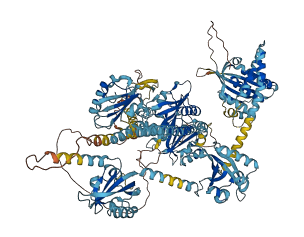
The autoinhibited protein was predicted that may have potential autoinhibitory elements via cis-regPred.
Autoinhibitory domains (AIDs)
Target domain |
|
Relief mechanism |
|
Assay |
cis-regPred |
Accessory elements
No accessory elements
Autoinhibited structure

Activated structure
3 structures for P14713
| Entry ID | Method | Resolution | Chain | Position | Source |
|---|---|---|---|---|---|
| 4OUR | X-ray | 340 A | A/B | 90-624 | PDB |
| 7RZW | EM | 330 A | A/B | 1-1172 | PDB |
| AF-P14713-F1 | Predicted | AlphaFoldDB |
55 variants for P14713
| Variant ID(s) | Position | Change | Description | Diseaes Association | Provenance |
|---|---|---|---|---|---|
| tmp_2_8140086_C_A | 3 | S>Y | No | 1000Genomes | |
| 9 | G>del | strain: cv. Kas-1 [UniProt] | No | ||
| ENSVATH01839675 | 19 | E>K | strain: cv. Kas-1 [UniProt] | No | 1000Genomes |
| tmp_2_8140145_T_C | 23 | S>P | No | 1000Genomes | |
| ENSVATH01839676 | 40 | S>L | No | 1000Genomes | |
| ENSVATH13268388 | 69 | A>V | No | 1000Genomes | |
| tmp_2_8140301_G_A | 75 | G>S | No | 1000Genomes | |
| tmp_2_8140344_C_A | 89 | T>K | No | 1000Genomes | |
| ENSVATH01839678 | 93 | G>D | No | 1000Genomes | |
| ENSVATH14517390 | 129 | R>Q | No | 1000Genomes | |
| tmp_2_8140476_A_T | 133 | Y>F | No | 1000Genomes | |
| ENSVATH00237392 | 143 | I>L | strain: cv. Kas-1 [UniProt] | No | 1000Genomes |
| ENSVATH01839688 | 247 | A>S | No | 1000Genomes | |
| ENSVATH05527854 | 264 | V>M | No | 1000Genomes | |
| ENSVATH14517392 | 295 | L>F | No | 1000Genomes | |
| ENSVATH05527856 | 461 | A>V | No | 1000Genomes | |
| ENSVATH01839699 | 501 | D>E | No | 1000Genomes | |
| tmp_2_8141582_G_C | 502 | V>L | No | 1000Genomes | |
| ENSVATH05527857 | 509 | N>Y | No | 1000Genomes | |
| ENSVATH05527858 | 543 | Y>F | No | 1000Genomes | |
| tmp_2_8141895_C_T | 606 | A>V | No | 1000Genomes | |
| ENSVATH00237406 | 624 | A>D | No | 1000Genomes | |
| ENSVATH13268394 | 637 | C>S | No | 1000Genomes | |
| ENSVATH05527861 | 706 | K>Q | No | 1000Genomes | |
| ENSVATH01839705 | 709 | E>K | No | 1000Genomes | |
| tmp_2_8142241_A_T | 721 | R>S | No | 1000Genomes | |
| ENSVATH01839707 | 736 | S>T | No | 1000Genomes | |
| tmp_2_8142391_A_C | 742 | K>T | No | 1000Genomes | |
| tmp_2_8142453_G_A | 763 | V>I | No | 1000Genomes | |
| tmp_2_8142550_A_T | 795 | N>I | No | 1000Genomes | |
| ENSVATH00237414 | 826 | S>G | No | 1000Genomes | |
| tmp_2_8142648_G_A | 828 | V>M | No | 1000Genomes | |
| ENSVATH13268417 | 830 | G>E | No | 1000Genomes | |
| ENSVATH05527865 | 837 | V>M | No | 1000Genomes | |
| tmp_2_8142791_C_G | 875 | D>E | No | 1000Genomes | |
| tmp_2_8142795_A_G | 877 | N>D | No | 1000Genomes | |
| tmp_2_8142807_G_C | 881 | V>L | No | 1000Genomes | |
| tmp_2_8142913_C_G | 916 | A>G | No | 1000Genomes | |
| ENSVATH05527868 | 924 | E>V | No | 1000Genomes | |
| tmp_2_8142967_A_T | 934 | Y>F | No | 1000Genomes | |
| ENSVATH13268419 | 946 | M>L | No | 1000Genomes | |
| ENSVATH00237418 | 948 | F>L | No | 1000Genomes | |
| ENSVATH01839714 | 949 | A>T | No | 1000Genomes | |
| tmp_2_8143051_A_T | 962 | Q>L | No | 1000Genomes | |
| ENSVATH05527869 | 967 | E>G | No | 1000Genomes | |
| ENSVATH00237420 | 980 | V>I | strain: cv. Kas-1 [UniProt] | No | 1000Genomes |
| ENSVATH01839715 | 989 | E>D | No | 1000Genomes | |
| tmp_2_8143294_C_T | 1013 | A>V | No | 1000Genomes | |
| ENSVATH05527873 | 1017 | L>F | No | 1000Genomes | |
| tmp_2_8143364_G_C | 1036 | E>D | No | 1000Genomes | |
| tmp_2_8143401_G_T | 1049 | A>S | No | 1000Genomes | |
| ENSVATH05527874 | 1068 | H>R | No | 1000Genomes | |
| ENSVATH00237425 | 1072 | L>V | strain: cv. Kas-1 [UniProt] | No | 1000Genomes |
| tmp_2_8144016_G_A | 1128 | M>I | No | 1000Genomes | |
| ENSVATH05527885 | 1166 | M>T | No | 1000Genomes |
No associated diseases with P14713
1 regional properties for P14713
| Type | Name | Position | InterPro Accession |
|---|---|---|---|
| domain | AMMECR1 domain | 8 - 202 | IPR002733 |
Functions
4 GO annotations of cellular component
| Name | Definition |
|---|---|
| cytosol | The part of the cytoplasm that does not contain organelles but which does contain other particulate matter, such as protein complexes. |
| nuclear body | Extra-nucleolar nuclear domains usually visualized by confocal microscopy and fluorescent antibodies to specific proteins. |
| nuclear speck | A discrete extra-nucleolar subnuclear domain, 20-50 in number, in which splicing factors are seen to be localized by immunofluorescence microscopy. |
| nucleus | A membrane-bounded organelle of eukaryotic cells in which chromosomes are housed and replicated. In most cells, the nucleus contains all of the cell's chromosomes except the organellar chromosomes, and is the site of RNA synthesis and processing. In some species, or in specialized cell types, RNA metabolism or DNA replication may be absent. |
8 GO annotations of molecular function
| Name | Definition |
|---|---|
| far-red light photoreceptor activity | The function of absorbing and responding to electromagnetic radiation with a wavelength of approximately 730nm. The response may involve a change in conformation. |
| identical protein binding | Binding to an identical protein or proteins. |
| phosphorelay sensor kinase activity | Catalysis of the phosphorylation of a histidine residue in response to detection of an extracellular signal such as a chemical ligand or change in environment, to initiate a change in cell state or activity. The two-component sensor is a histidine kinase that autophosphorylates a histidine residue in its active site. The phosphate is then transferred to an aspartate residue in a downstream response regulator, to trigger a response. |
| promoter-specific chromatin binding | Binding to a section of chromatin that is associated with gene promoter sequences of DNA. |
| protein homodimerization activity | Binding to an identical protein to form a homodimer. |
| red light photoreceptor activity | The function of absorbing and responding to electromagnetic radiation with a wavelength of approximately 660nm. The response may involve a change in conformation. |
| red or far-red light photoreceptor activity | The function of absorbing and responding to electromagnetic radiation with a wavelength of approximately 660-730nm. The response may involve a change in conformation. |
| sequence-specific DNA binding | Binding to DNA of a specific nucleotide composition, e.g. GC-rich DNA binding, or with a specific sequence motif or type of DNA e.g. promotor binding or rDNA binding. |
23 GO annotations of biological process
| Name | Definition |
|---|---|
| abscisic acid metabolic process | The chemical reactions and pathways involving abscisic acid, 5-(1-hydroxy-2,6,6,trimethyl-4-oxocyclohex-2-en-1-y1)-3-methylpenta-2,4-dienoic acid. |
| chromatin organization | The assembly or remodeling of chromatin composed of DNA complexed with histones, other associated proteins, and sometimes RNA. |
| circadian regulation of calcium ion oscillation | Any process that modulates the concentration of cytosolic free calcium ion |
| detection of visible light | The series of events in which a visible light stimulus is received by a cell and converted into a molecular signal. A visible light stimulus is electromagnetic radiation that can be perceived visually by an organism; for organisms lacking a visual system, this can be defined as light with a wavelength within the range 380 to 780 nm. |
| entrainment of circadian clock | The synchronization of a circadian rhythm to environmental time cues such as light. |
| gravitropism | The orientation of plant parts under the stimulation of gravity. |
| jasmonic acid mediated signaling pathway | The series of molecular signals mediated by jasmonic acid. |
| negative regulation of DNA-templated transcription | Any process that stops, prevents, or reduces the frequency, rate or extent of cellular DNA-templated transcription. |
| photomorphogenesis | The control of plant growth, development, and differentiation by the duration and nature of light, independent of photosynthesis. |
| photosynthesis | The synthesis by organisms of organic chemical compounds, especially carbohydrates, from carbon dioxide (CO2) using energy obtained from light rather than from the oxidation of chemical compounds. |
| phototropism | The movement of an organism, or part of an organism, in response to a light stimulus, usually toward or away from it. |
| protein-phytochromobilin linkage | The linkage of the chromophore phytochromobilin to phycocyanin or allophycocyanin. |
| red light signaling pathway | The series of molecular signals initiated upon sensing of red light by a photoreceptor molecule. Red light is electromagnetic radiation of wavelength of 580-700nm. An example of this response is seen at the beginning of many plant species developmental stages. These include germination, and the point when cotyledon expansion is triggered. In certain species these processes take place in response to absorption of red light by the pigment molecule phytochrome, but the signal can be reversed by exposure to far red light. During the initial phase the phytochrome molecule is only present in the red light absorbing form, but on absorption of red light it changes to a far red light absorbing form, triggering progress through development. An immediate short period of exposure to far red light entirely returns the pigment to its initial state and prevents triggering of the developmental process. A thirty minute break between red and subsequent far red light exposure renders the red light effect irreversible, and development then occurs regardless of whether far red light exposure subsequently occurs. |
| regulation of defense response | Any process that modulates the frequency, rate or extent of a defense response. |
| regulation of photoperiodism, flowering | Any process that modulates the frequency, rate or extent of photoperiodism, flowering. |
| regulation of seed germination | Any process that modulates the frequency, rate or extent of seed germination. |
| response to cold | Any process that results in a change in state or activity of a cell or an organism (in terms of movement, secretion, enzyme production, gene expression, etc.) as a result of a cold stimulus, a temperature stimulus below the optimal temperature for that organism. |
| response to far red light | Any process that results in a change in state or activity of a cell or an organism (in terms of movement, secretion, enzyme production, gene expression, etc.) as a result of far red light stimulus. Far red light is electromagnetic radiation of wavelength 700-800nm. An example of this response is seen at the beginning of many plant species developmental stages. These include germination, and the point when cotyledon expansion is triggered. In certain species these processes take place in response to absorption of red light by the pigment molecule phytochrome, but the signal can be reversed by exposure to far red light. During the initial phase the phytochrome molecule is only present in the red light absorbing form, but on absorption of red light it changes to a far red light absorbing form, triggering progress through development. An immediate short period of exposure to far red light entirely returns the pigment to its initial state and prevents triggering of the developmental process. A thirty minute break between red and subsequent far red light exposure renders the red light effect irreversible, and development then occurs regardless of whether far red light exposure subsequently occurs. |
| response to low fluence blue light stimulus by blue low-fluence system | Any process that results in a change in state or activity of a cell or an organism (in terms of movement, secretion, enzyme production, gene expression, etc.) as a result of the detection of a low fluence blue light stimulus by the blue low-fluence system. Blue light is electromagnetic radiation with a wavelength of between 440 and 500nm. The blue low-fluence system responds to blue light at or below 0.1 micromols/m2. In certain species excitation of the blue low fluence system induces the transcription of a number of nuclear and plastid coded genes. |
| response to low fluence red light stimulus | Any process that results in a change in state or activity of a cell or an organism (in terms of movement, secretion, enzyme production, gene expression, etc.) as a result of a low fluence red light stimulus. Red light is electromagnetic radiation of wavelength of 580-700nm. Low fluence red light is defined in this case as short pulses of red light followed by darkness, providing a light level of 0.001-0.1 mmol/m2/sec. |
| response to temperature stimulus | Any process that results in a change in state or activity of a cell or an organism (in terms of movement, secretion, enzyme production, gene expression, etc.) as a result of a temperature stimulus. |
| stomatal complex development | The process whose specific outcome is the progression of the stomatal complex over time from its formation to the mature structure. The stomatal complex is the stomatal guard cells and their associated epidermal cells. |
| transpiration | Release of water by the plant into the air as water vapor mainly through leaves. |
| 10 | 20 | 30 | 40 | 50 | 60 |
| MVSGVGGSGG | GRGGGRGGEE | EPSSSHTPNN | RRGGEQAQSS | GTKSLRPRSN | TESMSKAIQQ |
| 70 | 80 | 90 | 100 | 110 | 120 |
| YTVDARLHAV | FEQSGESGKS | FDYSQSLKTT | TYGSSVPEQQ | ITAYLSRIQR | GGYIQPFGCM |
| 130 | 140 | 150 | 160 | 170 | 180 |
| IAVDESSFRI | IGYSENAREM | LGIMPQSVPT | LEKPEILAMG | TDVRSLFTSS | SSILLERAFV |
| 190 | 200 | 210 | 220 | 230 | 240 |
| AREITLLNPV | WIHSKNTGKP | FYAILHRIDV | GVVIDLEPAR | TEDPALSIAG | AVQSQKLAVR |
| 250 | 260 | 270 | 280 | 290 | 300 |
| AISQLQALPG | GDIKLLCDTV | VESVRDLTGY | DRVMVYKFHE | DEHGEVVAES | KRDDLEPYIG |
| 310 | 320 | 330 | 340 | 350 | 360 |
| LHYPATDIPQ | ASRFLFKQNR | VRMIVDCNAT | PVLVVQDDRL | TQSMCLVGST | LRAPHGCHSQ |
| 370 | 380 | 390 | 400 | 410 | 420 |
| YMANMGSIAS | LAMAVIINGN | EDDGSNVASG | RSSMRLWGLV | VCHHTSSRCI | PFPLRYACEF |
| 430 | 440 | 450 | 460 | 470 | 480 |
| LMQAFGLQLN | MELQLALQMS | EKRVLRTQTL | LCDMLLRDSP | AGIVTQSPSI | MDLVKCDGAA |
| 490 | 500 | 510 | 520 | 530 | 540 |
| FLYHGKYYPL | GVAPSEVQIK | DVVEWLLANH | ADSTGLSTDS | LGDAGYPGAA | ALGDAVCGMA |
| 550 | 560 | 570 | 580 | 590 | 600 |
| VAYITKRDFL | FWFRSHTAKE | IKWGGAKHHP | EDKDDGQRMH | PRSSFQAFLE | VVKSRSQPWE |
| 610 | 620 | 630 | 640 | 650 | 660 |
| TAEMDAIHSL | QLILRDSFKE | SEAAMNSKVV | DGVVQPCRDM | AGEQGIDELG | AVAREMVRLI |
| 670 | 680 | 690 | 700 | 710 | 720 |
| ETATVPIFAV | DAGGCINGWN | AKIAELTGLS | VEEAMGKSLV | SDLIYKENEA | TVNKLLSRAL |
| 730 | 740 | 750 | 760 | 770 | 780 |
| RGDEEKNVEV | KLKTFSPELQ | GKAVFVVVNA | CSSKDYLNNI | VGVCFVGQDV | TSQKIVMDKF |
| 790 | 800 | 810 | 820 | 830 | 840 |
| INIQGDYKAI | VHSPNPLIPP | IFAADENTCC | LEWNMAMEKL | TGWSRSEVIG | KMIVGEVFGS |
| 850 | 860 | 870 | 880 | 890 | 900 |
| CCMLKGPDAL | TKFMIVLHNA | IGGQDTDKFP | FPFFDRNGKF | VQALLTANKR | VSLEGKVIGA |
| 910 | 920 | 930 | 940 | 950 | 960 |
| FCFLQIPSPE | LQQALAVQRR | QDTECFTKAK | ELAYICQVIK | NPLSGMRFAN | SLLEATDLNE |
| 970 | 980 | 990 | 1000 | 1010 | 1020 |
| DQKQLLETSV | SCEKQISRIV | GDMDLESIED | GSFVLKREEF | FLGSVINAIV | SQAMFLLRDR |
| 1030 | 1040 | 1050 | 1060 | 1070 | 1080 |
| GLQLIRDIPE | EIKSIEVFGD | QIRIQQLLAE | FLLSIIRYAP | SQEWVEIHLS | QLSKQMADGF |
| 1090 | 1100 | 1110 | 1120 | 1130 | 1140 |
| AAIRTEFRMA | CPGEGLPPEL | VRDMFHSSRW | TSPEGLGLSV | CRKILKLMNG | EVQYIRESER |
| 1150 | 1160 | 1170 | |||
| SYFLIILELP | VPRKRPLSTA | SGSGDMMLMM | PY |