P11725
Gene name |
Otc |
Protein name |
Ornithine transcarbamylase, mitochondrial |
Names |
OTCase, Ornithine carbamoyltransferase, mitochondrial |
Species |
Mus musculus (Mouse) |
KEGG Pathway |
mmu:18416 |
EC number |
2.1.3.3: Carboxy- and carbamoyltransferases |
Protein Class |
|
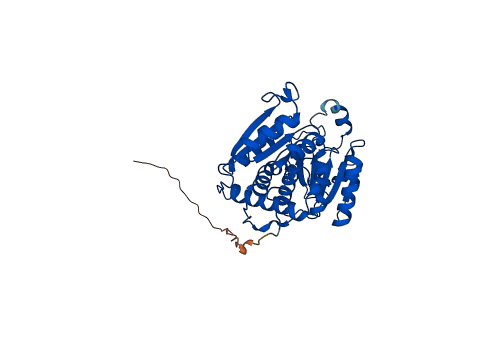
Descriptions
The autoinhibited protein was predicted that may have potential autoinhibitory elements via cis-regPred.
Autoinhibitory domains (AIDs)
Target domain |
|
Relief mechanism |
|
Assay |
cis-regPred |
Accessory elements
No accessory elements
Autoinhibited structure

Activated structure
1 structures for P11725
| Entry ID | Method | Resolution | Chain | Position | Source |
|---|---|---|---|---|---|
| AF-P11725-F1 | Predicted | AlphaFoldDB |
15 variants for P11725
| Variant ID(s) | Position | Change | Description | Diseaes Association | Provenance |
|---|---|---|---|---|---|
| rs3389500821 | 3 | S>F | No | EVA | |
| rs3389568016 | 38 | K>N | No | EVA | |
| rs3409162993 | 44 | T>S | No | EVA | |
| rs3409465467 | 47 | N>I | No | EVA | |
| rs3409470867 | 47 | N>Y | No | EVA | |
| rs3408398286 | 53 | I>V | No | EVA | |
| rs3409817343 | 57 | L>R | No | EVA | |
| rs3389565243 | 101 | F>S | No | EVA | |
| 117 | H>N | spf [UniProt] | No | ||
| rs3389565281 | 150 | T>N | No | EVA | |
| rs3389546986 | 250 | P>Q | No | EVA | |
| rs3389546999 | 253 | A>V | No | EVA | |
| rs3389546366 | 258 | N>Y | No | EVA | |
| rs3389565313 | 323 | V>M | No | EVA | |
| rs3389565298 | 339 | V>I | No | EVA |
1 associated diseases with P11725
Without disease ID
Functions
| Description | ||
|---|---|---|
| EC Number | 2.1.3.3 | Carboxy- and carbamoyltransferases |
| Subcellular Localization |
|
|
| PANTHER Family | ||
| PANTHER Subfamily | ||
| PANTHER Protein Class | ||
| PANTHER Pathway Category | No pathway information available | |
5 GO annotations of cellular component
| Name | Definition |
|---|---|
| cytoplasm | The contents of a cell excluding the plasma membrane and nucleus, but including other subcellular structures. |
| intracellular membrane-bounded organelle | Organized structure of distinctive morphology and function, bounded by a single or double lipid bilayer membrane and occurring within the cell. Includes the nucleus, mitochondria, plastids, vacuoles, and vesicles. Excludes the plasma membrane. |
| mitochondrial inner membrane | The inner, i.e. lumen-facing, lipid bilayer of the mitochondrial envelope. It is highly folded to form cristae. |
| mitochondrial matrix | The gel-like material, with considerable fine structure, that lies in the matrix space, or lumen, of a mitochondrion. It contains the enzymes of the tricarboxylic acid cycle and, in some organisms, the enzymes concerned with fatty acid oxidation. |
| mitochondrion | A semiautonomous, self replicating organelle that occurs in varying numbers, shapes, and sizes in the cytoplasm of virtually all eukaryotic cells. It is notably the site of tissue respiration. |
5 GO annotations of molecular function
| Name | Definition |
|---|---|
| amino acid binding | Binding to an amino acid, organic acids containing one or more amino substituents. |
| identical protein binding | Binding to an identical protein or proteins. |
| ornithine carbamoyltransferase activity | Catalysis of the reaction: carbamoyl phosphate + L-ornithine = phosphate + L-citrulline. |
| phosphate ion binding | Binding to a phosphate ion. |
| phospholipid binding | Binding to a phospholipid, a class of lipids containing phosphoric acid as a mono- or diester. |
13 GO annotations of biological process
| Name | Definition |
|---|---|
| ammonium homeostasis | Any biological process involved in the maintenance of an internal steady state of ammonium. |
| anion homeostasis | Any process involved in the maintenance of an internal steady state of anions within an organism or cell. |
| arginine biosynthetic process via ornithine | The chemical reactions and pathways resulting in the formation of arginine (2-amino-5-guanidinopentanoic acid) via the intermediate compound ornithine. |
| citrulline biosynthetic process | The chemical reactions and pathways resulting in the formation of citrulline, N5-carbamoyl-L-ornithine, an alpha amino acid not found in proteins. |
| liver development | The process whose specific outcome is the progression of the liver over time, from its formation to the mature structure. The liver is an exocrine gland which secretes bile and functions in metabolism of protein and carbohydrate and fat, synthesizes substances involved in the clotting of the blood, synthesizes vitamin A, detoxifies poisonous substances, stores glycogen, and breaks down worn-out erythrocytes. |
| midgut development | The process whose specific outcome is the progression of the midgut over time, from its formation to the mature structure. The midgut is the middle part of the alimentary canal from the stomach, or entrance of the bile duct, to, or including, the large intestine. |
| ornithine catabolic process | The chemical reactions and pathways resulting in the breakdown of ornithine, an amino acid only rarely found in proteins, but which is important in living organisms as an intermediate in the reactions of the urea cycle and in arginine biosynthesis. |
| ornithine metabolic process | The chemical reactions and pathways involving ornithine, an amino acid only rarely found in proteins, but which is important in living organisms as an intermediate in the reactions of the urea cycle and in arginine biosynthesis. |
| response to biotin | Any process that results in a change in state or activity of a cell or an organism (in terms of movement, secretion, enzyme production, gene expression, etc.) as a result of a biotin stimulus. |
| response to insulin | Any process that results in a change in state or activity of a cell or an organism (in terms of movement, secretion, enzyme production, gene expression, etc.) as a result of an insulin stimulus. Insulin is a polypeptide hormone produced by the islets of Langerhans of the pancreas in mammals, and by the homologous organs of other organisms. |
| response to xenobiotic stimulus | Any process that results in a change in state or activity of a cell or an organism (in terms of movement, secretion, enzyme production, gene expression, etc.) as a result of a stimulus from a xenobiotic, a compound foreign to the organim exposed to it. It may be synthesized by another organism (like ampicilin) or it can be a synthetic chemical. |
| response to zinc ion | Any process that results in a change in state or activity of a cell or an organism (in terms of movement, secretion, enzyme production, gene expression, etc.) as a result of a zinc ion stimulus. |
| urea cycle | The sequence of reactions by which arginine is synthesized from ornithine, then cleaved to yield urea and regenerate ornithine. The overall reaction equation is NH3 + CO2 + aspartate + 3 ATP + 2 H2O = urea + fumarate + 2 ADP + 2 phosphate + AMP + diphosphate. |
| 10 | 20 | 30 | 40 | 50 | 60 |
| MLSNLRILLN | NAALRKGHTS | VVRHFWCGKP | VQSQVQLKGR | DLLTLKNFTG | EEIQYMLWLS |
| 70 | 80 | 90 | 100 | 110 | 120 |
| ADLKFRIKQK | GEYLPLLQGK | SLGMIFEKRS | TRTRLSTETG | FALLGGHPSF | LTTQDIHLGV |
| 130 | 140 | 150 | 160 | 170 | 180 |
| NESLTDTARV | LSSMTDAVLA | RVYKQSDLDT | LAKEASIPIV | NGLSDLYHPI | QILADYLTLQ |
| 190 | 200 | 210 | 220 | 230 | 240 |
| EHYGSLKGLT | LSWIGDGNNI | LHSIMMSAAK | FGMHLQAATP | KGYEPDPNIV | KLAEQYAKEN |
| 250 | 260 | 270 | 280 | 290 | 300 |
| GTKLSMTNDP | LEAARGGNVL | ITDTWISMGQ | EDEKKKRLQA | FQGYQVTMKT | AKVAASDWTF |
| 310 | 320 | 330 | 340 | 350 | |
| LHCLPRKPEE | VDDEVFYSPR | SLVFPEAENR | KWTIMAVMVS | LLTDYSPVLQ | KPKF |