P11483
Gene name |
CHRM3 |
Protein name |
Muscarinic acetylcholine receptor M3 |
Names |
|
Species |
Sus scrofa (Pig) |
KEGG Pathway |
ssc:100144478 |
EC number |
|
Protein Class |
|
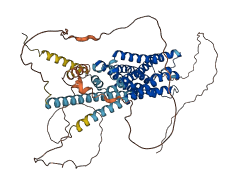
Descriptions
The autoinhibited protein was predicted that may have potential autoinhibitory elements via cis-regPred.
Autoinhibitory domains (AIDs)
Target domain |
|
Relief mechanism |
|
Assay |
cis-regPred |
Accessory elements
No accessory elements
Autoinhibited structure

Activated structure
1 structures for P11483
| Entry ID | Method | Resolution | Chain | Position | Source |
|---|---|---|---|---|---|
| AF-P11483-F1 | Predicted | AlphaFoldDB |
No variants for P11483
| Variant ID(s) | Position | Change | Description | Diseaes Association | Provenance |
|---|---|---|---|---|---|
| No variants for P11483 | |||||
No associated diseases with P11483
7 regional properties for P11483
| Type | Name | Position | InterPro Accession |
|---|---|---|---|
| repeat | WD40 repeat | 169 - 210 | IPR001680-1 |
| repeat | WD40 repeat | 215 - 294 | IPR001680-2 |
| repeat | WD40 repeat | 298 - 337 | IPR001680-3 |
| repeat | WD40 repeat | 344 - 386 | IPR001680-4 |
| repeat | WD40 repeat | 389 - 429 | IPR001680-5 |
| repeat | WD40 repeat | 432 - 471 | IPR001680-6 |
| domain | Anaphase-promoting complex subunit 4-like, WD40 domain | 223 - 278 | IPR024977 |
Functions
8 GO annotations of cellular component
| Name | Definition |
|---|---|
| anchoring junction | A cell junction that mechanically attaches a cell (and its cytoskeleton) to neighboring cells or to the extracellular matrix. |
| basolateral plasma membrane | The region of the plasma membrane that includes the basal end and sides of the cell. Often used in reference to animal polarized epithelial membranes, where the basal membrane is the part attached to the extracellular matrix, or in plant cells, where the basal membrane is defined with respect to the zygotic axis. |
| dendrite | A neuron projection that has a short, tapering, morphology. Dendrites receive and integrate signals from other neurons or from sensory stimuli, and conduct nerve impulses towards the axon or the cell body. In most neurons, the impulse is conveyed from dendrites to axon via the cell body, but in some types of unipolar neuron, the impulse does not travel via the cell body. |
| endoplasmic reticulum membrane | The lipid bilayer surrounding the endoplasmic reticulum. |
| integral component of plasma membrane | The component of the plasma membrane consisting of the gene products and protein complexes having at least some part of their peptide sequence embedded in the hydrophobic region of the membrane. |
| plasma membrane | The membrane surrounding a cell that separates the cell from its external environment. It consists of a phospholipid bilayer and associated proteins. |
| postsynaptic membrane | A specialized area of membrane facing the presynaptic membrane on the tip of the nerve ending and separated from it by a minute cleft (the synaptic cleft). Neurotransmitters cross the synaptic cleft and transmit the signal to the postsynaptic membrane. |
| synapse | The junction between an axon of one neuron and a dendrite of another neuron, a muscle fiber or a glial cell. As the axon approaches the synapse it enlarges into a specialized structure, the presynaptic terminal bouton, which contains mitochondria and synaptic vesicles. At the tip of the terminal bouton is the presynaptic membrane; facing it, and separated from it by a minute cleft (the synaptic cleft) is a specialized area of membrane on the receiving cell, known as the postsynaptic membrane. In response to the arrival of nerve impulses, the presynaptic terminal bouton secretes molecules of neurotransmitters into the synaptic cleft. These diffuse across the cleft and transmit the signal to the postsynaptic membrane. |
4 GO annotations of molecular function
| Name | Definition |
|---|---|
| acetylcholine binding | Binding to acetylcholine, an acetic acid ester of the organic base choline that functions as a neurotransmitter, released at the synapses of parasympathetic nerves and at neuromuscular junctions. |
| G protein-coupled acetylcholine receptor activity | Combining with acetylcholine and transmitting the signal across the membrane by activating an associated G-protein; promotes the exchange of GDP for GTP on the alpha subunit of a heterotrimeric G-protein complex. |
| G protein-coupled serotonin receptor activity | Combining with the biogenic amine serotonin and transmitting the signal across the membrane by activating an associated G-protein. Serotonin (5-hydroxytryptamine) is a neurotransmitter and hormone found in vertebrates and invertebrates. |
| neurotransmitter receptor activity | Combining with a neurotransmitter and transmitting the signal to initiate a change in cell activity. |
7 GO annotations of biological process
| Name | Definition |
|---|---|
| adenylate cyclase-inhibiting G protein-coupled acetylcholine receptor signaling pathway | An adenylate cyclase-inhibiting G protein-coupled receptor signaling pathway initiated by acetylcholine binding to its receptor, and ending with the regulation of a downstream cellular process. |
| chemical synaptic transmission | The vesicular release of classical neurotransmitter molecules from a presynapse, across a chemical synapse, the subsequent activation of neurotransmitter receptors at the postsynapse of a target cell (neuron, muscle, or secretory cell) and the effects of this activation on the postsynaptic membrane potential and ionic composition of the postsynaptic cytosol. This process encompasses both spontaneous and evoked release of neurotransmitter and all parts of synaptic vesicle exocytosis. Evoked transmission starts with the arrival of an action potential at the presynapse. |
| G protein-coupled acetylcholine receptor signaling pathway | A G protein-coupled receptor signaling pathway initiated by a ligand binding to an acetylcholine receptor on the surface of a target cell, and ends with regulation of a downstream cellular process, e.g. transcription. |
| G protein-coupled receptor signaling pathway, coupled to cyclic nucleotide second messenger | A G protein-coupled receptor signaling pathway in which the signal is transmitted via the activation or inhibition of a nucleotide cyclase activity and a subsequent change in the concentration of a cyclic nucleotide. |
| positive regulation of smooth muscle contraction | Any process that activates or increases the frequency, rate or extent of smooth muscle contraction. |
| regulation of vascular associated smooth muscle contraction | Any process that increases the frequency, rate or extent of vascular smooth muscle contraction. |
| saliva secretion | The regulated release of saliva from the salivary glands. In man, the saliva is a turbid and slightly viscous fluid, generally of an alkaline reaction, and is secreted by the parotid, submaxillary, and sublingual glands. In the mouth the saliva is mixed with the secretion from the buccal glands. In man and many animals, saliva is an important digestive fluid on account of the presence of the peculiar enzyme, ptyalin. |
8 homologous proteins in AiPD
| UniProt AC | Gene Name | Protein Name | Species | Evidence Code |
|---|---|---|---|---|
| P41984 | CHRM3 | Muscarinic acetylcholine receptor M3 | Bos taurus (Bovine) | PR |
| P49578 | CHRM3 | Muscarinic acetylcholine receptor M3 | Gallus gallus (Chicken) | PR |
| P20309 | CHRM3 | Muscarinic acetylcholine receptor M3 | Homo sapiens (Human) | PR |
| Q9ERZ3 | Chrm3 | Muscarinic acetylcholine receptor M3 | Mus musculus (Mouse) | PR |
| P04761 | CHRM1 | Muscarinic acetylcholine receptor M1 | Sus scrofa (Pig) | PR |
| P06199 | CHRM2 | Muscarinic acetylcholine receptor M2 | Sus scrofa (Pig) | PR |
| P08483 | Chrm3 | Muscarinic acetylcholine receptor M3 | Rattus norvegicus (Rat) | PR |
| Q9U7D5 | gar-3 | Muscarinic acetylcholine receptor gar-3 | Caenorhabditis elegans | PR |
| 10 | 20 | 30 | 40 | 50 | 60 |
| MTLHNNNTTS | PLFPNISSSW | IHGPSDAGLP | PGTVTHFGSY | NISQAAGNFS | SPNGTTSDPL |
| 70 | 80 | 90 | 100 | 110 | 120 |
| GGHTIWQVVF | IAFLTGILAL | VTIIGNILVI | VAFKVNKQLK | TVNNYFLLSL | ACADLIIGVI |
| 130 | 140 | 150 | 160 | 170 | 180 |
| SMNLFTTYII | MNRWALGNLA | CDLWLSIDYV | ASNASVMNLL | VISFDRYFSI | TRPLTYRAKR |
| 190 | 200 | 210 | 220 | 230 | 240 |
| TTKRAGVMIG | LAWVISFILW | APAILFWQYF | VGKRTVPPGE | CFIQFLSEPT | ITFGTAIAAF |
| 250 | 260 | 270 | 280 | 290 | 300 |
| YMPVTIMTIL | YWRIYKETEK | RTKELAGLQA | SGTEAEAENF | VHPTGSSRSC | SSYELQQQSL |
| 310 | 320 | 330 | 340 | 350 | 360 |
| KRSARRKYGR | CHFWFTTKSW | KPSAEQMDQD | HSSSDSWNNN | DAAASLENSA | SSDEEDIGSE |
| 370 | 380 | 390 | 400 | 410 | 420 |
| TRAIYSIVLK | LPGHSTILNS | TKLPSSDNLQ | VPEEELGTVD | LERKASKLQA | QKSMDDGGSF |
| 430 | 440 | 450 | 460 | 470 | 480 |
| QKSFSKLPIQ | LESAVDTAKA | SDVNSSVGKT | TATLPLSFKE | ATLAKRFALK | TRSQITKRKR |
| 490 | 500 | 510 | 520 | 530 | 540 |
| MSLIKEKKAA | QTLSAILLAF | IITWTPYNIM | VLVNTFCDSC | IPKTYWNLGY | WLCYINSTVN |
| 550 | 560 | 570 | 580 | ||
| PVCYALCNKT | FRTTFKMLLL | CQCDKRKRRK | QQYQQRQSVI | FHKRVPEQAL |