Descriptions
The autoinhibited protein was predicted that may have potential autoinhibitory elements via cis-regPred.
Autoinhibitory domains (AIDs)
Target domain |
|
Relief mechanism |
|
Assay |
cis-regPred |
Accessory elements
No accessory elements
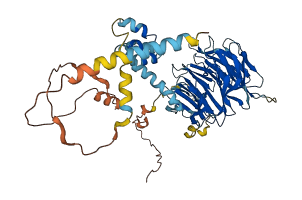
Autoinhibited structure

Activated structure
1 structures for P0DL28
| Entry ID | Method | Resolution | Chain | Position | Source |
|---|---|---|---|---|---|
| AF-P0DL28-F1 | Predicted | AlphaFoldDB |
No variants for P0DL28
| Variant ID(s) | Position | Change | Description | Diseaes Association | Provenance |
|---|---|---|---|---|---|
| No variants for P0DL28 | |||||
No associated diseases with P0DL28
6 regional properties for P0DL28
| Type | Name | Position | InterPro Accession |
|---|---|---|---|
| repeat | WD40 repeat | 196 - 234 | IPR001680-1 |
| repeat | WD40 repeat | 246 - 283 | IPR001680-2 |
| repeat | WD40 repeat | 287 - 325 | IPR001680-3 |
| repeat | WD40 repeat | 419 - 459 | IPR001680-4 |
| repeat | WD40 repeat | 462 - 508 | IPR001680-5 |
| domain | F-box domain | 111 - 159 | IPR001810 |
6 GO annotations of cellular component
| Name | Definition |
|---|---|
| 3M complex | A protein complex, at least composed of CUL7, CCDC8 and OBSL1, that is required for maintaining microtubule and genome integrity. |
| Cul7-RING ubiquitin ligase complex | A ubiquitin ligase complex in which a cullin from the Cul7 subfamily and a RING domain protein form the catalytic core; substrate specificity is conferred by a Skp1 linker and an F-box protein. |
| cytosol | The part of the cytoplasm that does not contain organelles but which does contain other particulate matter, such as protein complexes. |
| Golgi apparatus | A membrane-bound cytoplasmic organelle of the endomembrane system that further processes the core oligosaccharides (e.g. N-glycans) added to proteins in the endoplasmic reticulum and packages them into membrane-bound vesicles. The Golgi apparatus operates at the intersection of the secretory, lysosomal, and endocytic pathways. |
| perinuclear region of cytoplasm | Cytoplasm situated near, or occurring around, the nucleus. |
| SCF ubiquitin ligase complex | A ubiquitin ligase complex in which a cullin from the Cul1 subfamily and a RING domain protein form the catalytic core; substrate specificity is conferred by a Skp1 adaptor and an F-box protein. SCF complexes are involved in targeting proteins for degradation by the proteasome. The best characterized complexes are those from yeast and mammals (with core subunits named Cdc53/Cul1, Rbx1/Hrt1/Roc1). |
1 GO annotations of molecular function
| Name | Definition |
|---|---|
| ubiquitin-protein transferase activity | Catalysis of the transfer of ubiquitin from one protein to another via the reaction X-Ub + Y --> Y-Ub + X, where both X-Ub and Y-Ub are covalent linkages. |
7 GO annotations of biological process
| Name | Definition |
|---|---|
| cell population proliferation | The multiplication or reproduction of cells, resulting in the expansion of a cell population. |
| Golgi organization | A process that is carried out at the cellular level which results in the assembly, arrangement of constituent parts, or disassembly of the Golgi apparatus. |
| labyrinthine layer blood vessel development | The process whose specific outcome is the progression of a blood vessel of the labyrinthine layer of the placenta over time, from its formation to the mature structure. The embryonic vessels grow through the layer to come in close contact with the maternal blood supply. |
| positive regulation of dendrite morphogenesis | Any process that activates or increases the frequency, rate or extent of dendrite morphogenesis. |
| positive regulation of transcription factor catabolic process | Any process that activates or increases the frequency, rate or extent of transcription factor catabolic process. |
| protein ubiquitination | The process in which one or more ubiquitin groups are added to a protein. |
| spongiotrophoblast layer development | The process in which the spongiotrophoblast layer of the placenta progresses from its formation to its mature state. |
5 homologous proteins in AiPD
| UniProt AC | Gene Name | Protein Name | Species | Evidence Code |
|---|---|---|---|---|
| Q969H0 | FBXW7 | F-box/WD repeat-containing protein 7 | Homo sapiens (Human) | PR |
| Q008S8 | ECT2L | Epithelial cell-transforming sequence 2 oncogene-like | Homo sapiens (Human) | PR |
| Q8N3Y1 | FBXW8 | F-box/WD repeat-containing protein 8 | Homo sapiens (Human) | PR |
| Q9QZM9 | Fbxo16 | F-box only protein 16 | Mus musculus (Mouse) | PR |
| Q8BIA4 | Fbxw8 | F-box/WD repeat-containing protein 8 | Mus musculus (Mouse) | PR |
| 10 | 20 | 30 | 40 | 50 | 60 |
| MEDHNLEEFR | QRWQEELAHS | QVLRRRRRLE | AGERRPRRPE | AGARGEPASG | YLGLAQGLLE |
| 70 | 80 | 90 | 100 | 110 | 120 |
| GAGRPPAPRP | GRTDRKDVSS | RSRSPPDRDA | AEPEPLVDQL | IRDLNEMDDV | PFFDVHLPYE |
| 130 | 140 | 150 | 160 | 170 | 180 |
| LAINIFQYLN | RRELGLCAQV | SKTWKVIAED | EVLWYRLCRQ | EGHLPHSRFS | DYTCWKLILQ |
| 190 | 200 | 210 | 220 | 230 | 240 |
| ECLAPVHLIR | PSWMNRKGAV | SELEHVPDAV | LCDVRSHDGV | VIAGYTSGEV | RVWDTRTWDY |
| 250 | 260 | 270 | 280 | 290 | 300 |
| VAPFLESESE | EEDPGMQPYV | SFVRINSSLA | VAAYEDGILN | VWDLRTGRFP | IFRFEHDARI |
| 310 | 320 | 330 | 340 | 350 | 360 |
| QALALSQEKP | VVATASAFDV | VMLYPNEEGN | WHVASEFEVQ | KLVDYLEIVP | NTGRYPVAIA |
| 370 | 380 | 390 | 400 | 410 | 420 |
| TAGDLVYLLK | AEDSARTLHY | VYGQPATCLD | VSASQVAFGV | KSLGWVYEGN | KILVYSLEAE |
| 430 | 440 | 450 | 460 | 470 | 480 |
| RCLSKLGNAL | GDFTCVNIRD | SPPNLMVSGN | MDRRVRLHDL | RTDKIALSLS | AHQLGVSAVQ |
| 490 | 500 | 510 | 520 | 530 | 540 |
| MDDWKIVSGG | EEGLVSVWDY | RMNQKLWEVH | SRHPVRYISF | NSHSLITANV | PYEKVLRNSD |
| 550 | 560 | 570 | 580 | 590 | |
| LDNFACHRRH | RGLIHAYEFA | VDQLAFQSPL | PICRLPRDTV | AGYSYDLALS | FPYDSI |