P0C588
Gene name |
Cnnm4 (Acdp4) |
Protein name |
Metal transporter CNNM4 |
Names |
Ancient conserved domain-containing protein 4, Cyclin-M4 |
Species |
Rattus norvegicus (Rat) |
KEGG Pathway |
rno:363216 |
EC number |
|
Protein Class |
|
Descriptions
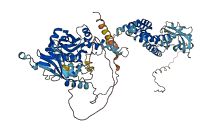
The autoinhibited protein was predicted that may have potential autoinhibitory elements via cis-regPred.
Autoinhibitory domains (AIDs)
Target domain |
|
Relief mechanism |
|
Assay |
cis-regPred |
Accessory elements
No accessory elements
Autoinhibited structure

Activated structure
1 structures for P0C588
| Entry ID | Method | Resolution | Chain | Position | Source |
|---|---|---|---|---|---|
| AF-P0C588-F1 | Predicted | AlphaFoldDB |
No variants for P0C588
| Variant ID(s) | Position | Change | Description | Diseaes Association | Provenance |
|---|---|---|---|---|---|
| No variants for P0C588 | |||||
No associated diseases with P0C588
7 GO annotations of cellular component
| Name | Definition |
|---|---|
| basolateral plasma membrane | The region of the plasma membrane that includes the basal end and sides of the cell. Often used in reference to animal polarized epithelial membranes, where the basal membrane is the part attached to the extracellular matrix, or in plant cells, where the basal membrane is defined with respect to the zygotic axis. |
| dendrite | A neuron projection that has a short, tapering, morphology. Dendrites receive and integrate signals from other neurons or from sensory stimuli, and conduct nerve impulses towards the axon or the cell body. In most neurons, the impulse is conveyed from dendrites to axon via the cell body, but in some types of unipolar neuron, the impulse does not travel via the cell body. |
| integral component of membrane | The component of a membrane consisting of the gene products and protein complexes having at least some part of their peptide sequence embedded in the hydrophobic region of the membrane. |
| intracellular membrane-bounded organelle | Organized structure of distinctive morphology and function, bounded by a single or double lipid bilayer membrane and occurring within the cell. Includes the nucleus, mitochondria, plastids, vacuoles, and vesicles. Excludes the plasma membrane. |
| neuronal cell body | The portion of a neuron that includes the nucleus, but excludes cell projections such as axons and dendrites. |
| plasma membrane | The membrane surrounding a cell that separates the cell from its external environment. It consists of a phospholipid bilayer and associated proteins. |
| protein-containing complex | A stable assembly of two or more macromolecules, i.e. proteins, nucleic acids, carbohydrates or lipids, in which at least one component is a protein and the constituent parts function together. |
3 GO annotations of molecular function
| Name | Definition |
|---|---|
| magnesium ion transmembrane transporter activity | Enables the transfer of magnesium (Mg) ions from one side of a membrane to the other. |
| sodium ion transmembrane transporter activity | Enables the transfer of sodium ions (Na+) from one side of a membrane to the other. |
| transmembrane transporter activity | Enables the transfer of a substance, usually a specific substance or a group of related substances, from one side of a membrane to the other. |
7 GO annotations of biological process
| Name | Definition |
|---|---|
| enamel mineralization | The process in which calcium salts, mainly carbonated hydroxyapatite, are deposited in tooth enamel. |
| magnesium ion homeostasis | Any process involved in the maintenance of an internal steady state of magnesium ions within an organism or cell. |
| magnesium ion transport | The directed movement of magnesium (Mg) ions into, out of or within a cell, or between cells, by means of some agent such as a transporter or pore. |
| metal ion homeostasis | Any process involved in the maintenance of an internal steady state of metal ions within an organism or cell. |
| response to stimulus | Any process that results in a change in state or activity of a cell or an organism (in terms of movement, secretion, enzyme production, gene expression, etc.) as a result of a stimulus. The process begins with detection of the stimulus and ends with a change in state or activity or the cell or organism. |
| sodium ion transmembrane transport | A process in which a sodium ion is transported from one side of a membrane to the other by means of some agent such as a transporter or pore. |
| visual perception | The series of events required for an organism to receive a visual stimulus, convert it to a molecular signal, and recognize and characterize the signal. Visual stimuli are detected in the form of photons and are processed to form an image. |
6 homologous proteins in AiPD
| UniProt AC | Gene Name | Protein Name | Species | Evidence Code |
|---|---|---|---|---|
| Q8NE01 | CNNM3 | Metal transporter CNNM3 | Homo sapiens (Human) | PR |
| Q9H8M5 | CNNM2 | Metal transporter CNNM2 | Homo sapiens (Human) | PR |
| Q6P4Q7 | CNNM4 | Metal transporter CNNM4 | Homo sapiens (Human) | PR |
| Q3TWN3 | Cnnm2 | Metal transporter CNNM2 | Mus musculus (Mouse) | PR |
| Q69ZF7 | Cnnm4 | Metal transporter CNNM4 | Mus musculus (Mouse) | PR |
| Q8RY60 | CBSDUF7 | DUF21 domain-containing protein At1g47330 | Arabidopsis thaliana (Mouse-ear cress) | PR |
| 10 | 20 | 30 | 40 | 50 | 60 |
| MAPGGGGGRR | DGWPARGRLL | LAALLLLLWT | RAASGQSSPQ | QSVILGMRLA | SCNKSCGMNP |
| 70 | 80 | 90 | 100 | 110 | 120 |
| DGIIFVSEGS | TVNLRLYGHR | LGEISSNLIS | FTEVDDAETV | HNSTNCLELT | KDLVVQRLVN |
| 130 | 140 | 150 | 160 | 170 | 180 |
| VSRGNTSGML | VVITKFLRRS | ENMKLYALCT | RTRADGPWLK | WTDKDSLLFM | VEEHGRFLPL |
| 190 | 200 | 210 | 220 | 230 | 240 |
| WLHILLVLVL | LVLSGIFSGL | NLGLMALDPM | ELRIVQNCGT | EKERRYARKI | EPIRRKGNYL |
| 250 | 260 | 270 | 280 | 290 | 300 |
| LCSLLLGNVL | VNTSLTILLD | NLIGSGIMAV | ASSTIGIVIF | GEILPQALCS | RHGLAVGANT |
| 310 | 320 | 330 | 340 | 350 | 360 |
| IVLTKIFMLL | TFPLSFPISK | LLDFVLGQEI | RTVYNREKLM | EMLKVTEPYN | DLVKEELNMI |
| 370 | 380 | 390 | 400 | 410 | 420 |
| QGALELRTKT | VEDIMTQLHD | CFMIRSDAIL | DFNTMSEIME | SGYTRIPVFE | DEQSNIVDIL |
| 430 | 440 | 450 | 460 | 470 | 480 |
| YVKDLAFVDP | DDCTPLKTIT | RFYNHPVHFV | FHDTKLDAML | EEFKKGKSHL | AIVQKVNNEG |
| 490 | 500 | 510 | 520 | 530 | 540 |
| EGDPFYEVLG | LVTLEDVIEE | IIKSEILDES | DTYTDNRTRK | RVSMKNKRDF | SAFKDADNEL |
| 550 | 560 | 570 | 580 | 590 | 600 |
| KVKISPQLLL | AAHRFLATEV | PQFSPSLMSE | KILLRLLKYP | DVIQELRFDE | HNKHCTRHYL |
| 610 | 620 | 630 | 640 | 650 | 660 |
| YTRNKPADCF | ILILQGKVEV | EAGKENMKFE | TGAFSYYGTM | ALSLAPPDRS | PAHPTPLSRS |
| 670 | 680 | 690 | 700 | 710 | 720 |
| ASLSYPDRNT | DMTPSSLAGS | NQFGSCILGQ | YVSDFSVRAL | TDLQYIKVTR | QQYQNGLLAS |
| 730 | 740 | 750 | 760 | 770 | |
| RMDNSPQLTL | DGCATCTENL | SERPELPVVD | ETTTLLNERN | LLLHRASQEG | TI |