P0AE88
Gene name |
cpxR (yiiA, b3912, JW3883) |
Protein name |
Transcriptional regulatory protein CpxR |
Names |
|
Species |
Escherichia coli (strain K12) |
KEGG Pathway |
eco:b3912 |
EC number |
|
Protein Class |
|
Descriptions
The autoinhibited protein was predicted that may have potential autoinhibitory elements via cis-regPred.
Autoinhibitory domains (AIDs)
Target domain |
|
Relief mechanism |
|
Assay |
cis-regPred |
Accessory elements
No accessory elements
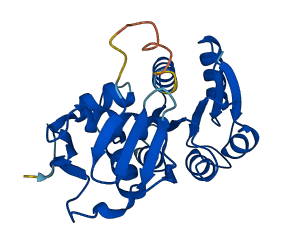
Autoinhibited structure

Activated structure
5 structures for P0AE88
| Entry ID | Method | Resolution | Chain | Position | Source |
|---|---|---|---|---|---|
| 4UHJ | X-ray | 190 A | A/B/C | 1-123 | PDB |
| 4UHK | X-ray | 260 A | A/B/C | 1-123 | PDB |
| 4UHS | X-ray | 500 A | A/B/C | 1-123 | PDB |
| 4UHT | X-ray | 115 A | A/B | 131-231 | PDB |
| AF-P0AE88-F1 | Predicted | AlphaFoldDB |
No variants for P0AE88
| Variant ID(s) | Position | Change | Description | Diseaes Association | Provenance |
|---|---|---|---|---|---|
| No variants for P0AE88 | |||||
No associated diseases with P0AE88
2 GO annotations of cellular component
| Name | Definition |
|---|---|
| cytosol | The part of the cytoplasm that does not contain organelles but which does contain other particulate matter, such as protein complexes. |
| protein-DNA complex | A macromolecular complex containing both protein and DNA molecules. |
4 GO annotations of molecular function
| Name | Definition |
|---|---|
| DNA-binding transcription activator activity | A DNA-binding transcription factor activity that activates or increases transcription of specific gene sets. |
| DNA-binding transcription factor activity | A transcription regulator activity that modulates transcription of gene sets via selective and non-covalent binding to a specific double-stranded genomic DNA sequence (sometimes referred to as a motif) within a cis-regulatory region. Regulatory regions include promoters (proximal and distal) and enhancers. Genes are transcriptional units, and include bacterial operons. |
| phosphorelay response regulator activity | Responds to a phosphorelay sensor to initiate a change in cell state or activity. The activity of the response regulator is regulated by transfer of a phosphate from a histidine residue in the sensor, to an aspartate residue in the response regulator. Many but not all response regulators act as transcriptional regulators to elicit a response. |
| transcription cis-regulatory region binding | Binding to a specific sequence of DNA that is part of a regulatory region that controls transcription of that section of the DNA. The transcribed region might be described as a gene, cistron, or operon. |
4 GO annotations of biological process
| Name | Definition |
|---|---|
| cell adhesion | The attachment of a cell, either to another cell or to an underlying substrate such as the extracellular matrix, via cell adhesion molecules. |
| negative regulation of DNA-templated transcription | Any process that stops, prevents, or reduces the frequency, rate or extent of cellular DNA-templated transcription. |
| positive regulation of DNA-templated transcription | Any process that activates or increases the frequency, rate or extent of cellular DNA-templated transcription. |
| regulation of cell-substrate adhesion | Any process that modulates the frequency, rate or extent of cell-substrate adhesion. Cell-substrate adhesion is the attachment of a cell to the underlying substrate via adhesion molecules. |
| 10 | 20 | 30 | 40 | 50 | 60 |
| MNKILLVDDD | RELTSLLKEL | LEMEGFNVIV | AHDGEQALDL | LDDSIDLLLL | DVMMPKKNGI |
| 70 | 80 | 90 | 100 | 110 | 120 |
| DTLKALRQTH | QTPVIMLTAR | GSELDRVLGL | ELGADDYLPK | PFNDRELVAR | IRAILRRSHW |
| 130 | 140 | 150 | 160 | 170 | 180 |
| SEQQQNNDNG | SPTLEVDALV | LNPGRQEASF | DGQTLELTGT | EFTLLYLLAQ | HLGQVVSREH |
| 190 | 200 | 210 | 220 | 230 | |
| LSQEVLGKRL | TPFDRAIDMH | ISNLRRKLPD | RKDGHPWFKT | LRGRGYLMVS | AS |