P09450
Gene name |
Junb (Jun-b) |
Protein name |
Transcription factor JunB |
Names |
MyD21, Transcription factor AP-1 subunit JunB |
Species |
Mus musculus (Mouse) |
KEGG Pathway |
mmu:16477 |
EC number |
|
Protein Class |
|
Descriptions
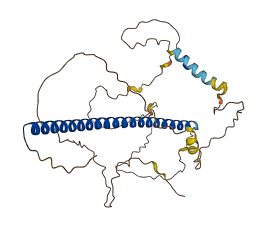
The autoinhibited protein was predicted that may have potential autoinhibitory elements via cis-regPred.
Autoinhibitory domains (AIDs)
Target domain |
|
Relief mechanism |
|
Assay |
cis-regPred |
Accessory elements
No accessory elements
Autoinhibited structure

Activated structure
1 structures for P09450
| Entry ID | Method | Resolution | Chain | Position | Source |
|---|---|---|---|---|---|
| AF-P09450-F1 | Predicted | AlphaFoldDB |
22 variants for P09450
| Variant ID(s) | Position | Change | Description | Diseaes Association | Provenance |
|---|---|---|---|---|---|
| rs3388456570 | 40 | A>V | No | EVA | |
| rs3388456903 | 44 | A>V | No | EVA | |
| rs3388997993 | 63 | S>N | No | EVA | |
| rs3388456953 | 82 | L>V | No | EVA | |
| rs3388993842 | 87 | L>P | No | EVA | |
| rs3388457169 | 100 | T>M | No | EVA | |
| rs3388990595 | 107 | G>E | No | EVA | |
| rs3388972384 | 134 | D>Y | No | EVA | |
| rs3388990566 | 149 | V>M | No | EVA | |
| rs3388997996 | 183 | S>C | No | EVA | |
| rs3388985256 | 199 | V>F | No | EVA | |
| rs3399449400 | 205 | Y>* | No | EVA | |
| rs3388456638 | 208 | A>T | No | EVA | |
| rs3388997166 | 219 | F>S | No | EVA | |
| rs3389000671 | 226 | Q>H | No | EVA | |
| rs3398450043 | 245 | E>V | No | EVA | |
| rs3388457430 | 287 | L>M | No | EVA | |
| rs3388456795 | 289 | R>H | No | EVA | |
| rs3388998003 | 298 | K>M | No | EVA | |
| rs3388990567 | 313 | L>I | No | EVA | |
| rs3389001330 | 324 | K>T | No | EVA | |
| rs3388456972 | 332 | G>D | No | EVA |
No associated diseases with P09450
5 GO annotations of cellular component
| Name | Definition |
|---|---|
| nucleoplasm | That part of the nuclear content other than the chromosomes or the nucleolus. |
| nucleus | A membrane-bounded organelle of eukaryotic cells in which chromosomes are housed and replicated. In most cells, the nucleus contains all of the cell's chromosomes except the organellar chromosomes, and is the site of RNA synthesis and processing. In some species, or in specialized cell types, RNA metabolism or DNA replication may be absent. |
| RNA polymerase II transcription regulator complex | A transcription factor complex that acts at a regulatory region of a gene transcribed by RNA polymerase II. |
| transcription factor AP-1 complex | A heterodimeric transcription factor complex composed of proteins from the c-Fos, c-Jun, activating transcription factor (ATF) or JDP families. The subunits contain a basic leucine zipper (bZIP) domain that is essential for dimerization and DNA binding. Jun-Fos heterodimers bind preferentially to a heptamer consensus sequence (TPA responsive element (TRE)), whereas Jun-ATF dimers bind the cyclic AMP responsive element (CRE) to regulate transcription of target genes. |
| transcription regulator complex | A protein complex that is capable of associating with DNA by direct binding, or via other DNA-binding proteins or complexes, and regulating transcription. |
9 GO annotations of molecular function
| Name | Definition |
|---|---|
| DNA binding | Any molecular function by which a gene product interacts selectively and non-covalently with DNA (deoxyribonucleic acid). |
| DNA-binding transcription activator activity, RNA polymerase II-specific | A DNA-binding transcription factor activity that activates or increases transcription of specific gene sets transcribed by RNA polymerase II. |
| DNA-binding transcription factor activity | A transcription regulator activity that modulates transcription of gene sets via selective and non-covalent binding to a specific double-stranded genomic DNA sequence (sometimes referred to as a motif) within a cis-regulatory region. Regulatory regions include promoters (proximal and distal) and enhancers. Genes are transcriptional units, and include bacterial operons. |
| DNA-binding transcription factor activity, RNA polymerase II-specific | A DNA-binding transcription factor activity that modulates the transcription of specific gene sets transcribed by RNA polymerase II. |
| double-stranded DNA binding | Binding to double-stranded DNA. |
| RNA polymerase II cis-regulatory region sequence-specific DNA binding | Binding to a specific upstream regulatory DNA sequence (transcription factor recognition sequence or binding site) located in cis relative to the transcription start site (i.e., on the same strand of DNA) of a gene transcribed by RNA polymerase II. |
| RNA polymerase II transcription regulatory region sequence-specific DNA binding | Binding to a specific sequence of DNA that is part of a regulatory region that controls the transcription of a gene or cistron by RNA polymerase II. |
| sequence-specific DNA binding | Binding to DNA of a specific nucleotide composition, e.g. GC-rich DNA binding, or with a specific sequence motif or type of DNA e.g. promotor binding or rDNA binding. |
| sequence-specific double-stranded DNA binding | Binding to double-stranded DNA of a specific nucleotide composition, e.g. GC-rich DNA binding, or with a specific sequence motif or type of DNA, e.g. promotor binding or rDNA binding. |
19 GO annotations of biological process
| Name | Definition |
|---|---|
| cell differentiation | The process in which relatively unspecialized cells, e.g. embryonic or regenerative cells, acquire specialized structural and/or functional features that characterize the cells, tissues, or organs of the mature organism or some other relatively stable phase of the organism's life history. Differentiation includes the processes involved in commitment of a cell to a specific fate and its subsequent development to the mature state. |
| cellular response to calcium ion | Any process that results in a change in state or activity of a cell (in terms of movement, secretion, enzyme production, gene expression, etc.) as a result of a calcium ion stimulus. |
| decidualization | The cellular and vascular changes occurring in the endometrium of the pregnant uterus just after the onset of blastocyst implantation. This process involves the proliferation and differentiation of the fibroblast-like endometrial stromal cells into large, polyploid decidual cells that eventually form the maternal component of the placenta. |
| embryonic process involved in female pregnancy | A reproductive process occurring in the embryo or fetus that allows the embryo or fetus to develop within the mother. |
| in utero embryonic development | The process whose specific outcome is the progression of the embryo in the uterus over time, from formation of the zygote in the oviduct, to birth. An example of this process is found in Mus musculus. |
| labyrinthine layer blood vessel development | The process whose specific outcome is the progression of a blood vessel of the labyrinthine layer of the placenta over time, from its formation to the mature structure. The embryonic vessels grow through the layer to come in close contact with the maternal blood supply. |
| osteoblast differentiation | The process whereby a relatively unspecialized cell acquires the specialized features of an osteoblast, a mesodermal or neural crest cell that gives rise to bone. |
| osteoblast proliferation | The multiplication or reproduction of osteoblasts, resulting in the expansion of an osteoblast cell population. An osteoblast is a bone-forming cell which secretes an extracellular matrix. Hydroxyapatite crystals are then deposited into the matrix to form bone. |
| osteoclast differentiation | The process in which a relatively unspecialized monocyte acquires the specialized features of an osteoclast. An osteoclast is a specialized phagocytic cell associated with the absorption and removal of the mineralized matrix of bone tissue. |
| osteoclast proliferation | The multiplication or reproduction of osteoclasts, resulting in the expansion of an osteoclast cell population. An osteoclast is a specialized phagocytic cell associated with the absorption and removal of the mineralized matrix of bone tissue, which typically differentiates from monocytes. |
| positive regulation of cell differentiation | Any process that activates or increases the frequency, rate or extent of cell differentiation. |
| positive regulation of transcription by RNA polymerase II | Any process that activates or increases the frequency, rate or extent of transcription from an RNA polymerase II promoter. |
| regulation of cell cycle | Any process that modulates the rate or extent of progression through the cell cycle. |
| regulation of cell population proliferation | Any process that modulates the frequency, rate or extent of cell proliferation. |
| regulation of DNA-templated transcription | Any process that modulates the frequency, rate or extent of cellular DNA-templated transcription. |
| regulation of transcription by RNA polymerase II | Any process that modulates the frequency, rate or extent of transcription mediated by RNA polymerase II. |
| transcription by RNA polymerase II | The synthesis of RNA from a DNA template by RNA polymerase II (RNAP II), originating at an RNA polymerase II promoter. Includes transcription of messenger RNA (mRNA) and certain small nuclear RNAs (snRNAs). |
| trophectodermal cell differentiation | The process in which a relatively unspecialized cell acquires the specialized features of a trophectoderm cell. |
| vasculogenesis | The differentiation of endothelial cells from progenitor cells during blood vessel development, and the de novo formation of blood vessels and tubes. |
| 10 | 20 | 30 | 40 | 50 | 60 |
| MCTKMEQPFY | HDDSYAAAGY | GRSPGSLSLH | DYKLLKPTLA | LNLADPYRGL | KGPGARGPGP |
| 70 | 80 | 90 | 100 | 110 | 120 |
| EGSGAGSYFS | GQGSDTGASL | KLASTELERL | IVPNSNGVIT | TTPTPPGQYF | YPRGGGSGGG |
| 130 | 140 | 150 | 160 | 170 | 180 |
| TGGGVTEEQE | GFADGFVKAL | DDLHKMNHVT | PPNVSLGASG | GPQAGPGGVY | AGPEPPPVYT |
| 190 | 200 | 210 | 220 | 230 | 240 |
| NLSSYSPASA | PSGGSGTAVG | TGSSYPTATI | SYLPHAPPFA | GGHPAQLGLS | RGASAFKEEP |
| 250 | 260 | 270 | 280 | 290 | 300 |
| QTVPEARSRD | ATPPVSPINM | EDQERIKVER | KRLRNRLAAT | KCRKRKLERI | ARLEDKVKTL |
| 310 | 320 | 330 | 340 | ||
| KAENAGLSSA | AGLLREQVAQ | LKQKVMTHVS | NGCQLLLGVK | GHAF |