P08171
Gene name |
Est-6 (EST6, CG6917) |
Protein name |
Esterase-6 |
Names |
Est-6, Carboxylic-ester hydrolase 6, Carboxylesterase-6 |
Species |
Drosophila melanogaster (Fruit fly) |
KEGG Pathway |
dme:Dmel_CG6917 |
EC number |
3.1.1.1: Carboxylic ester hydrolases |
Protein Class |
|
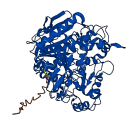
Descriptions
The autoinhibited protein was predicted that may have potential autoinhibitory elements via cis-regPred.
Autoinhibitory domains (AIDs)
Target domain |
|
Relief mechanism |
|
Assay |
cis-regPred |
Accessory elements
No accessory elements
Autoinhibited structure

Activated structure
2 structures for P08171
| Entry ID | Method | Resolution | Chain | Position | Source |
|---|---|---|---|---|---|
| 5THM | X-ray | 215 A | A | 22-544 | PDB |
| AF-P08171-F1 | Predicted | AlphaFoldDB |
20 variants for P08171
| Variant ID(s) | Position | Change | Description | Diseaes Association | Provenance |
|---|---|---|---|---|---|
| 10 | I>T | strain: 178.7, 357F, 517S, Bar-F-77F, Bar-F-79F, Bar-F-96S, DPF-13, DPF-30, DPF-82.1, EM-10, F-274F, F-517F, F-1461S, MA-4.4 and Zim-F-H31 [UniProt] | No | ||
| 24 | T>I | strain: 178.7, 377F, 357F, 517S, Bar-F-79F, DPF-13, DPF-30, DPF-82.1, EM-10, F-274F, F-517F, F-775F, F-1461S, MA-4.4, Ven-S-13F, Zim-F-H27, Zim-F-H31, Zim-F-S11, Zim-F-S18, Zim-F-S53, Zim-S-S2, Zim-S-S30 and Zim-S-S34 [UniProt] | No | ||
| 33 | P>S | strain: Zim-S-H13 [UniProt] | No | ||
| 58 | T>I | strain: 178.7, 357F, 517S, Bar-F-77F, Bar-F-79F, Bar-F-96S, DPF-13, DPF-30, DPF-82.1, EM-10, F-274F, F-1461S, MA-4.2, VC-805, Ven-S-1F, Ven-S-2F, Ven-S-3F, Ven-S-11F, Ven-S-21F, Zim-F-H31, Zim-F-S18 and Zim-S-S10 [UniProt] | No | ||
| 120 | S>T | strain: DPF-2 and 521S [UniProt] | No | ||
| 258 | N>D | strain: 178.7, 357F, 517S, 709.6, Bar-F-7F, Bar-F-77F, Bar-F-79F, Bar-F-93F, Bar-F-96S, DPF-13, DPF-30, DPF-46, DPF-77, DPF-82.1, EM-10, F-96S, F-274F, F-517F, F-531F, F-611F, F-775F, F-1461S, MA-4.2, Zim-F-H27, Zim-F-H31, Zim-F-S11, Zim-F-S18 and Zim-F-S53 [UniProt] | No | ||
| 268 | T>A | strain: 174F, 178.7, 357F, 517S, 709.6, Bar-F-7F, Bar-F-77F, Bar-F-79F, Bar-F-93F, Bar-F-96S, Bar-S-24F, Bar-S-60F, Bar-S-78F, Bar-S-89F, Bar-S-99F, Bar-S-95F, DPF-13, DPF-30, DPF-46, DPF-77, DPF-82.1, EM-10, F-96S, F-274F, F-517F, F-531F, S-549S, F-611F, F-775F, F-1461S, MA-4.2, S-114S, S-2588S, VC-815, Ven-S-1F, Ven-S-2F, Ven-S-3F, Ven-S-4F, Ven-S-11F, Ven-S-21F, Zim-F-H27, Zim-F-H31, Zim-F-S11, Zim-F-S18, Zim-F-S53, Zim-S-S34 and Zim-S-44F [UniProt] | No | ||
| 276 | S>P | strain: VC-805 [UniProt] | No | ||
| 309 | A>V | strain: Ven-S-13F [UniProt] | No | ||
| 356 | I>T | strain: F-775F [UniProt] | No | ||
| 363 | E>D | strain: F-775F [UniProt] | No | ||
| 371 | Y>H | strain: F-775F [UniProt] | No | ||
| 376 | R>G | strain: Zim-S-S34 [UniProt] | No | ||
| 394 | E>D | strain: Ven-S-13F and Zim-F-S18 [UniProt] | No | ||
| 397 | G>R | strain: US-255F [UniProt] | No | ||
| 409 | L>V | strain: 357F, 517S, Bar-F-7F, Bar-F-77F, Bar-F-79F, Bar-F-93F, Bar-F-96S, DPF-13, DPF-30, F-96S, F-274F, F-517F, F-1461S, S-114S, S-549S, S-2588S, VC-805, Ven-S-4F, Zim-S-S2, Zim-S-S30 and Zim-S-S34 [UniProt] | No | ||
| 441 | V>I | strain: Zim-F-S53 [UniProt] | No | ||
| 492 | R>K | strain: 94F, 174F, Bar-S-24F, Bar-S-89F, Bar-S-99F, Bar-S-95F, Bar-S-60F, F-531F, F-611F, MA-4.2, Zim-F-H27, Zim-F-S18 and Zim-S-44F [UniProt] | No | ||
| 500 | D>N | strain: Zim-F-S18, Zim-S-H32 and Zim-S-S2 [UniProt] | No | ||
| 508 | S>A | strain: 357F, 517S, Bar-F-79F, Bar-S-78F, DPF-13, DPF-30, F-96S, F-517F, F-1461S, MA-4.2, VC-805, Ven-S-1F, Ven-S-2F, Ven-S-3F, Ven-S-11F, Ven-S-21F and Zim-F-S11 [UniProt] | No |
No associated diseases with P08171
Functions
| Description | ||
|---|---|---|
| EC Number | 3.1.1.1 | Carboxylic ester hydrolases |
| Subcellular Localization |
|
|
| PANTHER Family | ||
| PANTHER Subfamily | ||
| PANTHER Protein Class | ||
| PANTHER Pathway Category | No pathway information available | |
2 GO annotations of cellular component
| Name | Definition |
|---|---|
| extracellular region | The space external to the outermost structure of a cell. For cells without external protective or external encapsulating structures this refers to space outside of the plasma membrane. This term covers the host cell environment outside an intracellular parasite. |
| extracellular space | That part of a multicellular organism outside the cells proper, usually taken to be outside the plasma membranes, and occupied by fluid. |
4 GO annotations of molecular function
| Name | Definition |
|---|---|
| carboxylic ester hydrolase activity | Catalysis of the hydrolysis of a carboxylic ester bond. |
| methyl indole-3-acetate esterase activity | Catalysis of the reaction: methyl indole-3-acetate + H2O = indole-3-acetate + methanol + H+. |
| serine hydrolase activity | Catalysis of the hydrolysis of a substrate by a catalytic mechanism that involves a catalytic triad consisting of a serine nucleophile that is activated by a proton relay involving an acidic residue (e.g. aspartate or glutamate) and a basic residue (usually histidine). |
| short-chain carboxylesterase activity | Catalysis of the reaction: a carboxylic ester + H2O = an alcohol + a carboxylic anion, where the carboxylic chain has 8 or fewer carbon atoms. |
9 GO annotations of biological process
| Name | Definition |
|---|---|
| courtship behavior | The behavior of an organism for the purpose of attracting sexual partners. |
| mating | The pairwise union of individuals for the purpose of sexual reproduction, ultimately resulting in the formation of zygotes. |
| organic substance catabolic process | The chemical reactions and pathways resulting in the breakdown of an organic substance, any molecular entity containing carbon. |
| ovulation | The release of a mature ovum/oocyte from an ovary. |
| pheromone biosynthetic process | The chemical reactions and pathways resulting in the formation of pheromones, a substance that is secreted and released by an organism and detected by a second organism of the same or a closely related species, in which it causes a specific reaction, such as a definite behavioral reaction or a developmental process. |
| regulation of female receptivity, post-mating | Any process that modulates the receptiveness of a female to male advances subsequent to mating. |
| regulation of oviposition | Any process that modulates the frequency, rate or extent of the deposition of eggs, either fertilized or not, upon a surface or into a medium. |
| sexual reproduction | A type of reproduction that combines the genetic material of two gametes (such as a sperm or egg cell or fungal spores). The gametes have an haploid genome (with a single set of chromosomes, the product of a meiotic division) and combines with one another to produce a zygote (diploid). |
| sperm storage | The retention of sperm by a female following mating. |
| 10 | 20 | 30 | 40 | 50 | 60 |
| MNYVGLGLII | VLSCLWLGSN | ASDTDDPLLV | QLPQGKLRGR | DNGSYYSYES | IPYAEPPTGD |
| 70 | 80 | 90 | 100 | 110 | 120 |
| LRFEAPEPYK | QKWSDIFDAT | KTPVACLQWD | QFTPGANKLV | GEEDCLTVSV | YKPKNSKRNS |
| 130 | 140 | 150 | 160 | 170 | 180 |
| FPVVAHIHGG | AFMFGAAWQN | GHENVMREGK | FILVKISYRL | GPLGFVSTGD | RDLPGNYGLK |
| 190 | 200 | 210 | 220 | 230 | 240 |
| DQRLALKWIK | QNIASFGGEP | QNVLLVGHSA | GGASVHLQML | REDFGQLARA | AFSFSGNALD |
| 250 | 260 | 270 | 280 | 290 | 300 |
| PWVIQKGARG | RAFELGRNVG | CESAEDSTSL | KKCLKSKPAS | ELVTAVRKFL | IFSYVPFAPF |
| 310 | 320 | 330 | 340 | 350 | 360 |
| SPVLEPSDAP | DAIITQDPRD | VIKSGKFGQV | PWAVSYVTED | GGYNAALLLK | ERKSGIVIDD |
| 370 | 380 | 390 | 400 | 410 | 420 |
| LNERWLELAP | YLLFYRDTKT | KKDMDDYSRK | IKQEYIGNQR | FDIESYSELQ | RLFTDILFKN |
| 430 | 440 | 450 | 460 | 470 | 480 |
| STQESLDLHR | KYGKSPAYAY | VYDNPAEKGI | AQVLANRTDY | DFGTVHGDDY | FLIFENFVRD |
| 490 | 500 | 510 | 520 | 530 | 540 |
| VEMRPDEQII | SRNFINMLAD | FASSDNGSLK | YGECDFKDNV | GSEKFQLLAI | YIDGCQNRQH |
| VEFP |