P05197
Gene name |
Eef2 |
Protein name |
Elongation factor 2 |
Names |
EF-2 |
Species |
Rattus norvegicus (Rat) |
KEGG Pathway |
rno:29565 |
EC number |
|
Protein Class |
|
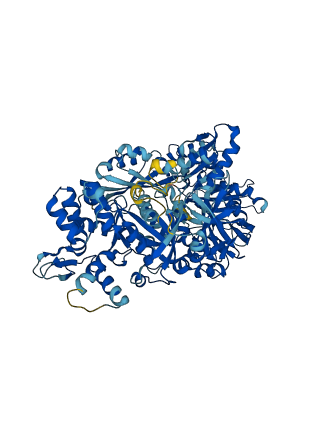
Descriptions
The autoinhibited protein was predicted that may have potential autoinhibitory elements via cis-regPred.
Autoinhibitory domains (AIDs)
Target domain |
|
Relief mechanism |
|
Assay |
cis-regPred |
Accessory elements
No accessory elements
Autoinhibited structure

Activated structure
1 structures for P05197
| Entry ID | Method | Resolution | Chain | Position | Source |
|---|---|---|---|---|---|
| AF-P05197-F1 | Predicted | AlphaFoldDB |
No variants for P05197
| Variant ID(s) | Position | Change | Description | Diseaes Association | Provenance |
|---|---|---|---|---|---|
| No variants for P05197 | |||||
No associated diseases with P05197
7 regional properties for P05197
| Type | Name | Position | InterPro Accession |
|---|---|---|---|
| domain | Elongation factor EFG, domain V-like | 739 - 828 | IPR000640 |
| domain | Translational (tr)-type GTP-binding domain | 17 - 362 | IPR000795 |
| domain | Translation elongation factor EFTu-like, domain 2 | 411 - 485 | IPR004161 |
| domain | Small GTP-binding protein domain | 19 - 164 | IPR005225 |
| domain | Translation elongation factor EFG/EF2, domain IV | 621 - 737 | IPR005517 |
| conserved_site | Tr-type G domain, conserved site | 58 - 73 | IPR031157 |
| domain | Elongation Factor G, domain II | 503 - 564 | IPR041095 |
Functions
7 GO annotations of cellular component
| Name | Definition |
|---|---|
| cytoplasm | The contents of a cell excluding the plasma membrane and nucleus, but including other subcellular structures. |
| cytosol | The part of the cytoplasm that does not contain organelles but which does contain other particulate matter, such as protein complexes. |
| membrane raft | Any of the small (10-200 nm), heterogeneous, highly dynamic, sterol- and sphingolipid-enriched membrane domains that compartmentalize cellular processes. Small rafts can sometimes be stabilized to form larger platforms through protein-protein and protein-lipid interactions. |
| polysomal ribosome | A ribosome bound to mRNA that forms part of a polysome. |
| polysome | A multiribosomal structure representing a linear array of ribosomes held together by messenger RNA. They represent the active complexes in cellular protein synthesis and are able to incorporate amino acids into polypeptides both in vivo and in vitro. |
| ribonucleoprotein complex | A macromolecular complex that contains both RNA and protein molecules. |
| synapse | The junction between an axon of one neuron and a dendrite of another neuron, a muscle fiber or a glial cell. As the axon approaches the synapse it enlarges into a specialized structure, the presynaptic terminal bouton, which contains mitochondria and synaptic vesicles. At the tip of the terminal bouton is the presynaptic membrane; facing it, and separated from it by a minute cleft (the synaptic cleft) is a specialized area of membrane on the receiving cell, known as the postsynaptic membrane. In response to the arrival of nerve impulses, the presynaptic terminal bouton secretes molecules of neurotransmitters into the synaptic cleft. These diffuse across the cleft and transmit the signal to the postsynaptic membrane. |
9 GO annotations of molecular function
| Name | Definition |
|---|---|
| 5S rRNA binding | Binding to a 5S ribosomal RNA, the smallest RNA constituent of a ribosome. |
| actin filament binding | Binding to an actin filament, also known as F-actin, a helical filamentous polymer of globular G-actin subunits. |
| GTP binding | Binding to GTP, guanosine triphosphate. |
| GTPase activity | Catalysis of the reaction: GTP + H2O = GDP + H+ + phosphate. |
| p53 binding | Binding to one of the p53 family of proteins. |
| protein kinase binding | Binding to a protein kinase, any enzyme that catalyzes the transfer of a phosphate group, usually from ATP, to a protein substrate. |
| ribosome binding | Binding to a ribosome. |
| RNA binding | Binding to an RNA molecule or a portion thereof. |
| translation elongation factor activity | Functions in chain elongation during polypeptide synthesis at the ribosome. |
16 GO annotations of biological process
| Name | Definition |
|---|---|
| aging | A developmental process that is a deterioration and loss of function over time. Aging includes loss of functions such as resistance to disease, homeostasis, and fertility, as well as wear and tear. Aging includes cellular senescence, but is more inclusive. May precede death and may succeed developmental maturation (GO:0021700). |
| cellular response to brain-derived neurotrophic factor stimulus | A process that results in a change in state or activity of a cell (in terms of movement, secretion, enzyme production, gene expression, etc.) as a result of a brain-derived neurotrophic factor stimulus. |
| glial cell proliferation | The multiplication or reproduction of glial cells by cell division, resulting in the expansion of their population. Glial cells exist throughout the nervous system, and include Schwann cells, astrocytes, and oligodendrocytes among others. |
| hematopoietic progenitor cell differentiation | The process in which precursor cell type acquires the specialized features of a hematopoietic progenitor cell, a class of cell types including myeloid progenitor cells and lymphoid progenitor cells. |
| positive regulation of cytoplasmic translation | Any process that activates or increases the frequency, rate or extent of cytoplasmic translation. |
| positive regulation of translation | Any process that activates or increases the frequency, rate or extent of the chemical reactions and pathways resulting in the formation of proteins by the translation of mRNA or circRNA. |
| response to endoplasmic reticulum stress | Any process that results in a change in state or activity of a cell (in terms of movement, secretion, enzyme production, gene expression, etc.) as a result of a stress acting at the endoplasmic reticulum. ER stress usually results from the accumulation of unfolded or misfolded proteins in the ER lumen. |
| response to estradiol | Any process that results in a change in state or activity of a cell or an organism (in terms of movement, secretion, enzyme production, gene expression, etc.) as a result of stimulus by estradiol, a C18 steroid hormone hydroxylated at C3 and C17 that acts as a potent estrogen. |
| response to ethanol | Any process that results in a change in state or activity of a cell or an organism (in terms of movement, secretion, enzyme production, gene expression, etc.) as a result of an ethanol stimulus. |
| response to folic acid | Any process that results in a change in state or activity of a cell or an organism (in terms of movement, secretion, enzyme production, gene expression, etc.) as a result of a folic acid stimulus. |
| response to hydrogen peroxide | Any process that results in a change in state or activity of a cell or an organism (in terms of movement, secretion, enzyme production, gene expression, etc.) as a result of a hydrogen peroxide (H2O2) stimulus. |
| response to ischemia | Any process that results in a change in state or activity of an organism (in terms of movement, secretion, enzyme production, gene expression, etc.) as a result of a inadequate blood supply. |
| response to xenobiotic stimulus | Any process that results in a change in state or activity of a cell or an organism (in terms of movement, secretion, enzyme production, gene expression, etc.) as a result of a stimulus from a xenobiotic, a compound foreign to the organim exposed to it. It may be synthesized by another organism (like ampicilin) or it can be a synthetic chemical. |
| skeletal muscle cell differentiation | The process in which a relatively unspecialized cell acquires specialized features of a skeletal muscle cell, a somatic cell located in skeletal muscle. |
| skeletal muscle contraction | A process in which force is generated within skeletal muscle tissue, resulting in a change in muscle geometry. Force generation involves a chemo-mechanical energy conversion step that is carried out by the actin/myosin complex activity, which generates force through ATP hydrolysis. In the skeletal muscle, the muscle contraction takes advantage of an ordered sarcomeric structure and in most cases it is under voluntary control. |
| translational elongation | The successive addition of amino acid residues to a nascent polypeptide chain during protein biosynthesis. |
3 homologous proteins in AiPD
| 10 | 20 | 30 | 40 | 50 | 60 |
| MVNFTVDQIR | AIMDKKANIR | NMSVIAHVDH | GKSTLTDSLV | CKAGIIASAR | AGETRFTDTR |
| 70 | 80 | 90 | 100 | 110 | 120 |
| KDEQERCITI | KSTAISLFYE | LSENDLNFIK | QSKDGSGFLI | NLIDSPGHVD | FSSEVTAALR |
| 130 | 140 | 150 | 160 | 170 | 180 |
| VTDGALVVVD | CVSGVCVQTE | TVLRQAIAER | IKPVLMMNKM | DRALLELQLE | PEELYQTFQR |
| 190 | 200 | 210 | 220 | 230 | 240 |
| IVENVNVIIS | TYGEGESGPM | GNIMIDPVLG | TVGFGSGLHG | WAFTLKQFAE | MYVAKFAAKG |
| 250 | 260 | 270 | 280 | 290 | 300 |
| EGQLGAAERA | KKVEDMMKKL | WGDRYFDPAN | GKFSKSANSP | DGKKLPRTFC | QLILDPIFKV |
| 310 | 320 | 330 | 340 | 350 | 360 |
| FDAIMNFRKE | ETAKLIEKLD | IKLDSEDKDK | EGKPLLKAVM | RRWLPAGDAL | LQMITIHLPS |
| 370 | 380 | 390 | 400 | 410 | 420 |
| PVTAQKYRCE | LLYEGPPDDE | AAMGIKSCDP | KGPLMMYISK | MVPTSDKGRF | YAFGRVFSGV |
| 430 | 440 | 450 | 460 | 470 | 480 |
| VSTGLKVRIM | GPNYTPGKKE | DLYLKPIQRT | ILMMGRYVEP | IEDVPCGNIV | GLVGVDQFLV |
| 490 | 500 | 510 | 520 | 530 | 540 |
| KTGTITTFEH | AHNMRVMKFS | VSPVVRVAVE | AKNPADLPKL | VEGLKRLAKS | DPMVQCIIEE |
| 550 | 560 | 570 | 580 | 590 | 600 |
| SGEHIIAGAG | ELHLEICLKD | LEEDHACIPI | KKSDPVVSYR | ETVSEESNVL | CLSKSPNKHN |
| 610 | 620 | 630 | 640 | 650 | 660 |
| RLYMKARPFP | DGLAEDIDKG | EVSARQELKA | RARYLAEKYE | WDVAEARKIW | CFGPDGTGPN |
| 670 | 680 | 690 | 700 | 710 | 720 |
| ILTDITKGVQ | YLNEIKDSVV | AGFQWATKEG | ALCEENMRGV | RFDVHDVTLH | ADAIHRGGGQ |
| 730 | 740 | 750 | 760 | 770 | 780 |
| IIPTARRCLY | ASVLTAQPRL | MEPIYLVEIQ | CPEQVVGGIY | GVLNRKRGHV | FEESQVAGTP |
| 790 | 800 | 810 | 820 | 830 | 840 |
| MFVVKAYLPV | NESFGFTADL | RSNTGGQAFP | QCVFDHWQIL | PGDPFDNSSR | PSQVVAETRK |
| 850 | |||||
| RKGLKEGIPA | LDNFLDKL |